Six Light Chasers: The Past and Unfinished Journey of China's Photonic Computing Startups
Photon computing, simply put, is using light for computation instead of traditional electronic chips. Its allure lies in the fact that the speed of light is much faster than that of electrical signals, and light signals hardly interfere with each other. In theory, it can achieve ultra - high computing power and ultra - low power consumption.
In the era of large models, computing power is like oil. Photon computing is regarded as one of the potential breakthrough points for the next - generation computing power revolution.
Currently, IT Juzi's observation reveals that there are mainly six domestic startups that are truly centered around "photon computing" and have gained capital recognition. Their founders are almost all graduates with doctoral degrees from prestigious universities. They returned to China to start businesses with papers from their laboratories, attempting to turn the formulas in the papers into chips that can change the world.
Lightelligence: From an MIT paper to the Hong Kong Stock Exchange, it completed the first IPO
Lightelligence has gone the farthest in the entire track. On April 28, 2026, it was listed on the main board of the Hong Kong Stock Exchange as "the world's first AI photon computing stock." On the first day of listing, its stock price soared by 380%, and the public offering was over - subscribed by 5,784 times.
The founder, Yichen Shen, is a PhD from MIT and studied under Nobel laureate Frank Wilczek. In 2017, Shen published a cover paper in Nature Photonics, theoretically verifying for the first time the feasibility of using photons for deep - learning computation. This paper is the technological cornerstone of Lightelligence.
Yichen Shen likes to use a popular analogy: "Electronic computing is like a gasoline - powered car, while photon computing is like an electric car. Gasoline - powered cars have mature technology, but electric cars have natural physical advantages in acceleration performance and energy consumption."
Looking at its financing history, Lightelligence is the company with the strongest capital - attracting ability in the domestic photon computing track:
• In 2018, it raised 64.48 million yuan in Series A, with participation from ZhenFund, Matrix Partners China, Fengrui Capital, and Baidu Ventures.
• In 2021, it raised over 400 million yuan in Series B and Series B +, with additional investment from Matrix Partners China, Tencent, and CICC Capital.
• In March 2024, it raised 1.265 billion yuan in Series C, with joint investment from Sequoia China, Tencent, Baidu, Zhongke Chuangxing, and China Mobile. After the investment, its valuation was about 6.28 billion yuan.
• In April 2025, it raised 300 million yuan in Series C +, with investment from Pudong Venture Capital and Futeng Capital.
• In April 2026, it raised HK$1.644 billion in the cornerstone round of its IPO, with subscriptions from 20 top - tier institutions such as Alibaba, Temasek, BlackRock, Hillhouse, Fidelity, GIC, Lenovo, and China Mobile.
A notable detail:
In the shareholder list of Lightelligence, from early - stage financial investments like ZhenFund and Baidu Ventures, to mid - stage local state - owned assets such as Shanghai Science and Technology Innovation Fund and Shanghai State - owned Investment Corporation, and then to global top - tier capital like Alibaba, Temasek, and BlackRock at the IPO stage, it has completed a typical three - step jump from "technology verification → industrial implementation → global recognition."
However, Lightelligence is still in the red. From 2023 to 2025, it accumulated a loss of about HK$5.27 billion, and its revenue in 2025 was only 106 million yuan. As the first uncommercialized specialized technology company under Chapter 18C of the Hong Kong Stock Exchange, its listing is more like an early pricing of the future.
Yichen Shen predicts that the proportion of optical chips in intelligent computing centers will rise from less than 1% to over 30% within five years, and Lightelligence currently holds an 88.3% share in the independent Scale - up optical interconnection market in China.
Light Standard: Two post - 95s closed their US company, suspended their PhD studies at Oxford, and returned to China to "chase the light"
The founders of Light Standard, Yinjiang Xiong and Tangsheng Cheng, were both under 30 years old when they started their business in 2022.
Yinjiang Xiong is a master of computational science from the University of Chicago and once founded an AI company in the United States. Tangsheng Cheng once studied under Harish Bhaskaran, the world's leading figure in "phase - change material photon computing" and a fellow of the Royal Academy of Engineering, and was pursuing a PhD at the University of Oxford. He suspended his PhD studies when starting the business.
Before starting the business, the two had completed the tape - out verification of small - matrix chips such as 3×3 and 4×4, accumulating full - process experience.
Light Standard has the most compact financing rhythm among these six companies.
It was founded in Shanghai in April 2022 and completed six rounds of financing in about three years and eight months from the seed round to Series A:
• In August 2022, it received a seed - round investment from MiraclePlus.
• In July 2023, it raised 50 million yuan in the angel round, with investment from Fengrui Capital, Xiaomiao Langcheng, and MiraclePlus.
• In March 2024, it received an additional nearly 100 million yuan in the angel round, with investment from Venture Relay, Fengrui Capital, Zhongying Venture Capital, Xiaomiao Langcheng, and Mush Stone Capital.
• In December 2024, it received a strategic investment from Zhongying Venture Capital, Xiaomiao Langcheng, Jinqiu Fund, and Mush Stone Capital.
• In July 2025, it raised a Pre - A round, with investment from Guofa Venture Capital, Pudong Venture Capital, Zhongying Venture Capital, Dunhong Assets, and Zhangjiang Group.
• In April 2026, it raised a Series A round, with investment from Venture Relay, Huarui Investment, Haitong Kaiyuan, Haihui Investment, Dunhong Assets, Xiaomiao Langcheng, SenseTime, Jinqiu Fund, Mush Stone Capital, and Shanghai State - owned Investment Corporation. After the Series A investment, its valuation was 2 billion yuan.
Light Standard follows the "silicon photonics + phase - change material" route and pioneered the Crossbar photon matrix computing structure, claiming that its integration degree is more than 10 times higher than other solutions. In early 2026, the 128×128 optical chip was successfully taped out, which is an important milestone for route verification.
Its investors have two characteristics:
One is the deep participation of local state - owned assets (Pudong Venture Capital, Zhangjiang Group, Shanghai State - owned Investment Corporation). The other is that SenseTime, as an industrial capital, entered in the Series A round, which is relatively rare in the photon computing track, indicating that downstream AI customers have started to bind upstream computing power suppliers with equity.
In addition, Fengrui Capital has continuously increased its investment since the angel round and is the most committed "accompanying runner."
Qisuan Guangqi: The "Jiuzhang" team enters the arena, and a post - 95s founder leads with top - notch academic background
Qisuan Guangqi is a new company founded in October 2024, but its founder has the most "top - notch academic background" among the six:
Hansen Zhong, a PhD from the University of Science and Technology of China, was the first author of the world's first optical quantum computing prototype "Jiuzhang." He was selected for the national - level young talent program, won the Green Orange Award, and was included in the "35 Innovators Under 35" list in China by MIT Technology Review. He is also a core member of Academician Jianwei Pan's team.
It should be noted that Qisuan Guangqi's technical route is optical quantum computing, which is fundamentally different from the "classical photon computing" of companies like Lightelligence. The former uses quantum superposition states for computation, while the latter uses the deterministic physical properties of light to accelerate matrix operations. However, both belong to the broad category of "computing with light."
Qisuan Guangqi has a fast financing rhythm:
• In August 2025, it received an angel - round investment from Shenliu Capital.
• In January 2026, it raised a Pre - A round, with investment from Baidu Ventures, Hillhouse Capital, and Zhangjiang Haocheng (under Zhangjiang Group). After the investment, its valuation was about 100 million yuan.
The simultaneous entry of Baidu Ventures and Hillhouse Capital in the Pre - A round is a "luxurious" lineup.
Baidu Ventures was an early investor in Lightelligence, and Hillhouse is a top - tier PE in China. Their simultaneous investment in a company that has only been established for three months shows that the founder's academic background is very persuasive. Zhangjiang Haocheng represents the industrial capital of Shanghai Zhangjiang Science City.
Photon Core Power: The youngest player from Tsinghua, betting on "full - wave metasurface"
Photon Core Power was founded in July 2024. Its founder is Dr. Qisheng Yang from the School of Integrated Circuits at Tsinghua University, who is currently an associate professor at the School of Semiconductors of Hunan University. The entire core team is from Tsinghua University.
In 2025, the team won the Tsinghua University President's Cup, the Gold Award of the National Innovation and Entrepreneurship Competition, and the Kunshan Cup, making it a "star project" in Tsinghua's entrepreneurial ecosystem.
In April 2025, it received an angel - round investment from MiraclePlus. In May 2026, it completed an angel - round financing of tens of millions, jointly led by Kaiyuan Mingxin, Chixing Venture Capital, and Shengjing Jiacheng, with participation from Kaiyuan Venture Capital.
Photon Core Power follows the "full - wave metasurface" route, which unifies the design of all wave - optical effects such as diffraction, interference, and scattering. It claims that the computing power density can reach 1,000 TOPS per square millimeter, and the chip size is more than ten times smaller than that of the traditional MZI solution. Currently, it has just completed the principle verification and entered the engineering stage.
Among the investors, Kaiyuan Mingxin represents the forward - looking layout of local industrial capital in photon computing. Shengjing Jiacheng is an institution with a Tsinghua background, following the logic of alumni investing in alumni.
Photon Core Power is currently in the "verification stage" overall, and the capital mainly comes from angel institutions and university - affiliated funds.
Core Computing Technology: "High - dimensional photon computing" solely invested by Nine - Rivers Capital
Core Computing Technology was founded in Haidian, Beijing in August 2023. The specific names of its core team members have not been publicly disclosed, but they are from universities such as the Massachusetts Institute of Technology, the University of Oxford, the University of Chinese Academy of Sciences, and Shanghai Jiao Tong University. They have published many papers in Nature and its series of sub - journals.
Core Computing Technology positions itself as a "developer of high - dimensional photon computing chips" for scenarios such as AI acceleration, cloud servers, and data centers. In April 2024, it received tens of millions of yuan in the angel round, solely invested by Nine - Rivers Capital.
Among the six companies, Core Computing Technology has the least public information. It doesn't have an official website yet, there are few media reports, and the background of its founder has not been publicly disclosed. The only thing that can be confirmed is that it is working on optoelectronic hybrid computing boards, focusing on "high - dimensional" photon computing. The sole investment by Nine - Rivers Capital as an early - stage institution indicates that it is still in the technology verification stage and is far from commercial implementation.
Photon Arithmetic: An "eight - year long march" by a PhD from Beijing Jiaotong University, with the most tortuous path
Photon Arithmetic is the earliest - founded among the six. It was established in November 2017, several months earlier than Lightelligence. Its founder, Bing Bai, is a PhD from Beijing Jiaotong University and started his business while still pursuing his PhD in 2017.
Financing history:
• In December 2018, it received an angel - round investment from Innoangel Fund, Changjian Investment, Tsinghua Alumni Seed Fund, and Zhenyun Venture Capital.
• In August 2019, it raised tens of millions of yuan in Series A, with investment from Zhongke Chuangxing, Changjian Investment, and Nanjing Qilin Venture Capital.
• In 2021, it raised a Pre - A round, and the details have not been disclosed.
• In 2022, it raised a Series B round, and the details have not been disclosed.
Although the financing rhythm slowed down after Series A, Photon Arithmetic didn't stop. In 2020, it completed the R & D of an optoelectronic hybrid computing accelerator card. In 2021, it passed the testing and certification of the China Electronics Standardization Institute, becoming the first certified product in the field of photon computing. In 2024, Bing Bai, the chairman of Photon Arithmetic, acquired a 5% equity stake in listed company Maixinlin and started the industrial integration route of "chips + computing power services."
However, in September 2025, the company's business name was changed from "Photon Arithmetic (Beijing) Technology Co., Ltd." to "Guohang North (Beijing) Technology Co., Ltd." In March 2026, a 71.32 - million - yuan equity stake was frozen. The specific reasons for the name change and equity freeze are unknown, but according to the recruitment information on BOSS Zhipin, the company is still in operation, and its positioning has shifted to "optical interconnection computing power cluster solutions," focusing on the in - depth integration of NPO/CPO optical interconnection technology and domestic GPUs.
The case of Photon Arithmetic shows that photon computing requires more than just technology. Being the first to enter the field doesn't mean going the farthest. The choice of commercialization path and continuous capital support are also crucial.
Capital landscape: Who is betting on photon computing?
After sorting out the investors of the six companies, several clear capital trends can be found:
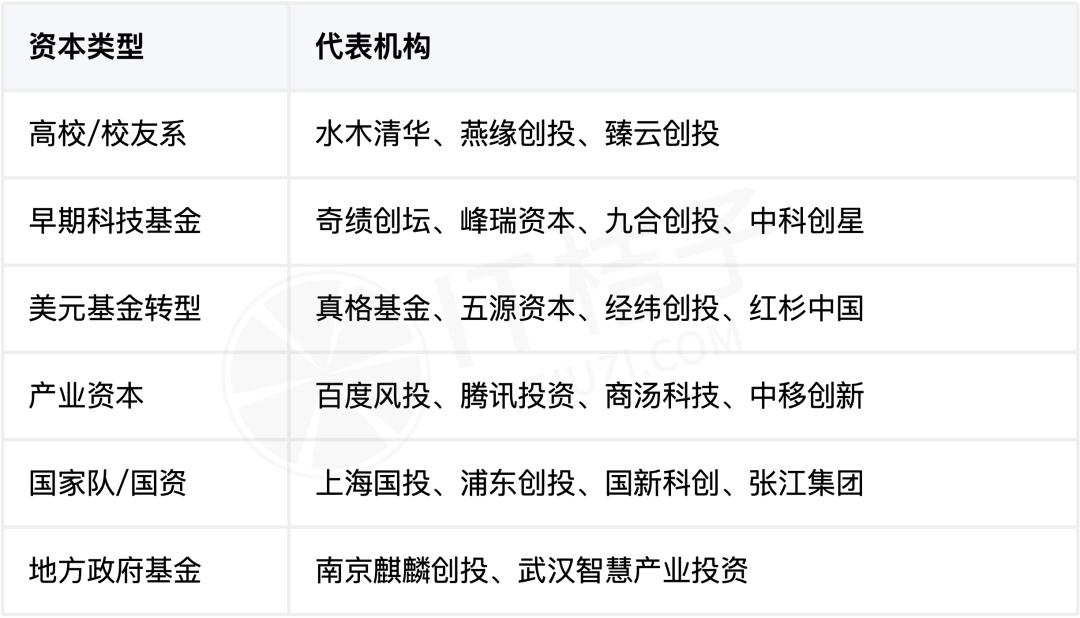
An obvious trend is that before 2023, photon - computing financing was mainly from US - dollar funds and early - stage technology funds. After 2023, state - owned assets and industrial capital became the main forces. This is consistent with the capital migration in the entire hard - technology track, where US - dollar funds are receding, and the "national team" among RMB funds is taking over.
Some observations
1. Capital is accelerating, but the concentration at the top is obvious. Lightelligence has attracted most of the funds in the track, followed closely by Light Standard. The total financing scale of the remaining four companies is even less than a fraction of Lightelligence's Series C financing.
2. Local state - owned assets are the key driving force. The Shanghai state - owned asset system (Pudong Venture Capital, Zhangjiang Group, Shanghai State - owned Investment Corporation, Futeng Capital) almost supports both Lightelligence and Light Standard. Without the "patient capital" of state - owned assets in the photon - computing track, it would be difficult to survive the long cycle from the laboratory to commercialization.
3. The technical routes have not converged. The six companies have at least four different routes: MZI interference (Lightelligence), phase - change material Crossbar (Light Standard), all - optical interference (Qisuan Guangqi), and full - wave metasurface (Photon Core Power). The industry is still in the "searching for the direction" stage and is far from the "standard answer."
4. There is a huge gap between academic breakthroughs and commercial implementation. Lightelligence has an annual revenue of just over 100 million yuan and has accumulated losses of over HK$5 billion. Photon Arithmetic has not achieved large - scale revenue after eight years of establishment. The other companies are still in