Storage prices soar: South Korea and the US feast, why does Japan only get the scraps?
There is a short - term shortage of chips, but a perpetual shortage of storage.
In early May, the global storage industry entered a super boom cycle.
SK Hynix's stock price soared tenfold within a year and a half, with its market value approaching $942 billion; Samsung's single - quarter operating profit reached 260.7 billion yuan, a year - on - year increase of over 750%; Micron's market value is approaching $900 billion, hitting new highs for many consecutive days.
With the sky - rocketing storage prices, South Korean and American companies have become the biggest beneficiaries, reaping huge profits.
Why has Japan, the former global storage powerhouse, only gotten a small share of the pie?
Who is reaping the big rewards?
The epic rise in the storage chip sector this time is not just hype based on market sentiment. There are solid performance figures behind it.
During the earnings season, global leading storage manufacturers have all delivered better - than - expected reports, with their profit explosive power exceeding market expectations.
SK Hynix's Q1 2026 performance far exceeded expectations, with an operating profit of about $24.9 billion in Q1, a year - on - year increase of +405%; Samsung Electronics' Q1 operating profit was about $37.8 billion, a year - on - year increase of +756%, setting the strongest single - quarter profit record in South Korean corporate history.
Micron's net profit in Q2 2026 (from February to April 2026) was $13.785 billion, a year - on - year increase of +771%.
The significant increase in the performance of storage companies has driven up the domestic stock markets.
South Korea's KOSPI has risen by over 70% this year, with Samsung Electronics and SK Hynix contributing more than half of the increase.
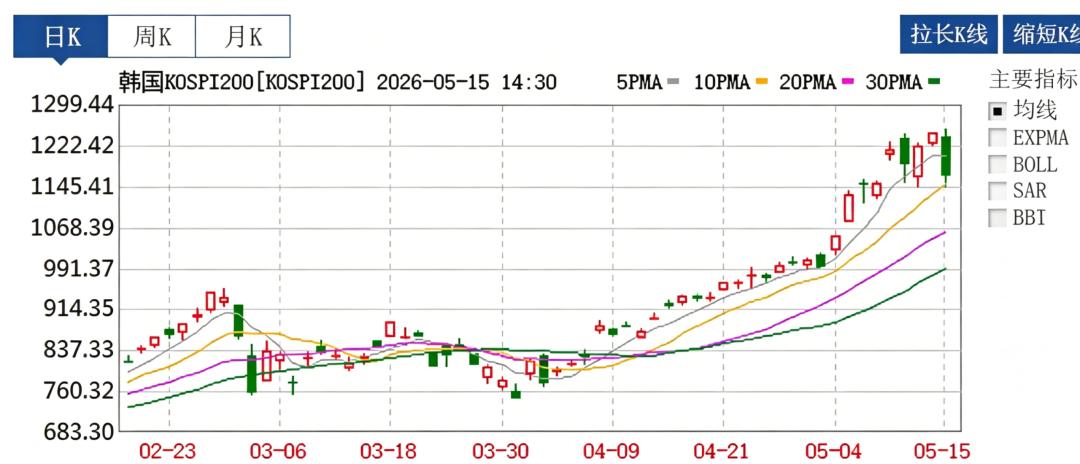
As of May 15, the cumulative increase of KOSPI this year. Source: Eastmoney
Micron in the United States has hit new highs for seven consecutive days, which is an important driving force behind the sharp rise of the Nasdaq.
In contrast, look at Japan.
Kioxia, Japan's largest storage company, has a profit scale only one - seventh of that of SK Hynix, and is not in the same league as South Korea's Samsung and SK Hynix, or Micron in the United States.
Its stock price has risen by 20%, showing a good upward trend, but it is hardly noticeable in the Nikkei Index.
The main contributors to the rise are companies like Toyota, Mitsubishi Corporation, and Tokyo Electron. There are no storage companies among the top ten performers.
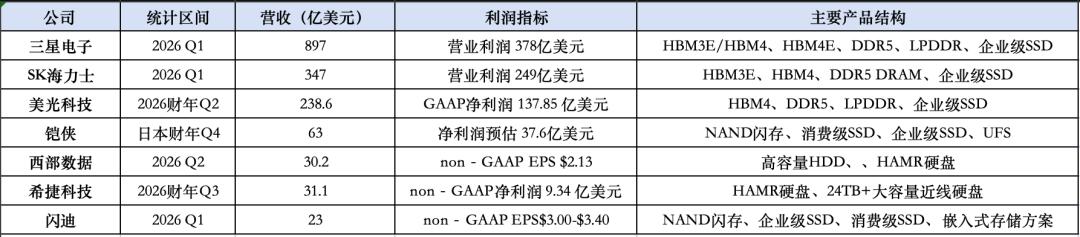
Operating data of the world's seven major storage giants. Source: Financial reports of each company
In summary, Japanese storage companies are smaller in scale compared to those in South Korea and the United States and have not created "spill - over dividends" for the domestic stock market.
More importantly, Japanese storage companies have not gotten the biggest share of the benefits in the storage industry.
Currently, there are three main types of storage chips:
DRAM: The "temporary memory" in computers and mobile phones. It loses data when powered off but has high speed.
NAND Flash: The core of solid - state drives (SSD). It can retain data even when powered off and is used to store files.
HBM: Essentially a more advanced type of DRAM. It is stacked like building blocks and placed close to AI chips (such as NVIDIA H100 and B200) to serve as a "super - high - speed cache" for AI.
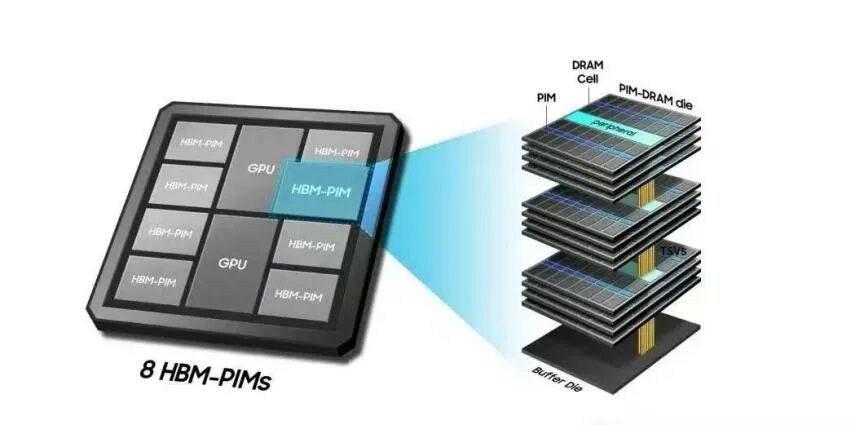
HBM - PIM architecture
Previously, DRAM factories mainly produced general - purpose memory for use in computers and mobile phones.
The core of this AI - driven storage price surge is HBM and server DRAM, not traditional consumer - grade NAND.
During the AI reasoning process, HBM data needs to be transferred to enterprise - level SSDs, which has greatly increased the demand for high - performance NAND.
SEMI predicts that the HBM market will grow by 58% to $54.6 billion in 2026, and the HBM production capacity gap will reach 50% - 60%.
Whoever can manufacture HBM can reap the biggest profits in the storage industry.
Only three companies in the world can mass - produce HBM, namely Samsung in South Korea, SK Hynix in South Korea, and Micron in the United States.
The world's three major DRAM giants
Japan's only storage company, Kioxia, cannot produce HBM, so it can only get a small share of the benefits.
How did Japan, the former global storage powerhouse, end up in this situation?
Japan's absence
Who remembers that Japan was once the absolute leader in the global storage chip market?
In the 1980s, Japan accounted for nearly half of the global DRAM market; in the 1990s, six of the world's top ten semiconductor companies were from Japan.
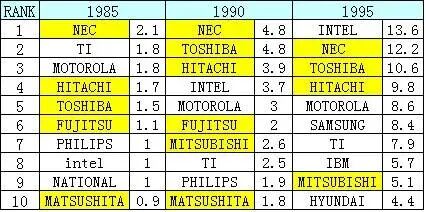
Revenue rankings of the world's top ten semiconductor companies in the 1990s (in billions of dollars). The highlighted parts are Japanese companies
Back then, Japanese companies like NEC, Toshiba, and Hitachi were synonymous with storage.
How did Japan fall from its peak?
The global storage technology has experienced two regional shifts, and the most recent one has occurred in the past three decades.
During this period, the Japanese storage chip industry has gone through a path from dominance to transformation and finally to decline.
Japan's manufacturing industry was in its golden age. It was strong in automobiles, home appliances, precision instruments, and consumer electronics. And semiconductors were the most technology - intensive and profitable part of this industrial system.
A big tree attracts the wind.
The first external shock Japan faced was the systematic suppression from the United States.
This is all too familiar to the Chinese people.

In 1987, a congressman angrily smashed a Toshiba radio
In the spring of 1986, the United States determined that Japanese DRAM chips were being dumped at low prices in the US market.
In September of the same year, the "US - Japan Semiconductor Agreement" was signed. Japan was required to open its semiconductor market and ensure that foreign companies would obtain a 20% market share within five years; subsequently, a 100% punitive tariff was imposed on $300 million worth of Japanese - exported chips, and Fujitsu's acquisition of Fairchild Semiconductor was rejected.
After this series of measures, the once - booming expansion momentum of Japanese storage companies was directly curbed.
There were also major problems internally while facing external pressure.
In the 1990s, Japan's economic bubble burst. Enterprises entered a long - term balance - sheet repair period, and capital expenditures became more conservative.
The deteriorating employment environment led to a brain drain. A large number of engineers and other talents flowed to competitors such as South Korea and Taiwan, China, weakening the industrial ecosystem.
While Japan was in a difficult situation both at home and abroad, South Korea took advantage of the opportunity.
They used the same "national system" that Japan was good at in the past.
While the United States and Japan were in a fierce fight, the South Korean government stepped in and fully supported the semiconductor industry. Universities and laboratories worked together to tackle technical problems.
At this time, the "Atari shock" occurred, the game console market collapsed, and the memory price dropped to rock - bottom.
With a 300% debt - to - asset ratio, Samsung carried out "counter - cyclical investment" with government support.
Taking advantage of the cyclical nature of DRAM, when prices were falling and production capacity was in surplus, Samsung used its scale advantage to expand production madly, lower product prices, and eliminate competitors through price wars.
South Korea has built a deep moat in DRAM stacking, packaging, and yield control. The HBM industrial chain has become a closed system where the first - movers take all.
Japan tried to save itself, but unfortunately missed the best opportunity, resulting in a failed transformation.
NEC, the world's largest company at that time, and Hitachi, the third - largest, spun off their DRAM businesses and merged them into a new company, Elpida. Later, the DRAM business of Mitsubishi Electric, the seventh - largest, was also incorporated.
On the other hand, the semiconductor divisions of Hitachi and Mitsubishi Electric merged to form Renesas Electronics, focusing on the consumer electronics market.
Renesas Electronics. Source: Renesas official website
This DRAM company, which was arranged by the government and carried the hopes of all of Japan, after years of struggling, could not withstand the attacks of South Korean competitors and the fluctuations of the global market. It declared bankruptcy in 2012 and was acquired by Micron in the United States.
This marked Japan's complete exit from the DRAM field.
The suppression from the United States and competition from South Korea are external reasons, and there are also internal problems in Japan.
Japanese companies adhere to the principle of technology supremacy, which has given rise to a unique closed - door innovation model.
They never allow foreign forces to get involved in their own technology. They want to keep all the profits to themselves.
Japan's semiconductor industry follows the IDM model, which integrates design, manufacturing, and packaging and testing. This is the source of its technological and quality advantages.
This model is highly dependent on the pull of its own terminal products. Once the terminal products decline, the upstream chip business will also be affected.
With the arrival of the PC and smartphone era, the markets for products like radios, cameras, and DVDs, which Japan once dominated globally, shrank rapidly, and Japan's globally - dominant terminal products collapsed across the board.
Japan has not yet digested the lesson that the collapse of consumer - electronics terminals led to a shortage of upstream chips.
The storage chip industry itself has significant cyclical characteristics. The biggest difference between this round of storage chip shortage and previous ones is that the demand side has undergone a fundamental change.
The industry's production capacity is being re - structured.
80% of the global storage production capacity is shifting towards high - profit HBM and DDR5, while Kioxia mainly relies on the consumer - electronics NAND market.
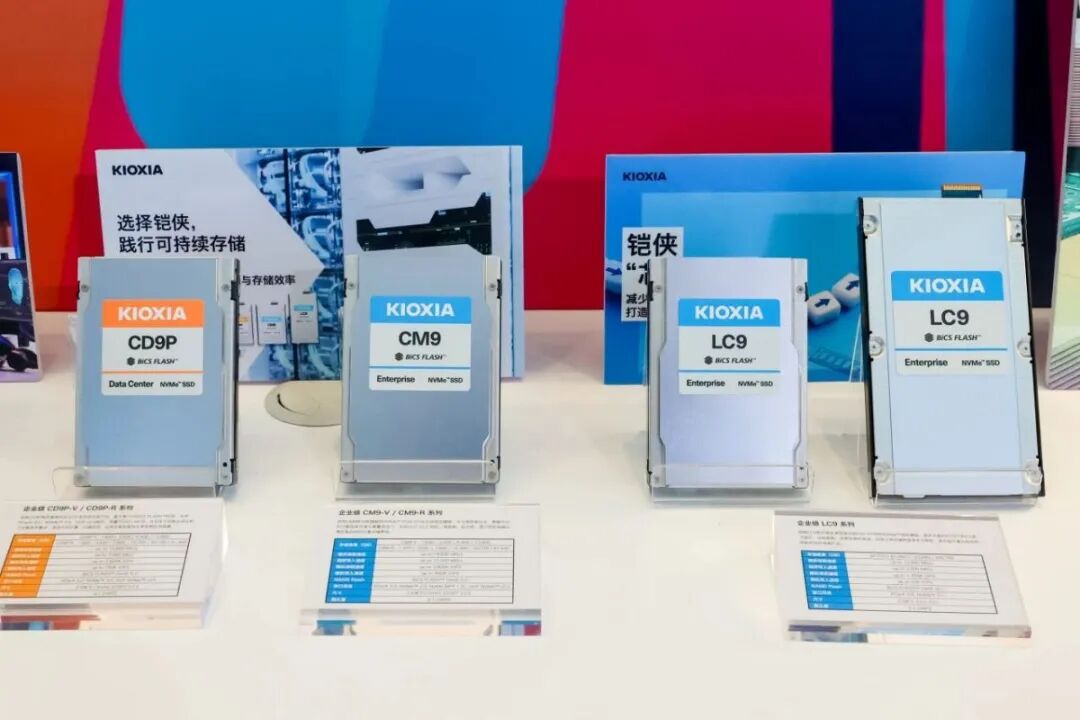
Kioxia's flagship CM9 series
Japan does not have the mainstream DRAM production capacity. 95% of the global market is divided among three companies in South Korea and the United States. It also lacks HBM technology accumulation and the ability to make large - scale capital investments.
Moreover, Japan's presence is only reflected in materials, equipment parts, and some packaging processes. It is only a supporting role, and is basically absent at the product level.
In this AI - driven "super cycle", Japanese companies still failed to keep up with the fundamental change in the storage chip supply structure.
AI is competing for production capacity, and Japan can only rely on its past achievements.
A lesson from the past
In the current context of the global AI computing power explosion in 2026, Japan's storage chip industry seems particularly desolate.
It is an indispensable "hidden champion" in the high - computing - power chain, but can hardly get a share of the benefits, falling into an embarrassing situation of being "needed but unable to monetize".
In fact, Kioxia has already been "sold".
In 2018, Toshiba sold its storage business (now Kioxia) to a consortium led by Bain Capital in the United States for about $18 billion.
This company, which carried Japan's last hope for NAND, has fallen into the hands of US and South Korean capital. So even if it makes money, most of it will go to the United States.
In this way, the share of benefits that Japan gets will be even smaller.
So, what is the most important lesson that China can learn from Japan?
It is not about technological backwardness, but the lack of perseverance in a "protracted war" and a "holistic - war" perspective for strategic industries.
By comparing Japan's decline from its peak with China's current situation, we can see that the two countries have amazing similarities in the path of semiconductor development.
For example, China today is similar to Japan in the 1980s in some development models. It is in the stage of technological catch - up, trying to break through technological bottlenecks such as advanced manufacturing processes, and is also facing systematic suppression from the United States and a long - term "trade war".
Japan's history is a "lesson from the past" for China, and there are many insights worth our consideration.
