Roundtable Discussion: From "Personalized Experiences" to "Insight into Human Hearts" | 2026 AI Partner · Beijing Yizhuang AI + Industry Conference
How can AIGC evolve from a production tool to an emotional insight tool? When AI can write scripts, generate music, and perform micro - expressions, what is left for humans?
The content industry is undergoing a transformation in its production mode. Traditional user profiles are being disrupted in the AI era. What we really need to do is understand users' emotional states rather than static labels. The brand effect will not disappear. After crossing the technological threshold, what humans ultimately hold on to is the aesthetics and meaning of "hand - crafted" works.
The following is the content of the round - table dialogue, compiled and edited by 36Kr:
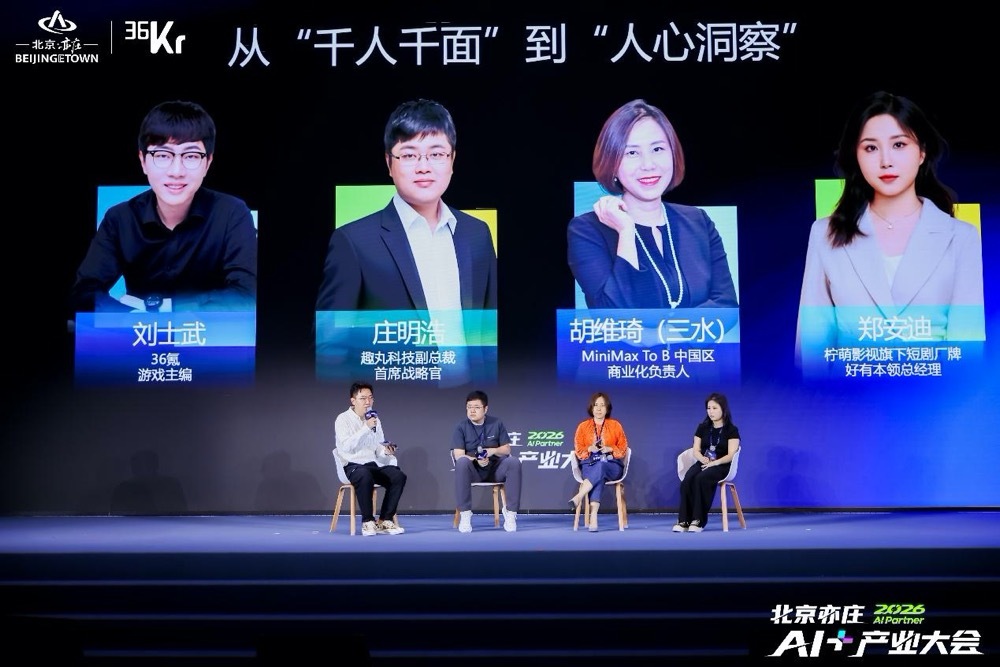
Liu Shiwu | Editor - in - chief of 36Kr's gaming section (Host)
Zhuang Minghao | Vice President and Chief Strategy Officer of Quwan Technology
Hu Weiqi | Head of Commercialization in China for MiniMax's To B business
Zheng Andi | General Manager of Haoyou Benling, a short - drama brand under Lemon Pictures
Liu Shiwu: Hello, everyone. I'm Liu Shiwu, the editor - in - chief of 36Kr's gaming section and the host of this round - table. The theme of this round - table forum is from "personalized content for each individual" to "insight into human hearts". AIGC has evolved from providing personalized content for each individual to permeating the entire content production, distribution, and commercialization ecosystem. In this process, what changes has AIGC brought about, and what changes has the market undergone? The three guests here today will answer our questions. First, please let the three guests introduce themselves briefly.
Zhuang Minghao: Hello, everyone. I'm Zhuang Minghao from Quwan Technology. Our company develops mobile voice social products. In recent years, we have explored AI - related businesses such as AI music, AI short - drama translation, as well as AI digital humans and AI 3D. We are also integrating AI into our traditional social business.
Hu Weiqi: Hello, everyone. I'm Hu Weiqi from MiniMax. I'm in charge of the commercialization business in China at MiniMax. MiniMax is a large - model company that provides various model capabilities, including text, video, audio, and music. I'm very glad to be here at the 36Kr event to communicate and share with you.
Zheng Andi: Hello, everyone. I'm Zheng Andi from Haoyou Benling, a short - drama brand under Lemon Pictures. Popular dramas like "Nothing But Thirty", "Twenty Your Life On", "Sketch Story", "Ode to Joy", and "Go Away, Mr. Tumor" are all produced by Lemon Pictures. Since 2022, when there was no clear definition of short dramas in the market, we started working on short dramas and pioneered the star short - drama track. For example, "Twenty - Nine" starring actress Yang Rong and "Little Happiness" starring actress Ni Hongjie last year were all high - quality short dramas produced by us. This year, we started to transform into the AI production segment.
Liu Shiwu: Mr. Zhuang just mentioned that Quwan Technology started as a product - oriented company in the mobile Internet era. Now, in the AI era, Quwan has also launched various AI businesses. Do you think that since AI has been deeply involved in the company's development, what major changes have occurred in the overall operation of the enterprise? Can you give an example from aspects such as product concept and business model changes to share?
Zhuang Minghao: The identities of the three guests here are quite interesting. One is a representative of a model provider, one is a representative of an application company, and what we do in the AI segment is exactly something in between. We use MiniMax's API for relevant product development. After the products are developed, we also provide product services to companies like Lemon Pictures. This combination represents different roles in the AI field, from the model layer, the intermediate layer to the application layer.
Speaking of our own situation, with the rapid evolution of AI, for our company with traditional businesses, the most obvious change is that due to the overly rapid iteration of AI technology, the traditional approach that relies on processes, sets OKR/KPI on a semi - annual or annual basis, and follows the rhythm of "idea → execution → testing → release" is no longer applicable today. At least in AI - related businesses, the rhythm and progress of products, as well as the corresponding organizational forms, will undergo fundamental changes.
Previously, our way of thinking was more like "launching a powerful move". We would develop a complete product around an idea, and then launch, maintain, and interact with it. However, AI is developing too fast, and user needs are not stable. This rhythm simply cannot keep up. Now, we have to release products frequently. We can first put a product with a score of even just 60 on the market. In this way, the team can more nimbly grasp user perception and market demand during rapid execution.
Take our AI music business as an example. Our original team was engaged in an online music community for playing and singing. They already had a foundation in music technology and also tried to move towards AI music. Initially, the team also developed its own model, just like what MiniMax does. Later, we found that just developing the model was difficult to meet user needs. We gradually developed applications, agents, and even explored hardware on the basis of the model. It's imaginable that for a mature team that has been in the mobile Internet era for more than a decade and has a complete product, technology, planning, and operation system, these new things are a huge challenge. During the process, the team has experienced a lot of changes, adjustments, and adaptations. So far, we are still exploring and don't have particularly mature experience or answers. But we clearly feel that this is completely different from the previous way.
Liu Shiwu: From the Internet to the mobile Internet, people already felt that the rhythm was speeding up from the perspective of the enterprise's internal operations, and efficiency was constantly improving. In the AI era, this pace has not stopped. While efficiency has improved, some problems have also emerged.
Zhuang Minghao: You may often encounter such a situation: you are working on a planning scheme, and suddenly the model is updated to a new version, making the workload accumulated over several months meaningless. Of course, you can still continue to release, maintain, and promote it, but you know in your heart that this thing will have to be redone sooner or later. For example, AI music has developed very rapidly in the past year. Now, there are more than one company making AI guitars in the market. Then you have to think about what your advantages are, how to bind, explore, and integrate with your existing business. At the same time, you also have to consider the hardware cycle and the impact of changes in the international situation on public infrastructure such as the hardware supply chain. For a traditional Internet company, this proposition is really too difficult. There is no other way but to grit your teeth and make changes and adjustments, and adapt to new colleagues joining. Fortunately, the first - generation product turned out okay.
Liu Shiwu: Find the answers in practice. Mr. Zhuang mentioned that the three guests are all manufacturers in the upstream, mid - stream, and downstream of this industrial chain. As a model provider, MiniMax has already implemented its solutions in the film, television, and entertainment fields in the B - end market. So, are there any differences between the customers in the film and television sector and those in the model field or other fields?
Hu Weiqi: There are similarities and special features in the overall direction. Why do people feel that the transformation in this AI era is so drastic? The core is that AI has entered the enterprise's productivity tools, changing many production methods, and even changing the enterprise's organizational efficiency and organizational responsibility settings. This is what people feel deeply.
From the perspective of the video field alone, in my opinion, first, enterprises still care a lot about the quality of content generation. People often talk about whether it can reach the film - level standard, with multi - camera shooting, multiple references, and simultaneous audio and video output, which have become standard requirements. This is the first aspect.
Second, people are more concerned about achieving satisfactory results in terms of the overall efficiency and cost of content creation in film and television production. In the past, models could also do this, but the success rate was relatively low. Now, many models can do it, but the cost is relatively high. In the future, with the use of short dramas and animated dramas, people will also care about content compliance, including legal compliance in terms of copyright. I understand that there are still some gray areas in the content used for AI training. When applying the generated content commercially, content producers and distributors need to take certain responsibilities in this regard. They hope that model providers can jointly impose constraints on the compliance of pre - production materials and content, which are the aspects that video content producers are more concerned about.
Liu Shiwu: So far in the business, are B - end customers satisfied with the quality and speed of content output?
Hu Weiqi: Different models solve different problems in different scenarios. Most of them have achieved usable results. Usable results can be divided into two aspects: speed and quality. Speed can be measured by objective indicators, such as the number of tokens generated per minute, which represents the quantity and speed of content. However, quality is difficult to measure with a constant standard. Everyone has different definitions of quality. Generally speaking, people have a basic concept that using AI tools can achieve a productivity equivalent to that of a medium - level manual worker and will not make major mistakes, which is considered a usable quality by most enterprises in production.
Liu Shiwu: Thank you, Mr. Hu. In 2025, many AI - generated animated dramas were launched, and this year is said to be the year of the explosion of AI - generated live - action dramas. From the beginning of this year to now, some AI - generated works have made it onto the hot lists of short - drama platforms, which was unimaginable in the past. Before this round - table, I had a discussion with Mr. Zheng. There is an interesting thing in the industry recently. A crew has to shoot three short dramas in four days, and the crew has to work around the clock. Otherwise, if you don't do AI, you won't be able to keep up. Haoyou Benling is a team that has been at the forefront. Can you share your team's experience in AI casting and AI - generated live - action short dramas based on the above - mentioned case or previous cases?
Zheng Andi: We are a company that started working on short dramas very early, even before there was a clear definition of short dramas. At the beginning of this year, after the big explosion of AI in the second half of 2025, the first thing I said in a meeting with my colleagues in the office was a joke: I hope Ye Wenjie can send a signal to the Trisolarans. The industry and production methods have been completely disrupted. In the past, when shooting a TV series, everyone knew that a crew had three or four hundred people. Later, short dramas were defined as a low - end disruption, and only twenty or thirty people on - site could produce content of good quality. At the end of last year, we found that one person could handle it. When we realized this, we found that most people in this industry might lose their jobs.
This year, in the process of producing high - quality projects, we found that the high - quality segment still has a very high demand for people. The core qualities of people, as people often say, literary creators need to have culture, and this requirement is still very high. When we produce large - scale AI - generated dramas, using AI tools can improve efficiency. If we want to produce high - quality AI short dramas, for example, at the beginning of this year, many friends may have seen a project called "Paper Phone" that went viral on WeChat Moments. At that time, people didn't realize it was AI - generated, and they couldn't feel the boundary. For such high - quality content, with the help of AI, the efficiency is definitely improved. However, whether it's from creativity to production, the fineness of manual work and the number of attempts still require a lot of cost and effort. Our high - quality projects are still done manually. We hope that our original ideas and stories, which we have put a lot of effort into, can be created in a way that is focused and touching.
Liu Shiwu: How do investors view the production of high - quality AI content?
Zheng Andi: We are also investors ourselves, and we invest in our own dramas. As an investor, I consider the ROI recovery. When I switch to the role of a content creator, I hope my works can be recognized by the audience or move the audience, and this feeling is very important. As mentioned before, regarding AI casting and AI - generated images, whether customers and investors recognize them, we found that the recognition rate is increasing. We are about to launch a project on JD.com, which is a project that combines live - action shooting and AI directly. For brand customers, they are not brave enough to jump directly to fully AI - generated content, but they are in the process of making the leap. Their reaction is not slow, only one or two months behind the most forward - thinking creators, and they can catch up quickly. Their acceptance is also very high.
Liu Shiwu: Thank you, Mr. Zheng. We look forward to more high - quality AI short dramas in the future. Mr. Hu just mentioned that for large - model providers, they have to face various customers and needs. When content can be generated in real - time with high efficiency and personalized expansion, does the traditional definition of user profiles still work?
Hu Weiqi: This is a very interesting question. The traditional user profile is a concept mentioned in the Internet era and is the core of all product design and commercial monetization. Personally, I feel that this is being disrupted in the AI era. When the content we produce is limited, we need to classify users and recommend our limited content to them, which is the most efficient way. In the AI era, our content has changed from limited to unlimited. As long as you dare to imagine, you can generate all kinds of content. Whether in terms of content or quantity, we should not just label users but generate the content they need in real - time according to their current state. From the perspective of human needs, we are not completely label - based. In different emotional states, we have different emotional needs. What AI can try to do is to understand users' needs, understand the needs in different emotional states, and even predict what needs may arise in the next emotional state. If we can achieve this, it will be an infinite expansion and satisfaction of users' needs.
Liu Shiwu: Thank you, Mr. Hu. Maybe one day in the future, after I finish watching a certain piece of content, AI will recommend new content to me based on the change in my state of mind. Mr. Minghao, whether it's Quwan Qianyin or the music agent Tunee, your team has also contacted people from different parts of the world in the global market. Are there any differences in the needs and perceptions of AI among users from different cultures or different circles?
Zhuang Minghao: Globally, the users of our AI music and AI voice segments vary greatly in different parts of the world. In terms of music, in addition to the domestic market, we mainly target the European and American markets overseas because the music industry in Europe and America is relatively more mature. In China, there is another trend, which is related to the changes in the Chinese music industry itself. In China, the BGM market is larger than the narrow - sense music industry. The demand for short - video background music is much larger than traditional music creation. The requirements of such creators for music cost and emotional fluctuations are completely different from those of classical music, with a big difference.
Our Quwan Qianyin business mainly cooperates with short - drama overseas - expansion companies to help them with multi - language translation and dubbing. Most domestic short - drama companies face similar challenges when expanding overseas. At the most basic level is text translation, and there are many other levels above it, including local cultural taboos, language richness, and different regions' preferences for different themes. Themes like "son - in - law" and "war god" that domestic companies are good at don't work in many regions. Local regions have their own characteristic themes, such as vampires and werewolves, and adaptations and adjustments are necessary. Coupled with the fact that the controllability of AI tools has a certain range and cannot be 100% controlled like humans. Assuming there are three links, and each link can achieve 80% controllability, the overall controllability after stacking may be less than 50%, just like a one - to - one draw. The process connection needs continuous adjustment and adaptation, and we have been exploring along with our cooperation customers.
In practice, taking the short - drama customers we serve as an example, there was a period when short - dramas were shot with local actors overseas when paid live - action short - dramas were popular. Later, people also tried to cooperate with actors' unions, but the working hours and other aspects were completely different from those in China, and it was not cost - effective. In the past six months, AI capabilities have improved from AI - generated animated dramas to AI - generated live - action dramas, and the quality of generating faces from all over the world, not just Chinese faces, has been improving. This has led to a new batch of companies entering the market.