Comparing with Yann LeCun, the person in charge of Huawei's "Embodied Brain" has raised funds again.
Today, China Venture Capital News exclusively learned that Juenao Panshi has completed a new round of financing worth hundreds of millions of yuan. This round of financing was led by top industrial capital with a profound background in brain-like and embodied industries, and old shareholders and multiple top funds reinvested and followed the investment. Meanwhile, another round of financing is also in the process of synchronous delivery. It is reported that this round of financing will be mainly invested in core technology R & D, team expansion, and global market expansion, accelerating the R & D of the cognitive world model, its engineering implementation, and verification in real scenarios.
Before this financing was completed, on the other side of the ocean, AMI Labs, founded by "Turing Award" winner Yann LeCun, just completed a $1.03 billion seed round of financing in March this year, with a pre - investment valuation of $3.5 billion. This has gradually clarified the technical route of the world model of brain - like intelligence.
For investors in China, what they are looking for is undoubtedly a reliable brain - like intelligence player with the best founding team in the same technical direction. Thus, Juenao Panshi, founded by Zhu Senhua, the former director of the AI Algorithm Innovation Lab of Huawei Cloud and the pioneer of Huawei's embodied intelligent brain, emerged.
The "Number One Person in Huawei's Embodied Brain" Starts a Business
The Route of Brain - like Intelligence Emerges
As an interviewer for Huawei's "Genius Teenagers", Zhu Senhua is well - known in the industry.
Within Huawei, he is recognized as the "Number One Person in the Embodied Brain". During his tenure, Zhu Senhua led the team to build Huawei Cloud Brain and the brain - like AI cloud platform, and conducted forward - looking exploration of new paradigms for future AI development. He also incubated Huawei's first embodied large model and completed the technical implementation and verification of the integration of brain - like intelligence and embodied models. In his six years at Huawei, he was both a technology explorer and a business implementer, with the cross - border characteristics of "AI engineering ability" and "brain science research".
Compared with entrepreneurs with a pure academic background, Zhu Senhua also has the rare gene of "combining liberal arts and sciences". His resume shows that his academic background spans computer science and cognitive neuroscience: he focused on the AI direction during his undergraduate and master's studies, went to the University of Pennsylvania to study cognitive neuroscience during his doctoral stage, and completed his post - doctoral research at the State Key Laboratory of Brain and Cognitive Sciences of the Chinese Academy of Sciences.
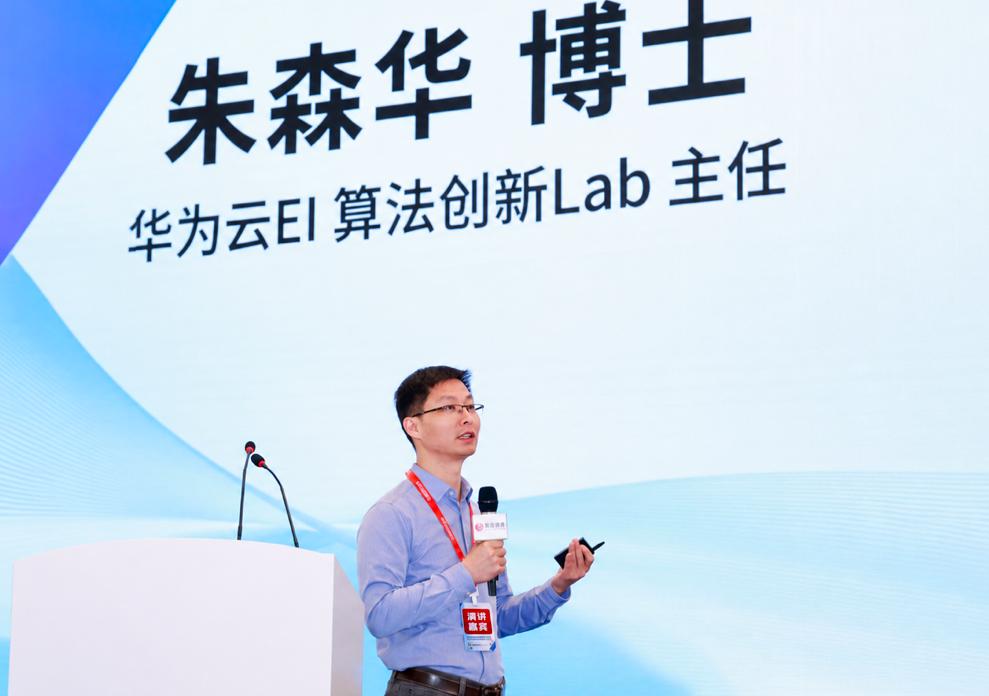
This unique characteristic of "brain science + AI" laid the foundation for his current entrepreneurship. In 2025, when the track was at its hottest and many players were entering the market, he made a counter - intuitive decision: instead of following the mainstream of the industry's VLA (Vision - Language - Action) model, piling up data and taking the technical route of "big data alchemy", he chose an alternative path, the less - known Neural AI paradigm (Brain Inspired Neural AI) of brain - like intelligence. He assembled a "iron - clad" team that had been well - integrated within Huawei for many years and founded Juenao Panshi in the second half of 2025.
Why choose the "brain - like intelligence" route?
To some extent, although this is related to Zhu Senhua's academic background, he believes that although today's AI performs well in text and image generation, it still has four "major shortcomings" that are difficult to overcome: it highly depends on a large amount of data, has weak generalization ability, cannot achieve lifelong learning, and has extremely high power consumption for training and inference. Zhu Senhua believes that since it is called "artificial intelligence", the ultimate goal from the first - principles perspective should be to approach the intelligent ability of the human brain, rather than staying at the shallow stage of "fitting data and imitating reproduction".
Meanwhile, the 1.0 stage of embodied intelligence has come to an end: in a framework centered on LLM, relying on brute - force computing, consuming a large amount of data and high power, and lacking the ability of lifelong learning, robots cannot achieve true intelligence.
Therefore, in his judgment, the next stage of artificial intelligence should not be to continue piling up data, computing power, and parameters, but to return to the origin of intelligence - learning from the "brain".
In this context, as a "cross - border person" with the ability of AI frontier exploration, engineering, and brain science research, Zhu Senhua believes that the origin and application of artificial intelligence is the modeling of brain neurons. "What Juenao Panshi wants to do is to create a'real brain' with autonomous cognition, logical reasoning, environmental adaptation, and continuous evolution ability for various robots."
From "Parroting" to "Cognitive World"
A Revolution in the Efficiency of the Embodied Brain
Looking at the current situation, in the melee of the world model, Zhu Senhua found that there are five major factions, each representing a different path to general artificial intelligence. These five factions are the spatial intelligence school led by Fei - Fei Li, with the core of explicit 3D modeling; the video generation route of OpenAI, which firmly believes that "prediction is understanding"; the learning - based simulation school led by DeepMind, which does not pursue pixel - level perfection but generates an interactive virtual environment through the Genie series, and then allows agents (such as Dreamer) to explore and acquire skills autonomously through reinforcement learning.
Moreover, there is the JEPA (Joint Embedding Prediction Architecture) proposed by Yann LeCun, who strongly opposes predicting pixels and advocates predicting the evolution law of the world in the abstract latent representation space, believing that this is an efficient path to machine common sense. Finally, there is the active inference framework of Karl Friston, with the core of the "free energy principle" - the brain does not passively receive signals but actively constructs a world model and continuously minimizes prediction errors.
Based on the industry research and the understanding of the underlying logic of brain science, Juenao Panshi established the JEPA (Joint Embedding Prediction Architecture) route, which is the same as Yann LeCun's, at the beginning of its establishment, and is committed to building a "Cognitive World Model" that can autonomously understand, reason, and adapt to the environment.
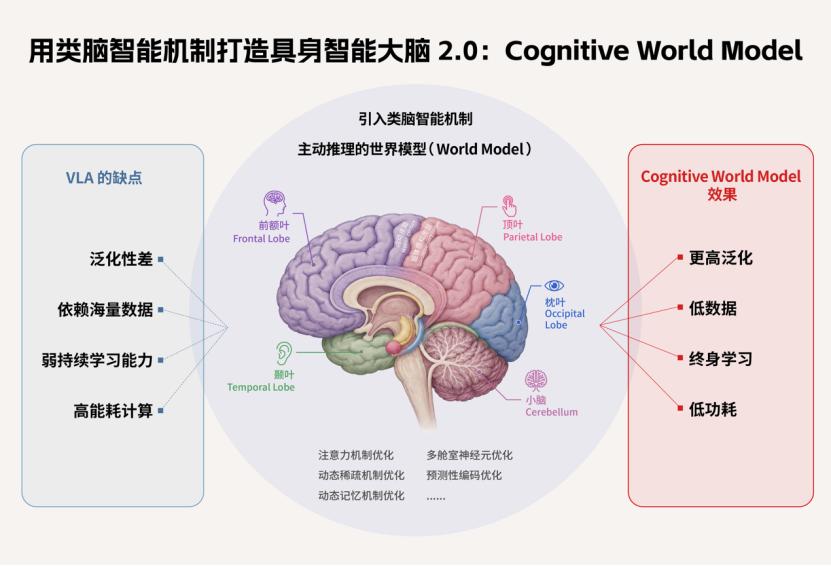
However, with the diverse technical routes, Zhu Senhua still noticed that most embodied intelligence technologies only stay at the shallow stage of "parroting". "They just remember the rules by relying on a large amount of data and do not really understand the causal logic of the physical world."
Compared with the traditional "parroting", the "Cognitive World Model" built by Juenao Panshi is not just an iterative upgrade of an algorithm framework but also a revolution in efficiency. Simply put, Juenao Panshi has completely jumped out of the inherent model: it allows AI to focus on extracting and understanding the "abstract concepts" and "physical laws" behind things without consuming computing power to generate real - scene pictures or memorizing a large number of details.
For example, when facing a cup, the embodied brain does not need to predict each frame of the cup falling but only needs to understand and predict abstract concepts such as "tilting", "center - of - gravity change", and "fragility". When facing tasks such as handling and palletizing, it does not need to memorize every object posture but directly understand the underlying physical causality.
"This cognitive logic based on abstract concepts allows robots to autonomously judge that a coconut shell has the function of holding water when they first encounter such an unfamiliar object without additional special training, truly achieving the ability to draw inferences about other cases from one instance at a human - like level." Zhu Senhua gave an example.
The technological leap from mechanical "parroting" to understanding - based "cognitive world" is exactly the technological change that Juenao Panshi wants to seize.
According to Juenao Panshi's vision, the company will not only deliver a code package for controlling robots or a single action or skill execution model but also a "Cognitive World Model" that can autonomously understand, reason, and adapt to the environment. At the same time, Zhu Senhua also proposed that Juenao Panshi will not create a robot brain customized for a single enterprise or a single customer but will build a new development paradigm suitable for multi - brand and multi - form robots through the construction of the upstream and downstream ecosystem.
The generalized technical route also enables this cognitive model to have extremely high data - use efficiency. According to Zhu Senhua, in public benchmark tests, they achieved the same skill - learning effect as the traditional route with only 1/10 of the industry's data volume, and the training cost, inference power consumption, and deployment difficulty have all been significantly reduced.
In addition, the entire industry is at a critical node of transformation from the "VLA large model" to the "world model". However, Zhu Senhua believes that a real world model should have five levels from bottom to top: the first and second levels are visual reality and physical reality, the third level is interactive reality, and the fourth and fifth levels are abstract learning ability and active inference respectively.
"Currently, most robot technologies on the market only solve the basic capabilities of the first three levels, while Juenao Panshi, which follows Yann LeCun's JEPA route, directly focuses its R & D on the fourth and fifth levels of high - order intelligence."
In the long run, Juenao Panshi's ultimate goal is to create an "embodied brain" that can understand physical causality, has human - like abstract learning and lifelong learning abilities, does not suffer from catastrophic forgetting, and has low power consumption and high generalization, which is the core bottleneck that embodied intelligence 1.0 cannot break through.
For the Embodied Intelligence Industry, Implementation is King
Recently, with the continuous popularity of Yann LeCun's JEPA architecture and Karl Friston's active inference theory, the global AI field's exploration of brain - like intelligence and autonomous intelligence has entered a new stage.
However, for embodied intelligence, beyond the popularity, the industry will ultimately have to face the tough battle of industrial implementation.
As the former "Number One Person in Huawei's Embodied Brain" and an interviewer for Huawei's "Genius Teenagers", Zhu Senhua is well aware that the core of the competition in the second half of the industry is the reserve density of top - notch cross - border talents. "Currently, the talents needed by Juenao Panshi are not traditional computer experts but cross - border scarce talents with a background in 'brain and brain - like' disciplines, neuroscience training, and AI engineering capabilities." Zhu Senhua emphasized during the communication.
In addition to Zhu Senhua himself, China Venture Capital News learned that this "iron - clad" team built around Huawei's backbone has also recruited scientific research talents from Tsinghua University, Peking University, and the Chinese Academy of Sciences, as well as veterans from large companies such as Huawei, Megvii, and Geek+.
Among them, co - founder Liu Jinyu has long been deeply involved in the technical productization and product commercialization in the fields of AI and robotics. He has led the incubation of multiple product divisions from scratch and their global commercial implementation, accumulating sufficient practical experience in project incubation, market expansion, and large - scale delivery in industrial and commercial service scenarios.
The original zero - running - in team configuration and foundation enable Juenao Panshi's capabilities to cover the entire chain from technology pre - research, system engineering to customer scenarios and industrial delivery, rather than just staying at the frontier R & D level.
Also, because of the clear track direction, the hardcore founding team, and the scarce brain - like intelligence technical route, Juenao Panshi has become the focus of capital. Although Juenao Panshi was founded in 2025 and is not an early entrant in terms of time, Zhu Senhua believes that from the perspective of industrial implementation, the entire embodied intelligence industry has just begun.
In terms of commercialization, Zhu Senhua said that from the first day of its establishment, Juenao Panshi established a clear commercial implementation strategy: it only selects scenarios with real willingness to pay, can be replicated on a large scale, and can drive the iteration of core technologies. "Currently, the company will promote the maturity of technology and large - scale application with the phased development goals of industrial - commercial - household use, and precipitate and abstract an open - platform system from the basic model to productivity tools through the implementation in local scenarios. At the same time, the company also made globalization one of its core strategies from the very beginning." Zhu Senhua revealed.
Compared with the domestic market, the implementation logic in the overseas market is significantly different: the core factor for domestic customers to make a purchase decision is ROI. Currently, the cost of robots is high, and their capabilities are limited, far exceeding the actual labor cost, and most are still in the pilot verification stage. In developed overseas countries, there is a factual labor shortage. Even if the robot solutions have not fully reached the same level as human labor, customers are willing to pay for the partial effectiveness of robots to fill the labor gap. At the same time, different business models can be tried overseas to increase customers' willingness to purchase.
This is also an important reason why Juenao Panshi chose the strategy of "parallel development at home and abroad, with priority on overseas breakthroughs" early in its commercialization path.
As of now, embodied intelligence has been continuously included in the government work report, and "brain - like and intelligent computing" has also appeared in the "Standards System for Humanoid Robots and Embodied Intelligence (2026 Edition)". This indicates that the combination of brain - like intelligence and embodied intelligence is moving from frontier exploration to industrial deployment.
In Zhu Senhua's view, after Yann LeCun raised the technical flag of "JEPA" and proved the correctness of the direction, the market needs a Chinese team that can truly carry this flag into engineering implementation, run through commercialization, and build real barriers. For this reason, Juenao Panshi will solidly promote the JEPA technical route to the real - world work sites of robots, enabling robots to truly have cognitive abilities close to the human brain and seize the opportunity in the global next - generation autonomous intelligence industry.
This article is from the WeChat official account "China Venture Capital News". Author: Chen Mei, Editor: Wang Qingwu. Republished by 36Kr with permission.