Google's Gemini enters the scientific community, appearing in Nature twice in one day. AlphaFold is just an appetizer.
On May 19th, during the window period of Google I/O, Nature published two papers on the same day.
One paper introduces ERA (Empirical Research Assistance), a system driven by large models and tree search. Its goal is to enable AI to automatically write expert - level scientific software for computational experiments.
The other paper introduces Co - Scientist (AI Cooperative Scientist), a multi - agent architecture that allows AI to continuously generate, critique, and refine scientific research hypotheses. As the computational volume expands during testing, the quality of the hypotheses continues to improve.
Both papers were published by Google. The release time was also chosen on the same day when Google officially announced the launch of the "Gemini for Science" toolset.
https://blog.google/innovation-and-ai/technology/research/gemini-for-science-io-2026/
The fact that the two papers were published in Nature on the same day, coinciding with the release of the Gemini for Science toolset, sends a signal that Google is using peer review to back the entire toolchain with credibility.
This is another significant achievement Google has made in the scientific field after AlphaFold.
Two Papers in Nature in One Day
Gemini Takes Over Two Scientific Research Pipelines
Following the two papers is a list of more than 100 institutions.
Google officially stated that it has collaborated with more than 100 institutions to verify the new systems and tools, including Stanford University, Imperial College London, the Crick Institute, ICML, STOC, NeurIPS, and U.S. national laboratories.
It has also established a "trusted testers" community composed of doctoral students, industrial researchers, and Nobel laureates, and piloted peer - review assistance tools with conferences such as ICML, STOC, and NeurIPS.
While launching the AI workstation, Google also published two papers in Nature to back the entire toolchain with credibility.
Let's first look at the ERA paper.
https://www.nature.com/articles/s41586-026-10658-6
ERA is positioned as an empirical research assistant, and its main task is to write experimental software at an expert level for scientists. Its underlying technology is a large language model combined with tree search, aiming to maximize a quality indicator.
This system presented an outstanding report card in the Nature paper:
In the field of bioinformatics, ERA independently discovered 40 new single - cell data analysis methods, outperforming all methods submitted by humans on the public leaderboard.
In the field of epidemiology, ERA produced 14 independent models for the task of predicting the number of infectious disease hospitalizations, all of which exceeded the CDC's integrated model.
It also covers geospatial analysis, zebrafish neural activity prediction, and numerical integration. These are all reproducible experiments in the Nature paper.
The ERA paper states that this system is not just about running code. It can absorb external research ideas and combine them into expert - level solutions.
Now let's look at Co - Scientist.
https://www.nature.com/articles/s41586-026-10644-y
Co - Scientist is a multi - agent system based on Gemini, and its core mechanism is the "idea tournament".
Multiple agents continuously generate, debate, critique, and refine hypotheses, and then use test - time compute scaling to continuously improve the quality of the hypotheses.
The paper focuses on validating three biomedical scenarios: drug repurposing, new target discovery, and interpretation of antimicrobial resistance mechanisms.
Among them, the drug repurposing candidates and combination therapy for acute myeloid leukemia (AML) have been verified in in vitro experiments by researchers from Stanford School of Medicine.
Both papers target the two most time - consuming aspects of scientific research: writing computational experiment software and generating verifiable scientific research hypotheses.
Three Labs Prototypes
Breaking Down the Scientific Method into Three Parts
In addition to the Nature papers, Google also simultaneously opened three Labs experimental prototypes, corresponding to the three core aspects of the scientific method.
The first is Hypothesis Generation, which is based on Co - Scientist and supported by the Nature paper.
Multiple agents generate hypotheses through an idea tournament, and each claim is accompanied by a clickable citation.
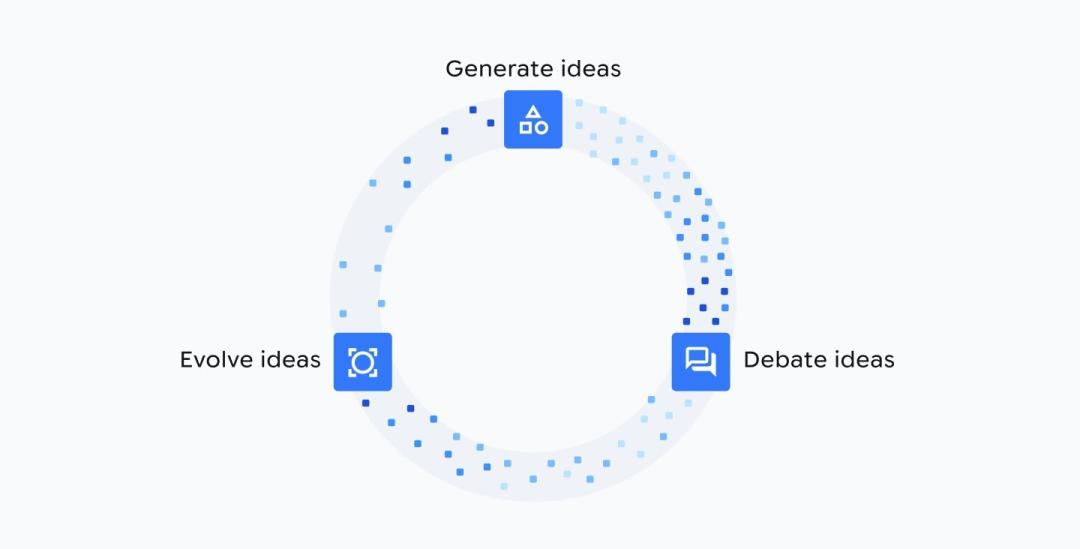
The working cycle of the Co - Scientist multi - agent system: the three stages of generating, debating, and evolving hypotheses are completed through the collaboration of multiple specialized agents such as Generation, Reflection, Ranking, Evolution, Meta - review, Proximity, and Supervisor.
The second is Computational Discovery.
It is based on AlphaEvolve and ERA. The ERA paper has just been published in Nature, and AlphaEvolve has the independent endorsement of Google DeepMind.
This engine generates thousands of code variants in parallel, and each variant is automatically scored. This compresses the complex modeling path that originally took humans months to explore into the scope of machine search. Solar energy prediction and epidemiology are two scenarios specifically mentioned by Google.
The third is Literature Insights.
It is based on NotebookLM, which currently does not have the endorsement of Nature and is positioned as an early preview. Functionally, it structures the literature into a searchable attribute table and can directly produce reports, slides, infographics, and audio - video overviews.
In addition to the workstation, Google also released a set of Science Skills, which integrates more than 30 life - science databases and tools, including UniProt, AlphaFold Database, AlphaGenome API, and InterPro.
This set of Skills runs on an agent platform similar to Google Antigravity. It can integrate the structural bioinformatics and genomic analysis processes that previously required jumping back and forth between more than a dozen databases into a single link.
In the early tests of Google's research team, Science Skills produced new insights into the potential mechanisms in the analysis of rare genetic diseases related to the AK2 gene. A complex analysis that originally took hours was compressed to minutes.

The actual operation screen of Google Antigravity analyzing AK2 gene variants with the support of Science Skills. The entire workflow is completed in minutes using natural language instructions.
The Problem That a Century - Old Chemical Giant Failed to Solve Multiple Times
Was Solved in This Way
In addition to the endorsement of the two Nature papers, Google also played another card: BASF's agricultural solutions.
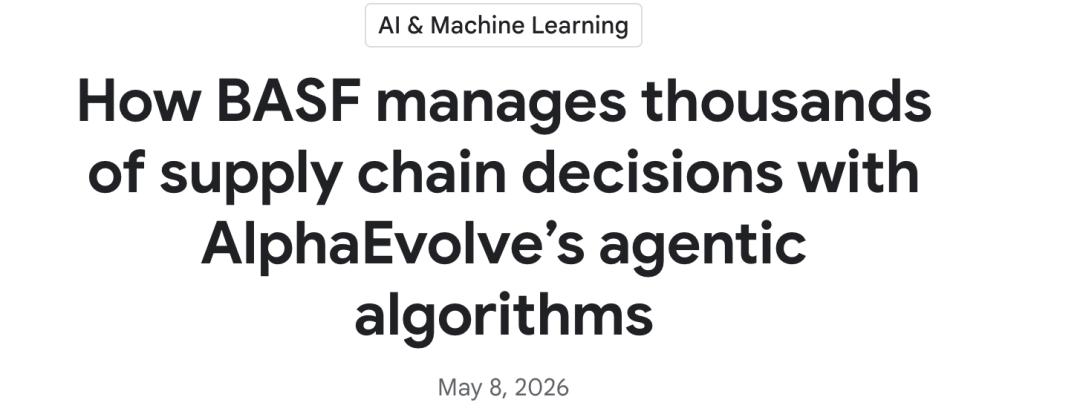
The problems faced by BASF are extremely complex: 180 production bases, more than 5,000 value chains, and the bill of materials for a single product can sometimes be as deep as 30 levels, spanning different production locations and regions.
Human planners have to make thousands of local decisions every day, but no one can clearly see in real - time how local decisions affect the entire global supply - chain network.
Goetz Krabbe, the senior vice - president of BASF's supply chain, said, "Previously, we tried multiple times to build a digital twin using deterministic models, but all attempts failed."
Google's goal is not to let AI replace human decision - making but to establish a decision - support system.
They input a "seed program" into AlphaEvolve as the basic planning logic and then fed in three years of historical data, including inventory levels, market demand, and actual production records. AlphaEvolve began to generate code variants and automatically discover the internal laws of supply - chain operations.
Finally, AlphaEvolve automatically extracted three rules that would require domain experts to manually code in traditional modeling:
Production integration (how to combine small - batch production to optimize production - line time); dynamic safety stock (how to handle seasonal fluctuations with parameters); network - level coordination (how to map the dependencies between different production levels).
Compared with the initial seed model, the latest round of AlphaEvolve's operation results achieved a relative improvement of more than 80% in accuracy.
BASF plans to use this digital twin to cover the entire global production network as the basis for scenario prediction and optimization.
According to Google, Daiichi Sankyo, Bayer Crop Science, and national laboratories under the U.S. Department of Energy (Genesis Mission project) have also connected to Co - Scientist. The Swedish fintech company Klarna used AlphaEvolve to double the training speed of a large Transformer model while improving the model quality.
Competing for the "Trusted Verification" Ticket
The Nature papers are just a significant move by Google to seize the high - ground of credibility in its overall "AI for Science" layout. The purpose is to add a layer of endorsement from the scientific community to the toolchain, giving researchers a psychological anchor of "this has passed peer review" when facing the system.
Google has currently publicly announced more than 100 partner institutions, covering Stanford University (in the field of liver fibrosis), Imperial College London (in the field of antibiotic resistance), and the Crick Institute (a long - term cooperation project).
The trusted testers range from doctoral students to Nobel laureates, and each of them looks for loopholes in the system in real scientific research scenarios.
What's more worthy of attention is an ongoing related event by Google: collaborating with top academic conferences such as ICML, STOC, and NeurIPS to develop the agent - based peer - review tools PAT (Paper Assistant Tool) and ScholarPeer.
This means that the scientific credibility infrastructure is becoming a new competitive arena: whoever's AI suggestions can be cited, whose hypotheses can withstand audits, and whose system can be integrated into the workflow of top - tier journals will be able to take root in the future scientific research ecosystem.
OpenAI launched GPT - Rosalind in April, focusing on cutting - edge reasoning in biology, drug development, and translational medicine.
Anthropic connected Claude for Life Sciences to AWS Marketplace and connected with Databricks and Snowflake for large - scale bioinformatics analysis.
This time, Google has bet on the Nature papers, more than 100 institutions, ERA, and Co - Scientist.
All three companies have separated "science" into product lines. The next competition will be which platform's toolchain can become the preferred choice trusted and relied on by scientists.
Reference Materials:
https://blog.google/innovation-and-ai/technology/research/gemini-for-science-io-2026/%20
https://www.nature.com/articles/s41586-026-10658-6%20
https://www.nature.com/articles/s41586-026-10644-y%20
https://cloud.google.com/blog/products/ai-machine-learning/how-basf-manages-thousands-of-supply-chain-decisions-with-alphaevolve
This article is from the WeChat official account "New Intelligence Yuan", author: ASI Revelation, editor: Yuan Yu Moses. Republished by 36Kr with authorization.