Credit limit maxed out, OpenAI's ambition to build chips with $180 billion stuck on a Microsoft procurement contract
In October last year, OpenAI and Broadcom jointly announced a strategic cooperation:
The two parties will jointly deploy 10GW of customized AI accelerators. OpenAI is responsible for designing the chips and systems, while Broadcom participates in the development and is responsible for the deployment. The deployment will start in the second half of 2026 and be fully completed by the end of 2029.

OpenAI and Broadcom officially announced a cooperation on 10GW customized AI accelerators. Altman said in a joint interview that "cooperating with Broadcom is a crucial step in unlocking the potential of AI."
It is generally believed in the outside world that OpenAI has finally established a self - developed chip path outside of NVIDIA.
What no one noticed is that the two parties did not finalize the source of funds when officially announcing the cooperation. This is not the first time OpenAI has done this.
According to The Information, the investment arrangement of up to $100 billion with NVIDIA previously announced by OpenAI did not materialize as initially planned. Subsequently, NVIDIA made an equity investment of $30 billion in OpenAI.
In January this year, OpenAI, SoftBank, Oracle, etc. announced the Stargate plan, stating that they would immediately deploy $100 billion and planned to invest $500 billion in the next four years. However, the Stargate plan has been hindered due to differences among the participants in details and concerns of the lenders about OpenAI's business model.
Announcing first and then discussing details is a common rhythm for OpenAI in the computing power competition. The difference this time is that it is Microsoft that is causing the bottleneck.
The Triangular Game of the Financing Structure
Where is the financing bottleneck?
According to an internal memorandum obtained by The Information and two people familiar with the matter, for the first - stage data center capacity of 1.3GW, the chip production cost alone will be $18 billion.
Extrapolating from this ratio, the chip production cost for the complete 10GW project will be $180 billion, not including the peripheral costs such as data center construction, power supply, and network equipment.
OpenAI's cash flow cannot support this figure. The company's internal forecast is that the operating expenses will exceed $200 billion by 2029. While burning its own money, it has to find financiers for the $180 - billion chip payment.
Broadcom is very willing to do this business, but it requires risk - sharing. There is only one condition: Broadcom will only finance if Microsoft agrees to purchase about 40% of the chips in the first stage.
The implementation structure is: Microsoft will buy the chips, install them in its own data centers, and then provide them to OpenAI for use in the form of leasing.
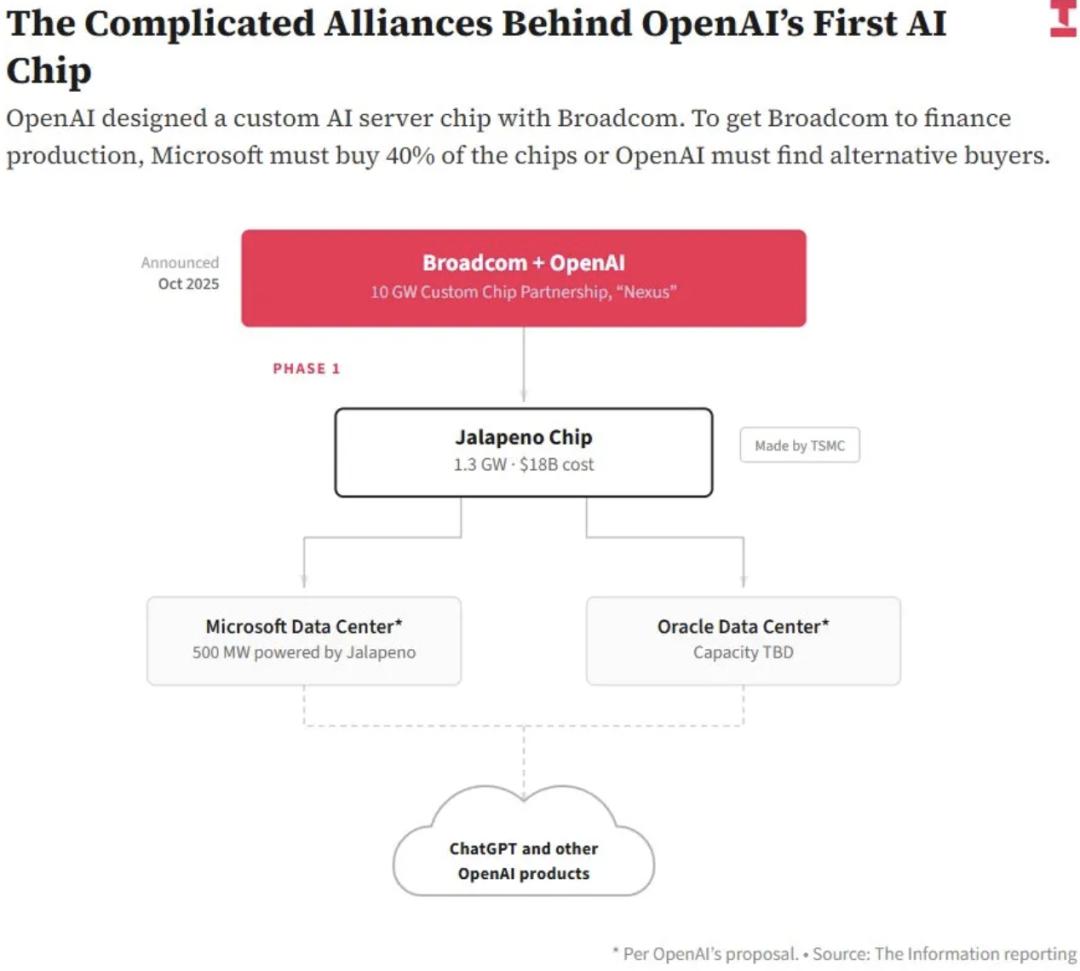
The financing and deployment structure of OpenAI's first self - developed chip, "Jalapeno". The first - stage 1.3GW with a cost of about $18 billion will be manufactured by TSMC; the chips will be installed in Microsoft or Oracle data centers to ultimately provide computing power for products such as ChatGPT.
A person involved in the negotiation explained that Microsoft is "one of the technology companies with the highest global credit ratings and has decades of data center operation experience." Its purchase commitment can make Broadcom confident that it can get the money back.
The draft agreement also includes a guarantee clause: if Microsoft's actual purchase volume is lower than the agreed value, OpenAI must find alternative buyers to make up the shortfall.
Broadcom has abandoned a long - standing iron rule for this cooperation: requiring OpenAI to contribute funds on a 1:1 basis to share risks. This time, it has rarely agreed to invest more capital in the early stage, and the only safety valve it has left for itself is Microsoft's endorsement.
The problem is that Microsoft has not yet agreed to purchase.
According to a person familiar with the matter who has had direct communication with Microsoft's senior management, Microsoft has reserved some data center space for these chips, but the purchase commitment has never been put in writing. The memorandum mentions that "Microsoft's failure to finally fulfill the purchase commitment" is the "core risk to the project's sustainability."
What's more intriguing is that Broadcom doesn't seem to be fully aware of this risk.
The memorandum states that because OpenAI and Microsoft "have not fully disclosed all the details of their relationship," Broadcom mistakenly thought that this matter "was within OpenAI's control" and assumed that OpenAI could directly ask Microsoft to make the purchase.
The financing plan of one company depends on a procurement decision of another company, and the third - party financier doesn't know how complicated this matter is.
The current direction of the negotiation is to sign a "conditional agreement" first so that Broadcom can lock in the production capacity at TSMC.
The memorandum points out the time pressure: "Broadcom's production capacity quota at TSMC in 2027 is limited, and there is an urgent time window." TSMC is also the manufacturer of NVIDIA's advanced AI chips, and production capacity is a scarce resource.
The negotiation is still ongoing, and the project has not been terminated. However, this financing threshold is blocking all the subsequent steps.
Microsoft's Influence Has Never Disappeared
In the past year, there has been a general impression in the outside world that OpenAI is gradually breaking free from Microsoft's constraints. This impression is not unfounded.
According to OpenAI's official announcement, the latest agreement between the two parties does include an important adjustment: Microsoft no longer has the "right of first refusal" as OpenAI's computing power supplier, and OpenAI can freely cooperate with other suppliers. This is a substantial loosening of the constraints.
However, a sentence in the memorandum reveals the truth: Microsoft "has always held the cards" in the chip project. OpenAI has spent "a great deal of effort and a considerable amount of time" in seeking Microsoft's purchase commitment, but there is still no definite result.
Why Has Microsoft Not Given the Green Light?
Microsoft's current situation is that it has reserved some data center space for these chips but has not agreed to purchase them.
This shows that Microsoft has a plan for the future deployment of OpenAI's self - developed chips but is not willing to bear the financial burden yet.
A person involved in the negotiation revealed that if Microsoft agrees to purchase, it will not only bear the financial risk but also have to make concessions in its data center architecture.
Microsoft's data centers are designed according to the principle of general compatibility, which makes it easy to switch suppliers at any time; what OpenAI wants is a data center optimized specifically for its self - developed chips, and the construction logics of the two are fundamentally different.
For Microsoft, making the purchase means moving closer to OpenAI in terms of architecture, and the cost has not been agreed upon yet.
OpenAI's Considerations
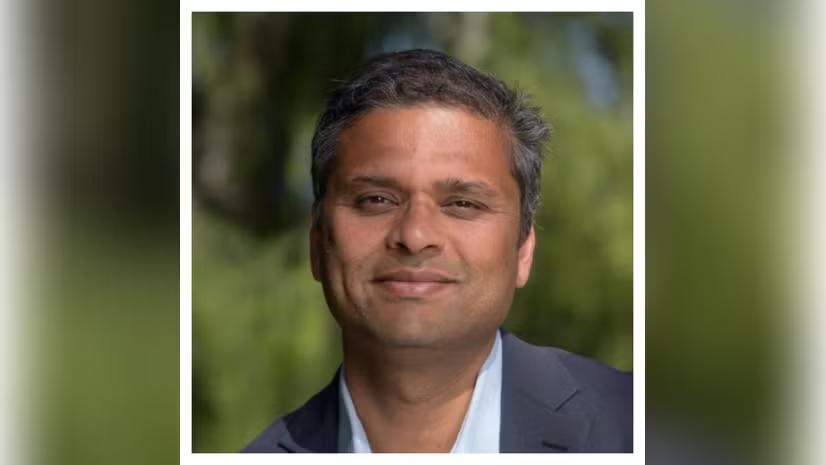
Sachin Katti, the head of industrial computing power at OpenAI. He was the former chief technology officer of Intel and joined OpenAI in November 2025, responsible for computing power infrastructure and chip cooperation.
Sachin Katti, an executive at OpenAI in charge of cloud contracts and chip projects, mentioned in a message to colleagues that making Microsoft's purchase commitment a prerequisite for financing would set a precedent, "which would be a great constraint on us in the long run." He also pointed out that Microsoft's in - depth involvement makes this deal "commercially unattractive."
Katti believes that tying Microsoft's purchase commitment as a pre - condition for Broadcom's financing means that for each generation of chips in the future, a super - buyer will be needed for credit guarantee, and OpenAI's supply - chain negotiations will always be in the hands of others.
In addition, if Microsoft buys the chips and then leases them back to OpenAI, there will inevitably be a profit margin, which is equivalent to an additional financial cost out of thin air.
However, in the memorandum, Katti finally said that for strategic value, the deal should still be done. "I'm just reminding everyone that this business structure may not work at all for the second - generation chips and beyond."
It's impossible not to do it, but doing it has structural hidden risks. The contract says it's free, but in reality, whether Microsoft buys or not still determines whether OpenAI can truly produce its own chips.
Not a Single - Line Bet
But This Line Can't Lose Momentum
It should be clear that OpenAI's computing power expansion is not just betting on the cooperation with Broadcom.
At the same time as the official announcement of the cooperation with Broadcom, OpenAI also signed a cooperation agreement for at least 10GW of systems with NVIDIA. NVIDIA plans to provide a maximum investment of $100 billion with the deployment of each GW, and the first 1GW of the Vera Rubin platform system will be launched in the second half of 2026.
OpenAI also signed a 6GW GPU cooperation agreement with AMD. The first 1GW of AMD Instinct MI450 series GPUs are also planned to be deployed starting in the second half of 2026.
With NVIDIA, AMD, and Broadcom's self - developed chips, as well as the data center resources of Azure and Oracle/Stargate, OpenAI is taking a multi - supplier parallel approach to deliberately diversify risks.
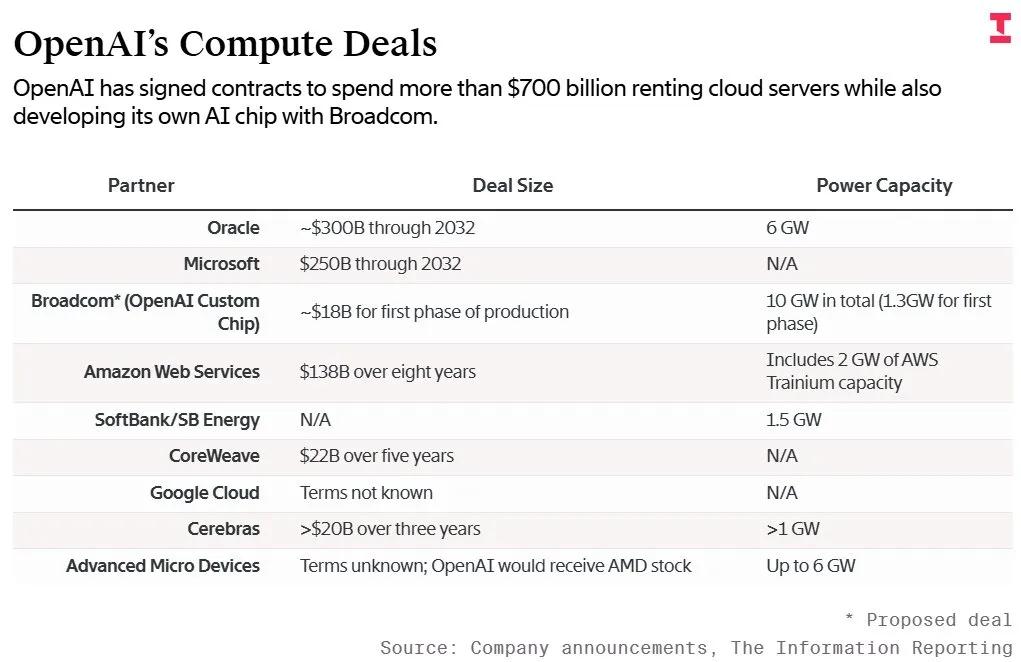
An overview of OpenAI's computing power contracts, with a total contract value of over $700 billion. The cost of the first stage of Broadcom's self - developed chips (marked as a "proposed transaction") is about $18 billion, and the financing is still undecided.
The problem is that the strategic significance of these lines is not equal.
If OpenAI continues to use NVIDIA or AMD's GPUs, it has to rent computing power at market prices, and the GPU rental fees will directly eat into the profit margin.
According to The Information, OpenAI predicts that its operating expenses will exceed $200 billion by 2029. At this rate of burning money, "reducing dependence on NVIDIA" is not just a supply - chain strategy but a key variable that determines whether the company can be financially stable.
The core product of the cooperation with Broadcom, Jalapeno, is a customized accelerator designed specifically for inference tasks. The goal is to make the existing models run cheaper and more efficiently during inference than NVIDIA's general - purpose GPUs. This is the most direct way for OpenAI to reduce service costs and improve the gross profit margin.
However, the progress is slower than expected. According to several people familiar with the matter, most of the first - batch Jalapeno chips will not be ready until 2027, which is postponed from the originally planned second half of 2026.
The design work of the next - generation chip, "Serrano," has already started, but if the first - stage financing cannot be finalized for a long time, the entire schedule may be affected.
Other suppliers can ensure computing power, but only self - developed chips can ensure profits. If this line loses momentum, reducing dependence on NVIDIA will just be an empty slogan.
The AI Arms Race
Enters the Credit Endorsement Stage
OpenAI is not an isolated case.
Google has been on this path for more than a decade. Google started cooperating with Broadcom to design customized AI chips (TPUs) around 2013. It is this self - developed system that has helped Google reduce its dependence on NVIDIA and improve the profit structure of its data centers.
Meta and Microsoft followed suit and signed their own customized chip agreements with Broadcom for the same reason: NVIDIA's servers are too expensive.
Now it's OpenAI's turn.
However, OpenAI faces a problem that Google, Meta, and Microsoft did not encounter at that time: its cash on hand and balance sheet cannot support this level of financing needs.
The $180 - billion chip production cost, plus data center construction, plus OpenAI's estimated $200 - billion operating expenses, means that the funding gap to be filled before 2029 far exceeds the scale that any round of financing can solve.
This means that OpenAI must find an institution willing to guarantee it. Broadcom needs Microsoft's endorsement before it dares to invest.
Lending institutions are hesitant about the Stargate project because OpenAI's "business model has not been verified." NVIDIA's $100 - billion commitment to OpenAI was finally reduced to a $3 - billion equity investment, which is based on a similar logic: you can make a bet, but it should be in the form of equity rather than debt.
In the first half of the AI arms race, the competition was about who had a stronger model and who could launch products faster.
In the second half, the competition is about who can obtain the credit endorsements of banks, technology giants, and industrial - chain enterprises to leverage massive infrastructure financing.
Technology is no longer the bottleneck; credit is.
Reference materials:
https://x.com/theinformation/status/2052810828764606810
This article is from the WeChat official account "New Intelligence Yuan", author: ASI Revelation, editor: Yuanyu. It is published by 36Kr with authorization.