The rapid expansion of short dramas overseas: Who is quietly reaping the dividends behind the scenes?
In the post-short drama era, when many people are sighing that "short dramas have completed in one year what long dramas took a decade to achieve", going global has become a track that short drama practitioners must deeply explore.
The "2026 Overseas Micro Short Drama Market Insights" released by DataEye shows that 2025 was the first year of the explosion of overseas micro short dramas, with the market scale exceeding $4 billion. It is expected to exceed $5 billion (about 35 billion RMB) in 2026. Currently, the monthly active users of overseas micro short dramas reach 100 million. Compared with the 1.8 billion global short - video users, there is huge room for growth.
However, behind the surging numbers is a fierce "money - burning competition": Zhongwen Online is expected to have a net loss of 580 million - 700 million yuan in 2025; Fengye Interactive (the parent company of ReelShort) turned from profit to loss in 2025, with a net loss of over 85 million yuan. The industry generally reports that 80% - 90% of overseas projects cannot recoup their costs.
Just as content providers are constantly losing money, a group of technology service providers are rising against the trend.
Hangzhou Xiaoying Technology uses AI to reduce the dubbing cost from 1,500 - 3,000 yuan per drama to 300 - 500 yuan per drama, and the efficiency has increased from about 10 dramas per month to over 1,000 dramas per month. Guangzhou Quwan Qianyin, based on the MaskGCT large - speech model jointly developed with The Chinese University of Hong Kong, Shenzhen, can produce 3,000 minutes of dubbed dramas per day. Changsha Malanshan Dubbing Center uses its self - developed AI algorithm to complete the translation and dubbing of a 120 - minute micro short drama in only 4 to 5 hours, with an accuracy rate of over 95%...
Obviously, in the collective rush of short dramas to go global, these "shovel sellers" are becoming the most certain link to reap the benefits in this track with their technological innovation and efficient services.
Precisely Reap with Efficiency and Cost Advantages
Undoubtedly, in the rapid expansion of short dramas going global, translation and localization have always been the "bottleneck" for content providers.
For example, some humorous segments that are very popular in Asian regions may be completely incomprehensible to European and American audiences and even regarded as offensive. Some plot settings with specific cultural backgrounds will leave overseas audiences confused and difficult to resonate emotionally if they are not properly localized during cross - cultural communication.
Although manual translation can ensure the accuracy of translation and the transmission of cultural connotations to a certain extent, its high cost and long cycle have become an unbearable burden for content providers. Especially when facing a large amount of short drama content that needs to be quickly dubbed and launched into the international market, the limitations of manual translation become more prominent.
To put it bluntly, manual translation not only has limited production capacity but also faces three major challenges: long cycle, high cost, and difficulty in scaling up. And the intervention of AI is reshaping this pattern with irresistible force.
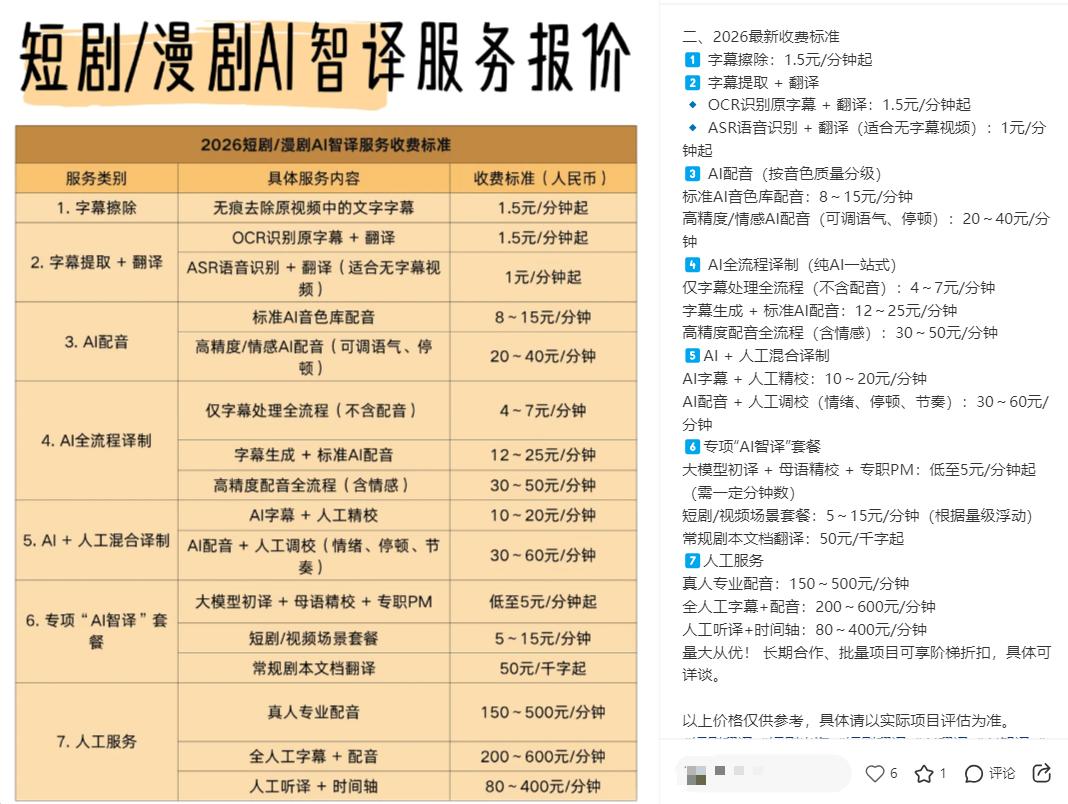
Image source: Xiaohongshu
At present, the paths of the players are different.
Xiaoying Technology chooses to enter the market with SaaS - based tools. Through tool chains such as AI dubbing, multi - language translation, and highlight video editing, it provides "one - stop" creative support for overseas enterprises. Its AI dubbing efficiency has increased by more than a hundred times compared with manual work, and the monthly production capacity has exceeded 1,000 dramas. This ability effectively solves the most urgent need of content providers for rapid volume increase.
When efficiency is no longer a problem, "who will pay" becomes the core variable determining the track. By June 2025, all the translation work of Stardust TV under Shanhai Xingchen had been completed by its internal team, moving from relying on outsourcing to 100% in - house processing. The average monthly translation and delivery volume reached more than 1,000 episodes, and the production capacity increased by more than 500% compared with 2024. It can even complete translation and listing within 2 hours at the fastest. This move once made it top the overseas short drama revenue list, successfully seizing the opportunity in the fierce market competition.
The practice of Hangzhou Judian Network Technology Co., Ltd. proves that even small and medium - sized players can quickly keep up with the rhythm with AI. Its AI agent realizes the full - process automation from subtitle extraction to video synthesis through "multi - modal translation" technology. A short drama that used to take 1 - 2 days to translate can now be completed in just a few seconds.
On one hand, the significant advantages of AI in high - efficiency mass production are emerging like a tide. On the other hand, the production capacity gap in the field of short dramas going global is expanding at an alarming speed. It is not difficult to find that between the subtle intersection of supply and demand rhythms, technology service providers naturally undertake this surging wave of rigid demand.
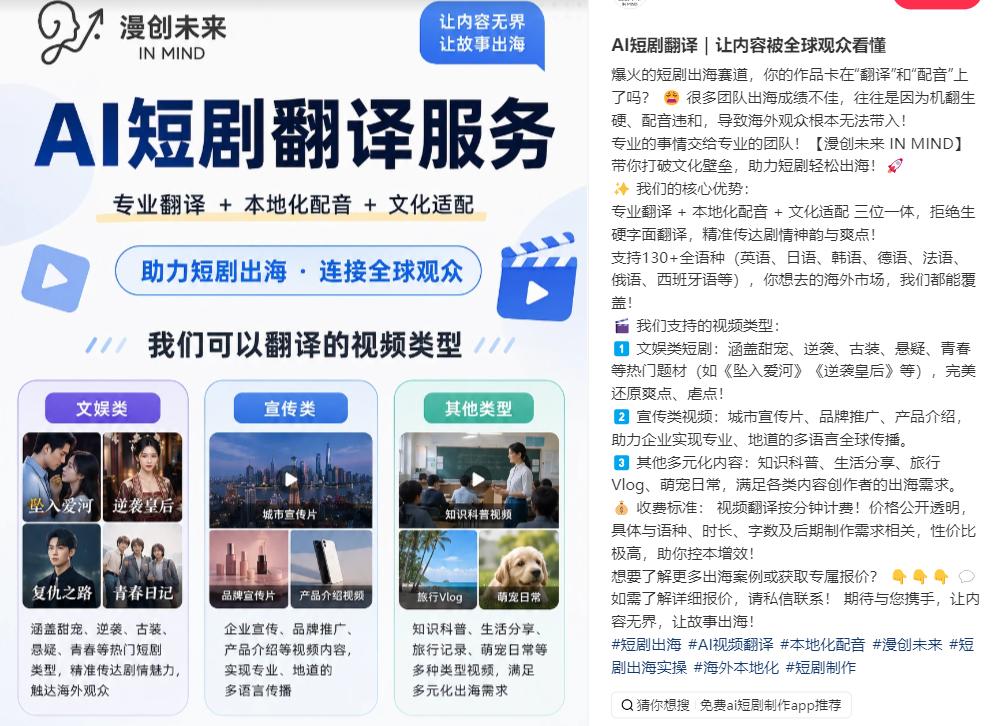
Image source: Manchuang Future IN MIND
Different from the intense involution and uneven profitability of front - end content producers, technology service providers, with their lightweight and standardized product delivery strategies, not only effectively reduce costs and improve efficiency but also achieve a relatively stable growth trend with the ability to scale up.
What is particularly crucial is that when leading short drama platforms such as FlexTV actively adopt the lightweight operation strategy of "third - party procurement combined with AI - assisted translation" to cut costs and get rid of the heavy - asset operation model, the market demand and bargaining power of technology service providers have been greatly enhanced.
This closed - loop of "the more intense the industry competition, the more cost - effective it is needed, and the more stable the benefits of technology service providers are" makes AI dubbing service providers one of the few players with certain anti - cyclical growth in the short drama going - global industry chain.
Why Become the "Water, Electricity, and Coal" of Overseas Short Dramas?
For an industry to truly mature, it often depends on the infrastructure of key links. At present, AI dubbing service providers are undergoing such a profound transformation.
When technical capabilities, business models, and ecological niches are perfectly integrated and superimposed on each other, a new set of industry standards is quietly established.
Technological moat is the foundation.
Quwan Qianyin, based on the MaskGCT large - speech model jointly developed with The Chinese University of Hong Kong, Shenzhen, realizes multi - dimensional decoupling and editing of semantics, emotions, timbre, and rhythm. The dubbed products can not only be linguistically accurate but also convey the emotional temperature of the original work, effectively breaking the early dilemma of AI tools of "mechanical reading and lack of emotion".
At the same time, the platform supports the dubbing and generation of 40 languages, with a maximum daily dubbing capacity of 3,000 minutes of dramas. It has reached strategic cooperation with global leading short drama platforms such as FlexTV, helping FlexTV achieve multi - language localization adaptation of an average of 400 short dramas per week, which is enough to achieve real "global daily updates".
The Malanshan Micro Short Drama Intelligent Dubbing Center takes the path of "public infrastructure". As an innovative platform jointly built by the government, scientific research institutions, and content platforms, the center integrates AI video algorithms such as large - language models, voice cloning, and subtitle recognition, and can support translation output in more than 20 languages.
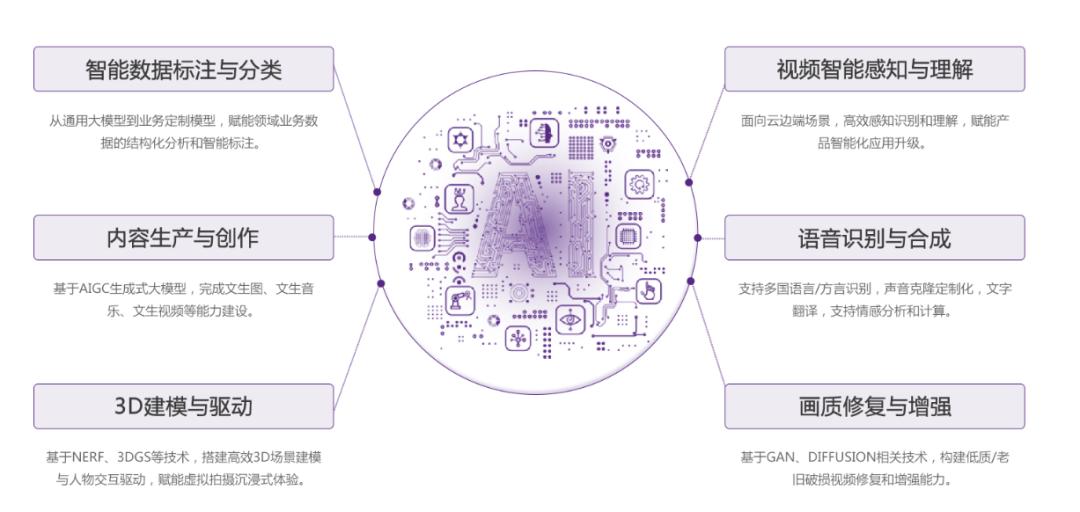
Image source: Malanshan Audio - Video Laboratory official website
On this basis, Malanshan further integrates full - process functions such as pre - compliance review and automated transcoding, and packages all the capabilities required for content to go global into a one - stop service, greatly improving the compliance and distribution efficiency of small and medium - sized enterprises. This upgrade of the model means that the "water, electricity, and coal" of the short drama going - global industry has evolved from a simple technical tool to a full - link integrated platform of "review - dubbing - distribution".
The evolution of the business model has led single - service to large - scale delivery.
Taking Shanhai Xingchen as an example, through the multi - language closed - loop process of "AI collaboration + manual refinement", it has built its own content production technology center, pushing the advertising placement consumption ratio of dubbed dramas to nearly 50%, and showing stronger user retention and payment conversion in multiple regional markets.
Similarly, StoReel has completely reshaped the content production process with AI human - simulation technology. By the end of March 2026, the platform had completed a $34 million financing, consisting of a $9 million Seed round led by Play Ventures and a $25 million user - growth financing from PVX Partners, becoming a new force attracting capital attention in the AI short drama track.

Image source: StoReel video account
This series of cases strongly shows that the role of technology service providers has broken through the limitations of traditional "back - end tools" and is gradually moving towards the core area of "front - end production", deeply penetrating and running through the entire life cycle of overseas content from creation, dubbing, review to distribution.
The key is that the convergence and collaboration of multiple forces are promoting profound changes in industrial division of labor. The pattern of "platforms controlling both ends and service providers undertaking the middle" is becoming increasingly clear: platforms focus on the procurement of upstream IP and content and the operation of downstream users, while technology service providers undertake key processes such as AI production, multi - language localization, and compliance review.
When overseas platforms use AI dubbing technology to significantly reduce costs to 1/5 to 1/10 of the manual cost and increase efficiency by 5 to 20 times, thus focusing resources on core links, the competition logic of the entire industry is quietly being reshaped.
The more platforms rely on third - party AI services or self - developed technology centers for lightweight operation, the more significant the voice of technology service providers in formulating technical standards, data pricing, and service rules will be.
In essence, leading technology service providers can continuously accumulate three types of core data assets: multi - language corpus, voice timbre library, and user preference model through continuous delivery. These assets build a high - barrier first - mover advantage that is difficult to overcome: even if new entrants have basic AI capabilities, it is difficult to accumulate the same scale of industry - specific data and model adaptation experience in the short term.
From this perspective, the field of short dramas going global is showing the characteristics of the winner - takes - all and the increasingly prominent Matthew effect, and those technology players with infrastructure - level service capabilities will undoubtedly become the core winners anchoring long - term value.
This article is from the WeChat official account "Zinc Scale" (ID: znkedu), author: Meng Huiyuan, editor: Li Wenjie, published by 36Kr with authorization.