The organizational chart of Elon Musk's reconstructed xAI has been exposed, with 12 former employees parachuted in and a major reshuffle across three lines.
Just now, the latest organizational structure chart of xAI after Elon Musk's reorganization was exposed, and almost all of them are his allies and confidants.
Gwynne Shotwell, President of SpaceX, has been supervising the operation of xAI since February 2026;
Michael Nicolls, a former Starlink executive, will take over as President of xAI in April 2026;
Jared Birchall, the head of Musk's family office, joined xAI as the "company secretary" in 2023.
The three have different resumes, and the only thing they have in common is that none of them have a background in AI research or large - model products.
It's not just these three.
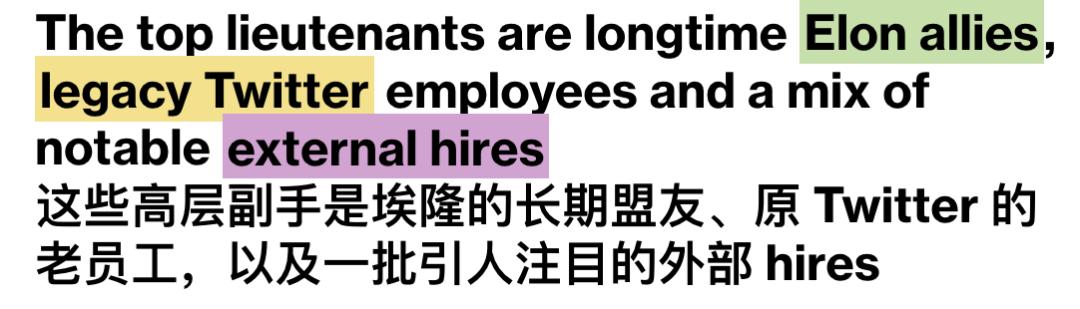
From SpaceX, Tesla, the family office to Musk's VC circle of friends, at least 12 confidants have been parachuted into xAI and have entered the three main lines of the executive management, product line, and engineering line respectively.
This is not an ordinary personnel adjustment. Musk has almost staked the core personnel of his entire business empire on the AI card.
Three - tier structure, all insiders
This organizational structure chart is mainly divided into three layers: management, product, and engineering.
Management
The top - most layer is the executive management, almost all of whom are Musk's allies and confidants. 8 out of 9 seats are from SpaceX, the family office, or DOGE.
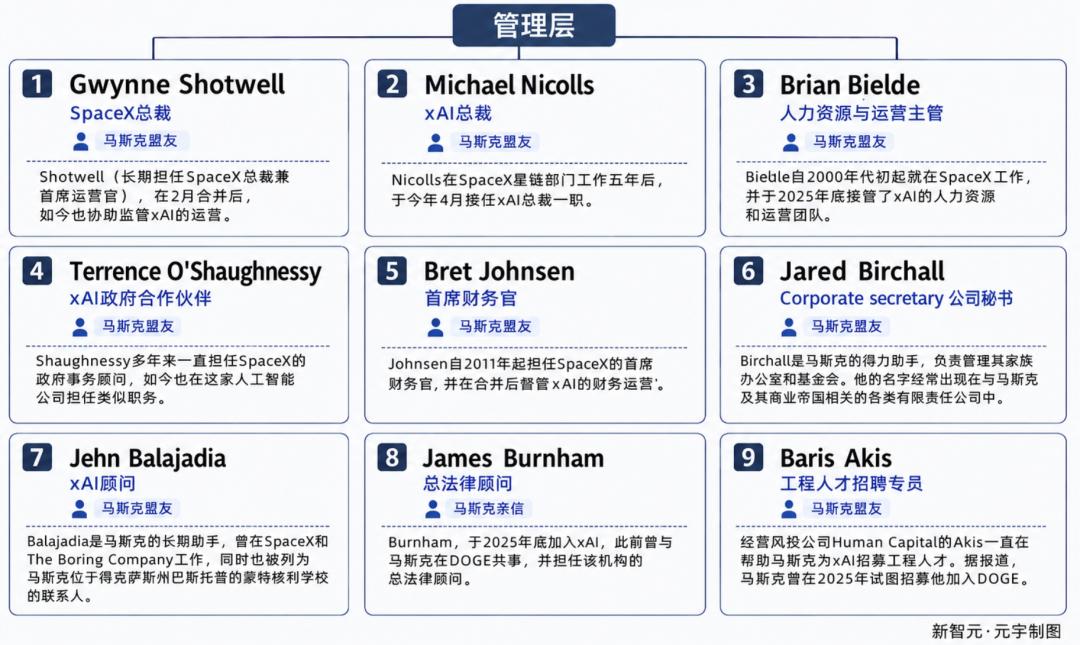
Gwynne Shotwell has long served as the President and Chief Operating Officer of SpaceX. After the merger in February, she now also assists in overseeing the overall operation of xAI.
Michael Nicolls serves as the President and is responsible for expansion.
Brian Bjelde joined SpaceX in 2003 and has served as the Vice President of Human Resources since 2014. He took over the HR and operations of xAI in November 2025; Terrence O'Shaughnessy is in charge of government affairs cooperation and is an old - timer from SpaceX's government relations.
Since February 2026, Bret Johnsen, the CFO of SpaceX, has directly supervised the financial operations of xAI.
The legal and talent lines are also staffed by insiders.
The General Counsel was taken over by James Burnham in November 2025. He was previously the General Counsel of DOGE; Baris Akis, who is in charge of engineering talent recruitment, is from the VC firm Human Capital and is dedicated to finding top - notch engineers for Musk.
Product
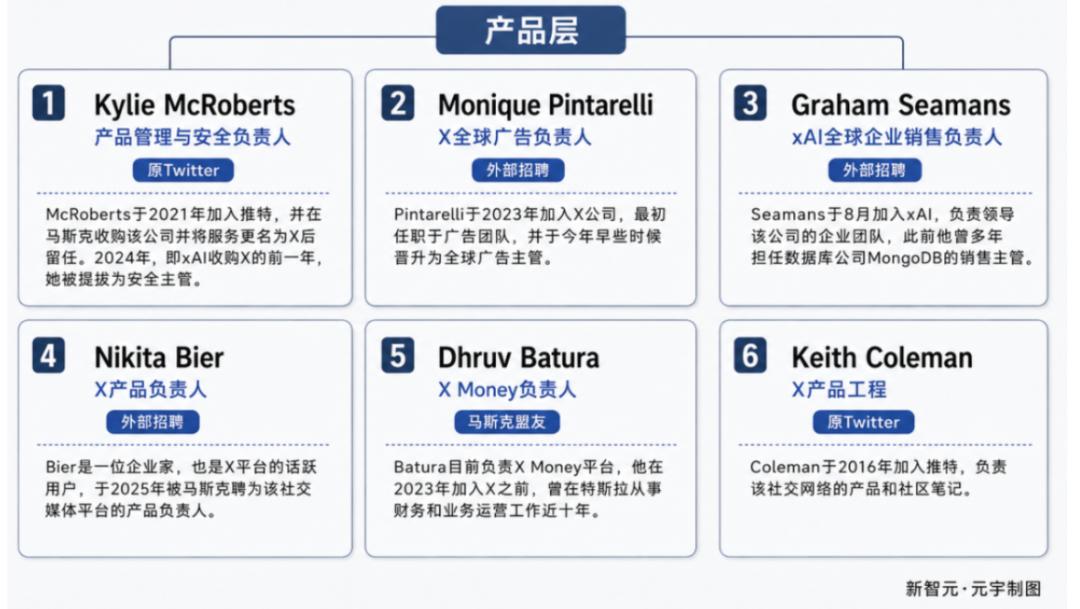
The product layer is a mixed - force composed of three parts: the remaining team from the original Twitter, external recruiters introduced after Musk took over X, and people transferred from Musk's other companies.
Kylie McRoberts and Keith Coleman are old employees from the Twitter era; Monique Pintarelli, Nikita Bier, and Graham Seamans are the heads of advertising, products, and corporate sales introduced after Musk took over X.
Meanwhile, some old - timers from Tesla have also been inserted into this layer: Dhruv Batura, the head of X Money, was previously in charge of finance and business operations at Tesla and joined X in 2023.
Engineering
Although the number of people in the engineering line is not large, they are very important.
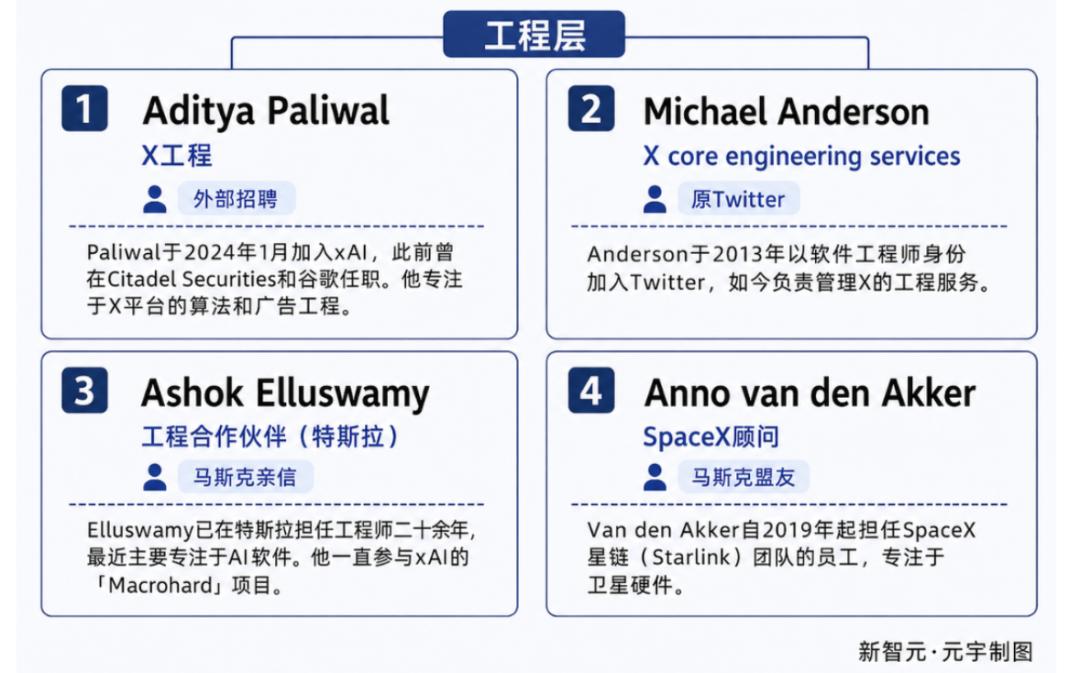
Michael Anderson, a core engineer who remained at Twitter, has been with the company since 2013. Aditya Paliwal of X Engineering is from Google and Citadel Securities.
Musk has inserted two key "outsiders" into this layer:
Ashok Elluswamy, from Tesla's AI software background, joined the xAI engineering cooperation team in March 2026 and participated in the Macrohard project; Anno van den Akker, an advisor to SpaceX, joined xAI in 2026 and has a background in Starlink satellite hardware.
One brings over the engineering ideas of Tesla's FSD, and the other brings over the methodology of Starlink's large - scale hardware deployment.
Musk's intention is obvious: xAI is no longer a "pure AI research company" but is going to become an engineer team in Musk's business empire that can directly take action and solve problems.
Musk's five core old - timers
Next, let's take a look at Musk's five core old - timers in this major personnel reshuffle one by one.
The first one is Gwynne Shotwell.
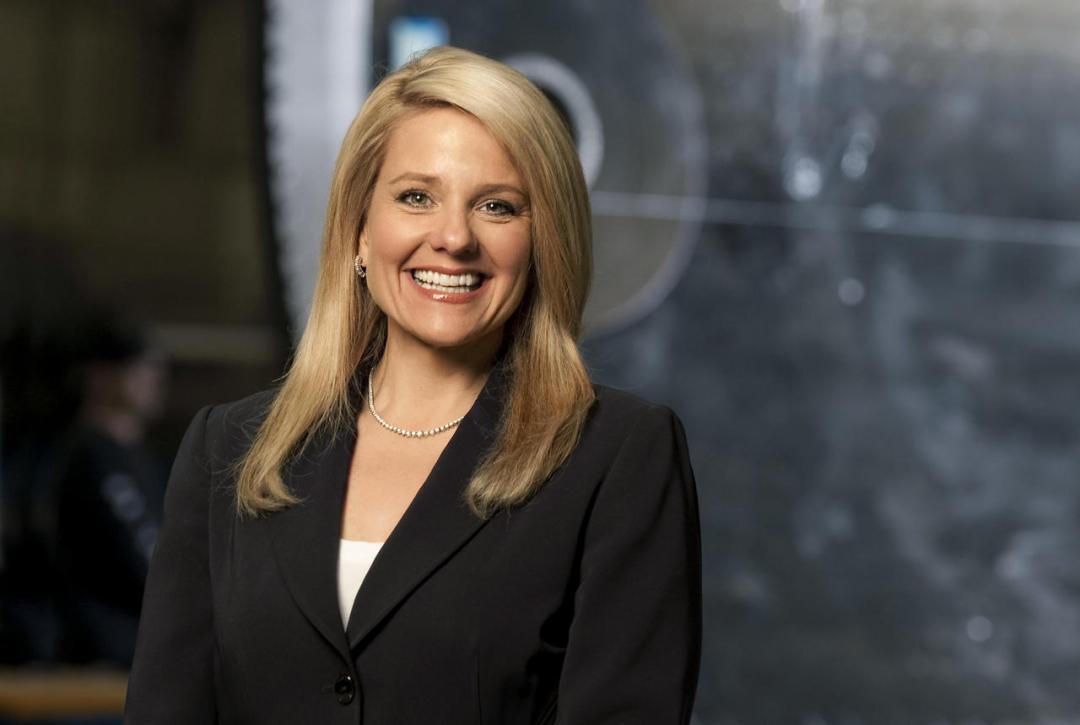
Gwynne Shotwell, President and COO of SpaceX, the second - in - command at SpaceX
The President of SpaceX and Musk's most trusted second - in - command, she has been supervising the operation of xAI since February 2026.
According to TIME magazine, she was the 7th employee at SpaceX and has been with the company for 24 years since 2002, with remarkable achievements. Over the past decade or so, SpaceX has gone from being on the verge of bankruptcy to winning contracts from the US military, NASA, and the private satellite market. Shotwell has been the most important driving force at the operational level.
The second one is Michael Nicolls.
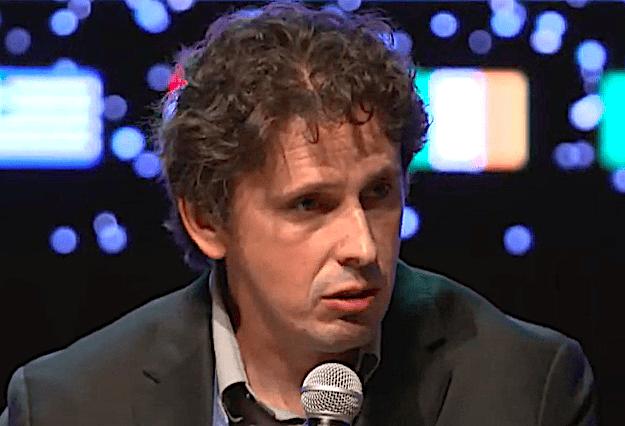
Michael Nicolls, a former Starlink executive, will take over as President of xAI in April 2026
He was an executive at Starlink for 5 years, mainly responsible for the operation and expansion of Starlink's global deployment.
Starlink's services cover more than 150 countries and markets. Musk's intention to transfer him to be the President of xAI is obvious: to replicate the implementation methodology of Starlink to xAI.
The third one is Bret Johnsen.
The CFO of SpaceX, he has also been supervising the finances of xAI since February 2026.
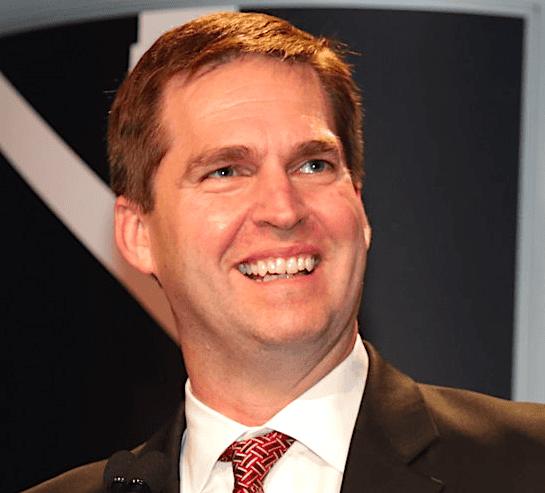
Bret Johnsen has served as the CFO of SpaceX since 2011. Since February 2026, he has also been in charge of xAI's finances
This arrangement is likely related to the background of SpaceX's IPO push: on the one hand, it helps the merged entity straighten out the financial statements before going public; on the other hand, it also shows that SpaceX is strengthening its control over xAI's financial operations.
The fourth one is Jared Birchall.
The head of Musk's family office.
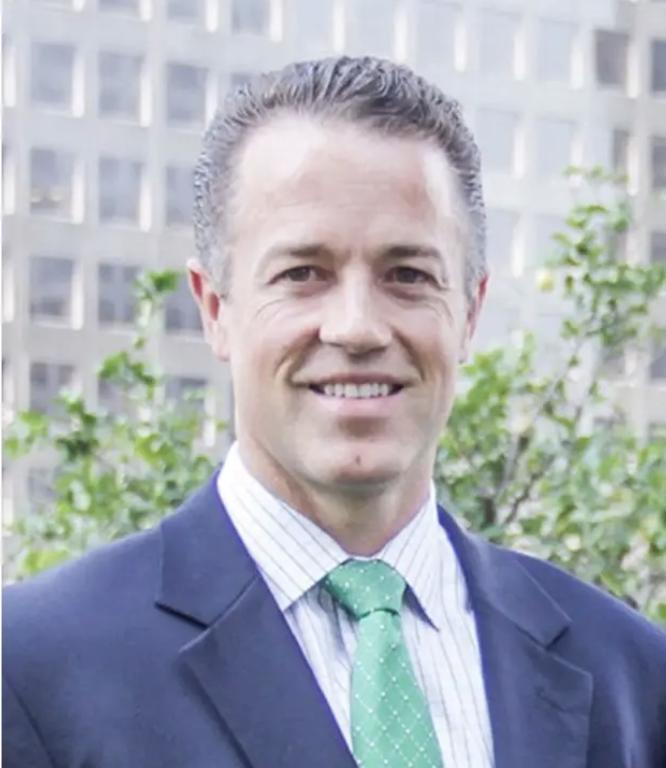
Jared Birchall
The family office manages Musk's personal wealth and family assets. A similar role usually does not appear in the organizational structure chart of an invested company, but Birchall joined xAI as the "company secretary" in 2023.
The fifth one is Ashok Elluswamy.
From Tesla's AI software background, he participates in the Macrohard project.
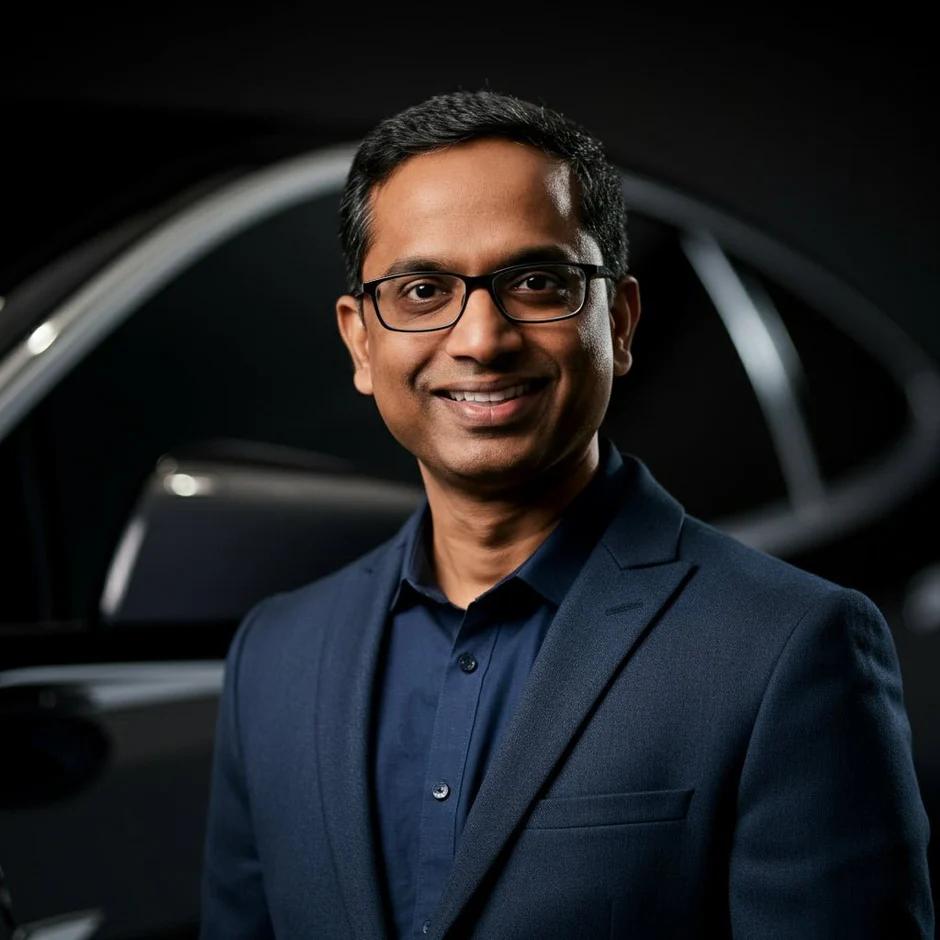
Ashok Elluswamy, one of the core engineers of Tesla's FSD. He joined the xAI Macrohard project as an engineering collaborator in March 2026
None of these five people have an academic background in AI.
AI companies usually recruit scientists from Google Brain, OpenAI, and Anthropic, and xAI has indeed done so.
But in this organizational chart, almost all those in key positions have engineering and operations backgrounds. Musk's important bet this time is on the engineering productization route, and the scientist route has been placed in a secondary position.
Where is xAI lagging behind?
In April 2026, according to an internal memo from Nicolls obtained by Business Insider, "xAI is significantly behind its competitors" and "is taking actions to catch up as soon as possible."
One way to catch up is to clearly divide xAI's engineering team into five lines: pre - training, tools, post - training, Grok Code, and video and image training.
These five lines are exactly the core capability matrices of OpenAI, Anthropic, and Google respectively. This means that xAI is re - allocating resources according to its competitors' capability maps.
Warnings on three fronts: cash, customers, and talent
Musk himself also stated on the X platform that xAI was not built correctly from the start and needs to be rebuilt from the basic structure.
Breaking down xAI's problems, there are warnings on three fronts simultaneously: cash, customers, and talent.
The first front is money.
xAI has been burning money. In January 2026, xAI completed a $20 billion Series E financing. The original target financing scale was $15 billion, but it ended up being $20 billion, a forced increase.
The investors include Valor Equity Partners, Stepstone, Fidelity, the Qatar Investment Authority (QIA), MGX, Baron Capital, as well as strategic investors NVIDIA and Cisco. According to CNBC, the valuation corresponding to this round of financing is about $230 billion.
But it may be burning even more money. xAI's computing power expenses mainly come from the Colossus supercomputer cluster: xAI officially announced that it had more than 1 million H100 - equivalent GPUs by the end of 2025.
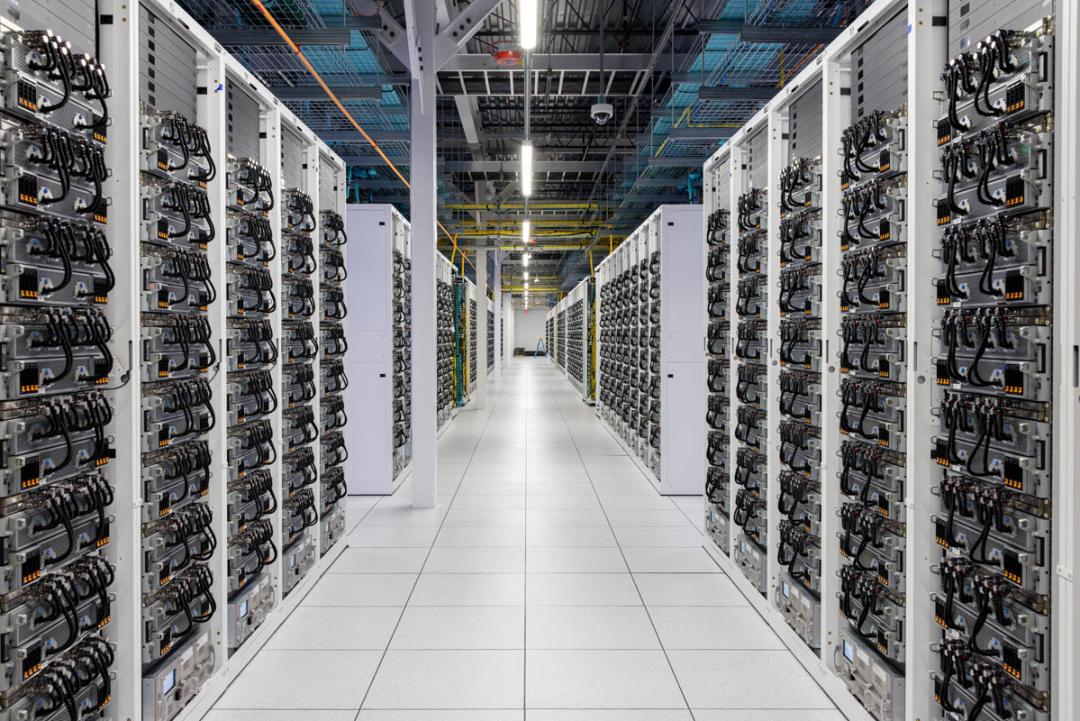
xAI's Colossus supercomputer cluster (Memphis): more than 1 million H100 - equivalent GPUs, one of the largest AI computing power clusters in the world
The superposition of electricity costs, GPU costs, and operation and maintenance costs is the real - world background for Bret Johnsen, the CFO of SpaceX, to supervise xAI's finances.
The second front is customers.
xAI has difficulties in expanding in the enterprise market. Grok has been repeatedly pitched to Wall Street investment banks for cooperation, but corporate sales have shown no improvement.
In recent weeks, xAI has come up with a new move: selling its computing power to competitors.
The third front is talent.
According to Bloomberg, since the beginning of 2026, dozens of xAI employees have left, including most of Musk's co - founders at xAI. Jon Shulkin of Valor Equity Partners has also stepped down from the CRO position and become an advisor.
With warnings on three fronts simultaneously, and xAI being the core piece of SpaceX's valuation narrative, this is why there has been a comprehensive leadership change in xAI's organizational chart.
Merging with SpaceX, a new story for the AI empire
The reorganization of xAI has never been an isolated event.
In February 2026, the merger of SpaceX and xAI was completed, and the valuation of the merged entity is $1.25 trillion. This merger means that SpaceX is no longer just a story about rockets and satellite internet.
According to reports from multiple media such as TechCrunch, CNBC, and SpaceNews, Musk stated in a SpaceX official memo:
The power and heat - dissipation requirements of AI computing power have pushed ground - based data centers to their limits. In the long run, the only way to achieve scale is in space.
Previously, Musk had publicly made a similar judgment at the Davos Forum in January 2026; three days before the merger, SpaceX also submitted an application to the FCC to launch up to 1 million orbital data - center satellites.
