Dividends of 338 million yuan in two years. A couple majoring in English built a leading fiber optic connector company and is leading Aide Technology to sprint for an IPO.
Recently, there has been a popular saying in the investment circle - "stand in the light." It means that with the rapid development of AI computing power infrastructure, the optical communication field is becoming a new high - ground pursued by capital.
Actually, besides CPO (Co - Packaged Optics), there is a more hidden and fundamental track in optical communication - fiber optic connectors. Companies engaged in this business neither directly produce optical engines nor silicon photonic chips. They are only responsible for establishing physical channels between devices, yet they are the unavoidable "gatekeepers" on every optical communication path.
Shenzhen Aide Tai Technology Co., Ltd. (hereinafter referred to as "Aide Tai") is the double champion on this track: it ranks first with a 9.7% global market share in the fiber optic connector market and also leads with a 12.6% market share in the high - density segment.
However, beneath the spotlight, there are still hidden risks: Aide Tai faces three challenges of single - product dependence, customer concentration, and market imbalance; it spent 338 million yuan on dividends before the IPO, which forms a sharp contrast with the plan to raise funds through the IPO to supplement operating capital.
In addition, whether the company can keep up with the transformation in a timely manner under the wave of CPO technology change is also one of the challenges it faces.
With these challenges, Aide Tai is heading to the Hong Kong Stock Exchange, but whether it can be successfully listed remains unknown.
The "Double Champion" in the AI Era, with Cumulative Revenue Growth of Over 3 Times in 2 Years
Aide Tai was jointly founded in 2007 by Bai Chang'an and Zhu Meihua, a couple, in Nanshan, Shenzhen. They both graduated in 2000, with Bai Chang'an majoring in English for Economics and Trade from Henan University of Technology and Zhu Meihua majoring in English for International Trade from Hefei University of Technology.
Before starting their business, they had no professional background in cutting - edge technologies such as optical engineering or chip research and development, but only rich experience in international trade. Nevertheless, relying on their mature foreign - trade operation capabilities and a keen vision of overseas market channels, they successfully entered the high - end and cutting - edge technology track of fiber optic connectors.
Since its establishment, Aide Tai has never introduced any external institutional capital, which is quite rare in the high - investment and high - iteration hard - technology industry. This also results in a highly concentrated equity structure, with the Bai Chang'an and Zhu Meihua couple holding a combined stake of up to 99.09%.
Currently, Aide Tai's main products include three categories: fiber optic connectors, optical connection infrastructure, and micro - optical connectors. Among them, the core products include MTP/MPO fiber optic connectors, VSFF fiber optic connectors, and high - density fiber optic distribution systems, which support 800G and 1.6T high - speed transmission scenarios and have been widely used in cloud service providers, global technology giants, and telecommunications operators.
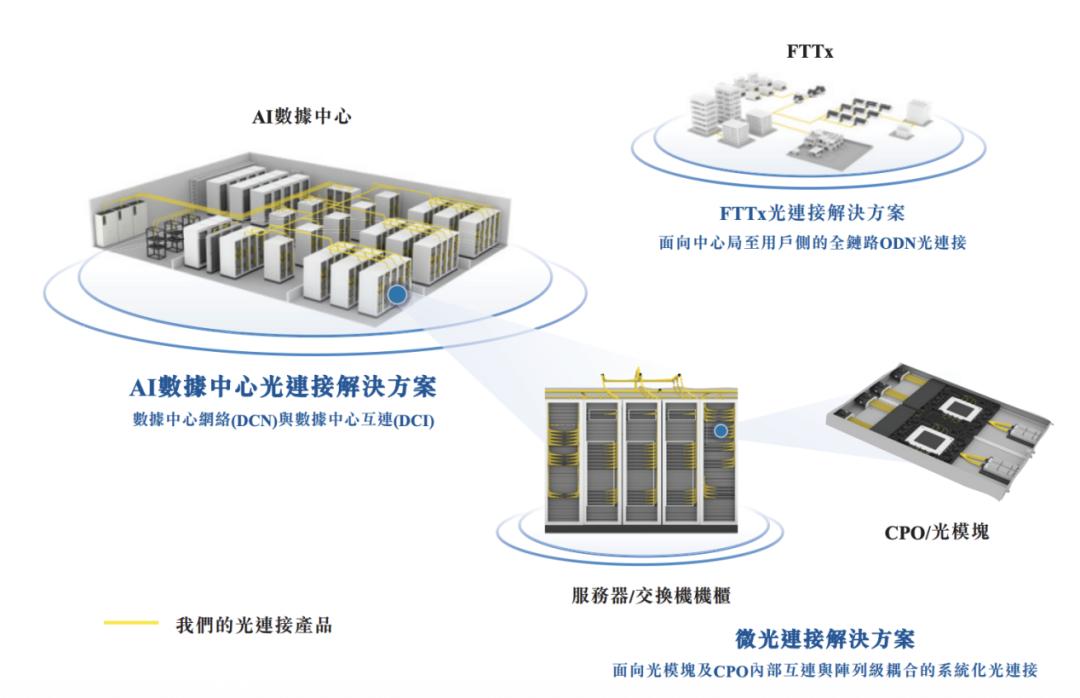
Image / Prospectus
After nearly 19 years of in - depth development, Aide Tai has grown into an invisible leading enterprise in the global optical connection field. According to Frost & Sullivan data, in terms of global fiber optic connector revenue in 2025, Aide Tai ranked first with a 9.7% market share; in the high - density fiber optic connector segment, its market share reached 12.6%, also ranking first globally.
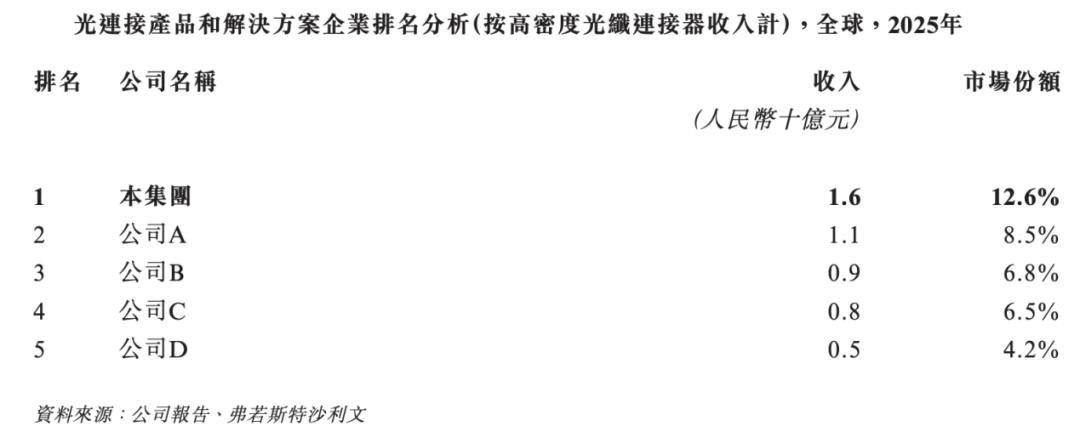
Image / Prospectus
Currently, the global demand for AI computing power is exploding, the high - density interconnection architecture of data centers is continuously upgrading, and the demand for high - bandwidth and low - latency data transmission in large - model training and inference clusters is continuously rising. This is driving the internal wiring system of data centers to evolve towards high - speed and high - density directions at an accelerated pace, and the optical connection track has entered a golden development period.
According to Frost & Sullivan data, the average annual compound growth rate of the global fiber optic connector market from 2021 to 2025 reached 31.6%, and the global end - user spending scale reached 3.42 billion yuan in 2025.
However, this "fiber optic connector" is a broad concept, which includes both high - density connectors such as MTP/MPO used in traditional pluggable modules and new - type connectors such as fiber array units (FAU) and micro - optical interconnection components required for the CPO architecture.
Riding on the industry's wave, Aide Tai has achieved explosive growth in performance. From 2023 to 2025, the company's operating revenue reached 500 million yuan, 889 million yuan, and 2.105 billion yuan, with a cumulative growth of 3.2 times and a compound annual growth rate of up to 105.1%.
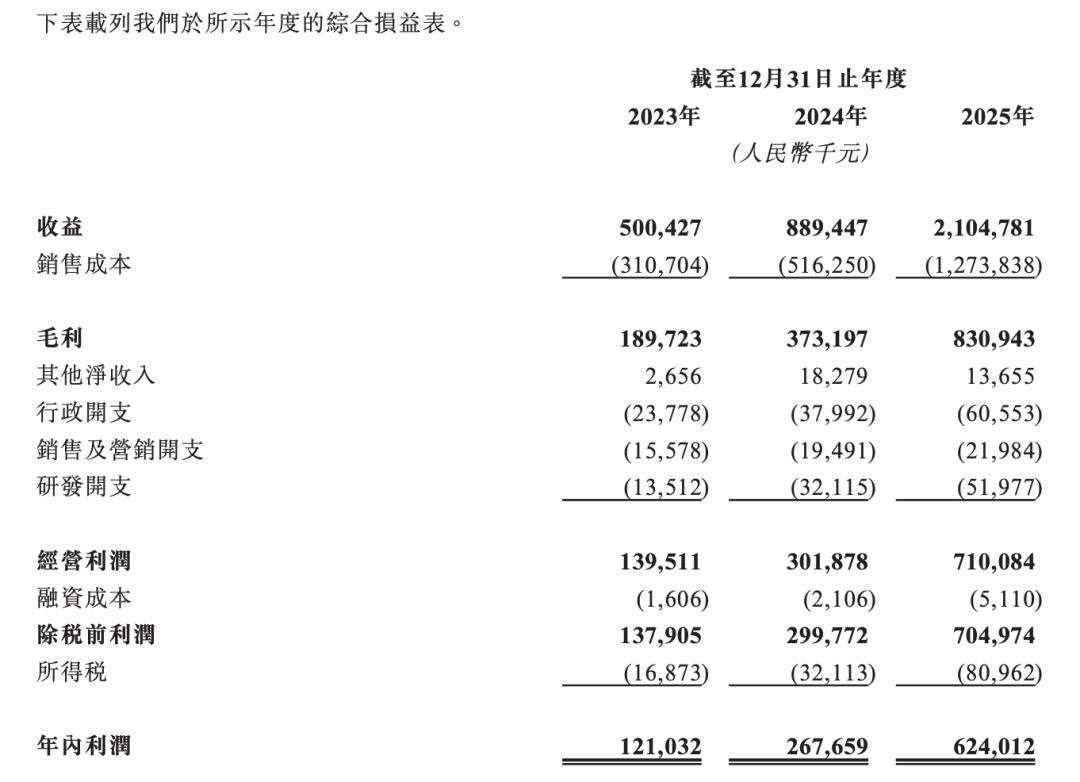
Image / Prospectus
During the same period, the company's profitability also increased significantly. From 2023 to 2025, the net profit was 121 million yuan, 268 million yuan, and 624 million yuan respectively, with a net profit growth of 4.2 times in three years and a compound annual growth rate of 127.1%. The gross profit margin for three years remained in the range of 37.9% to 42%, and the net profit margin was stable above 24%.
Aide Tai is in a high - quality and golden track. Coupled with its leading position and customer resource advantages, it has truly benefited from the development of the AI computing power industry.
However, it is worth noting that as CPO technology gradually moves towards large - scale commercialization, new - type fiber optic connectors will become the main growth force. Frost & Sullivan predicts that from 2025 to 2030, the average annual compound growth rate of the fiber optic connector market in the data communication field will increase to 60.3%, and the global market scale will exceed 298.6 billion yuan in 2030. Among them, the sub - market of CPO - related fiber optic connectors is expected to reach 80.4 billion yuan.
The growth space of traditional high - density fiber optic connectors is relatively limited, and they may even face pressure due to technological substitution - this is the deep - seated challenge that Aide Tai faces.
Hidden Concerns Behind High Growth: Trapped in the Predicament of Triple Dependence
Judging from the financial data, Aide Tai has indeed presented a beautiful "report card." However, the risks and hidden dangers the company faces have also attracted wide attention beneath its excellent performance.
Currently, the triple development dependence predicament that Aide Tai faces is quietly eroding the development foundation of this industry leader.
First, there is the risk of dependence on a single product.
Although Aide Tai's revenue is composed of three parts: fiber optic connectors, optical connection infrastructure products, and micro - optical connectors, in terms of composition, during the reporting period, the revenue contributed by fiber optic connectors accounted for 85%, 87.1%, and 93.7% of the total revenue respectively. Not only is the proportion high, but it is also continuously increasing.
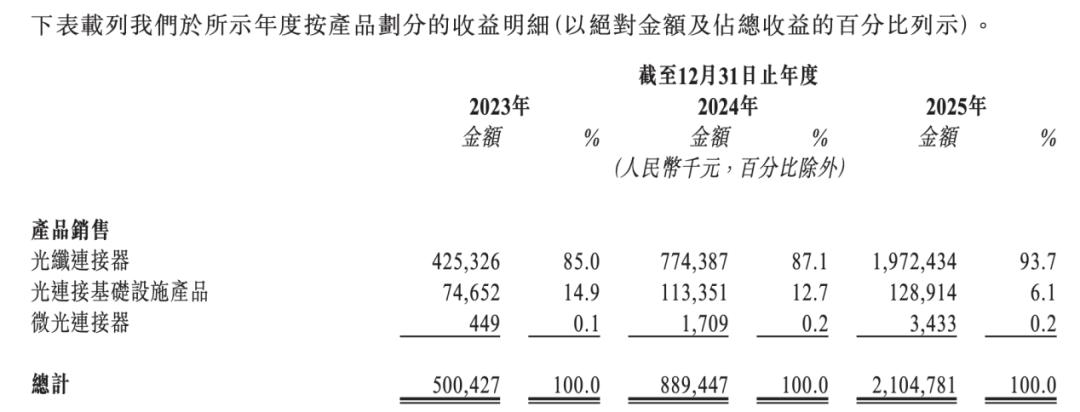
Image / Prospectus
This means that the company's fate is almost firmly tied to the fiber optic connector market. Once there is a revolutionary change in optical communication connection technology in the future, or the company is besieged by competitors in a "price war," Aide Tai will face the risk of performance decline.
Second, there is the risk of high dependence on major customers.
During the reporting period, the revenue contributed by Aide Tai's top five customers accounted for 81.3%, 87.6%, and 90.6% respectively. Among them, the revenue from the largest customer increased from 44.7% in 2023 to 63.2% in 2025. That is to say, in 2025, just one customer locked in more than 60% of Aide Tai's revenue.
Aide Tai admitted in its prospectus that this kind of dependence limits the company's bargaining power in product pricing. Once the core customers adjust their supply chains, reduce their procurement shares, or purchase at lower prices, Aide Tai's performance will face significant fluctuations or decline risks.
Third, there is the risk of dependence on a single market.
During the reporting period, the proportion of Aide Tai's revenue from the US market was 82.7%, 85.2%, and 86.2% respectively, while the proportion of revenue from the Chinese mainland gradually shrank from 6.9% in 2023 to 3.1% in 2025.
This means that Aide Tai's business almost entirely relies on the US market. Once there are fluctuations in Sino - US trade relations, changes in tariff policies, or the US strengthens export controls on AI - related technologies, Aide Tai will bear the brunt.
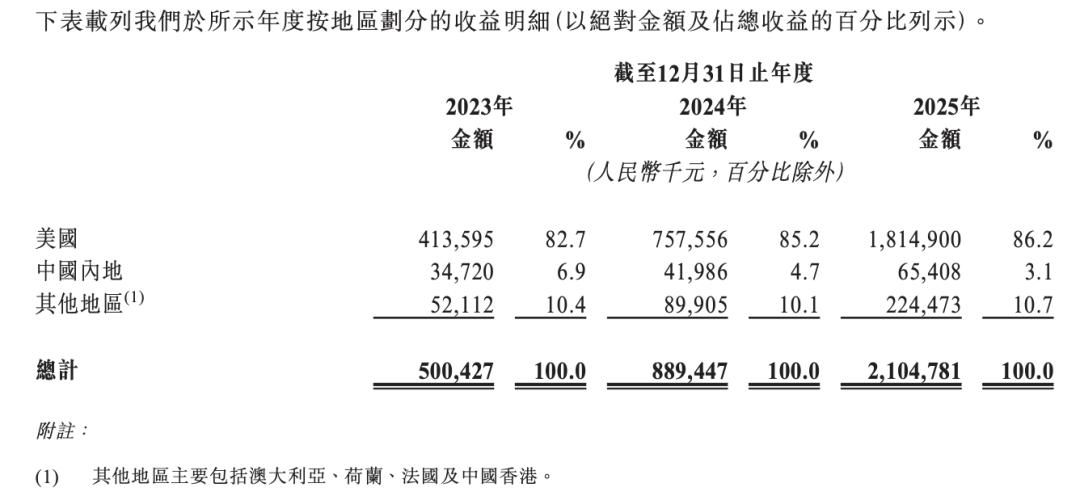
Image / Prospectus
Although Aide Tai stated in its prospectus that it will continue to expand its business layout in multiple jurisdictions in the future, judging from the trend of revenue data by region, the company's tilt towards the US market has increased rather than decreased.
Aide Tai admitted that cross - border operations will expose enterprises to a series of legal, regulatory, political, and compliance risks arising from different countries and regions.
International trade policies also bring many uncertainties. Changes in tariffs, taxes, export controls, and economic sanctions may not only affect the enterprise's ability to transport cross - border products but also change the cost structure of the entire supply chain.
The combination of triple dependence actually shows the fragility of operations: highly concentrated products, highly concentrated customers, and highly concentrated markets. Any problem in one link may trigger a chain reaction.
In this kind of operation that is overly dependent on customers and a single market, Aide Tai's trade receivables have increased rapidly. As of the end of each reporting period, the company's trade and other receivables increased from 161 million yuan in 2023 to 555 million yuan in 2025.
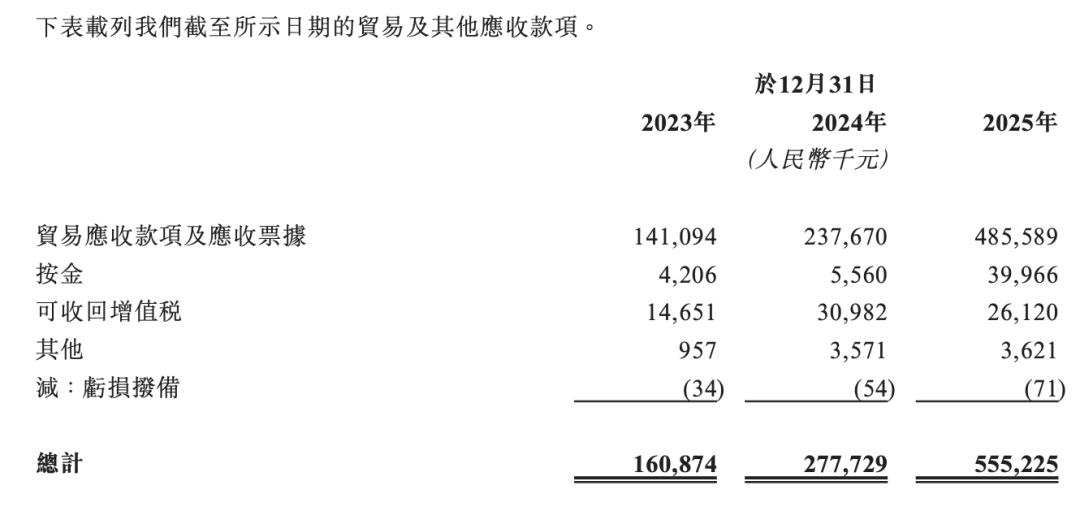
Image / Prospectus
In 2025, the scale of the company's accounts receivable and other receivables was nearly 90% of the net profit. This means that once the core customers delay payments or their credit conditions deteriorate, it will not only directly impact the company's cash flow but also may trigger the risk of bad - debt provision, thereby eroding profits.
Where Did the Money Go, and Where Is the Road Ahead?
What attracts more external attention than the performance structure is the company's capital flow.
In 2023 and 2025, Aide Tai declared dividends of 38 million yuan and 300 million yuan respectively, with a total of 338 million yuan in two years (no dividends were declared in 2024).
In 2025, Aide Tai's net profit was 624 million yuan, and the dividends that year accounted for about 48.1% of the net profit. During the same period, the company's year - end cash and cash equivalents decreased to 47.494 million yuan, a decrease of 61.67% compared with 124 million yuan in 2024, which is also related to its high - proportion dividends.
Calculated based on the 99.09% controlling stake of the real - controller couple, more than 300 million yuan of these dividends flowed into the "pockets" of Bai Chang'an and Zhu Meihua and the companies they control.
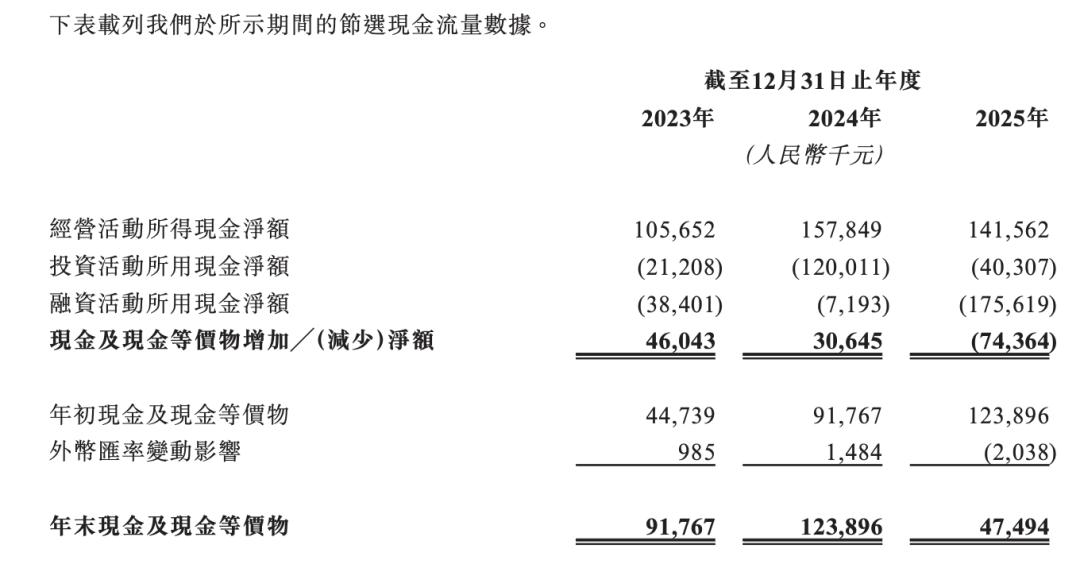
Image / Prospectus
In this IPO, Aide Tai's disclosed fund - raising plan shows that the raised funds will be mainly used in three major directions: expanding production capacity to increase the production of fiber optic connectors and micro - optical connectors; upgrading the R & D center; and for strategic investment, acquisitions, and supplementing working capital.
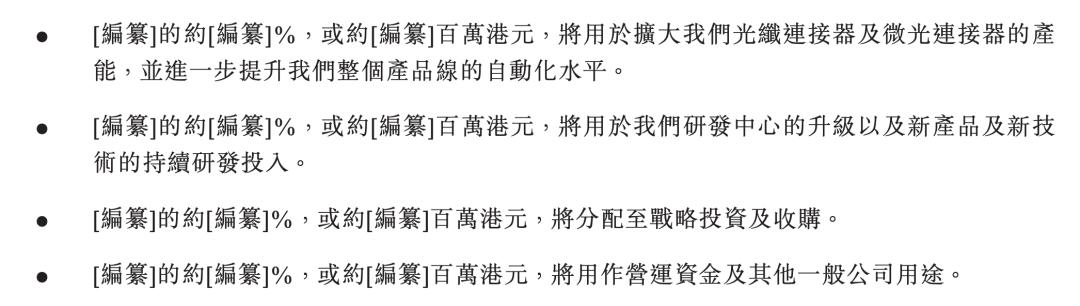
Image / Prospectus
On the one hand, the company made huge dividends just before the IPO; on the other hand, it plans to raise funds through the IPO for expansion. This contrast has also raised questions about the company's capital planning ability and the necessity of financing.
In addition, in the deep - seated game of technological routes, Aide Tai's situation is quite delicate.
In May 2026, NVIDIA announced a deep strategic cooperation with Corning, investing up to $3.2 billion to subscribe for equity, betting on CPO technology to replace traditional copper cables with optical fibers, and planning to increase Corning's optical connection production capacity by 10 times.
CPO is generally regarded as one of the important evolution directions of the next - generation data center optical interconnection. NVIDIA expects that the key volume - growth period of the CPO architecture will come from the second half of 2027 to 2028.
However, Aide Tai's revenue in the CPO - related