Jiangxing Intelligence: From Perceiving the Environment to Changing the World: Opportunities, Paths, and Practices of Physical AI | 2026 AI Partner · Beijing Yizhuang AI + Industry Conference
The real advantage of China's industrial physical AI lies not in model parameters, but in 12 times the global density of industrial robot deployments, twice the power generation, and dense 5G edge nodes. The combined force of scenario density, infrastructure foundation, and open - source models is driving physical AI from the laboratory to large - scale implementation.
Jiangxing Intelligence has proposed a three - layer model for industrial physical AI. This system has been implemented in new energy power stations and power grid inspection scenarios, covering multiple regions such as Guizhou and Inner Mongolia. The accuracy of the core algorithm reaches 99%.
Chen Long specifically pointed out that a seemingly simple inspection task in an industrial scenario usually needs to be broken down into 100 to 200 subtasks, which places far higher requirements on the stability and reliability of AI than consumer - grade applications.
The following is the content of the speech, compiled and edited by 36Kr:
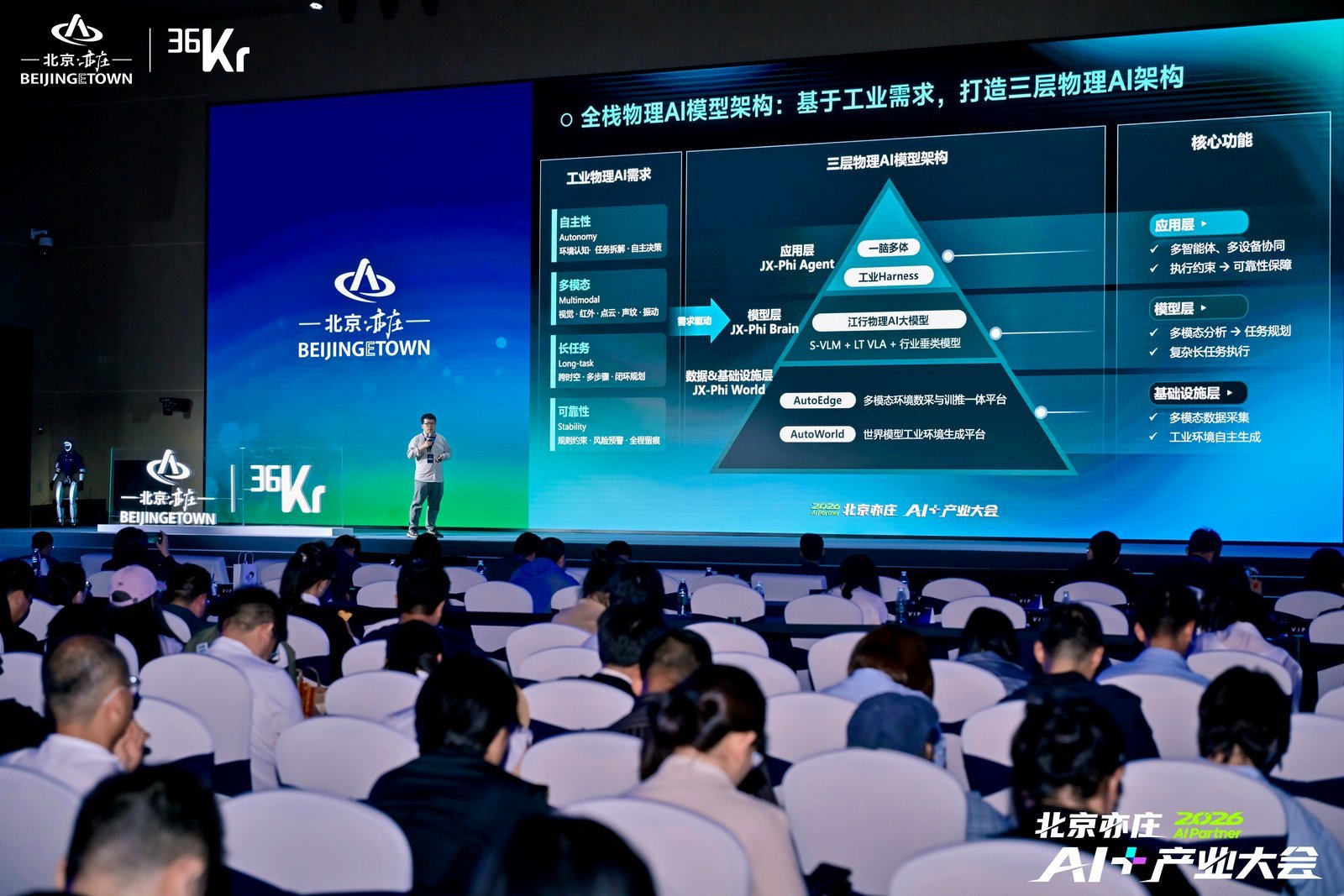
Chen Long | CTO of Embodied Foundation Model at Jiangxing Intelligence
Good afternoon, dear guests and industry partners. I'm Chen Long, the CTO of the embodied foundation model from Jiangxing Intelligence. The topic of my presentation is "From Perceiving the Environment to Changing the World: Opportunities, Paths, and Challenges of Physical AI".
The competition in AI has shifted from the competition of model parameters in the digital world to the competition of system capabilities in the real physical world. With its unique five - layer industrial foundation, China is becoming the best ground for the implementation of global industrial physical AI. By building a full - stack industrial physical AI model architecture, Jiangxing Intelligence has achieved large - scale deployment in core fields such as new energy and power grids, proving the feasibility of physical AI moving from concept to reality.
The AI competition is shifting from model competition to physical system competition
In the past few years, generative AI has fully demonstrated its value in the digital world, being able to complete tasks such as content generation, code writing, and intelligent Q&A. However, for industrial enterprises, the real value frontline is not on the screen, but in real physical spaces such as wind farms, photovoltaic power stations, substations, mines, chemical industrial parks, and production workshops.
AI is undergoing a crucial evolution from "generating answers" to "executing tasks". When AI enters the industrial field, the core of the competition is no longer the scale of model parameters or the accuracy of single - point algorithms, but whether artificial intelligence can be stably, controllably, and cost - effectively deployed in the real physical world. Tasks in the industrial field are never as simple as "looking at a picture to judge if there is an anomaly". It requires completing the entire process of data collection, environmental understanding, device access, task planning, execution feedback, and closed - loop iteration. This means that physical AI is not an isolated model, but a complete intelligent system that can run continuously on - site.
The five - layer foundation and three structural opportunities of China's industrial physical AI
Why does industrial physical AI have the best implementation conditions in China? China has formed a five - layer systematic foundation that is difficult to replicate in other countries.
The first layer is the application layer. China has the highest - density industrial scenarios in the world. The installation volume of industrial robots is about 8.6 times that of the United States and has increased by about 12 times in the past decade. The denser the real scenarios, the easier it is to form a closed - loop of "data - model - embodied intelligent robot".
The second layer is the model layer. Domestic open - source models represented by DeepSeek, Tongyi Qianwen (Qwen), and Kimi are catching up rapidly, with their performance quickly approaching the industry's best level and having completed extensive vertical deployments across the industry, getting closer and closer to the actual needs of the industry.
The third layer is the infrastructure layer. China has more than 4.48 million 5G base stations, accounting for more than 60% of the world's total. At the same time, the newly added power generation capacity far exceeds that of the United States. This gives us stronger network and infrastructure capabilities at the edge and end sides, better supporting the on - site access and real - time interaction of physical AI devices.
The fourth layer is the chip layer. Undoubtedly, there is still a gap between us and the United States in the field of high - end training chips. However, this challenge has also forced the industry to take a more efficient technological route, prompting enterprises to maximize the performance potential of existing hardware through better model structures, edge - end collaboration, and joint optimization of software and hardware.
The fifth layer is the energy layer. Currently, China's power generation is about twice that of the United States, and the installed capacity of generators is three times that of the United States. Sufficient and stable energy supply provides long - term underlying support for AI to move from cloud - based training to large - scale on - site deployment.
The superposition of these five layers of foundation makes China's industrial physical AI not only have technological imagination but also a real implementation ground. On this basis, we have summarized three types of core structural opportunities for China's industrial physical AI.
The first type is the supply - side foundation opportunity. The continuous improvement of energy, networks, infrastructure, and edge nodes provides long - term and reliable support for AI to enter the industrial field.
The second type is the on - site closed - loop opportunity. High - density industrial scenarios, large - scale robot deployments, and multi - modal sensing devices enable physical AI to form a complete data flywheel of "deployment - collection - training - iteration - redeployment", which is an advantage that other countries cannot match.
The third type is the efficiency - side route opportunity. The constraints of high - end chips will drive the industry towards more efficient models, stronger edge intelligence, and deeper software - hardware collaboration, making industrial physical AI pay more attention to low cost, controllability, and deployability.
Jiangxing Intelligence positions itself to organize these combined advantages into an industrial physical AI system that is deployable, replicable, and sustainably iterable.
Jiangxing Intelligence's full - stack industrial physical AI model architecture
Problems in the industrial field cannot be solved by a single model. It requires the coordinated work of data infrastructure, physical world modeling, industry large models, application frameworks, device control, and security mechanisms. Based on this understanding, Jiangxing Intelligence has built a three - layer full - stack physical AI model architecture for industrial scenarios, designed around the core requirements of industrial physical AI for autonomy, multi - modality, long - term tasks, and reliability.
Data and infrastructure layer: JX - Phi World with dual - wheel drive
As the foundation of the entire architecture, JX - Phi World adopts a core design of dual - wheel drive with AutoEdge and AutoWorld to solve the problems of faster model training, more stable implementation, and lower costs.
AutoEdge is responsible for the full - process processing of real industrial data, including multi - modal environmental data collection, cloud - based training, edge - end inference, model deployment, and OTA upgrades. It can continuously collect task, device, working condition, and feedback data from the real site, and significantly reduce network transmission pressure and model end - to - end latency through edge - side inference. The underlying data covers all - dimensional information of the industrial field, such as sensors, thermal imaging, drone inspections, and low - orbit satellite remote sensing.
AutoWorld is a world model simulation and data engine. One of the pain points of industrial AI is that many key anomalies do not occur frequently, but once they occur, they must be accurately identified and reliably handled. Real industrial data usually only covers 90% - 95% of normal scenarios, and there is a data gap for 5% of potential risks and extreme working conditions such as extreme weather and emergencies. AutoWorld uses generative AI and 3D reconstruction technology to simulate and generate various rare scenarios and complex task processes, supporting Sim - to - Real migration, allowing AI to make all the mistakes in the simulation environment before being deployed to the real site.
Model layer: JX - Phi Brain evolving towards the World Action Model (WAM) in industrial scenarios
JX - Phi Brain is the core brain of the entire architecture and is evolving towards the World Action Model (WAM) in industrial scenarios, integrating three types of core capabilities.
The first type is the Spatial Vision - Language Model (S - VLM), which solves the problem of "perception + understanding". The industrial field is not a flat map but a dynamic environment that includes equipment, personnel, spatial relationships, operating states, and industry rules. S - VLM can not only perceive the physical environment of industrial plants but also understand various sensor readings and environmental parameters, realizing cross - modal reasoning and industrial scenario modeling.
The second type is the Long - Task Vision - Language - Action Model (LT - VLA), which solves the problem of "perception + execution". Industrial tasks are often not completed in one step but require the collaboration of multiple tasks, multiple devices, and multiple processes. LT - VLA can perceive on - site environmental constraints and task requirements, break down complex industrial tasks into a series of executable subtasks, and achieve self - guided task optimization and dynamic adjustment.
The third type is the industry - specific model, which integrates the professional knowledge of industries such as power, chemical, and mining into the model, enabling the model to understand real tasks under strong rules, strong constraints, and strong safety requirements. Currently, Jiangxing has supported the regular data collection of more than 1000 stations and points in industries such as power, chemical, and mining, continuously building a closed - loop of "model + data".
Application layer: JX - Phi Agent realizes value through industrial Harness and one - brain - multiple - bodies
The model itself does not automatically create industrial value. Value is created after the model is encapsulated into an on - site system that is deployable, callable, and supervisable. The core of the JX - Phi Agent application layer is two technologies: industrial Harness and one - brain - multiple - bodies control.
Industrial Harness is responsible for organizing task decomposition, safety specifications, tool calls, rule constraints, anomaly responses, and full - process record - keeping. It ensures that the model operates strictly within the industrial process and safety boundaries rather than freely, and can integrate industry knowledge bases and downstream dedicated models, automatically review the model output results, and support expert manual review intervention.
One - brain - multiple - bodies is a collaborative control engine for complex on - site scenarios. The core is a global pre - controller with a parameter count of 100B, responsible for global task scheduling and management across work areas. A station - end brain can connect to various terminals such as drones, robotic dogs, wheeled robots, fixed cameras, sensors, and robotic arms, realizing task allocation, status synchronization, conflict resolution, and collaborative execution. Currently, this architecture has been successfully deployed in complex scenarios such as the mountainous power grid in Guizhou and the desert photovoltaic in Inner Mongolia, achieving large - scale application of embodied terminals on the customer side.
Four key technologies support the implementation of industrial physical AI
To support the efficient operation of the full - stack architecture, Jiangxing Intelligence has achieved key breakthroughs in four core technology fields.
The first key technology is a dynamically updatable industrial scenario foundation. The real industrial field is dynamically changing, and a three - dimensional model built once will soon become out of touch with the real site. Jiangxing has solved the problem of stable reconstruction in dynamic scenarios through TrackerSplat technology, which can clearly capture key sensor data such as dashboards during the movement of robots and effectively filter environmental noise such as raindrops and electromagnetic interference. At the same time, it has solved the problem of three - dimensional content compression and transmission in a weak - network environment through SizeGS technology, ensuring that detection results and intermediate decisions can be stably transmitted back to the cloud brain.
The second key technology is world model and physical deduction. The cost of real - world trial - and - error in the industrial field is extremely high, especially in scenarios such as power, energy, and chemical industries. Some mistakes must never occur in the real site. Jiangxing organizes "real, simulation, real" into a closed - loop training through the world model, allowing robot strategies to be tested, evaluated, and iterated in the simulation before being migrated to the real site, significantly reducing the implementation risk and cost.
The third key technology is multi - modal perception and root - cause analysis. Jiangxing integrates infrared thermal imaging, visible light, three - dimensional spatial information, device status data, and data from drones and low - orbit satellite remote sensing, enabling the model not only to see anomalies but also to understand where the anomalies occur, why they are important, what the risk level is, and how to handle them next. This realizes the leap from "defect identification" to "defect understanding", providing customers with truly executable operation and maintenance decisions.
The fourth key technology is the VLA execution closed - loop and one - brain - multiple - bodies collaboration. Jiangxing uses DyGRO - VLA technology and the one - brain - multiple - bodies system to enable the global brain to complete semantic understanding, task decomposition, target allocation, path planning, and conflict resolution, and then the embodied terminals to complete navigation, obstacle avoidance, reading, review, operation, and status feedback. Different from the short - term tasks of consumer - grade embodied intelligence, a simple task of a robotic dog checking device readings in an industrial scenario usually needs to be broken down into 100 to 200 subtasks, and environmental factors such as terrain and climate also need to be comprehensively considered.
Two benchmark cases verify the large - scale value of physical AI
Jiangxing Intelligence's full - stack industrial physical AI technology has achieved large - scale implementation in multiple core industrial fields. Among them, new energy wind and photovoltaic power stations and power grid substations are two of the most representative scenarios.
In the new energy field, Jiangxing has built a physical AI operation and maintenance system for wind and photovoltaic power stations, achieving full - area coverage of multiple regions such as step - up stations, photovoltaic panel areas, wind turbine areas, and perimeter roads, and supporting 24/7 all - weather inspections. The system has been verified in more than 600 station - group - level scenarios across the country and can be quickly replicated across regions, station types, and owners. Traditional manual inspection of a large - scale power station may take more than 30 days, while the physical AI system can complete a full - station inspection in only 2 days, completely reconstructing the efficiency of new energy operation and maintenance.
In the power grid field, Jiangxing's substation physical AI intelligent inspection system has built a collaborative system of a central brain, an embodied brain, and controllable terminals, realizing air - ground three - dimensional inspections and multi - terminal collaborative execution. The system covers more than 10,000 high - density intelligent inspection points in the station, can complete a single full - station inspection within 4 hours, with the accuracy of the core algorithm reaching 99% and the average accuracy reaching 96%. Currently, the system has covered 27 provinces across the country and completed more than 500 scenario implementations in the State Grid and China Southern Power Grid systems.
It is particularly worth mentioning that the robotic dog equipped with a robotic arm developed by Jiangxing can independently complete complex tasks such as opening meter boxes, reading device readings, and simple voltage regulation operations, and is especially suitable for scenarios where it is difficult for personnel to reach, such as narrow spaces and high - risk areas. The device uses an edge - cloud collaborative architecture, deploys an 8B - parameter edge - side inference model on the robotic dog locally, and combines the computing resources of the edge and the cloud to achieve high - precision and low - latency operation capabilities.
As a firm practitioner of industrial physical AI, Jiangxing Intelligence firmly believes that physical AI has moved from concept to reality. In the next stage, the most important industrial value of AI will not only occur on the screen but in real spaces, real devices, real tasks, and real productivity.
Jiangxing Intelligence hopes to work with more industry partners to let physical AI enter the real industrial field, start from perceiving the environment, and truly change the industrial world with intelligence.
Thank you!