Alibaba and Google, agents march in step.
When you open the official website of Alibaba Cloud's brand - new AI products, the first thing you'll see is a line of installation skill instructions. This is an instruction readable by Agents. After invoking it, your AI agent can instantly leverage the native invocation capabilities of Tongyi Qianwen's large - scale model.
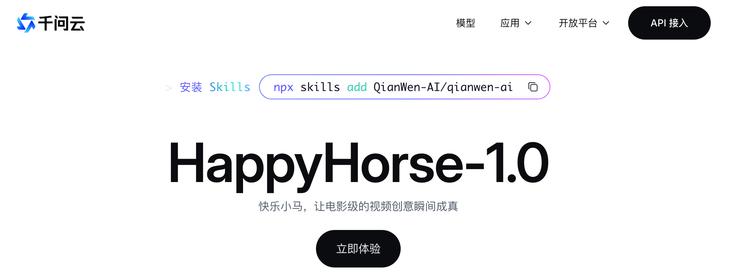
This is the first time in 17 years that Alibaba Cloud has established an independent product website outside its main official website. However, it didn't follow the convention of internet products to create a showcase website for users. Its first screen is specifically designed for Agents. The logic is: when your users are AIs, you don't need a banner; instead, you need an executable instruction.
The underlying logic is easy to understand. In the Agent era, the service targets are not only humans but also Agents that make autonomous decisions and operate. Alibaba Cloud has clearly carried out Skill componentization, MCP standardization, and CLI instruction - based transformation on its cloud products, turning each cloud product into a standardized capability module that agents can directly activate, similar to calling a program function.
Meanwhile, Agent - based transformation is also taking place across the ocean. Google also announced full - stack technology and product updates from chips, models to applications at its I/O Conference. The two major AI full - stack enterprises in China and the United States are once again making similar layouts on the same track.
Especially at the application layer, Google's latest Antigravity 2.0 platform is the core environment for developing and managing autonomous AI Agent clusters. It can independently write a complete operating system within 12 hours, focusing on core agent conversations, artifacts generated by agents, and multi - agent orchestration. "We are making Antigravity the only platform you need for Agent - first development."
With Agent - first and agents taking over everything, similar development trends are emerging at Alibaba Cloud and Google simultaneously.
This summer, Google started to introduce a smart shopping cart, which enables users to shop while browsing web pages or chatting with Gemini. It can automatically find discounts and price - cut information. Relying on underlying architectures such as the Universal Commerce Protocol (UCP) and collaborating with giants like Amazon, Meta, and Microsoft, this cross - platform shopping experience is bound to make shopping carts in the Agent era smarter.
Facing Google's complete shopping loop in the Agent era, how should Alibaba respond and establish industry basic rules in the field of agent - based shopping?
Alibaba Cloud Becomes More Open
Previously, the article "Google Cloud Teaches Alibaba Cloud a Lesson in Winning the Competition" mentioned that while it's important for cloud providers to win the competition, it's even more crucial to make the competition happen within their own ecosystems. Model freedom is one of Google Cloud's significant advantages, and this is also an important lesson Google has taught Alibaba Cloud.
Now, Alibaba Cloud is also learning from Google's strengths and striving to become the "most open cloud in the AI era." As an enterprise - level large - scale model application development platform, Alibaba Cloud Bailian has started to open up access to third - party models.
In addition to Alibaba's self - developed Qianwen model matrix, the Bailian platform will also integrate third - party models such as Zhipu GLM - 5.1, MiniMax M2.7, Darkside Kimi K2.6, Keling, and Vidu Q3.
On the official website of Qianwen Cloud, over 150 model series and more than 480 various models are available, covering mainstream models at home and abroad. It supports simultaneous comparison of multiple models, allowing developers to quickly complete experience, evaluation, and selection according to their needs.
Meanwhile, Qianwen Cloud encapsulates the core capabilities of model services into Skills and CLI tools. This means that Agent tools like OpenClaw can learn all the capabilities of the entire platform with just one instruction and plan autonomously. For example, it can use the vision model for image tasks, the image - generation model for image - generation tasks, and the video model for video tasks, all without manual intervention or writing integration code.
For customers of cloud providers, how to transparently consume Token resources is a very practical problem.
Qianwen Cloud's solution is an intelligent and transparent management mechanism. Agent A can retrieve real - time model usage data, analyze data trends, detect abnormal usage, and optimize costs. It can also pull data such as logs and Key activities through CLI to identify anomalies and trace tasks.
This is also a common trend for Alibaba Cloud and Google Cloud. They are no longer just selling models but aiming to transform into AI factories that provide computing power and mobilize infrastructure.
Google's advantage lies in its global developer density, while Alibaba's strength is its in - depth local ecosystem.
At this I/O Conference, Google announced that the number of tokens processed per minute through its API has reached 19 billion, and 8.5 million developers are using Google's AI models to build applications every month. Internally, Google processes over 3 trillion tokens daily through its AI development tools, and this number doubles every few weeks.
This is not only data on model computing power but also core data on the carrying capacity of infrastructure.
So, it's not hard to understand why the price of Gemini 3.5 Flash has tripled. Google's own calculation shows that although the unit price is higher, this model is more efficient and can help enterprises save over $1 billion in AI costs annually.
It's not about being cheap but about making every penny spent more worthwhile in terms of processing capacity. This is completely different from the traditional logic of reducing prices. Previously, price cuts were used to attract users, which was like an entry - ticket strategy. Now, increasing the price while improving efficiency, meaning whoever can produce higher - quality Tokens with lower chip costs, is the infrastructure - based logic.
The infrastructure logic means that when an Agent needs to invoke language capabilities, which capabilities and invocation paths the agent will prefer. This is the real goal of all the technology announcements at the Alibaba and Google summits.
Google Remains Alibaba's Teacher
Google announced a lot of content at I/O 2026, from the Gemini Omni world model at the model level to the first built - in Gemini audio smart glasses based on the Android XR platform at the hardware level. It can be said that Agents have been fully integrated into all of Google's businesses, building its own ecosystem in scenarios such as search, office, and shopping, which makes it difficult for all competitors to catch up.
More importantly, looking at the underlying investment, Google's annual capital expenditure this year is between $180 billion and $190 billion, with a key part being spent on custom - made chips.
Google had previously released the TPU 8t optimized for pre - training and the TPU 8i optimized for inference. This indicates that chips have reached a crossroads, with further segmentation in direction. Training requires extreme computing power density and large - scale parallelism, while inference requires extreme low latency and memory bandwidth. There is a fundamental design tension between these two goals, and pursuing both on the same chip comes at the cost of not achieving the best results in either direction.
Alibaba's newly released Zhenwu M890 is equipped with 144GB HBM video memory and has an inter - chip interconnect bandwidth of 800GB/s. Its overall performance is three times that of the previous - generation Zhenwu 810E.
A total of 128 chips form the Panjiu AL128 super - node, with a P2P latency of less than 150 nanoseconds. Gao Hui, the vice - president of Alibaba's Pingtouge, positions this chip as follows: When an Agent executes tasks, it may initiate dozens of model invocations within milliseconds, which requires close collaboration among the CPU, GPU, network, and storage, rather than simply piling up computing power.
The Zhenwu M890 adopts a unified design for training and inference, which clearly contrasts with Google's approach of separating training and inference. These two choices reflect different judgments on the current major bottlenecks.
In the R & D route of chip function integration, Alibaba's Pingtouge stands with NVIDIA and Baidu's Kunlun Chip, while Google's TPU and Huawei's Ascend belong to the "complete differentiation school." This kind of technological route divergence is an inevitable trend after the large - scale development of the computing power industry. Whether to provide enterprise customers with the simplest and most cost - effective all - around solution or a solution with clear division of labor is a result of catering to different market demands.
Alibaba and Google have different directions in the chip field. Coincidentally, Google's eighth - generation TPU and Alibaba's Zhenwu V900 chip are planned to be launched around the end of 2027.
This may be their consistent bet. The next major battlefield for AI performance competition is not about whose model has more parameters but about who can better meet market needs and produce high - quality tokens with the least energy consumption.
From the perspective of chip R & D, Google still serves as a teacher for Alibaba. Liu Weiguang, the senior vice - president of Alibaba Cloud Intelligence Group and the president of the Public Cloud Business Unit, believes that the combination of Google's TPU and Gemini has achieved the highest performance. The underlying logic is that using one's own chips with one's own models can definitely achieve the best cost - performance ratio.
Who Will Rewrite Intelligent Shopping?
What Alibaba needs to anticipate and plan for in advance is that Google has recently launched a universal shopping cart function, targeting e - commerce consumption in the Agent era.
This is a brand - new AI scenario created by Google called "Universal Cart." Users can add products at any time while searching, using YouTube, or Gmail. The shopping cart will automatically search for discounts, monitor price drops, and send restocking reminders in the background. Then, users can pay with Google Wallet, which will automatically calculate which payment card offers more discounts. Even if users don't use Google to pay, they can return to the retailer's website to complete the checkout process.
Actually, Google aims to turn itself into a one - stop shopping website. In users' shopping and consumption, Google acts as a "matchmaker" and currently doesn't charge commissions.
More importantly, Google's underlying Universal Commerce Protocol (UCP) and the AP2 protocol for guaranteed payment are establishing a new set of e - commerce rules, which is what all e - commerce industries need to anticipate in advance.
The UCP can be understood as an open standard protocol for artificial - intelligence - based shopping. From searching for products, adding them to the shopping cart, purchasing, paying to getting after - sales service, the initiators of this set of rules include large retailers such as Google, Walmart, Shopify, and Target. In April, companies like Amazon, Microsoft, and Meta also joined this open standard.
That is to say, in the future, it won't be humans but specific Agents that place orders on e - commerce websites. Agents can compare prices and place orders on behalf of humans and can execute these operations across multiple shopping websites, not just limited to one specific shopping site.
This forms a sharp contrast with the current e - commerce Agents in the Chinese market. Doubao can place orders on Douyin e - commerce, and the Qianwen App can be connected to Taobao for ordering. However, they can't achieve cross - platform consumption, so the capabilities of each Agent are limited within their respective scopes.
Google wants to promote this intelligent shopping experience to a larger market. The "Universal Cart" Agent - based consumption experience will be launched on Google Search and Gemini this summer. The UCP checkout experience will also be available in Canada, Australia, and the UK in the next few months and will gradually expand to vertical industries such as hotel bookings and local food delivery.
In addition, Google's AP2 protocol is also a fundamental rule for safeguarding intelligent shopping, aiming to allow Agents to make payments securely on behalf of users within the set limits.
The underlying mechanism of AP2 is to establish a transparent and verifiable connection among users, merchants, and payment processors, and encrypt user data throughout the process. The protocol also includes tamper - proof digital records to ensure that Agents always act on behalf of users and provides a permanent audit trail for both buyers and sellers in case of returns or disputes.
That is to say, Agent - based shopping needs to meet various limiting conditions, including specifying the required brands and products, as well as consumption limits. When these conditions are met, the Agent will automatically complete the purchase.
A2A covers communication between Agents, UCP covers Agents' business behaviors, and AP2 covers Agents' payment authorization. With these three layers combined, what Google is writing in the Agent era is not just a product but a set of fundamental regulations for cross - platform shopping and consumption. This is also an industry trend that domestic e - commerce giants need to anticipate in advance:
The battlefield is no longer about which platform users choose to buy from but which Agent they use to place orders.
For Chinese users, their consumption habits and trust foundation in e - commerce platform shopping won't change in the short term. However, in the long run, if the underlying protocol for intelligent shopping driven by Google matures globally, the concept of the "shopping entry" will be rewritten.
E - commerce platforms such as Alibaba, JD.com, and Pinduoduo are bound to face a choice: whether to independently build a new rule system or choose to be compatible with this globally - applicable protocol?
This article is from the WeChat official account “Bluehole Business” (ID: value_creation), written by Zhao Weiwei, and is published by 36Kr with authorization.