Those who can implement their plans should stay, while those who only tell stories should leave.

Make cooperation happen on the spot!

In the AI industry in 2026, a deep reconstruction of the value system is taking place. In the past two years, the spotlight has always been on the technology side - parameters, computing power, and rankings on lists. But today, the right to speak is shifting to the industrial side: those enterprises with real needs, real scenarios, and real business pressures are beginning to take control of the defining power. The most pressing concerns of the industrial community have become specific and urgent: Where results must be delivered, can AI really be relied on?
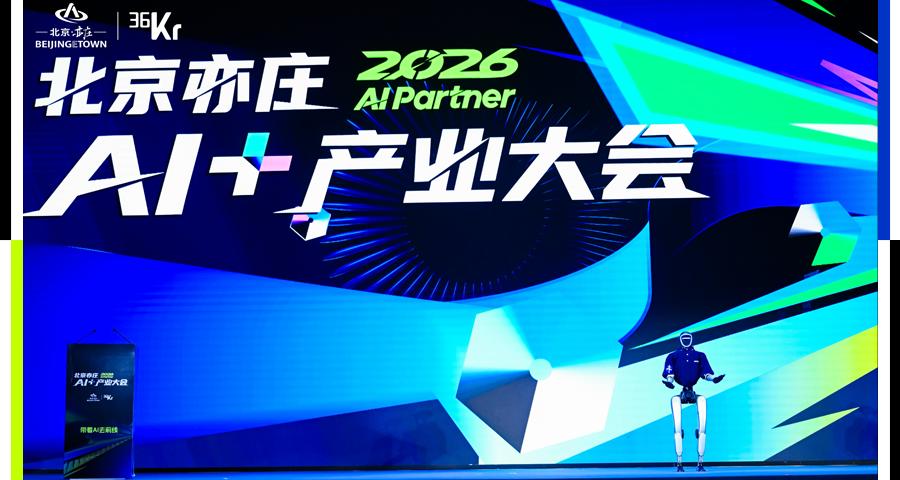
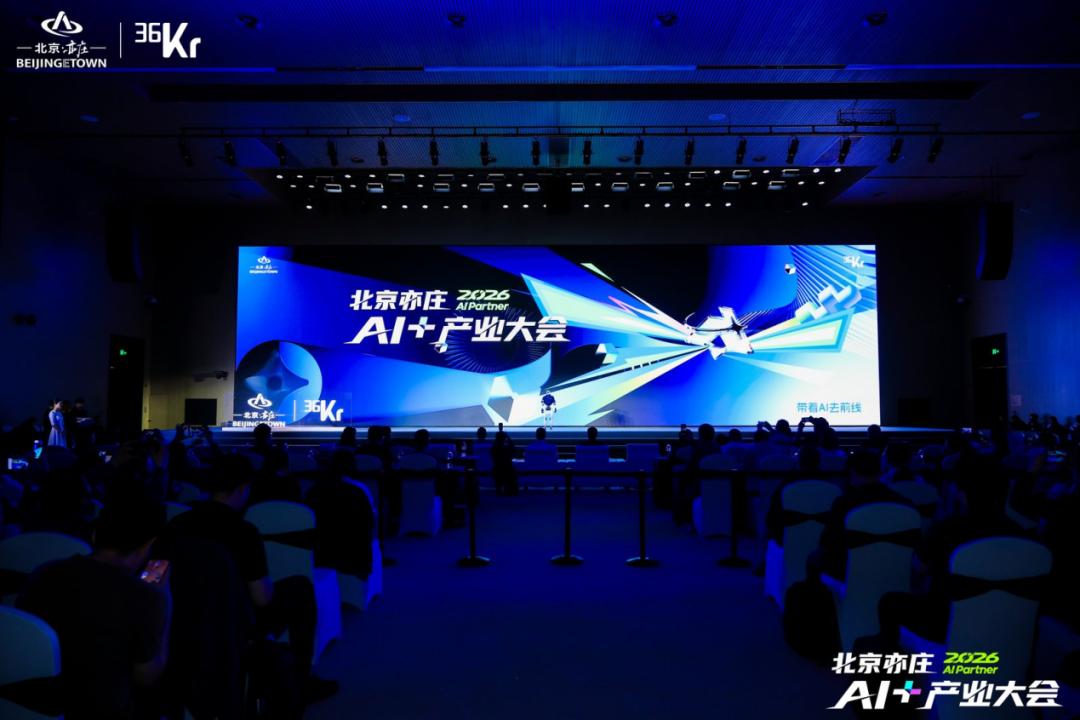
On May 19th, the 2026 AI Partner Conference with the theme of "Taking AI to the Frontline" opened at the Tongminghu Convention and Exhibition Center in Yizhuang, Beijing. This conference was guided by the Management Committee of Beijing Economic - Technological Development Area, hosted by 36Kr, and hosted by the National Information and Technology Innovation Park. As the main base for high - end and cutting - edge industries in the capital, Beijing Economic - Technological Development Area is building a "full - scale AI test field" covering multiple fields with scene opening as the core. This conference is a concentrated manifestation of this concept moving from "planning" to "actual combat".
36Kr is deeply in line with the strategy of Beijing Economic - Technological Development Area in promoting the implementation of the AI industry. As a long - term observer and connector of industrial innovation, 36Kr closely follows the full - scale scene blueprint of the development area and specially sets up an AI + industry docking meeting to let the needs and solutions collide on the spot and accelerate the rooting of "AI +" in the real economy. It is this design that has made the enthusiasm of both supply and demand sides in the outer venue far exceed expectations - the demand side comes with pain points, and the technology side comes with solutions, making cooperation happen on the spot!

"Taking AI to the Frontline":
It's not just a slogan, it's a judgment
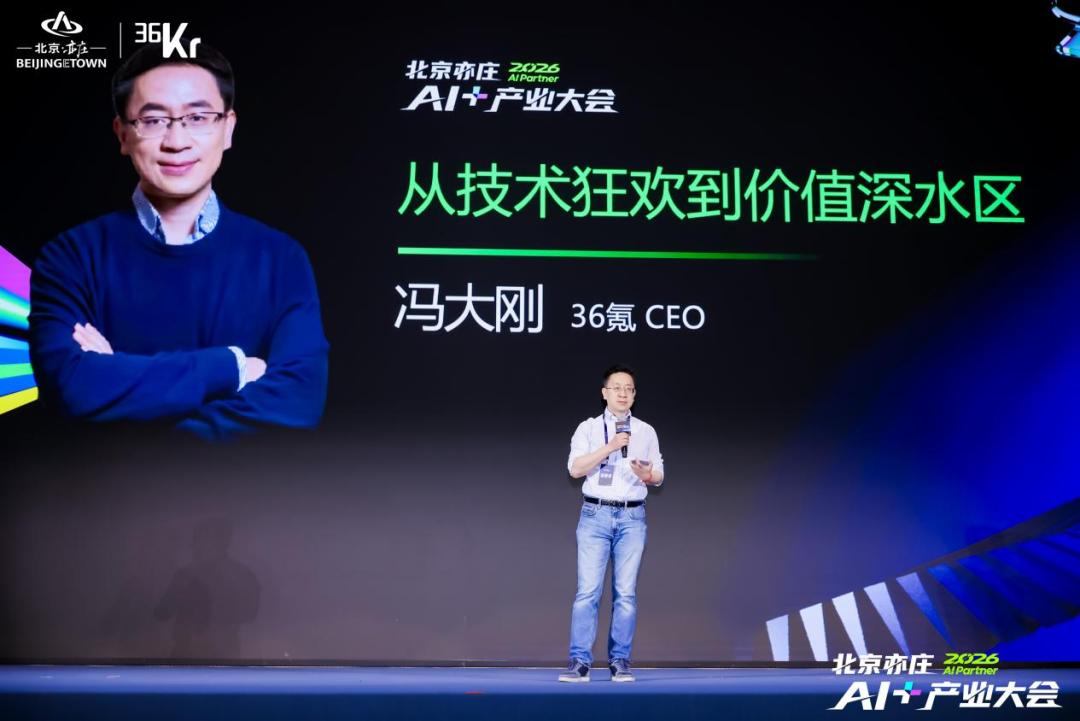
During the conference, Feng Dagang, the CEO of 36Kr, said in an interview with media such as China Media Group: " 'Taking AI to the Frontline' is not just a slogan, but a judgment." He pointed out that when the disruptive power of a technology surpasses that of the Internet, it is no longer just a track, but an infrastructure. This conference is not just an AI conference, but an industrial conference - the protagonists are finance, healthcare, manufacturing, consumption, and energy, and AI is their common language.
DAY 1 · Calculate the accounts: See the trends clearly and calculate the costs accurately
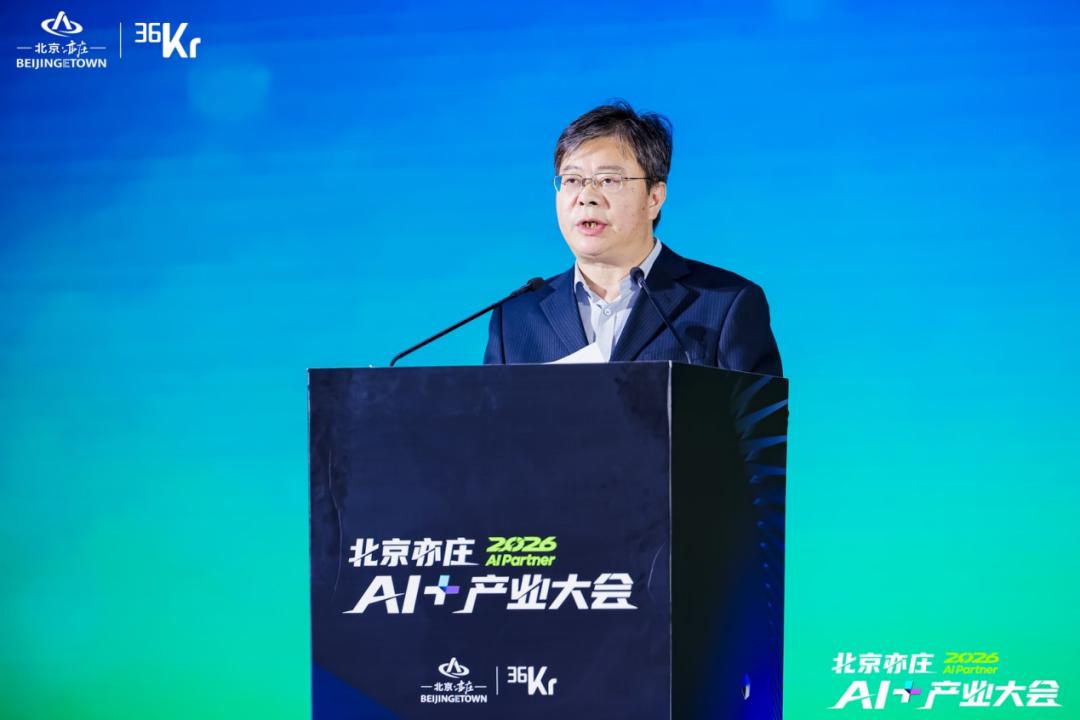
The conference officially kicked off with a welcome speech in Yizhuang, Beijing. The speaker said: "Yizhuang, Beijing, is not building a single show - room, but an open and inclusive innovation verification system. It aims to turn AI from a 'hot topic' into 'everyday use' and from 'possibility' into 'productivity'." Subsequently, Feng Dagang, the CEO of 36Kr, emphasized in the opening speech: "36Kr's AI conference is not about holding an 'AI anxiety conference'. The value of AI is to make people more useful, not to make people obsolete." This tone - setting directly opened the prelude to the morning session on the first day, "Policy dividends and industrial actual combat".
The first round - table was hosted by Cheng Xin, a global partner at Bain & Company, and representatives from the Shanghai Artificial Intelligence Industry Association, the AI Research Institute of Midea Group, Yunxiu Capital, and JD.com jointly discussed "The national promotion plan for AI + and the survival roadmap for enterprises". According to the data provided by Midea, the AIGC project alone reduced costs by 700 million yuan last year; JD.com revealed that it has freely opened its digital human live - streaming service, with more than 70,000 active merchants.
Subsequently, Tan Min, the chief brand officer of Ubtech, reviewed the commercialization path of humanoid robots: After 14 years of entrepreneurship, it has now achieved small - scale mass production in the industrial scenario. Tang Kai, the senior vice - president of SF Technology, presented the actual combat data of supply - chain AI: More than 5,000 agents are running internally every day, consuming 80 billion tokens per day, and the path - optimization algorithm has been reduced from minute - level to millisecond - level. Chen Weimeng, the minister of the AIoT Technology Marketing Department of BOE, shared the transformation from "selling screens" to "selling screens + algorithms" on - site.
In the morning of that day, the "2026 AI Best Scenario Penetration Cases" were announced, and 55 benchmarks that have truly achieved ROI were selected from nearly 200 applications. Immediately afterwards, He Sichong, the head of the NEXTA Innovation Laboratory of Ant Group, hosted a round - table on "Should we change the process first or replace the personnel first when introducing AI", engaging in a debate with scholars, manufacturing enterprises, and technology experts.
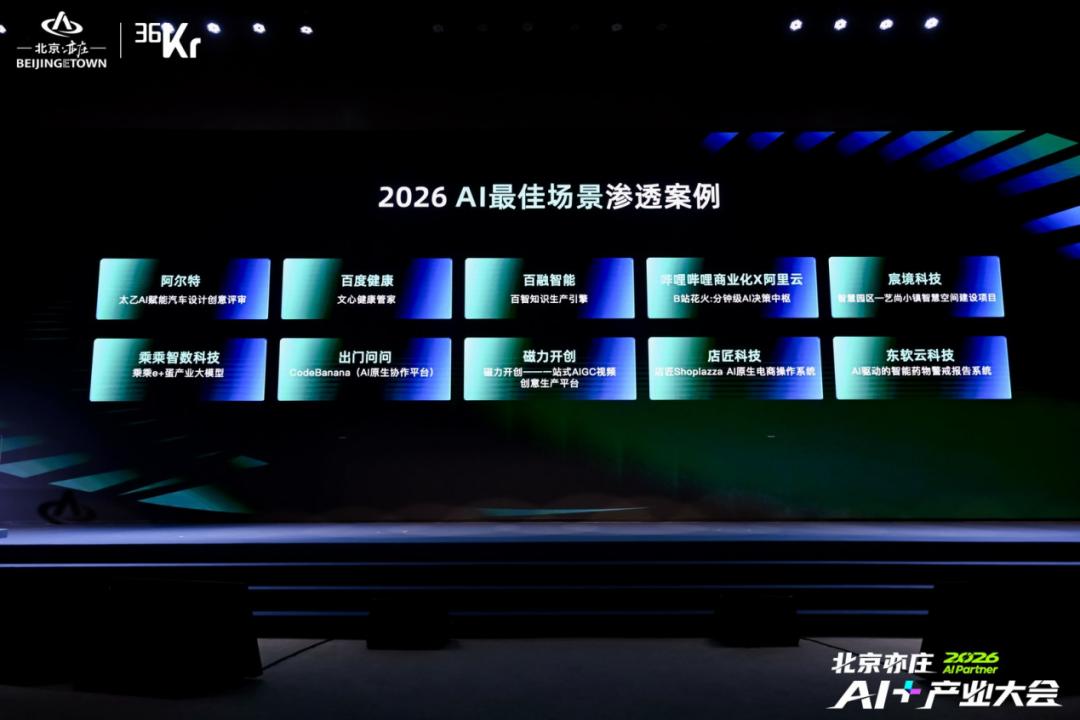
In the afternoon, practical cases in fields such as finance, content, computing power, digital assets, healthcare, agriculture, industrial manufacturing, and medical care were presented in sequence: Jinzhiwei and Galaxy Futures dissected the actual substitution rate of AI in financial risk control; Qwan Tech, MiniMax, and Lemongrass Pictures discussed the role of humans in AI - created content; enterprises such as Inbodata, ADOP, Baidu Health, and Luyu Technology contributed cases from the perspectives of computing - power base, digital assets, healthcare, agriculture, and industrial ERP respectively. The last round - table was hosted by Zheng Wangyu, the investment vice - president of 36Kr Fund, posing the ultimate question of "What should the remaining 20% of people do when AI completes 80% of standardized work".
DAY 2 · Negotiate well: Solve the technology and talent issues
In the morning of the next day, the agenda focused on cutting - edge fields such as embodied intelligence, automotive design, user insight, robot scale - up, driverless vehicles, and visual intelligence: Xu Liangwei, the CTO of Zhiyu Jishi, talked about the revolution in data supply for embodied intelligence; Liu Yabin, the vice - president of ALT Automotive, shared how AI is entering automotive design; Zhao Xiaopeng, the general manager of the innovation department of NIQ, analyzed user needs in the AI era; Li Kehong, the co - founder of Coolwalk Technologies, told the story of the large - scale implementation of urban robots from pilot projects; Xie Jinghua, the co - founder of Neolix, presented an AI - integrated solution from intelligent driving to intelligent dispatching; Zhou Wenkai, the vice - president of the R & D center of Dahua Technology, discussed the reconstruction of intelligent IoT through visual intelligence × AI Agent.
Subsequently, a round - table on "The next killer - level AI product" had an in - depth exchange. Then, 36Kr and PureblueAI jointly released the "2026 Key Industry GEO Practice Benchmark Enterprises"; Beijing Zhongguancun College, Capital University of Physical Education and Sports, and Jingao E - sports jointly launched the strategic signing of "Taking AI to the sports field". Finally, in the "Special Tribute Figures" session, awards were given to the "Lighthouse Keepers" and "Barrier Breakers" to pay tribute to the pioneers who dared to verify the implementation of AI in the hazy period.
In the afternoon, topics such as digital experience, international education, commercial implementation, industrial quality inspection, talent symbiosis, and edge computing took turns: Xue Bing, the vice - president of Shanghai Feiyu Information Technology, hosted a round - table on "AI concentration and conversion rate"; Ma Yawei, the founder of New Oriental Education & Technology Group, talked about the reconstruction of international education by AI; Li Shizun, the CEO of Jisi Technology, shared the commercial implementation in multiple industries; Cui Jiannan, the founder of Guangzhou Gaogaizhen Culture and Technology, and others participated in the discussion; Liu Jinshuo, the CEO of Yinte Intelligent Technology, focused on industrial quality inspection; Bangzhu, the editor - in - chief of 36Kr, hosted a round - table on "The symbiosis of AI - native talents and industry veterans"; Chen Long, the co - founder of Jiangxing Intelligence, expounded on the opportunities, paths, and practices of physical AI from perceiving the environment to changing the world. The last round - table was hosted by Zheng Wangyu, the investment vice - president of 36Kr Fund, posing the question of "The ultimate division of labor between humans and machines" to the audience again.
There were nine round - table discussions and more than twenty keynote speeches over the two days, covering more than a dozen directions such as AI + manufacturing, finance, healthcare, retail, supply chain, content production, education, automotive, and robotics.

Outer - field "World Café":
13 demand - side companies take the lead, and 36 technology - side companies take turns
If the inner - field session solves the question of "how to view", the outer - field session solves the question of "how to do".
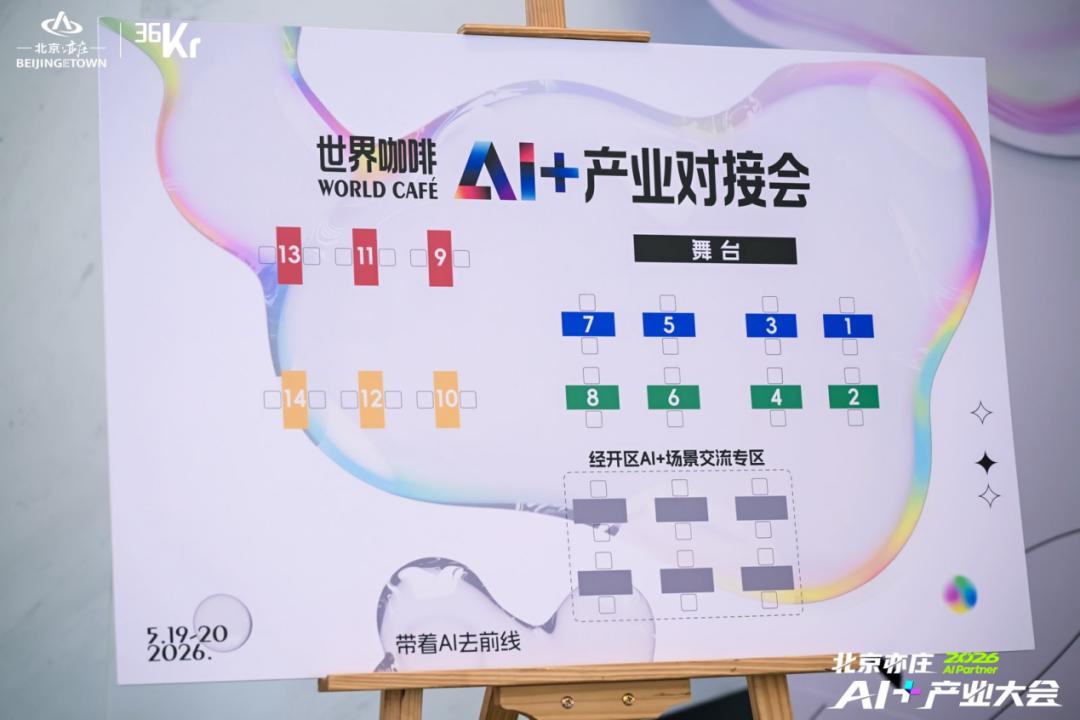
There are no spectator seats in the "World Café" industry docking meeting - 13 demand - side companies with real scenarios, real budgets, and real pain points each occupy a table, covering more than a dozen fields such as finance, commercial real estate, environmental protection, retail, catering, clothing, biotechnology, and auto parts. The capabilities of 36 technology - side companies cover almost all implementation aspects such as digital employees, multi - modal detection, industrial simulation, AI screenwriting, and agricultural remote sensing.
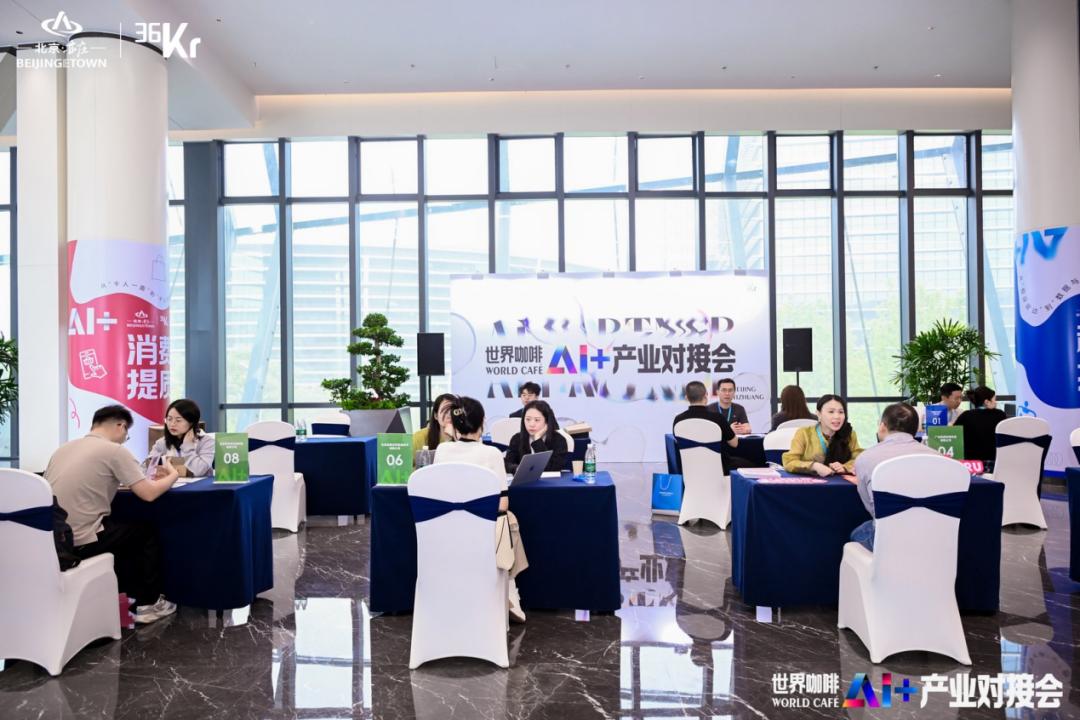
The docking meeting covers four major directions: AI + science and technology, AI + industrial development, AI + consumption upgrading, and AI + people's well - being. The demand - side companies are fixed, and the technology - side companies rotate to a new table every 30 minutes, with more than 100 rounds of docking in total over the two days. The organizer does not do random matching, and each round is cross - verified in advance.
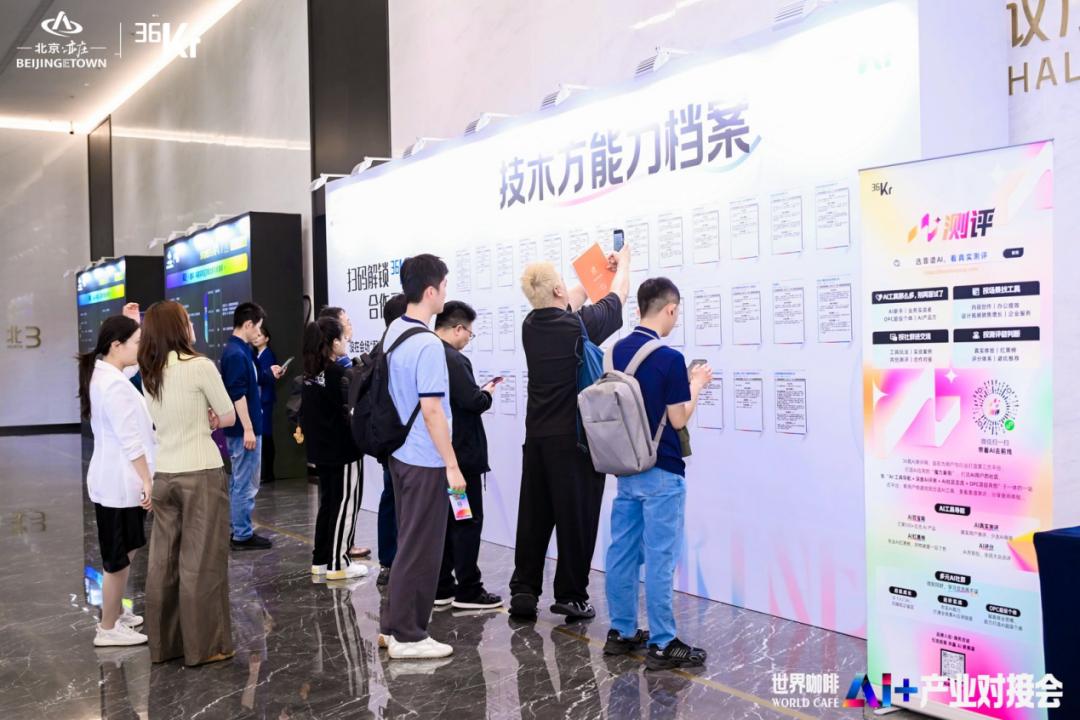
Some companies on - site have established connections on the spot and conducted on - site inspections. There have even been situations where a technology - side company is "snatched" by two demand - side companies at the same time. On the "demand wall" and "capability list" in the outer field, hundreds of new demands have been collected. The hand - written supplementary demands are pasted more and more densely, and no one wants to leave early even though the "World Café" coffee in their hands has been emptied one cup after another.

The positioning of Yizhuang:
Don