After FSD entered the Chinese market, I began to seriously think: Among Tesla, Huawei, and Momenta, which one is more worthy of entrusting my life to?
On May 21, 2026, Tesla officially announced that the supervised version of FSD could be used in China. At the same time, the cumulative assisted driving mileage of Huawei's Qiankun ADS had reached 10.47 billion kilometers, and its market share among domestic third - party intelligent driving suppliers was 77%.
The media has been writing about things like these: Will Huawei be severely affected? How much will the monthly fee for FSD be? What will XPeng and Li Auto do next? Will the landscape of intelligent driving in China be rewritten?
But I think the real questions that deserve serious answers this time are not the ones mentioned above.
A comment in the comment section put it more directly: "The commercial value doesn't matter much to us. What we care about is which one of FSD, Huawei, and Momenta is better, safer, and more labor - saving."
This is what the vast majority of people really want to ask.
Is it that difficult? Isn't it just a matter of choosing the one with a better experience? Isn't it okay as long as it feels convenient after use?
Actually, it's not that simple.
Behind these three systems are three completely different technical routes. Their differences are not about "usability" but rather: in different scenarios, which one is more likely to fail and in what way.
Without clarifying this, you can't make a truly informed choice.
As usual, I'll try to clarify the underlying differences between these three systems in one article.
First, lay out the cards of the three opponents
Before making a comparison, align the basic parameters of the three systems.
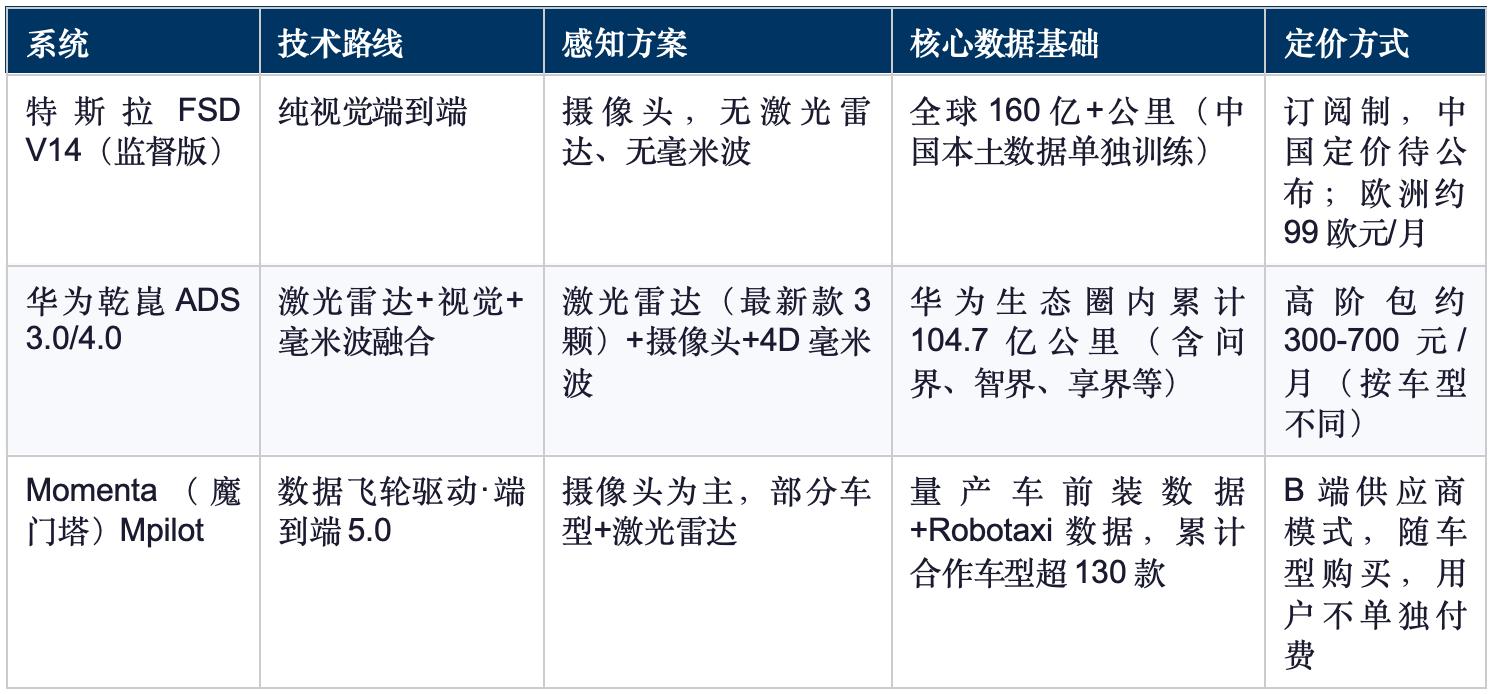
(Source: Tesla official, Huawei Qiankun press conference in April 2025, Momenta official, 2025 - 2026)
The three systems have three completely different underlying logics. To truly identify the differences, we can't just look at the parameter tables. We need to see where each of them might have problems.
Three routes, corresponding to three different failure modes
I call this analysis framework the "Three - dimensional Failure Model": Where are the perception blind spots? How strong is the scenario adaptability? In what way will it lose control when a problem occurs?
These are the three most important questions to think through before choosing any L2+ system.
Tesla FSD: The price of pure vision
FSD's technological bet is that since humans drive with their eyes, AI can also drive using only cameras. This logic holds true in most scenarios.
Its failure modes are concentrated in two types of scenarios:
First, extreme light and extreme weather. A pure vision system's ability to perceive strong backlighting, heavy rain, thick fog, and dark nights without streetlights is far inferior to that of a system with lidar. A set of comparison data from an industry testing institution is worth noting: In the "Chinese night heavy rain" scenario test, the average takeover interval of the FSD model trained only with Chinese local data was about 38 kilometers, while that of the version trained with global data was about 167 kilometers, a difference of about 4.4 times. The false braking rate also increased from about 0.12 times per 100 kilometers to about 0.58 times per 100 kilometers. (Source: Saiwen Transportation Network, based on the closed - test set data in October 2024)
This set of data shows one thing: The accumulation of localized data for FSD directly determines its upper - limit performance in extreme weather conditions in China. Currently, there is still a large gap between the volume of Chinese local data and global data.
Second, the generalization ability in Chinese - characteristic scenarios. Scenarios such as electric bicycles cutting in, pedestrians running red lights, unprotected left - turns, and "sudden appearances" occur very rarely in North American data. In the 260,000 - kilometer internal testing data of FSD in China, a significant proportion of the 37 manual emergency takeovers were related to non - motor vehicles and pedestrians. (Source: Saiwen Transportation Network, March 2026)
Huawei ADS: The other side of lidar
Huawei ADS's greatest advantage is multi - sensor redundancy: Lidar can still provide accurate three - dimensional point clouds during extreme light changes, making up for the shortcomings of cameras. This is the core reason why ADS 3.0 performs relatively stably in extreme scenarios.
Its failure modes are as follows:
First, the signal attenuation of lidar in rainy and snowy weather. Laser light scatters when it encounters water. In scenarios such as heavy rain and smog, the detection accuracy of lidar will decline. Huawei tries to make up for this shortcoming through multi - sensor fusion, but there is still a threshold under extreme rainfall conditions.
Second, the ecosystem limitation. Currently, Huawei ADS is mainly installed in Huawei - affiliated models such as AITO, Zhijie, and Xiangjie, as well as some cooperative car manufacturers. Its training data highly depends on the real - world road condition data of vehicles within this ecosystem. The data flywheel spins very fast within the ecosystem (the number of takeovers per 100 kilometers of the ADS 3.0 version of urban NOA is about 0.3 - 0.5 times. Source: Huxiu, January 2026), but it cannot cover outside the Huawei supply system.
Third, the hardware cost. The hardware cost of Huawei ADS's lidar solution is significantly higher than that of the pure vision solution. The latest ADS 4.0 is equipped with 3 lidars + 4D millimeter - wave radar (Source: A summary of Huawei Qiankun Intelligent Driving ADS on Zhihu, 2025), which has a clear upward effect on the vehicle's pricing and is not suitable for models in the mass - market price range.
Momenta Mpilot: The boundary of the mass - production flywheel
Momenta's core logic is the "data flywheel": It uses mass - produced vehicles to collect real - world road condition data to feed back into algorithm iteration, making the system smarter while you drive. This logic has allowed Momenta to accumulate more than 130 mass - production cooperation models, covering mainstream brands such as GM Buick, FAW Toyota, Honda China, SAIC Audi, and IM. (Source: Momenta official, Shanghai Auto Show in April 2026)
Its failure modes are as follows:
First, the data stratification between mass - production scenarios and Robotaxi scenarios. Momenta is running on two "legs": "front - loading mass production" and "Robotaxi". There is a data distribution difference between the driving scenarios of mass - produced vehicles (highways/urban daily commuting) and the operating scenarios of Robotaxis (specific operating areas, fixed routes). The performance of private cars in unfamiliar cities and extreme road conditions may not be directly enhanced by Robotaxi data.
Second, the user perception gap in the B - to - B model. Momenta is a system supplier. When ordinary consumers buy a car, they see brands such as "IM AD" and "Buick SuperCruise" rather than Momenta. This creates certain obstacles for users to trace problems and understand the system's capabilities and boundaries.
On Chinese roads, who is more adaptable?
After talking about the failure modes of the three systems, let's look at a more specific question: On Chinese roads, which one is more adaptable?
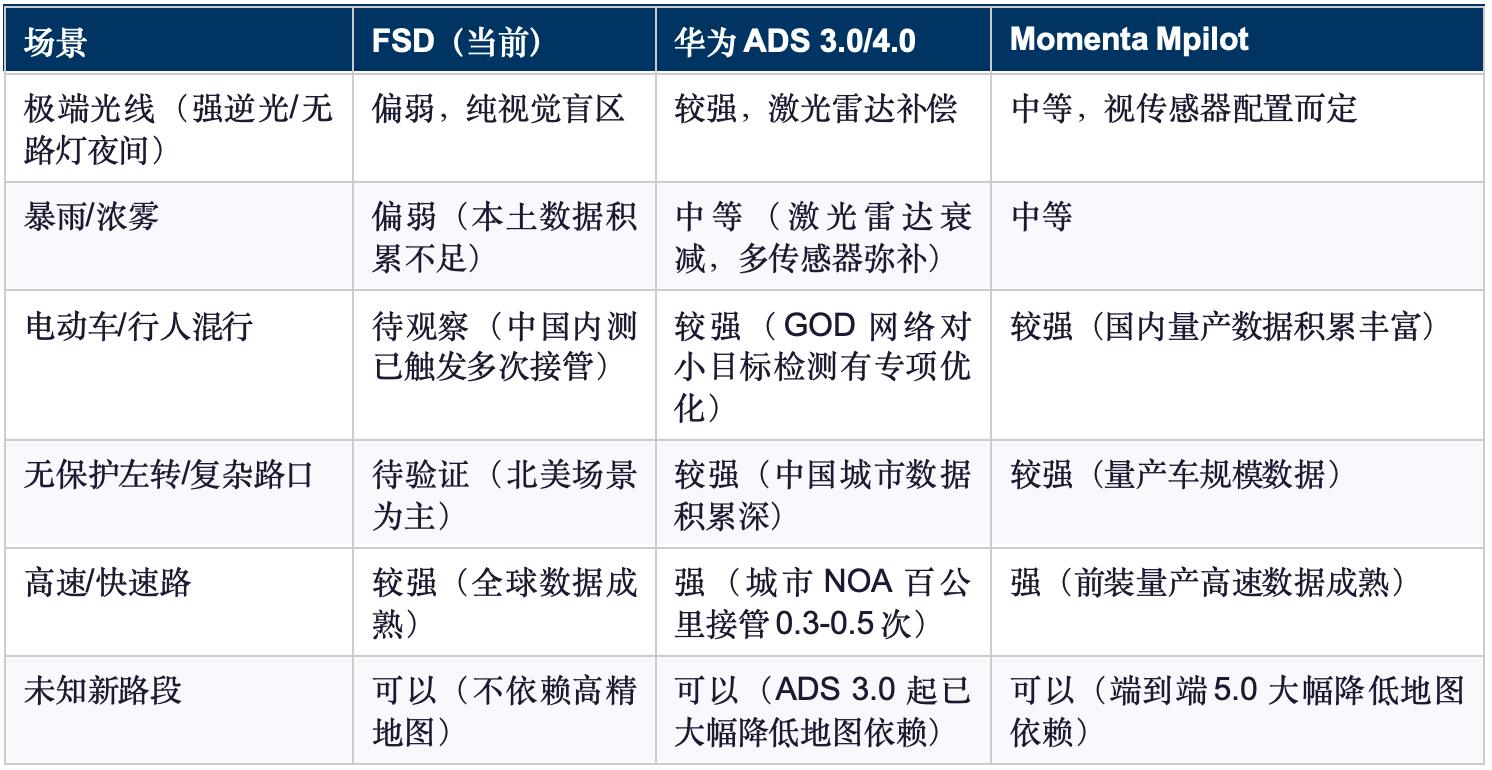
This table shows a basic judgment: Under the current road conditions in China, Huawei ADS and Momenta have a first - mover advantage in perception redundancy and local data accumulation. FSD's advantage lies in its algorithm framework and global data scale, but the accumulation of Chinese - localized data takes time, and there are verifiable weaknesses in extreme weather and characteristic scenarios at the current stage.
Of course, this judgment will change dynamically as FSD accumulates data in China. Six months later, the way this table is filled may be different.
A framework for readers to take away
I've organized the thinking tools for this problem into three questions. When evaluating any L2+ assisted driving system, you can go through these three questions:
Question 1: Where are the perception blind spots of this system on the roads I often drive on?
Is your daily commute mainly on highways and urban expressways, or does it include a large number of complex intersections and mixed - traffic scenarios? The differences between the three systems are not significant in the former case, while Huawei and Momenta have more accumulated advantages in the latter.
Question 2: In what way will it lose control when a problem occurs?
Is it a sudden brake (false brake)? Or a failure to brake (missed brake)? Or is the hand - over of control too slow (delayed takeover response)? The failure modes of the three systems are different, which affects how you should react near the system's capabilities and boundaries.
Question 3: Is the data flywheel of this company spinning fast enough in your scenario?
The core logic of the data flywheel is whether there are enough similar vehicles running on your route. If you drive in the downtown area of Shanghai, all three systems have enough training data coverage. If you drive on non - popular roads in third - and fourth - tier cities, this question is worth thinking about seriously.
What does this have to do with you?
If you're in the process of choosing a car and a model equipped with one of these three systems is on your shortlist: Before making a decision, first confirm your main vehicle - using scenarios, and then make a judgment based on the scenario adaptability of the three systems, rather than just looking at the feature list in the marketing promotion.
If you already have a car equipped with one of these systems: It is recommended to consult the official manual to confirm the usage suggestions of the system in extreme weather and high - risk intersections (usually, manufacturers will prompt "not recommended to turn on under XX conditions"). These instructions often tell you more directly where the system's boundaries are than experience evaluations.
If you're just a passer - by and don't drive such cars: The large - scale deployment of these three systems means that you'll encounter more and more assisted - driving vehicles on the road. Understanding their respective blind spots and failure modes is also part of your self - protection awareness on the road.
BT Finance's cautious judgment
There is no absolute good or bad among the three systems, only different technological bets and different failure modes.
FSD bets on: large - scale data + pure vision end - to - end, which can ultimately be generalized to all scenarios. Huawei ADS bets on: hardware redundancy + in - depth local data, to build a barrier on Chinese road conditions. Momenta bets on: mass - production flywheel + in - depth B - to - B binding, using scale to exchange for iteration speed.
All three bets have a chance of winning. However, their winning timelines are different, and their performances at the current stage in China are also different.
The real question is not which one is better, but: at the time when you're buying a car, which type of failure are you willing to accept?
It's best to think this question through before paying the deposit.
This article is from the WeChat official account "BT Finance" (ID: btcjv1), written by BT Finance and published by 36Kr with authorization.