Huawei's Embodied Brain No. 1 is working on a brain-inspired intelligent world model, competing with JEPA, and has received hundreds of millions of yuan in financing | Exclusive report from Yingke
Author | Huang Nan
Editor | Yuan Silai
Hard Krypton has learned that the embodied intelligence brain company "Juenao Panshi" has completed a new round of financing worth hundreds of millions of yuan. This round of financing was led by top industrial capital with a profound background in brain-like and embodied industries. Old shareholders and multiple top funds reinvested and followed the investment. Duowei Capital served as the exclusive financial advisor. At the same time, another round of financing is also in the process of simultaneous delivery.
The funds will be mainly invested in core technology R & D, talent team expansion, and global market expansion to accelerate the R & D, engineering implementation, and real - scene verification of the Cognitive World Model.
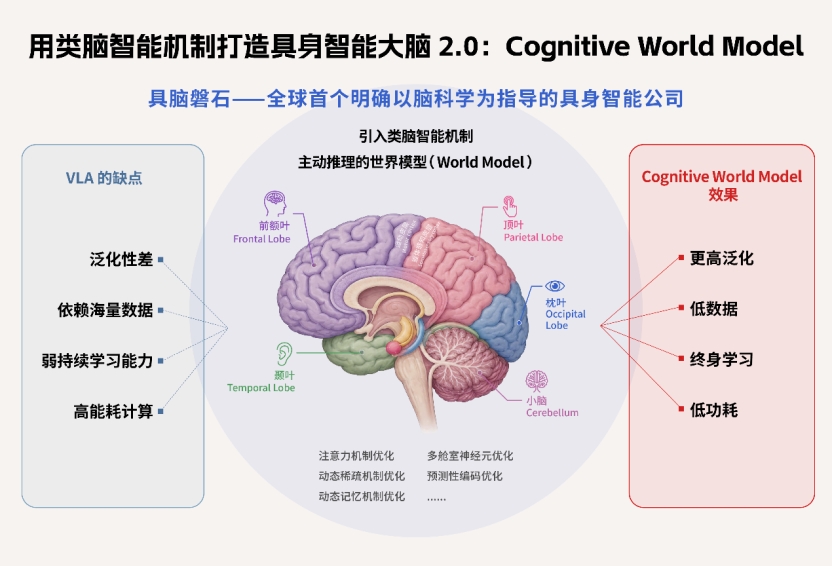
Brain-like intelligent world model (Source/Enterprise)
Juenao Panshi was founded in 2025. It uses brain-like intelligence as the underlying paradigm to build a Cognitive World Model for the real physical world. The company was founded by Zhu Senhua, the "No. 1 person in Huawei's embodied brain", who serves as the CEO. He has long been focused on the cross - research of AI and brain cognition. He once engaged in computer and AI research at Sun Yat - sen University, graduated with a doctorate in cognitive neuroscience from the University of Pennsylvania, and completed his post - doctoral research at the State Key Laboratory of Brain and Cognitive Sciences of the Chinese Academy of Sciences.
After joining Huawei, Zhu Senhua served as the director of the AI Algorithm Innovation Lab of Huawei Cloud, leading and being responsible for projects such as the AI Brain Science Cloud Platform, the Pangu Embodied Large Model, and the Global Embodied Intelligence Industry Innovation Center. He promoted the systematic verification of the integration route of the world model and brain - like intelligence. He is the pioneer of Huawei's embodied intelligence brain, with the compound ability of brain cognitive science research, innovation verification of brain - like AI routes, and implementation of the embodied intelligence industry.
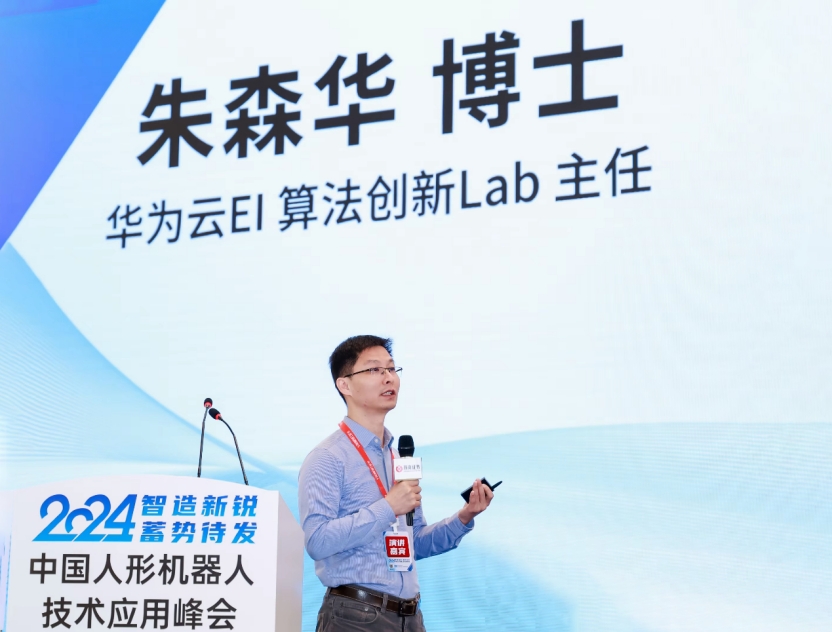
Zhu Senhua attends the Chinese Humanoid Robot Technology Application Summit (Source/Enterprise)
Co - founder Liu Jinyu has long focused on the productization and commercialization of AI robot technology. He has incubated multiple product business units from scratch and achieved large - scale global commercial implementation. Many technical, supply - chain, and operation partners come from scientific research institutions such as Tsinghua University, Peking University, Fudan University, and the Chinese Academy of Sciences, and have participated in AI algorithms, robot systems, supply chains, and global commercial implementation in companies such as Huawei, Lenovo, Megvii, and Geek+.
The original team has covered the complete closed - loop from frontier research, model R & D to system engineering implementation.
In the past year, the trends in the embodied intelligence track have iterated rapidly, and the hot industry term has quietly changed from "VLA" to "world model".
Feifei Li has bet on spatial intelligence, Yann LeCun founded AMI Labs to explore causal reasoning, and technology giants such as NVIDIA and Google DeepMind are accelerating the layout of physical simulation and real - interaction technologies. However, behind the popularity, a fundamental question has not been clarified: What exactly is the world model? Is it a brand - new academic concept, the core technical route of the next - generation AI, or a phased concept still being repeatedly verified by the market? Different teams give different definitions and paths.
Zhu Senhua, the founder of Juenao Panshi, believes that to get the answer, one needs to return to the origin of the problem. "To truly understand the world model, one needs to clarify its technical origin and core requirements, and understand where it comes from and what fundamental problems in the industry it aims to solve." Zhu Senhua pointed out to Hard Krypton, "The underlying logic of the world model is rooted in the 'Mental Model' of brain and cognitive science. It is the current frontier cross - system of brain science and AI. Without this cognitive system, most discussions tend to stay at the permutation and combination of technical terms. Today it is VLA superimposed with the world model, and tomorrow it is the world model spliced with VLA. It seems to be iterating rapidly, but in fact, it does not touch the essence of the technology."
This judgment directly affects Juenao Panshi's choice of technical path. In the view of the Juenao Panshi team, embodied intelligence is moving from "action intelligence" to "cognitive intelligence". The core of the next stage is not only to enable robots to understand tasks and complete actions but also to endow robots with the abilities of human - like small - sample abstract concept learning, multi - dimensional environmental perception, long - term memory, and active reasoning, and to act stably across scenarios in the real world.
However, the implementation of current embodied intelligence still faces multiple bottlenecks: it is difficult to obtain high - quality real data on a large scale, the model's generalization ability across scenarios is insufficient, and it often needs to be retrained when entering a new environment. Robots also lack long - term memory and continuous learning abilities. Data cannot be collected infinitely, and computing power is not an infinite resource.
In contrast, the human brain does not require a large amount of teaching data or high - energy - consuming and high - computing - power resources, but can continuously complete learning, perception, memory, prediction, planning, and action in complex and changeable environments. This is the reason why Juenao Panshi chooses brain - like intelligence as the underlying path, that is, not simply simulating the brain in structure but extracting the core abilities such as the functional neural mechanisms of the brain's intelligence and transforming them into computable algorithms and architectures to ultimately build the next - generation embodied intelligence brain.
Since its establishment, Juenao Panshi has proposed a cognitive world model driven by brain - like intelligence, which is in the same direction as the JEPA (Joint Embedding Predictive Architecture) route proposed by Yann LeCun. Based on the common theoretical foundation of active reasoning cognitive science, it focuses on reasoning, planning, and real - world modeling. The value of JEPA lies in enabling AI to not only generate results that "look like" but also learn how states evolve and reason about future trends in the abstract representation space, thus getting closer to the underlying laws of the human brain's cognition of the real world.
However, for robots that need to perform tasks in the real environment, only having the "representation - prediction" ability is not sufficient to form a complete intelligent closed - loop.
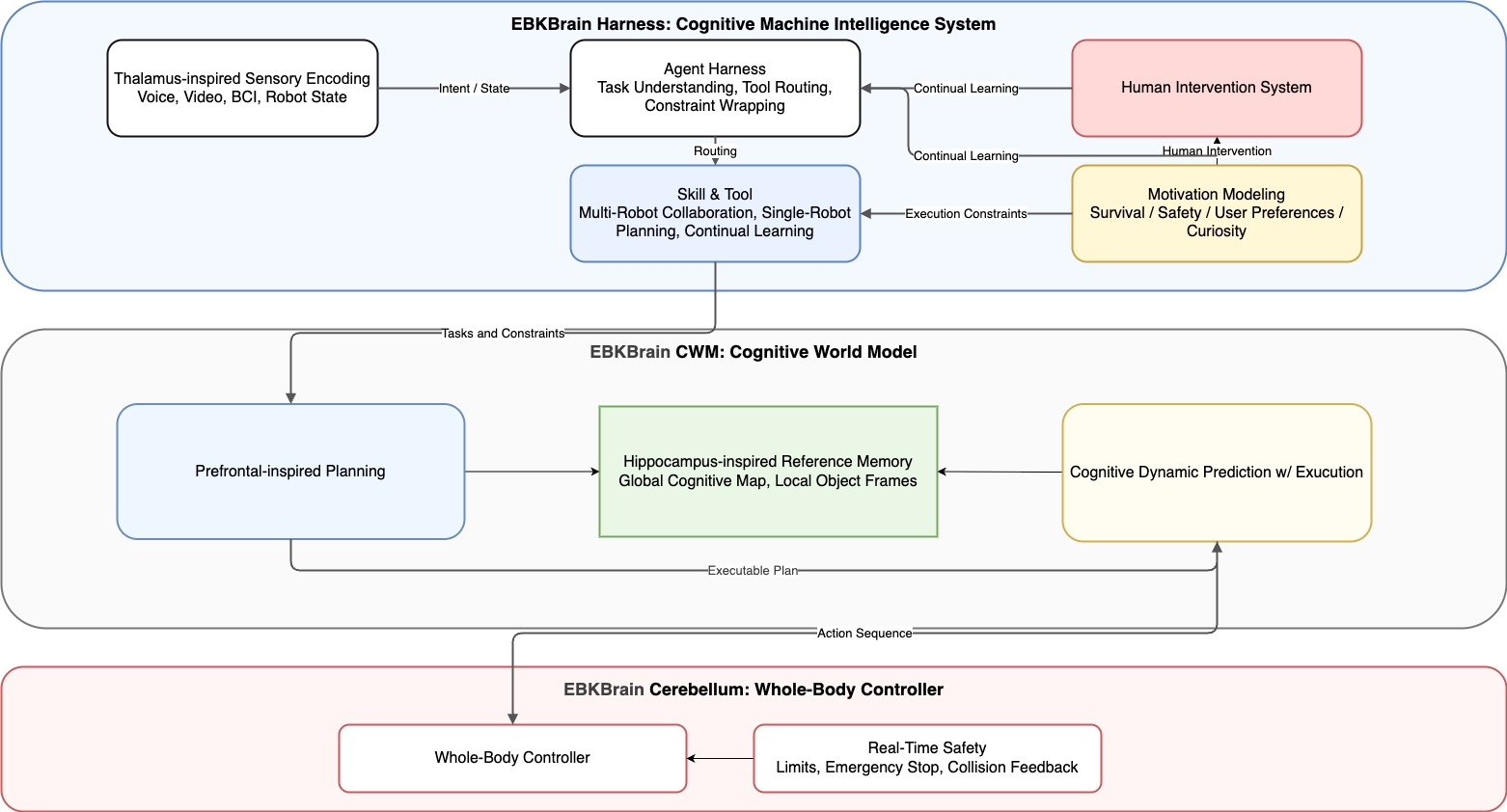
Intelligent closed - loop (Source/Enterprise)
An intuitive example is that when a person crosses the road, there is no need to accurately measure the speed, distance, and traffic light time of vehicles in all directions. Just by taking a simple look at the surrounding situation, one can safely cross the road at an appropriate speed and rhythm. This is the active reasoning in the mental model. Zhu Senhua said that the cognitive world model that Juenao Panshi wants to build is to engineer this set of abilities, enabling robots not only to predict how the world changes but also to independently set goals, plan actions, and execute operations based on their understanding of the environment, and continuously learn from environmental feedback to correct their own behaviors.
This means that a world model applicable to the embodied system must cover the full - link capabilities from state prediction to decision - making and execution.
Specifically in terms of the implementation path, the company is transforming mechanisms in brain science such as multi - compartment neurons, non - linear attention, multi - stage memory, sparse computing, and active reasoning into algorithm models and engineering system architectures that can be applied in practice. This path ultimately points to four core technical goals: low data, high generalization, lifelong learning, and low power consumption, jointly breaking through the real constraints of embodied intelligence in terms of data cost, cross - scenario adaptation, continuous operation, and computing power limitations.
Currently, Juenao Panshi has completed multiple system - level technical verifications in directions such as embodied perception and interaction, planning, mobile navigation, operation, and group embodiment, and is simultaneously promoting PoCs in real scenarios for multiple industry customers in domestic and overseas markets, advancing the cognitive world model from the algorithm framework to the real robot system.
This way of advancing from algorithms to systems also constitutes Juenao Panshi's understanding of Embodied Intelligence 2.0: not to enable robots to complete more actions in demonstrations but to endow robots with cognitive abilities close to the human brain - learning abstract laws from a small amount of experience, continuously perceiving and remembering in complex environments, and achieving active reasoning, stable decision - making, and continuous action across tasks and general scenarios.
The following is an excerpt from an interview between Hard Krypton and Zhu Senhua, the founder of Juenao Panshi (slightly edited):
Hard Krypton: There are many discussions about the world model in the market. How should we understand this concept?
Zhu Senhua: In our view, the world model actually has five levels. From bottom to top, the first level is visual reality; represented by the spatial intelligence led by Professor Feifei Li, it solves the problem of environmental reality from 2D to 3D. The second level is physical reality; similar to Sora, it tries to understand physical laws by piling up data, but whether this method is truly reliable is still controversial. The third level belongs to interactive reality; represented by Google DeepMind and NVIDIA, it solves how to learn the interaction process such as touch and feedback of agents in the environment.
The fourth level is abstract learning; represented by the JEPA proposed by Yann LeCun's team, it no longer learns pixel by pixel but conducts abstract learning at the representation level to solve the generalization problem.
The fifth level enters active reasoning, which is based on the active inference theory in cognitive neuroscience, pursuing low data, high generalization, lifelong learning, and low power consumption; among them, the human brain has proven that this path is feasible.
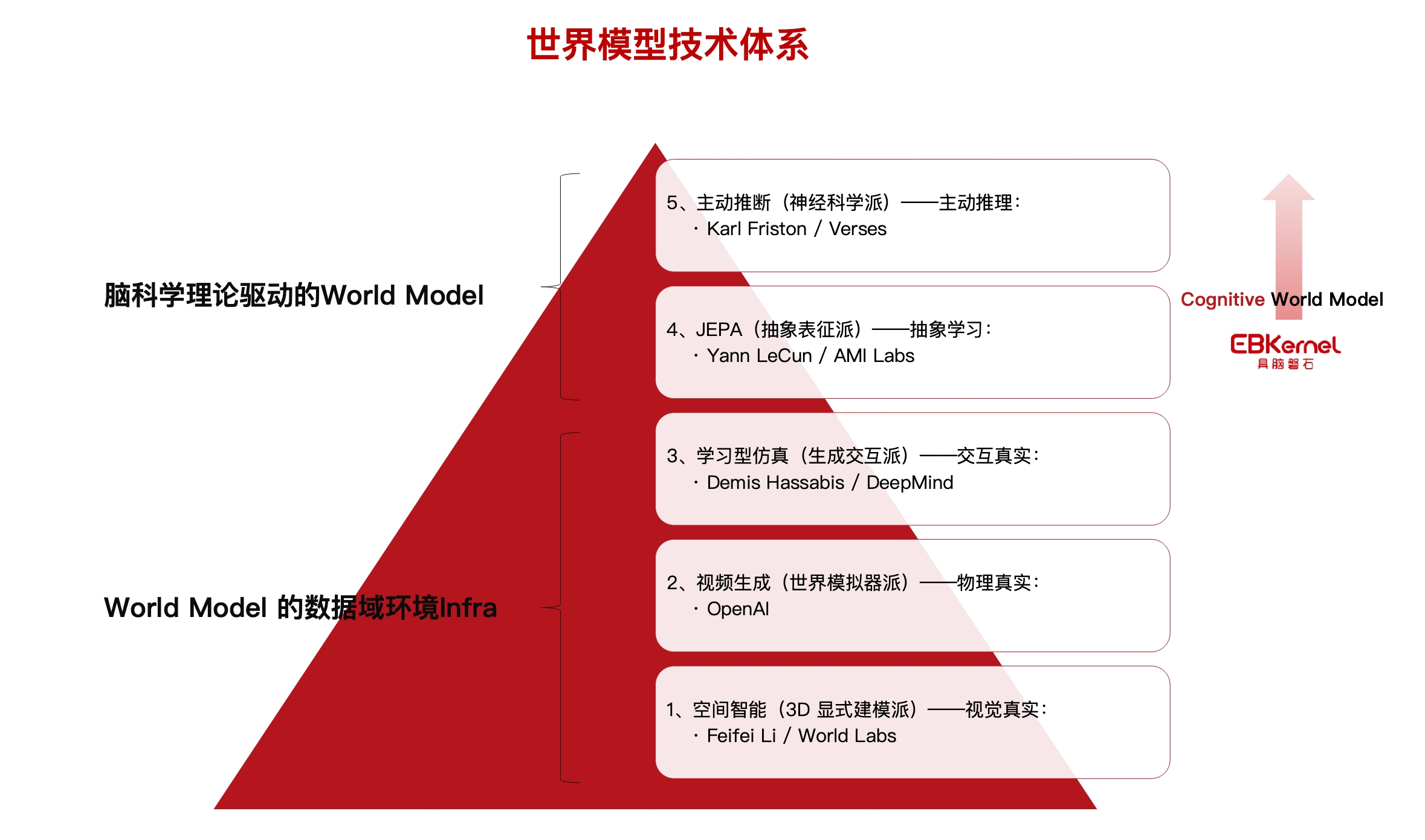
The "World Model" technical hierarchy system in Juenao Panshi's technical vision (Source/Enterprise)
These five levels are not parallel or independent schools but a system that evolves from infrastructure to intelligent capabilities. The first three levels solve the problem of "how to obtain data and training environments more cheaply and reliably", and the last two levels solve the problem of algorithm architecture for "how to learn and reason efficiently". They can be explored separately or support each other - when the infrastructure is improved, the upper - layer work will be more efficient; but even if the infrastructure is not mature, it does not affect the verification of the upper - layer algorithms.
Hard Krypton: What is the core bottleneck of the brain - like intelligence route? Is it computing power or the un - deciphered theory?
Zhu Senhua: Neither. In fact, many core concepts commonly used in the field of AI today, including neurons, neural networks, attention mechanisms, and world models, all originate from brain science. Every step of maturity in brain science can push AI forward. However, we also see that before brain science has fully deciphered the human brain, AI has reached its current height. So the bottleneck is not that "the theory is not mature enough, so we can't do it", nor is it the lack of computing power.
The real bottleneck lies in talent and the system. There is a lack of compound talents with a cross - background in brain science and AI, and there is also a lack of a systematic theoretical system to guide people to work in a definite direction. The current situation is that "the more manual work, the more intelligence". People are in a default framework, relying on a large amount of data and computing power, constantly making trial - and - error attempts, moving from one laboratory to another. Once a path is successful, they continue to build on it, but the cost is too high and the efficiency is too low.
So what we really need is to be guided by a relatively clear theoretical system, focus resources, explore separately, and learn from each other along a path with a generally correct strategic direction. This is also the underlying logic for Juenao Panshi to choose brain - like intelligence. Instead of waiting for the theory to be fully mature before taking action, we use the existing achievements in cognitive neuroscience to guide the algorithm architecture and engineering implementation, making the technology develop more steadily and quickly.
Hard Krypton: Juenao Panshi has proposed the application route of "one brain for multiple machines and one brain for multiple forms". How should we understand and implement it?
Zhu Senhua: First of all, we have to admit that no company today can use the same model to adapt to all forms of ontologies. Models for cross - configuration ontologies cannot be directly generalized, which is a phased reality.
Our strategy is divided into three levels: currently, we use the brain - like intelligent Agent framework to drive multi - machine collaboration; at the technical level, we continuously explore the adaptation of a single cognitive world model to multiple ontologies; in the hardware ecosystem, we have in - depth cooperation with multiple ontology manufacturers such as Leju, Xingchen Intelligence, and Zhidongli. Our long - term goal is to open our general embodied brain model and productivity tools for scenario - based applications to partners in the embodied industry ecosystem.
The reason for this design is that the generalization ability of the current world model is far from reaching the level of "one model drives all". Multi - machine collaboration is essentially an engineering problem. Multiple robots on the production line work simultaneously, with different forms and skills. Using a central Agent brain to schedule, decompose tasks, and coordinate actions is the most efficient and feasible solution at present. It is worth emphasizing that Juenao Panshi is also using brain - like intelligent mechanisms to improve the ability modules of the Agent, such as perception, memory, planning, and feedback error - correction. It is an extensible engineering system, an engineering bridge before the maturity of the world model, and a natural extension after the future capabilities are fully developed.