For the first time in history, Anthropic is about to make money.
[New Intelligence Era Introduction] Anthropic is about to turn its first profit! It has locked in a total of $330 billion in computing power from NVIDIA, Amazon, Google, Microsoft, and SpaceX, and is fully expanding its operations.
Anthropic is finally making money!
While everyone was still arguing about "whether AI companies can actually make money", Anthropic ended the debate with a quarterly report.
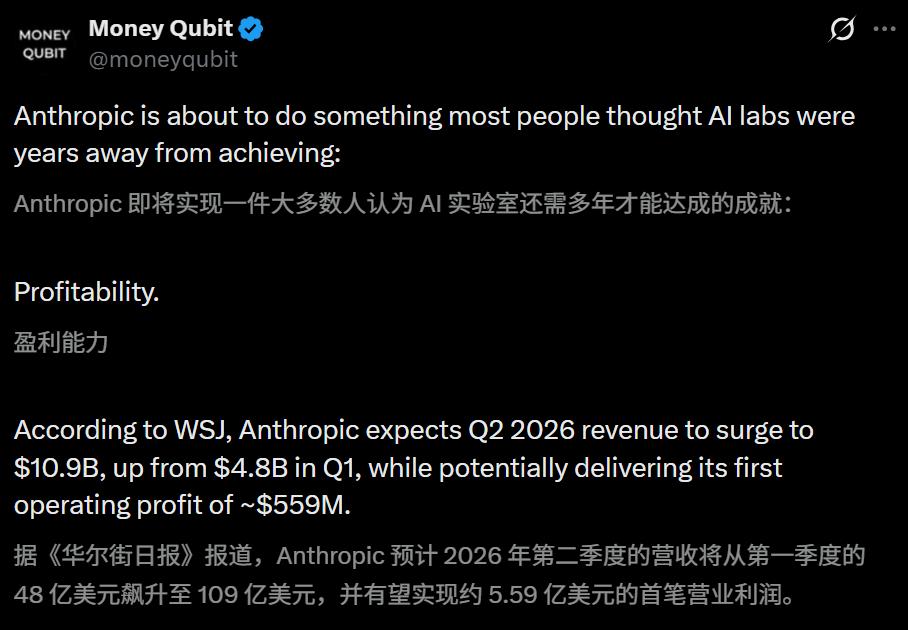
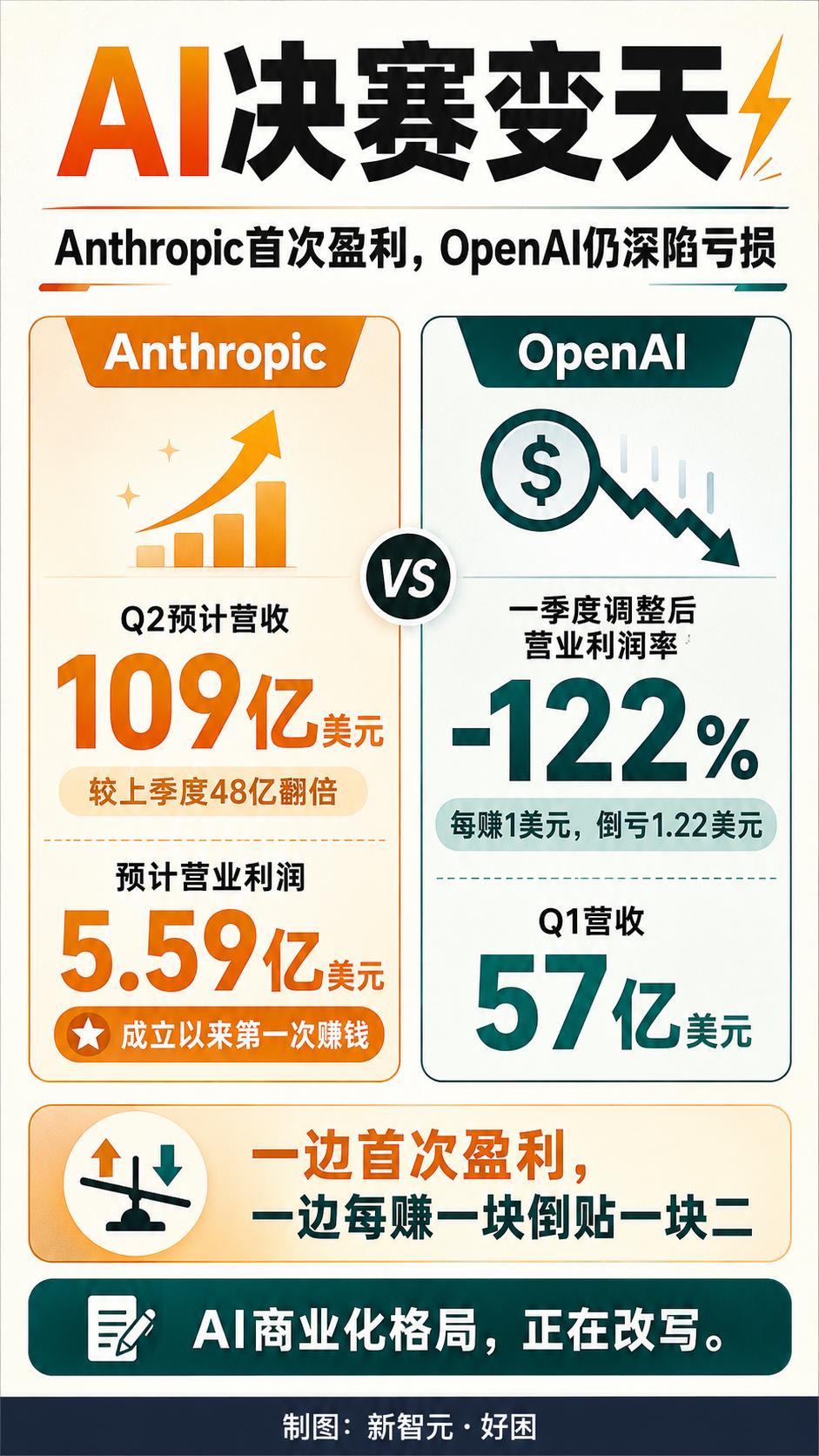
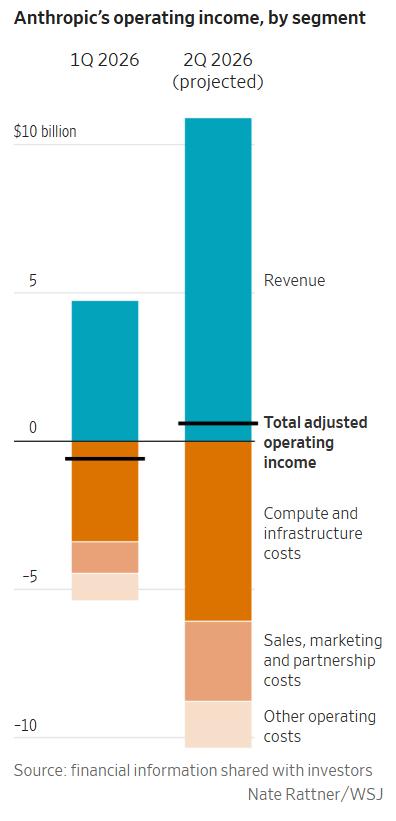
It is expected to generate $10.9 billion in revenue in the second quarter, doubling the $4.8 billion from the previous quarter.
Even more astonishing is that Anthropic will also make a profit this quarter, with an expected operating profit of $559 million.
This is the first time Anthropic has made a profit since its establishment, which is two years earlier than its prediction to investors.
On the same day, OpenAI's first-quarter accounts were also exposed.
Adjusted operating profit margin: -122%.
In other words, for every $1 OpenAI earns, it loses $1.22.
Even after deducting large expenses such as equity incentives, it is still burning money at a rapid pace.
$1.09 billion in revenue in one quarter surpasses the whole year
But this is not the most impressive part.
Anthropic's recent annualized revenue is approaching $45 billion.
OpenAI's annualized revenue in February this year was $25 billion.
The chaser has not only caught up but also overtaken, and has opened up a nearly two-fold gap.
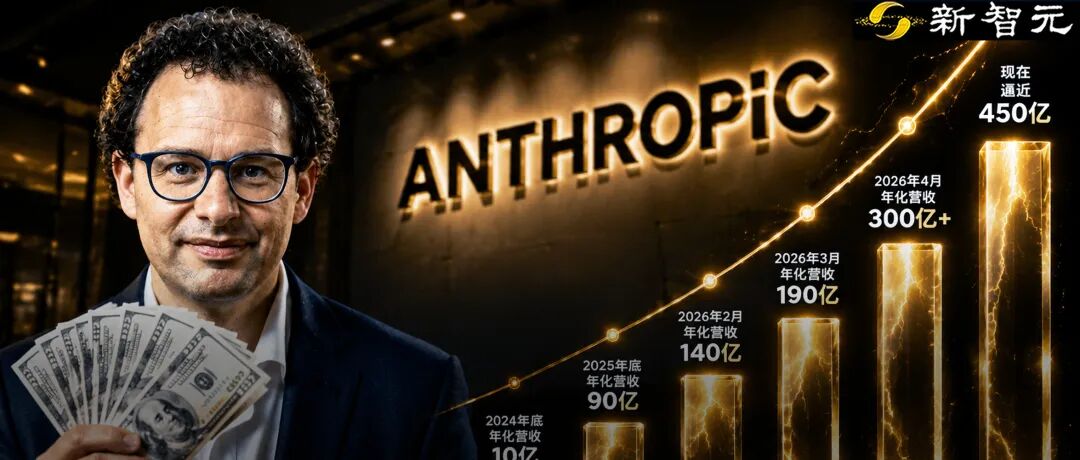
Back in late 2024, Anthropic's annualized revenue was about $1 billion. It reached $9 billion by the end of 2025. Then it took off in 2026, reaching $14 billion in February, $19 billion in March, breaking through $30 billion in April, and now approaching $45 billion.
Anthropic has increased from $1 billion to $45 billion in less than a year and a half.
CEO Dario Amodei recently revealed at a developer event that Anthropic originally planned its production capacity to increase by 10 times annually.
However, the actual growth rate in the first quarter of 2026 was 80 times. The computing power team was almost overwhelmed.
34.4% vs 32.3%, enterprise customers have switched sides
The answer to this growth lies in third-party data.
Ramp, one of the largest corporate expense management platforms in the United States, releases an AI procurement index every month.
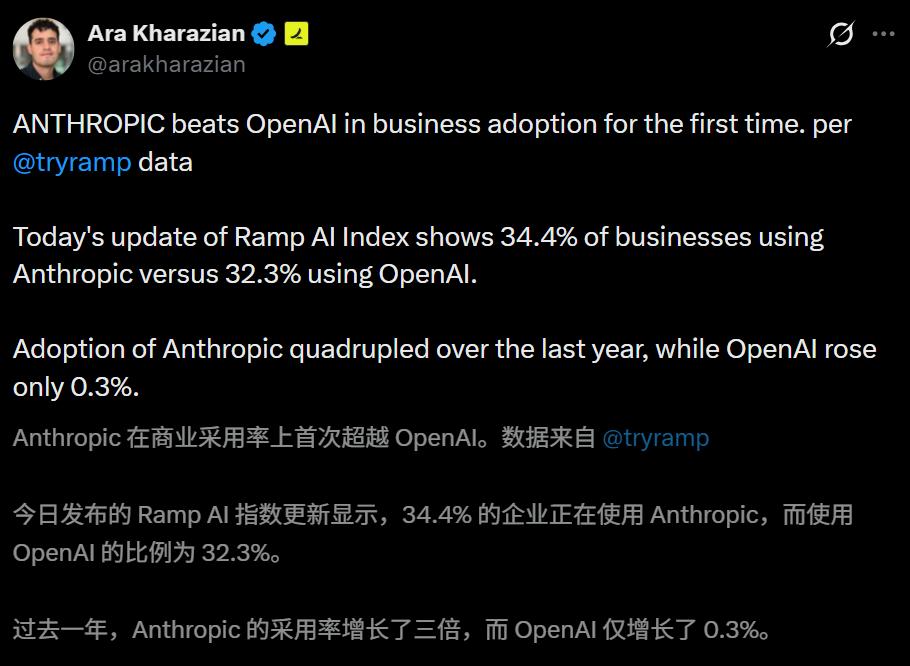
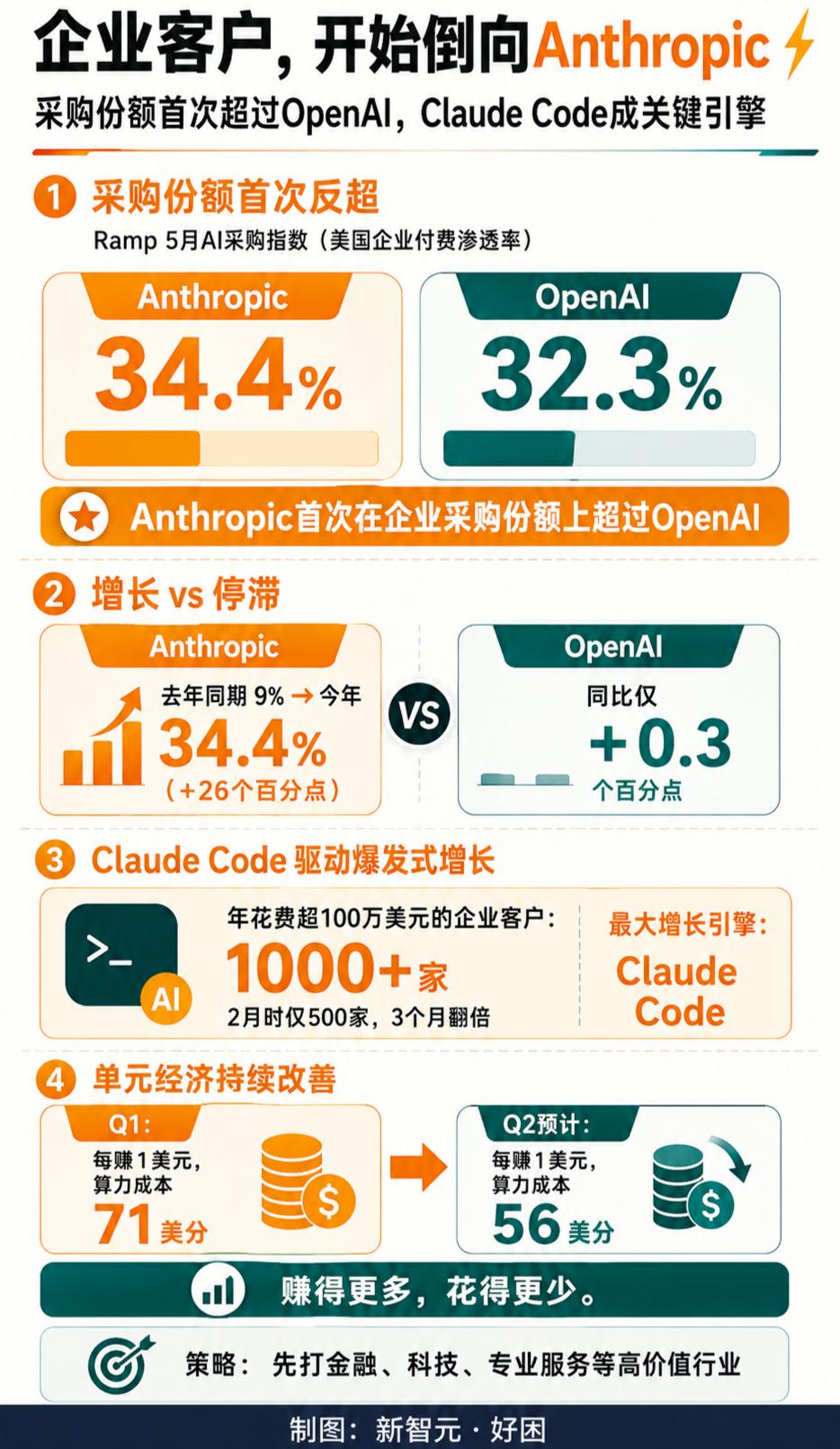
The data for May this year shows that 34.4% of US companies are paying for Anthropic, while for OpenAI it is 32.3%.
This is the first time in history that Anthropic has exceeded OpenAI in terms of enterprise procurement share.
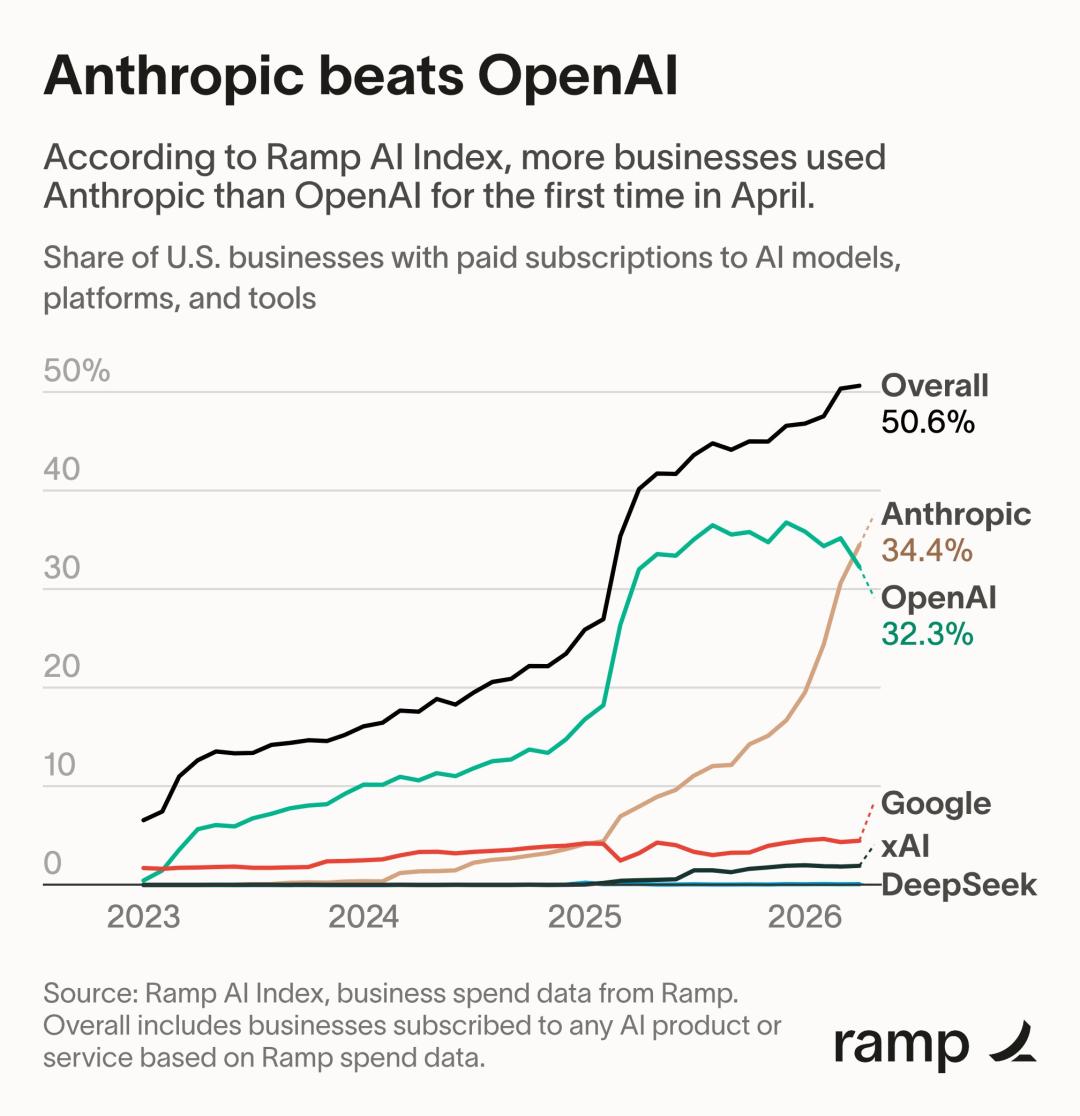
Compared with the same period last year, Anthropic has increased from 9% to 34.4%, a growth of 26 percentage points. In the same period, OpenAI only increased by 0.3%.
In response, Ara Kharazian, the chief economist at Ramp, analyzed that Anthropic's strategy is to "first target the technical teams in high-value industries such as finance, technology, and professional services, and then expand outward."
The biggest growth engine behind this is Claude Code.
Anthropic told investors that currently, more than 1,000 enterprise customers spend over $1 million on Claude annually.
In February this year, this number was only 500, and it has doubled in three months.
There is also a detail.
In the first quarter, for every $1 of revenue Anthropic earned, the computing power cost was 71 cents. In the second quarter, this figure is expected to drop to 56 cents.
That is to say, Anthropic is not only earning more but also spending less.
Losing $1.22 for every $1 earned
OpenAI's revenue in the first quarter was $5.7 billion, still nearly $1 billion more than Anthropic's in the same period in absolute terms.
However, leading in revenue is useless, as the profit statement is full of losses.
An adjusted operating profit margin of -122% means that even after deducting equity incentives, OpenAI still loses $1.22 for every $1 it earns.
905 million weekly active users, growth has stalled
The trouble OpenAI faces is not just losses. What's more troublesome is that the user growth of ChatGPT has also stalled.
In the first quarter, the average weekly active users of ChatGPT were about 905 million. This number seems large, but OpenAI originally expected to exceed 1 billion by the end of last year, but it failed to do so.
Looking more closely at the data, the number of weekly active users reached about 920 million in February this year, but the average for the entire first quarter was actually lower.
That is to say, the user volume actually declined during periods other than February.
OpenAI has issued a warning to its employees to be prepared for a "rough winter."
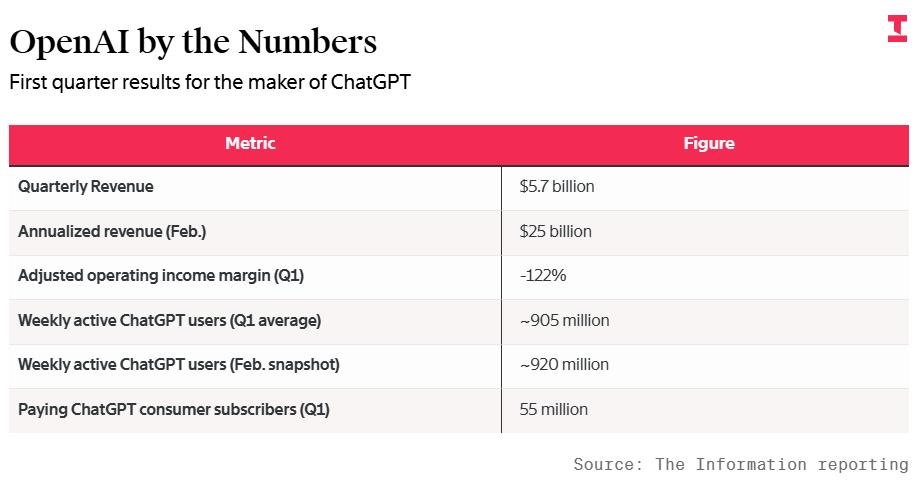
The number of paying users is still increasing. In the first quarter, there were 55 million consumer subscribers, 8 million more than at the end of last year. However, subscription fees alone cannot fill the -122% gap.
What really supported the first-quarter revenue were the programming Agent Codex, enterprise sales, and the advertising that has just started testing on ChatGPT.
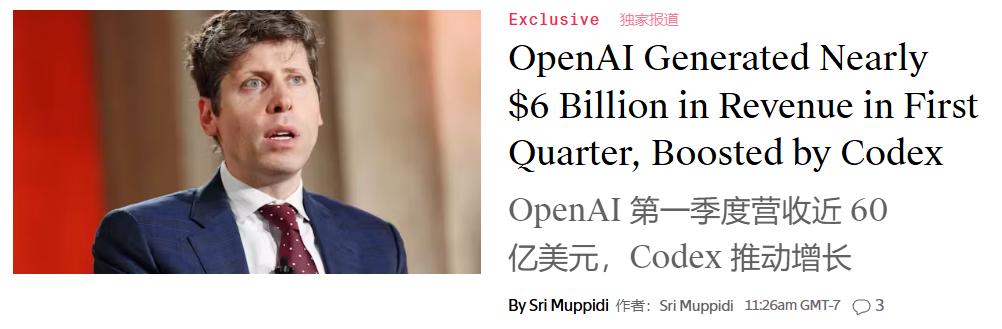
OpenAI has placed its biggest bet on advertising. Its plan is to generate over $100 billion in advertising revenue by 2030.
But that's a story for 2030. It's 2026 now.
Secret talks about Microsoft's Maia chips
$330 billion in computing power is fully deployed
Anthropic's ability to reach profitability so quickly is directly related to its computing power strategy.
Unlike OpenAI and xAI, which have long been tied to NVIDIA, Anthropic has taken a "multi-chip" approach from the beginning.
It uses NVIDIA GPUs, Amazon Trainium, Google TPUs, and GPUs from SpaceX's Colossus cluster simultaneously.
Now, it has set its sights on Microsoft's self-developed AI chips.

Today, it was reported that Anthropic is in talks with Microsoft about using its self-developed Maia 200 chips.
The Maia 200 is Microsoft's second-generation AI chip, which was launched in January this year. It uses TSMC's 3-nanometer process and has a reasoning efficiency more than 30% better than other chips at the same price.
However, this chip has a characteristic: its main focus is on efficiently running existing models rather than training new ones.
For Anthropic, this is just right. Claude has already been trained, and the reasoning cost is the major expense.
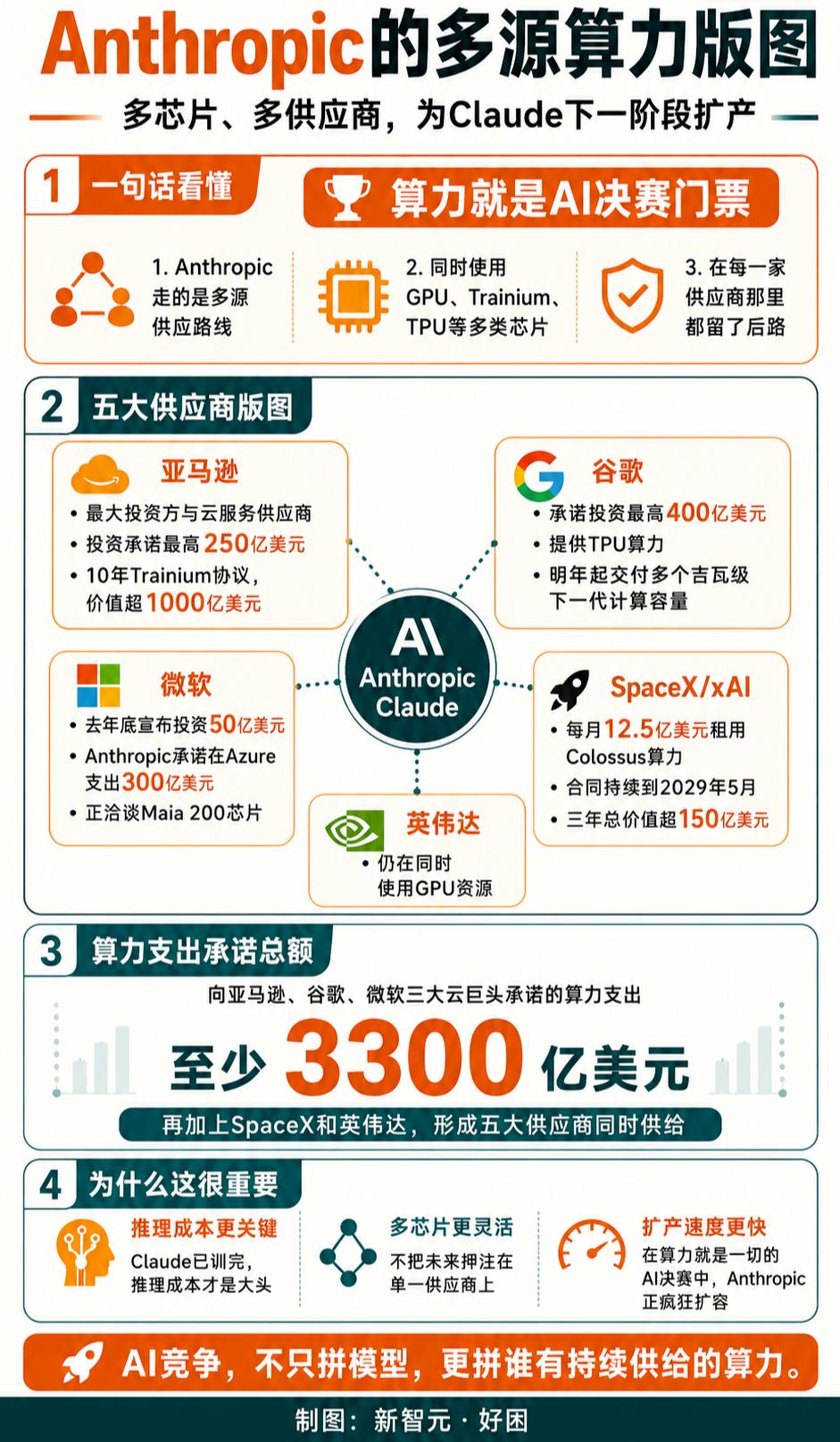
What does Anthropic's current computing power landscape look like?
Amazon: The largest investor and cloud service provider, it has promised to invest up to $25 billion. It signed a 10-year agreement to use Trainium chips last year, worth over $100 billion.
Google: It has promised to invest up to $40 billion, providing TPU computing power. It will start delivering multiple gigawatt-level next-generation computing capacities from next year.
SpaceX/xAI: It pays $1.25 billion per month to rent the computing power of the Colossus data center. The contract will last until May 2029, with a total value of over $15 billion in three years.
Microsoft: It announced an investment of $5 billion in Anthropic at the end of last year. Anthropic has promised to spend $30 billion on Azure. Now, it is also in talks about the Maia chips.
Anthropic has promised to spend at least $330 billion on computing power with Amazon, Google, and Microsoft, the three major cloud giants. Coupled with SpaceX and NVIDIA, five major suppliers are simultaneously providing computing power to a single company.
No other company in the entire AI industry has achieved such a high level of "multi-source supply."
Meta and OpenAI have recently started to learn Anthropic's multi-chip strategy, but they started much later.
It is worth mentioning that Anthropic has been steadily increasing its usage on Azure since November last year.
On Microsoft's side, it has not only allocated more existing NVIDIA servers to Anthropic but also started to build new server clusters for it. It has even reduced the resource allocation to some small customers to serve Anthropic.
In the AI final where computing power is everything, Anthropic is frantically expanding its production capacity. Moreover, it has left a backup plan with each supplier.
Both aiming for a trillion-dollar IPO
One is profitable, the other is bleeding
Now, the two strongest AI companies in the world are both rushing towards an IPO.
OpenAI is working behind closed doors with Goldman Sachs and Morgan Stanley on a draft prospectus. It plans to secretly submit it to the SEC as early as this Friday, with the goal of going public in September. Its valuation in the last round of financing was $852 billion, and this time the goal is to exceed $1 trillion.
Anthropic is also preparing for an IPO, as early as October this year. It is currently conducting a $30 billion round of financing, with a pre-investment valuation of up to $900 billion.
OpenAI has ChatGPT, 900 million weekly active users, and the most well-known AI brand in the world. However, the enterprises and developers who are actually paying for AI have chosen Anthropic.
The competition in the future will only be more costly.
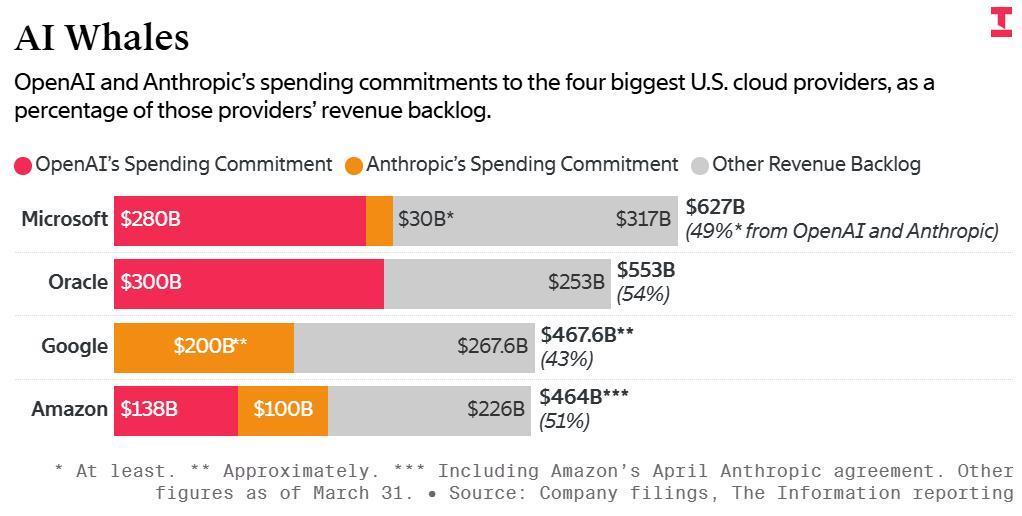
Both companies are fully committed to developing stronger next-generation models, and the computing power expenditure will continue to increase.
This competition is not only about whose model is smarter but also about who has enough money in the bank to keep going.
In 2021, Dario Amodei left OpenAI with a group of people and founded this company.
At that time, everyone thought it was just another challenger destined to live in the shadow of OpenAI.
Five years later, the ones who left are making money, while the ones who stayed are still losing $1.22 for every $1 they earn.
Reference materials