Chinese companies have fully occupied the top 10 list of energy storage cells, squeezing out Japanese and South Korean companies.
Huaxia Energy Network learned that on May 19th, InfoLink released the global energy storage cell shipment ranking for the first quarter of 2026, revealing notable new changes in both the market landscape and corporate competition.
In terms of the market, since the second half of 2025, the industry concentration of the Top 10 companies has dropped below 90% for the first time. In the first quarter of 2026, the CR10 industry concentration was 85.3%, showing a continuous decline.
In terms of companies, Chinese energy storage manufacturers have been developing rapidly and occupied all the spots in the Top 10 list. However, competition among manufacturers has become more intense, and new "disruptors" have emerged.
Chinese Companies Dominate the List, New Dark Horse Disrupts the Market
In the first quarter, the top five in the global energy storage cell shipment list remained stable. CATL (SZ: 300750) ranked first, Hichen Energy Storage held onto the second place, and the 3rd to 5th places were occupied by EVE Energy (SZ: 300014), BYD Energy Storage (SZ: 002594), and CALB (HK: 3931) respectively.
The 6th to 10th places were taken by Chueneng New Energy, Ruipu Lanjun (HK: 0666), Envision AESC, Penghui Energy (SZ: 300438), and Guoxuan High-Tech (SZ: 002074) respectively.
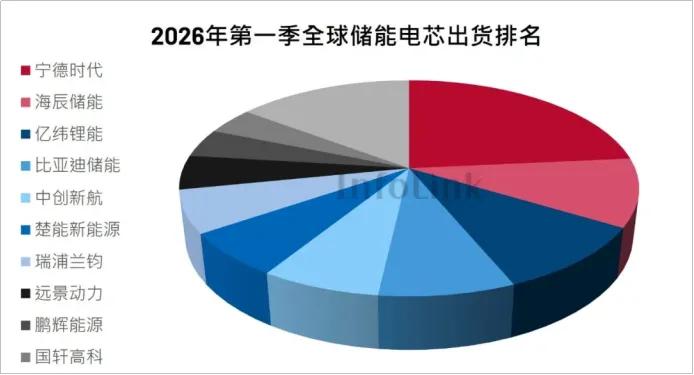
Huaxia Energy Network and Huaxia Energy Storage noticed that among the TOP10 list, the most significant change was Chueneng New Energy. In the Top 10 global energy storage cell shipments in 2025, Chueneng New Energy, as a "dark horse" in the industry, made its first appearance on the list, ranking 9th. In this ranking, it further jumped to the 6th place, demonstrating the company's strong development momentum.
Chueneng New Energy has been established for less than 5 years, but it has already built a production capacity of over 120GWh and is still expanding. Dai Deming, the chairman of Chueneng New Energy, previously predicted that in the next two years, only about a dozen energy storage battery factories will survive, and companies lacking R & D innovation and large - scale manufacturing capabilities will be eliminated.
From the perspective of the overall market share, the CR10 industry concentration in the first quarter was 85.3%, showing a continuous decline. This means that the competitiveness of second - and third - tier manufacturers is constantly strengthening. In the future, there may be a second or third Chueneng New Energy, becoming a "disruptor" on the list.
From a comparison between Chinese and foreign manufacturers, all overseas cell manufacturers have disappeared from the list. In the same period last year, South Korean cell manufacturer Samsung SDI still occupied the 10th place on the list with a large order from NextEra, maintaining a weak presence.
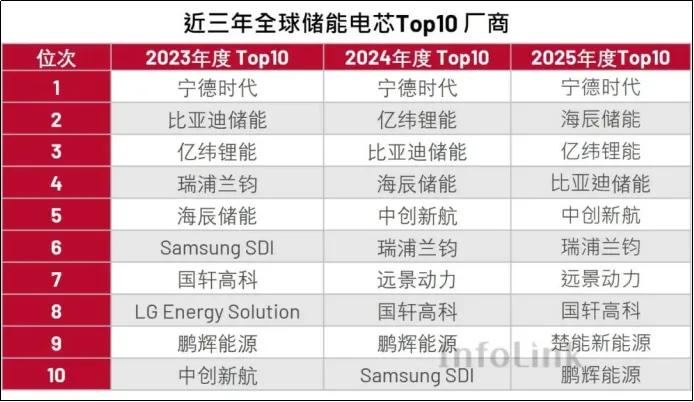
However, Chinese battery manufacturers are not without worries. South Korean manufacturers are still "working hard secretly" and hoping to make a comeback.
For example, Samsung SDI and SK On are expanding energy storage orders in North America and converting some power battery production lines into energy storage battery production lines. The adjustment has already started, and mass production and delivery are expected in the second half of the year. LG Energy Solution has invested heavily in lithium iron phosphate batteries, and its strategy of converting from power batteries to energy storage batteries has shown initial results. Currently, the production lines of several battery bases in North America have been fully switched from power batteries to energy storage batteries.
InfoLink said that LGES' market share has been rising quarter by quarter since the second quarter of 2025 and is expected to return to the global top ten in the third quarter of 2026.
Residential Energy Storage Soars Nearly 3 - fold, Large - sized Cells Accelerate to Capture the Market
In the first quarter of 2026, the global energy storage cell shipments reached 205.52GWh, a year - on - year increase of 98.7% and a slight quarter - on - quarter increase of 1.62%. The main driving force for the growth of energy storage cell shipments comes from the large - scale energy storage and residential energy storage sectors.
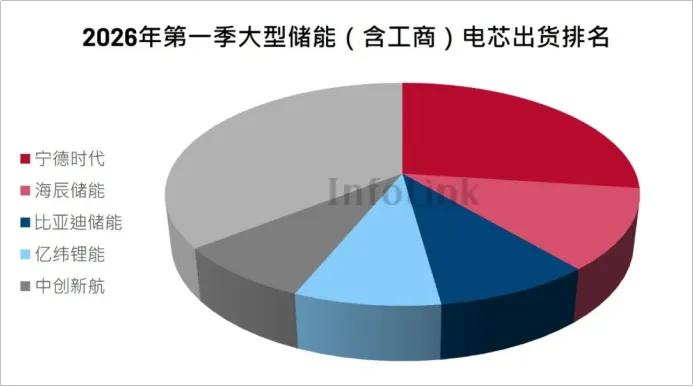
InfoLink said that in the first quarter of 2026, the global large - scale energy storage cell shipments reached 178.27GWh, a year - on - year increase of 84.54% and a slight quarter - on - quarter decrease of 3.47%. In the large - scale energy storage market, the top 5 companies are CATL, Hichen Energy Storage, BYD Energy Storage, EVE Energy, and CALB. The main change this quarter is that BYD Energy Storage has returned to the top three.
The residential energy storage market has witnessed explosive growth. InfoLink data shows that in the first quarter, the shipments of small - scale energy storage cells in the market reached 27.25GWh, a year - on - year increase of 298.98% and a quarter - on - quarter increase of 55.27%. EVE Energy continued to rank first, Ruipu Lanjun and Penghui Energy tied for second, and Chueneng New Energy entered the top five for the first time.
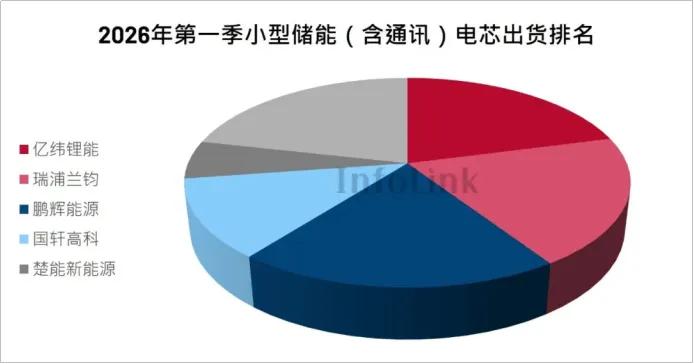
A year ago, Penghui Energy entered the Top 3 in the residential energy storage cell market, breaking the duopoly competition pattern of EVE Energy and Ruipu Lanjun. So far, the top 3 positions in the small - scale energy storage cell market have remained stable.
It is worth mentioning that the models of residential energy storage cells are also changing. The mainstream model is 100Ah. However, since 2025, battery manufacturers' willingness to expand production of 100Ah cells has been average, while 280/314Ah cells, with their high cost - effectiveness, are accelerating their penetration into the residential energy storage market. The mainstream residential cell model is accelerating the switch from 100Ah to 314Ah.
InfoLink data shows that in the first quarter of 2026, the penetration rate of 280/314Ah cells in the residential market was close to 22%, and it may reach 30% in the second quarter.
From the perspective of the entire industry, the new generation of large - sized cells is accelerating to capture the market, and the penetration rate of cells above 500Ah is close to 5%. Previously, InfoLink predicted that the penetration rate of cells above 500Ah would exceed 15% in 2026. In this list, InfoLink has raised the expected value, predicting that the penetration rate of cells above 500Ah will be close to 20%.
Huaxia Energy Network and Huaxia Energy Storage noticed that since 2026, at large - scale energy storage exhibitions, 587/588Ah has become the mainstream cell model for major battery manufacturers and will enter the mass - production stage in the second quarter and the second half of the year. Many industry insiders believe that cells above 500Ah will become the new mainstream to replace the current 314Ah cells in 1 - 2 years.
InfoLink said that the pace of upgrading and iterating cells above 500Ah by various manufacturers is relatively inconsistent. Leading manufacturers are aggressive and have entered the stable mass - production stage; mid - tier manufacturers are more conservative, mostly by upgrading the 314Ah production lines to enter the production of cells above 500Ah, or purchasing 1 - 2 new production lines with relatively cautious capital expenditure to observe the market trend.
Conclusion: Expected Shipments of 897GWh in 2026
According to InfoLink's data, the energy storage cell industry developed well in the first quarter, laying a foundation for the growth of annual shipments. However, the impact of variables cannot be ignored. Currently, as the prices of upstream raw materials continue to rise, cell prices are under pressure. If the cell price increase is too large, the enthusiasm for downstream installations may be affected.
For the energy storage cell market in 2026, InfoLink maintains its judgment of "tight balance in the first half of the year and moderate relaxation in the second half of the year" and raises the original shipment forecast. That is, the global energy storage cell shipments in 2026 will reach 897GWh, and the market will maintain a medium - to - high - speed growth trend.