The "top - stream" robot live - streaming has become popular, working continuously for seven days without errors.
Recently, a live stream has injected a shot in the arm into the robotics industry.
On May 20th local time, Brett Adcock, the founder of Figure, announced on social media that the F.03 robot under his company had been working continuously for nearly a week, 24 hours a day, in a live - streaming state, and "had no malfunctions" under fully autonomous operation.
According to the latest data, since the start of the live stream, the F.03 robot has been running continuously for 181 hours and 6 minutes so far, and has processed a total of about 226,000 packages. In terms of work efficiency, the F.03 can sort nearly 21 packages per minute on average, and its sorting speed is close to the 30 - 40 packages per minute of humans.
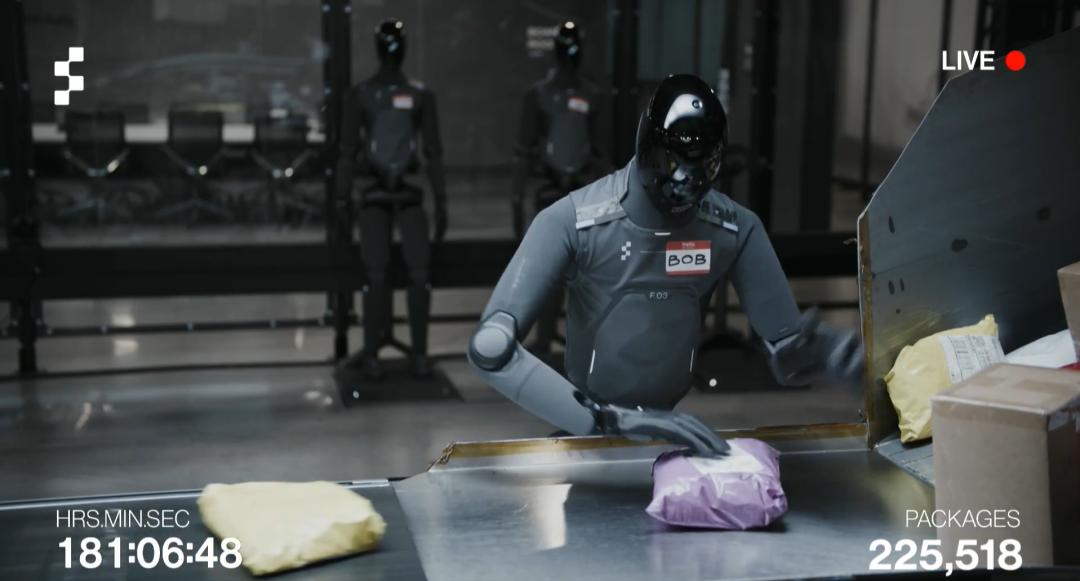
Not only does the F.03 exceed expectations in terms of duration and sorting efficiency, but it is also remarkable in terms of stability.
In terms of work content, during the live stream, a total of 3 F.03 robots took turns to carry out logistics sorting work. They needed to complete processes such as barcode detection, package grabbing, and direction adjustment beside the conveyor belt. Each robot worked continuously for about 3 - 4 hours per shift.
It is worth noting that when its battery is too low, the F.03 will autonomously request another robot to take over to minimize downtime. If it detects an abnormality, the F.03 will conduct self - diagnosis, autonomously go to the maintenance area, and request a replacement robot, that is, no human intervention is required in case of a malfunction.
Beyond stability, the mass - production capacity of humanoid robots has increasingly become the focus of the industry.
01
According to the official disclosure of Figure, its BotQ factory can now produce one F.03 robot per hour, which is 24 times the efficiency of 5 months ago. Moreover, the first - pass yield rate at the end of the production line has exceeded 80%, and the first - pass yield rate of the battery production line has reached 99.3%.
Tao Lin, the vice - president of Tesla, also posted today that at the Fremont factory in California, Elon Musk and the owners of the Signature Edition of Model S/X witnessed the last production run of these two models. This production line will soon be transformed into a production line for Tesla's humanoid robots to undertake more important tasks in the era of artificial intelligence.
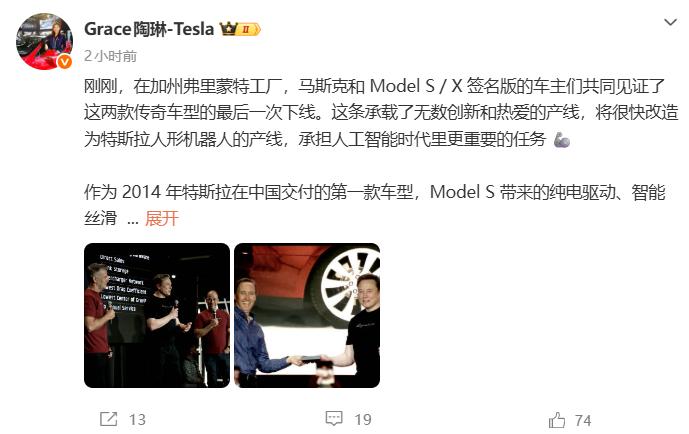
Just last month, Tesla said that the first - generation production line of Optimus is designed to produce 1 million robots per year and will replace the Model S and Model X production lines in Fremont; it is preparing a second - generation production line for the Texas Gigafactory, with a designed annual production capacity of 10 million robots.
Guoyuan Securities pointed out that for real - factory deployment, the industry's focus is usually not whether a robot "can complete a single action", but whether it can run continuously, work stably without continuous human intervention, maintain consistent performance when multiple devices are operating in parallel, and have a maintainable and engineerable system. Therefore, compared with a single demonstration, the expression of "24/7 continuous autonomous operation" is closer to the actual assessment standard when introducing robots into factories. It refers to system - level capabilities rather than showing off single - item functions.
Hualong Securities summarized that since 2026, the core issues surrounding humanoid robots have gradually shifted from "can they be made" to "how many can be made" and "can they be used". The good performance of humanoid robots in the generally recognized priority scenario of factories has become a prerequisite for their further large - scale application. Humanoid robots have verified their actual working capabilities through factory live streams, and customers in industries such as automotive, logistics, and consumer electronics are expected to accelerate their application, driving a rapid increase in their shipments.
Haitong International Securities judged that commercialization is the main line at the current stage of humanoid robots. The hardware system is basically mature, and the dexterous hand remains the main marginal constraint. Under this framework, the key to industry competition has shifted from single - point technological breakthroughs to the comprehensive ability of "system integration + scenario closure + continuous delivery", competing to be the first to transform technological advantages into replicable commercialization paths. Therefore, in terms of investment, it is recommended to focus on leading humanoid robot manufacturers with high delivery certainty, especially leading enterprises with a leading shipment rhythm and faster commercialization.
This article is from the WeChat official account "Kechuang Daily", author: Zhang Zhen. It is published by 36Kr with authorization.