Musk's $270 billion computing power order is made public, revealing all about 540,000 GPUs, space AI computing, and the progress of the $400 billion merger and acquisition case.
On May 21st, Xin Dongxi reported that today, SpaceX, the AI and space commercial company under Elon Musk, disclosed its IPO prospectus, revealing details of a $40 billion (approximately RMB 272.1 billion) data center deal with Anthropic, a major U.S. large - model unicorn, as well as more information and plans regarding its AI computing clusters, chip manufacturing factories, orbital AI computing satellites, and a $60 billion acquisition of Cursor.
After going through the 373 - page prospectus, Xin Dongxi sorted out the key information about Musk's AI computing power landscape, which mainly includes:
1. Anthropic agreed to pay SpaceX $1.25 billion (approximately RMB 8.5 billion) per month until May 2029.
2. The two data centers, COLOSSUS and COLOSSUS II, together provide approximately 1.0 gigawatt of computing power, with 10 H100s, 110,000 GB200s, and 110,000 GB300 GPUs. It is expected that the next - stage expansion of COLOSSUS II will bring at least 220,000 additional GB300 GPUs.
3. Terafab aims to become "the world's largest chip manufacturing factory" and will produce robot chips, automotive chips, and space chips. SpaceX has reached an agreement with Tesla on the development framework of Terafab, but specific projects have not been determined. "Neither Tesla nor Intel is obligated to continuously participate in this project."
4. The total target market for SpaceX's AI is estimated to be $26.5 trillion (approximately RMB 180 trillion), of which the total target market for AI infrastructure is $2.4 trillion (approximately RMB 16 trillion).
5. The key constraints on the continuous growth of AI are physical chip manufacturing, data center infrastructure, and power generation. The future of AI will be determined by control over the physical stack. Physical infrastructure, rather than models, will become the main competitive advantage for AI companies. "No AI company can control the complete physical infrastructure better than we can," SpaceX wrote.
6. Currently, SpaceX mainly relies on natural gas and gas turbine technology to power its data center operations. The company expects the structural power shortage to intensify in the next few years and believes that solar energy is 'the only truly scalable solution to Earth's energy limitations in the AI era', and "utilizing this energy in space is much more effective than on land."
7. Only SpaceX can solve the technical challenges of orbital AI computing on a large scale in the short term. SpaceX has overcome many major technical obstacles in developing connected satellites into AI computing satellites and is capable of delivering a comprehensive AI computing satellite constellation. The goal is to deploy 100 gigawatts of AI computing power annually through satellite launches, and it is expected to start deploying orbital AI computing satellites as early as 2028.
The prospectus shows that in 2025, SpaceX's revenue was $18.674 billion (approximately RMB 127 billion), and its net loss was $4.937 billion (approximately RMB 33.6 billion). The capital expenditure for its AI business was as much as $12.727 billion (approximately RMB 86.6 billion).
SpaceX also bears a huge debt. As of March 31st this year, the total outstanding principal debt was $29.132 billion (approximately RMB 198.1 billion).
According to an option agreement signed between SpaceX and Cursor, a star AI programming startup, SpaceX can acquire Cursor for $60 billion (approximately RMB 408.1 billion) within 7 trading days after the IPO or within 30 days after September 30th. If the agreement is terminated, SpaceX will pay Cursor $10 billion (approximately RMB 68 billion).
01 Securing a Big Computing Power Deal with Anthropic: $1.25 Billion per Month for 3 Years, Either Party Can Terminate
In May this year, SpaceX and Anthropic reached a cloud - service agreement regarding access to the computing power of the two large - scale data centers, COLOSSUS and COLOSSUS II.
According to the agreement, Anthropic agreed to pay SpaceX $1.25 billion (approximately RMB 8.5 billion) per month until May 2029 and increase production capacity at a reduced cost in May and June 2026.
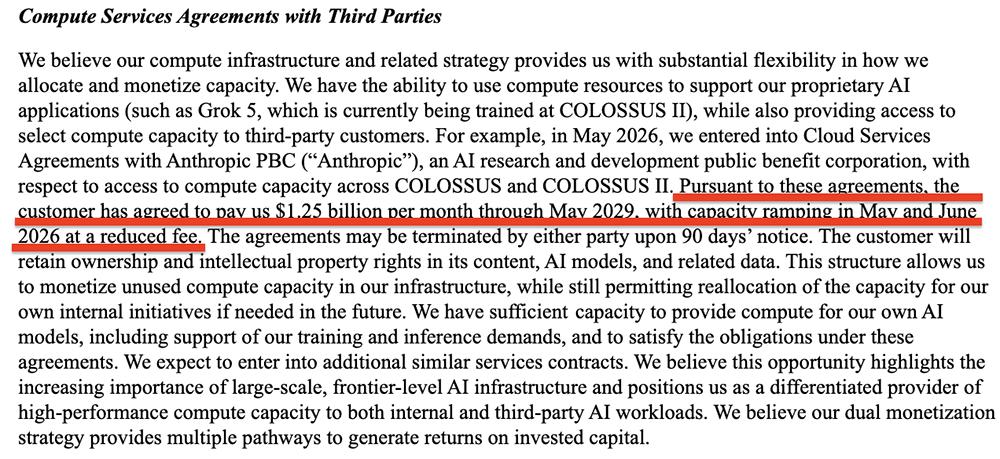
Either party can terminate the agreement with 90 - day notice, and the customer will retain the ownership and intellectual property rights of its content, AI models, and related data.
According to foreign media reports, this deal is worth approximately $40 billion (approximately RMB 272.1 billion) and will be one of the largest AI facility deals on record, helping to boost SpaceX's suddenly slowing revenue growth.
"We expect to sign more similar service contracts," SpaceX wrote in the prospectus.
02 Two Data Centers of xAI: 100,000 H100s, 110,000 GB200s, 330,000 GB300s
According to the prospectus, xAI is the first company to deploy a coherent gigawatt - scale AI training cluster and is still investing to expand its ground - based AI computing infrastructure.
The two computing clusters, COLOSSUS and COLOSSUS II, together provide approximately 1.0 gigawatt of computing power and additional power capacity for data center operations.
COLOSSUS launched its first cluster of approximately 100,000 H100 GPUs with approximately 130 megawatts of computing power in 122 days.
COLOSSUS II even launched its first cluster of approximately 110,000 GB200s with approximately 210 megawatts of computing power in 91 days. Later, COLOSSUS II launched a second cluster with 110,000 GB300s and approximately 220 megawatts of computing power in 64 days.
As an illustrative comparison, it takes approximately two years for the industry benchmark to launch a 100 - megawatt greenfield data center.
So far, COLOSSUS II has become one of the world's first data centers to deploy GB200s and GB300s on a large scale and is training SpaceX's next - generation cutting - edge models (including Grok - 5).
SpaceX expects that once fully operational, the next - stage expansion of COLOSSUS II will bring at least 220,000 additional GB300s and more than 400 megawatts of additional computing power.
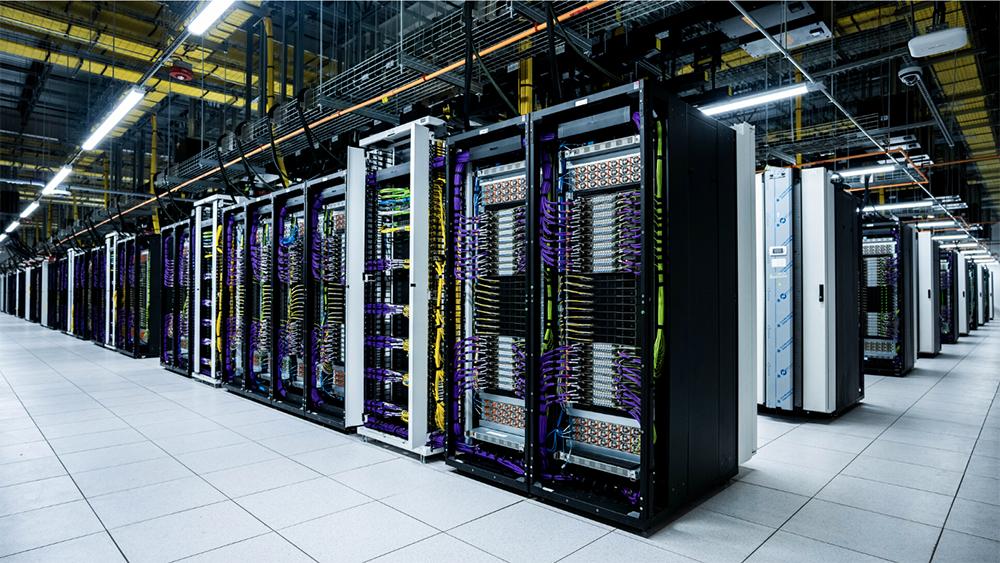
▲ The COLOSSUS II facility in Memphis, Tennessee, USA
The initial confidential version of the S - 1 draft included detailed information on the cost advantages of xAI in building data centers, stating that xAI built the first cluster at COLOSSUS II at a price of $2.7 million per megawatt (approximately RMB 18.36 million), far lower than the industry benchmark of $12.3 million per megawatt (approximately RMB 83.66 million).
However, in the final S - 1 document, this information disappeared, and SpaceX only generally mentioned "significant improvements in cost - efficiency, making the data center construction cost of COLOSSUS II significantly lower than the industry benchmark per megawatt."
In the latest prospectus, SpaceX disclosed: "Through first - principles thinking, meter - based power generation, combined with what we believe is the world's largest sustainable battery storage system network, as well as innovations in advanced liquid cooling, high - density rack layout, and efficient networking, we can deploy power and computing faster than other AI companies."
03 AI Chip Manufacturing Project Terafab: Join Hands with Tesla and Intel to Make Chips for Robots, Cars, and Space Computing
The prospectus shows that Musk's ambitious AI chip manufacturing project, Terafab, is far from a done deal.
In March this year, SpaceX announced a cooperation with Tesla to establish the Terafab project, with a long - term goal of producing 1 terawatt of computing hardware annually. Intel joined the project in April and is expected to contribute its expertise in designing, manufacturing, and packaging ultra - high - performance chips to help Terafab scale up.
Terafab aims to further expand its vertical integration in chip design, manufacturing, and packaging to alleviate potential future chip shortages at SpaceX, especially when it develops orbital AI on a large scale and designs chips optimized for the space environment.
SpaceX expects: "Terafab will become the world's largest chip manufacturing factory."
The Terafab project supports the growth of two types of chips:
1. Chips optimized for ground - edge and inference, mainly used in Tesla's Optimus robots and cars;
2. Chips optimized for the space environment, used in SpaceX's orbital computing infrastructure.
According to the prospectus, SpaceX has reached an agreement with Tesla on the overall framework for Terafab's future development, but any specific projects carried out under this framework will be subject to separate negotiations and agreements and have not been determined.
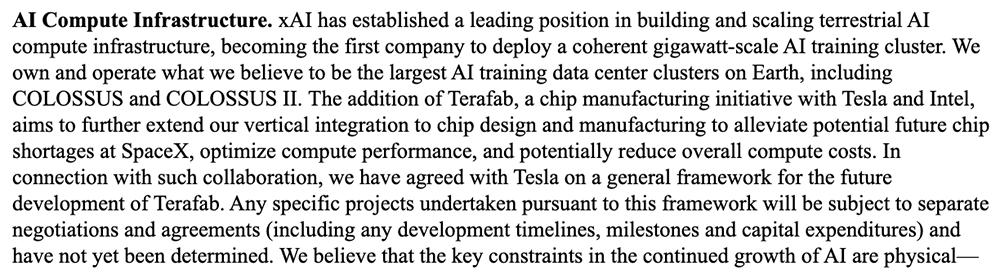
SpaceX expects to continue to purchase a significant portion of its computing hardware from third - party suppliers and cannot guarantee that it will achieve its goals for Terafab within the expected time or even at all.
"Although we have a framework agreement with Tesla, neither Tesla nor Intel is obligated to continuously participate in this project, and we may not sign any such final agreement," the prospectus wrote.

SpaceX also plans to explore strategic cooperation with Tesla in other fields in the future.
04 Large - Scale Deployment of Orbital AI Computing: Aim to Launch 100 Gigawatts of AI Computing Power Annually
SpaceX believes that the Earth cannot rapidly expand its power - generation scale, and physical, environmental, and regulatory limitations will prevent it from achieving the order - of - magnitude growth required to meet the future energy needs of the AI era.
According to the prospectus, the energy from the sun is a huge free fusion reactor in the sky, accounting for approximately 99.8% of the solar system's energy, "providing the only truly scalable solution to Earth's energy limitations."
"By combining the almost infinite solar energy in space with our industry - leading launch costs and satellite manufacturing capabilities, we believe that over time, we can provide computing at a lower cost structure than on Earth," SpaceX wrote.
"Orbital AI computing" refers to the AI computing infrastructure deployed in space, including satellite constellations as orbital data centers, using solar energy for power generation and the space environment for cooling.
By the end of this decade, SpaceX plans to deploy the first modular orbital AI computing shell and start monetizing its capabilities by selling AI software and AI computing.
Its goal is to launch 100 gigawatts of AI computing power on solar satellites annually, which is equivalent to about 1/5 of the total annual power generation in the United States in 2025.
The prospectus shows that the company's launchable computing power depends on three components: payload, satellite capacity, and launch frequency. Its satellites can carry more than 100 kilowatts of computing power per metric ton, can launch satellites thousands of times a year, send approximately 1 million metric tons of cargo into orbit, and deploy 100 gigawatts of AI computing power.
SpaceX expects to start deploying orbital AI computing satellites as early as 2028 and will use its mature Starlink in - orbit technology to optimize orbital AI computing.
05 The $60 - Billion Acquisition of Cursor is in Progress; $10 Billion Will Be Paid if the Agreement is Terminated
The prospectus also revealed more details about SpaceX's acquisition of Cursor, an AI programming startup.
In April this year, SpaceX and Cursor reached a computing agreement: SpaceX will provide Cursor with a certain GPU cluster computing power for specific development, training, improvement, and other activities related to AI models and other technologies and intellectual property.
In exchange, Cursor will provide certain personnel, data and datasets, documentation, know - how, workflows, prompts, specifications, and software code. SpaceX will cooperate with Cursor to improve SpaceX's existing models and may jointly develop AI models and related model - specific deliverables.
Meanwhile, SpaceX also signed an option agreement with Cursor. According to the agreement, SpaceX has the right (but not the obligation) to acquire Cursor.
If SpaceX acquires Cursor, it will pay $60 billion (approximately RMB 408.1 billion) in Class A common stock purchase price and can do so at any time within 7 trading days after the IPO or within 30 days after September 30th.
After meeting the closing conditions stipulated in the merger agreement, including obtaining the necessary regulatory approvals, Cursor will become a subsidiary of SpaceX, and SpaceX will acquire all of Cursor's cash, intellectual property, personnel, customer contracts, and other assets.
If SpaceX decides to terminate the option agreement, or if Cursor is eligible and decides to terminate the option agreement due to SpaceX's material breach of the option agreement, Cursor is entitled to a $1.5 - billion termination fee under the option agreement and an $8.5 - billion deferred service fee under the computing agreement. That is, SpaceX will pay $10 billion (approximately RMB 68 billion) in cash or stock fees.
