The most embarrassing moment for Jensen Huang was when AMD's Lisa Su decided to bet on China.
Four days after Jensen Huang left, Lisa Su arrived in Shanghai.
Last week, Jensen Huang squeezed into Trump's China visit entourage at the last minute. He wanted to bring NVIDIA back to China. However, since he left Beijing, many of the accompanying entrepreneurs have secured large orders, but there is still no clear statement regarding the implementation of the H200 in China.
Subsequently, Lisa Su, the CEO of AMD, landed in Shanghai. She moved AMD's annual technology event for developers, Advancing AI, out of the United States for the first time and held it in China. The venue was packed with more than two thousand Chinese developers.
During her speech, she made a prediction: In the next five years, five billion people will use AI every day. Then she asked the audience, "Are you excited?"
Then came the most important statement of the conference - China is at the core of AMD's roadmap.
This is a statement that no CEO of an American chip company has publicly made in the past few years.
To understand why Lisa Su said this, we need to first understand what she is betting on.
AMD's Loss to NVIDIA Has Never Been in Hardware
As a major GPU manufacturer, AMD is not without AI chips. In fact, it even leads NVIDIA in some hardware parameters.
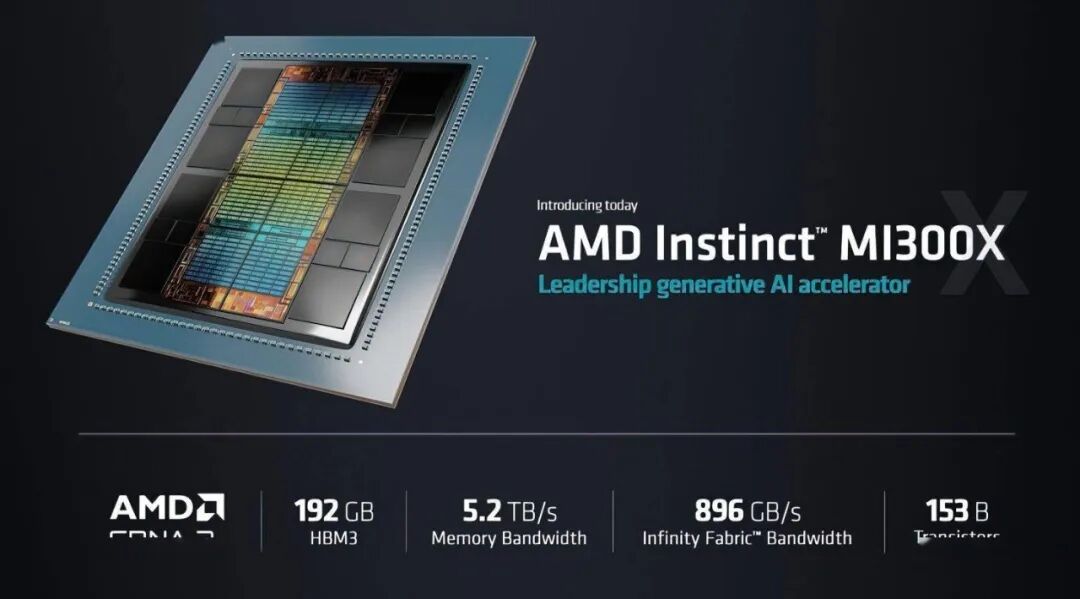
For example, the MI300X single - card has 192GB of HBM3 memory, which is more than twice that of NVIDIA's contemporary H100. Analysts write reports every once in a while with similar titles like "AMD has caught up in hardware this time."
However, the real rules of the market are never determined by hardware parameters.
Jensen Huang's moat is called CUDA. NVIDIA started to lay the groundwork in 2006 and spent twenty years making it the default underlying language for AI developers. Today, millions of developers around the world write CUDA code, and the toolchains for training and deploying models all revolve around the NVIDIA ecosystem. When an AI startup posts a job advertisement, the first requirement in the job description is usually "familiar with CUDA."
This is not just a technological advantage; it is a mental monopoly.
AMD has also developed a corresponding open - source software stack called ROCm, but it started more than a decade later. For developers to migrate from CUDA to ROCm means rewriting code, encountering new challenges, and rebuilding engineering intuition.
We can see how difficult this migration is from the recent DeepSeek case. Even with the help of domestic chip manufacturers, the release date of V4 was repeatedly postponed in order to migrate it from the NVIDIA ecosystem to Huawei and Cambricon.
So, we can see a recurring cycle. Every time AMD releases a new generation of GPUs, it catches up in hardware, but developers still write CUDA code. This has been AMD's deepest strategic dilemma in the past decade. It can win in hardware but not in the ecosystem.
Lisa Su has not always lost to NVIDIA and Intel.
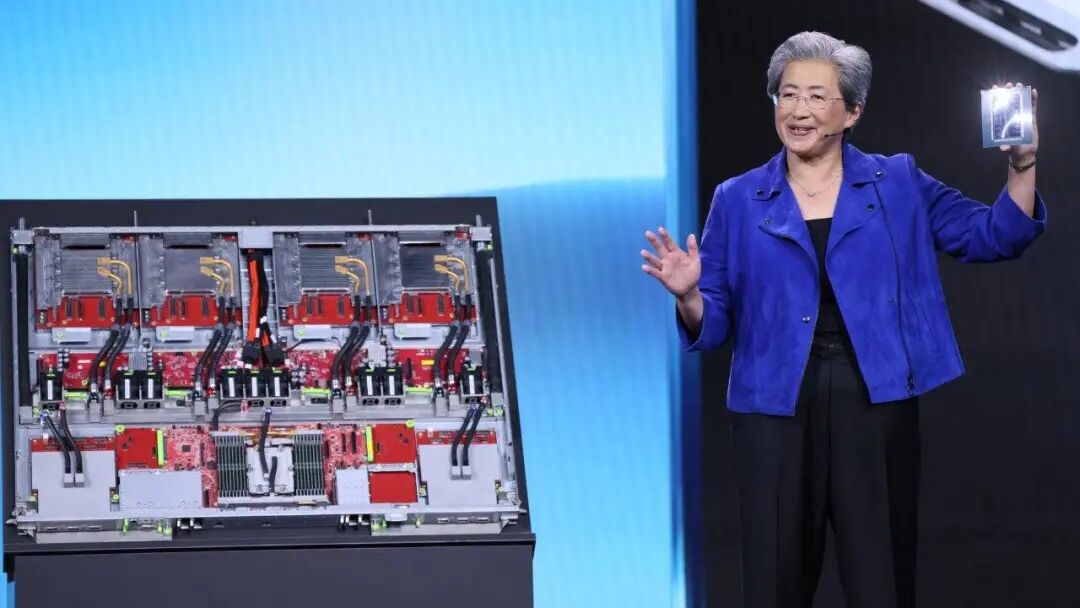
When she took over AMD in 2014, the company's stock price was less than $4, and the market was speculating whether it would be squeezed out of the game. Her bet was on the hardware architecture. She broke down complex giant chips into smaller, more easily manufacturable modules and then put them together. This is the Zen architecture and chiplet packaging, which bypasses the yield problem of single large chips.
AMD won this battle completely. In six years, AMD's share in the server CPU market increased from nearly zero to over 30%, taking a significant share from Intel.
Entering the AI era, AMD has also secured several major customers. The MI300X is the second - largest AI chip in North America after NVIDIA in terms of market share.
However, if we look closely at the procurement structure of large customers, we will find that Microsoft and OpenAI buy AMD products mainly as a supply - chain hedge. They don't want NVIDIA to have 100% of the market share, so they keep an alternative option. This means that as long as NVIDIA makes concessions, reduces prices, or improves services, AMD's market share could shrink at any time.
Customers buy AMD products not because they can't do without AMD.
Lisa Su is well aware of this. She needs a new battlefield, a market that is willing to use AMD as the primary choice rather than just an alternative.
This is almost impossible in the United States, so she needs China.
What AMD Wants to Capture in China Is the Next Wave
Since 2022, the US government has tightened its export controls on AI chips to China round by round. NVIDIA has continuously launched China - compliant versions, only to be restricted by new rules. By the time of the H20, the Chinese market has also become more cautious, and more and more customers are starting to evaluate domestic alternatives.
NVIDIA once held a 95% market share in China. In a public interview in May this year, Jensen Huang said that this figure is now close to zero.
Under the same policy environment, AMD's situation is completely different.
Its market value is only one - twentieth of NVIDIA's and it has never been regarded as a core target in the great - power technology game. Its product for export to China, the MI308, has obtained partial US licenses. In China, its market share is so low that there is no suspicion of monopoly, and its products are not on any security review list. There are rumors in the market that a large domestic company is negotiating to purchase 50,000 MI308 chips.
It is not strong enough, not large enough, and not iconic enough.
In the past, this was AMD's disadvantage. In the context of the China - US chip landscape in 2026, this status actually makes it easier for AMD to operate in the Chinese market.
Lisa Su doesn't need to create a new trend; AI itself is already big enough. What she wants is to find a group of customers in China who are willing to use AMD as their primary choice.
She has found them - those working on AI Agents.
In the past three years, the keyword in the global AI competition has been large - model training. In the next stage, almost everyone in the industry knows that it will be Agents.
Simply put, an Agent is a capable assistant. It can break down tasks, call tools, execute steps, and finally deliver the results to you.
It can create PPTs, book flights, follow up on sales leads, and process contracts. It doesn't just involve one - time Q&A but a series of judgments, breakdowns, and executions, with very different computing power requirements from the training era.
The US Agent market is concentrated in the hands of a few giants. They either develop their own chips or are deeply tied to NVIDIA, making it difficult for AMD to enter.
China is different. There are a large number of new customers who are not locked in by CUDA, and there is a mature mobile - Internet consumption habit, accustomed to a low - price, high - frequency business model. This environment has nurtured a group of developers who are technology - neutral, familiar with the open - source ecosystem, and price - sensitive.
This is exactly the type of customers that AMD has been looking for.
Understanding this, it becomes clear what Lisa Su did during her visit to Shanghai.
Lisa Su's keynote speech lasted only about ten minutes. The rest of the time was dedicated to technical workshops, ecosystem discussions, and one - on - one exchanges with engineers.
The theme of the conference was not the performance breakthrough of a new chip but a step - by - step migration guide.
Each of the key products promoted by AMD this time precisely corresponds to a migration step. For the two most popular open - source inference frameworks currently, AMD demonstrated their optimization on the MI series; for the most popular fine - tuning tool in China, AMD made it run on its own hardware.
The eight hands - on workshops conveyed only one message: What you can do with CUDA today, you can do with ROCm tomorrow. We'll send engineers to assist you.
Obviously, Lisa Su has learned from Jensen Huang that the real barrier is the developers' mindset. If an engineer has written CUDA code for five years, his engineering intuition, analysis framework, and debugging habits are deeply rooted in the NVIDIA ecosystem.
There are only two situations in which he will switch: either the hardware supply is cut off and he has no other choice, or someone accompanies him through the most painful first three months.
In the Chinese market in 2026, these two conditions are met for the first time.
The supply of NVIDIA's high - end products has become uncertain, and AMD has put its 4,000 - strong R & D team in China on the front line. These engineers can directly go to the offices of Alibaba, ByteDance, and other companies to solve specific problems. AMD has also established four AI Excellence Centers in China, making it one of its largest R & D bases in the world.
This approach is completely different from CUDA. CUDA is closed and controlled by NVIDIA; ROCm is open - source, and AMD approaches the market with the attitude of "building the ecosystem together with you."
The Crack in Lisa Su's Story
However, there is a crack in AMD's story.
Lisa Su gave a whole speech in Shanghai about the "CPU + GPU dual - engine," which corresponds to the computing power characteristics of the Agent era. That is, logical judgment, API calls, and tool scheduling of Agents are tasks that CPUs are good at, while model inference is the job of GPUs.
Under the traditional PCIe architecture, data exchange between the CPU and GPU across the bus every time will slow down the response.
This is exactly AMD's strength. It holds three cards at the same time: an x86 - architecture CPU, an AI GPU, and the MI300A, which integrates the two on a single chip. The CPU and GPU share the same HBM memory, eliminating the loss of data transfer.
This is something NVIDIA can't do. Its CPU is based on the Arm architecture, which is incompatible with more than 90% of the x86 software stacks in Chinese data centers.
But the crack lies here. The MI308 that AMD can sell to China today is not a CPU + GPU integrated product at all. It is a down - graded version of the MI300X, a pure GPU accelerator. The real star product, the MI300A, currently has no China - compliant version.
That is to say, the story Lisa Su told in Shanghai doesn't have a corresponding product on the market yet.
Her answer is to pave the way first. What she is aiming for now is not the orders in 2026 but the Chinese customers' computing power plans for the next two to three years.
Use the MI308 to hold the market, establish developer relationships and the open - source ecosystem. By the time Agents truly explode on a large scale, which is likely to be between 2027 and 2028, AMD's CPU + GPU integrated products had better obtain China - compliant licenses, so that the customer relationships built in the past two years can be seamlessly transferred to the next - generation platform.
This is a bet on time and on the market opening up.
However, time may not be on AMD's side.
The regulatory dividends will disappear, domestic alternatives will mature, and NVIDIA will eventually find a way to return. Every quarter of hesitation means a loss of the window of opportunity. Lisa Su is very aware of this, so she has to start running.
On May 19, 2026, Lisa Su stood in front of two thousand Chinese developers and asked, "Are you excited?"
At that moment, she was asking not only the developers but also AMD and herself.
This article is from the WeChat official account "Pixel 301", author: Auto Pixel. Republished by 36Kr with permission.