618 Preview: Fewer Traditional Promotions, More AI Integration
In the past few years, the 618 shopping festival has been stretched longer and longer, but it has become increasingly difficult to excite consumers. Special offers and flash sales are available all year round, inevitably weakening the appeal of the big promotion.
However, this year's 618 is different. Judging from the series of actions taken by various platforms before the big promotion and the recent press conferences, most of the attention has been on AI.
Alibaba announced the full integration of Tongyi Qianwen with Taobao. AI has become a new shopping entry, allowing users to directly use Tongyi Qianwen to select, compare, and place orders for products. Meanwhile, users can also use the "Tongyi Qianwen AI Shopping Assistant" on the Taobao app.
JD.com announced at the 618 launch press conference that "AI will be integrated into all scenarios and industries for the first time," covering more than 3,000 life and industrial scenarios such as retail, logistics, health, and food delivery.
Douyin E-commerce's one-stop intelligent marketing system, "Qianchuan · Chengfang," will be fully launched during the 618 promotion, using AI tool upgrades and coupon subsidies to incentivize merchants.
KS has positioned Magnetic Taurus as the AI placement hub and launched an AI Agent based on the OpenClaw open-source framework to help merchants with business operations.
Xiaohongshu has undergone a new round of organizational upgrades, comprehensively integrating its three major businesses: community, e-commerce, and commercialization, and establishing the first-level AI department Dots and the Enterprise Intelligence Department.
Pinduoduo has been relatively low-key, but its algorithms have long penetrated every aspect of pricing, traffic distribution, and recommendation matching.
Discounts are still available. JD.com offers "official direct price cuts, up to 50% off," Taotian continues with "official instant discounts," and Douyin E-commerce offers "direct price cuts on single items." However, everyone is well aware that brands have price benchmarks, and there won't be much difference among the platforms. Therefore, what truly sets the platforms apart is who can do something with AI that others haven't.
For the first time, the focus of the 618 narrative has shifted from sales volume and GMV to the implementation and verification of AI capabilities. For the first time, the efficiency of selling goods is being defined by AI.
Simplify Rules, Enhance with AI
During this 618, almost all platforms are doing two things simultaneously: reducing the complexity of the promotion and increasing the involvement of AI.
There has been an "industry consensus" on simplifying the rules. For example, Taotian has completely abolished the cross-store full discount and implemented an official direct discount model. Douyin focuses on "direct price cuts on single items" and "no need to combine orders," continuing the idea of making the discount rules more transparent. Although the platforms have different expressions, the direction is the same: stop making consumers do math.
This consensus on simplification didn't start this year. In recent years, simplifying big promotions has been the theme of e-commerce platforms. The logic behind this is easy to understand: when billion-yuan subsidies and daily flash sales have become the norm, complex full discount rules are no longer a tool to stimulate consumption but a friction that hinders order placement.
Everyone is simplifying, so those who don't are the outliers. Clearly, simplifying rules is no longer a differentiating highlight. The real competition lies in "enhancing with AI."
Platforms are collectively making efforts in AI, upgrading AI from an auxiliary tool to an operational infrastructure, and amplifying it comprehensively at three levels:
Firstly, the amplification at the tool level is manifested by integrating AI capabilities directly into the existing marketing tools and systems, covering all aspects.
For example, the "Super Operational Intelligence Engine" AI Wanxiang, released by Alibaba Marketing in March, will be fully applied during Taotian's 618 promotion. Merchants can use it in the original Wanxiang platform. Through the coordinated operation of the four Agents - Wanxiang Zhishi, Wanxiang Zhipin, Wanxiang Zhizao, and Wanxiang Zhitou, the entire link from intention recognition to placement optimization can be connected.
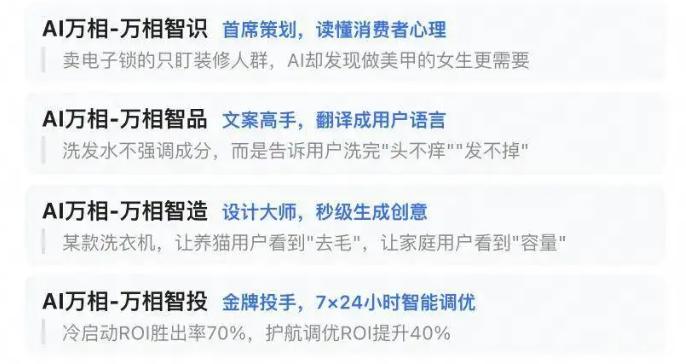
The Four Agents of AI Wanxiang
Another example is Qianchuan · Chengfang, which Douyin E-commerce mentioned will be fully launched during the 618 promotion. It is a marketing product released by ByteDance's Qianchuan platform, mainly including three modules: "Qiance" (system automatically allocates budget, bids, and selects products), "Qianyi" (AIGC creation, AI operational diagnosis, etc.), and "Qianxun" (full-domain precise recommendation), which can achieve intelligent marketing in all scenarios and aspects. Merchants can still use and operate within the existing Qianchuan system.
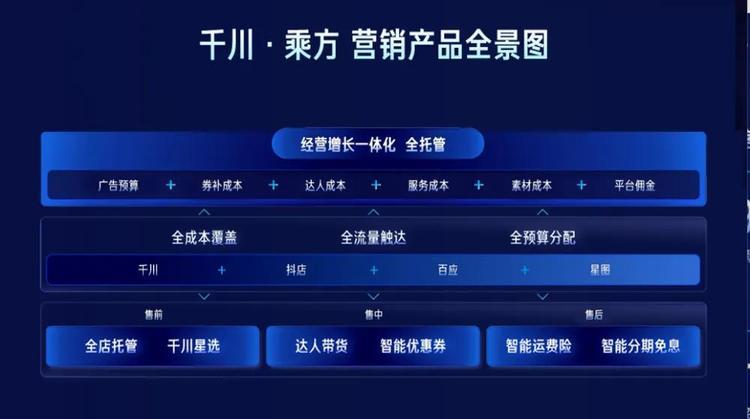
ByteDance's Qianchuan Releases "Qianchuan · Chengfang"
Secondly, at the system level, AI has changed from "helping merchants with one step" to "running the entire process for merchants."
KS's Magnetic Taurus is a typical example. It is positioned as an AI placement hub. Before placement, it integrates in-store and out-of-store product data to identify potential products. During placement, it uses large models to customize audience packages and bid intelligently. After placement, it provides 24/7 AI operational diagnosis. Meanwhile, the AI Agent based on the OpenClaw open-source framework can answer questions, provide diagnoses, give suggestions, and perform one-click placement.
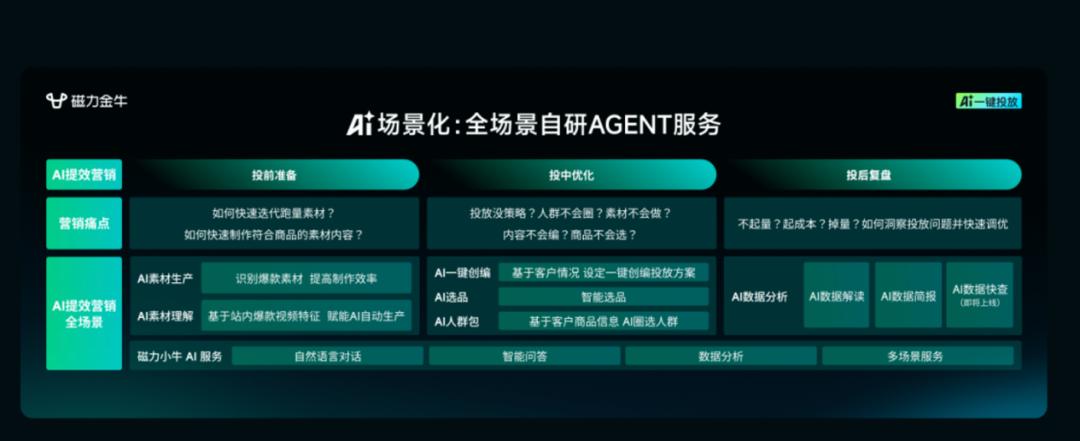
KS's Magnetic Taurus
Thirdly, at the organizational level, AI has been upgraded from a department-level function to a company-level strategic engine.
At the end of April this year, Xiaohongshu announced the comprehensive integration of its three major businesses - community, e-commerce, and commercialization - and the company's technology system. At the same time, it established the first-level department Dots centered around AI, building a complete technology system from model research and development, infrastructure, engineering to products. The newly established "Enterprise Intelligence Department" integrates the original Enterprise Efficiency Department and Data Science Department, and collaborates with the Strategy Department and Organizational Personnel Department to lay the foundation for the organization in the AI era from four dimensions: intelligence, talent, data, and resources.
The amplification at these three levels points in the same direction: What platforms are competing for is no longer "whose AI has more functions," but who can make their AI an indispensable part of merchants' operations, just like water, electricity, and coal.
Level the Technological Playing Field and Get Merchants Using AI Quickly
Platforms are working hard to enhance with AI, but a question remains: Have merchants started using it?
The current situation is divided. Some merchants have heard of AI but have never really used it in their operations. Some have tried but were discouraged by the complex interfaces and technical terms. Some have used basic functions like auto-reply but don't know what else AI can do. And some merchants are using AI but are anxious about the placement results due to the "black box" problem.
Simply put, AI capabilities are advancing rapidly, but merchants' capabilities have not kept up. This is not only because of the natural cognitive gap between the two but also because confidence and trust issues are the main factors slowing down merchants.
The big promotion is exactly the best time to break the ice.
During the big promotion, merchants are most sensitive to two things: First, the return on investment. During the big promotion, traffic is concentrated, and bidding prices are high. With the same budget, it's easier for the money to go to waste. Merchants dare not not invest, but they also dare not invest blindly. Second, human efficiency. With the surge in orders, customer service and operations are under full pressure. It's common for small and medium-sized merchants to make one person do the work of three.
These two pain points are exactly where AI can prove itself - AI can optimize in real-time at the placement end to ensure the return on investment, and it can also fill the gaps in areas like customer service and after-sales that used to require a lot of manpower.
Platforms are also aware of this. This year, they have played three cards with a clear goal: Make AI tools free for all merchants to use, ensure that the process of using them is effortless, and make the results visible.
First, offering free access and subsidies is the most direct and effective way to get merchants to "use" AI. Taking advantage of the big promotion, platforms are making more merchants start using AI tools for free or with subsidies, so that they can form usage habits later.
For example, JD.com started making all 14 "Jingmai" AI tools free in March this year. The merchant service intelligent agent platform "Jingxiaozhi" and the digital human live-streaming tool are also free. According to official data, the digital human live-streaming service has served over 70,000 merchants, and the number of live broadcasts in the first quarter increased tenfold year-on-year. Douyin E-commerce's Feige intelligent customer service is free for a limited time, and the ability of the after-sales order recovery assistant has been strengthened. KS E-commerce has also provided coupon packages for merchants who became new customers of Magnetic Taurus in the first quarter of this year.
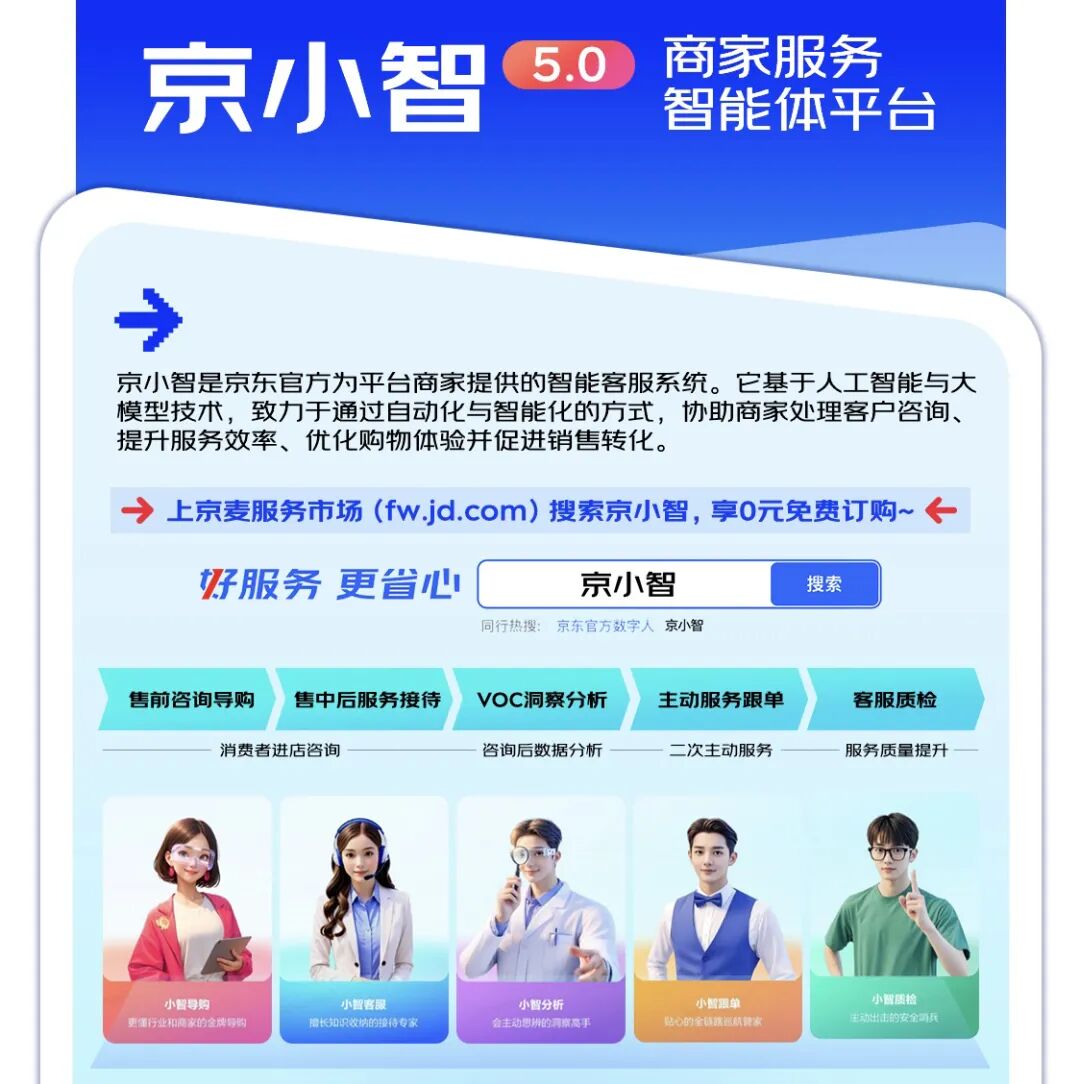
JD.com's Merchant Service Intelligent Agent Platform "Jingxiaozhi"
Second, for most small and medium-sized merchants, "new operations" are a threshold in themselves. Many people haven't fully mastered the existing backends yet. Therefore, to make it effortless for merchants to use AI, platforms choose not to change merchants' past operating habits but to make AI "smarter" in the background.
For example, Alibaba Marketing's "AI Wanxiang" doesn't add new operation entrances on the merchant side. Merchants can directly call the four Agents in the background under the existing interfaces of Wanxiangtai AI Wujie and Alibaba Marketing Bailing for coordinated work.
Merchants can use AI easily, but there's still one last step - making them believe that using it will really have an effect.
Previously, intelligent placement products generally faced the "black box dilemma": AI provides solutions, but merchants can't see the specific process or how the results are achieved.
To address this, KS's Magnetic Taurus shows the complete thinking chain step by step. For example, after the system generates a promotion plan for the "AI One-Click Promotion" product, merchants can click to view the plan generation process, and each decision step has a traceable basis.
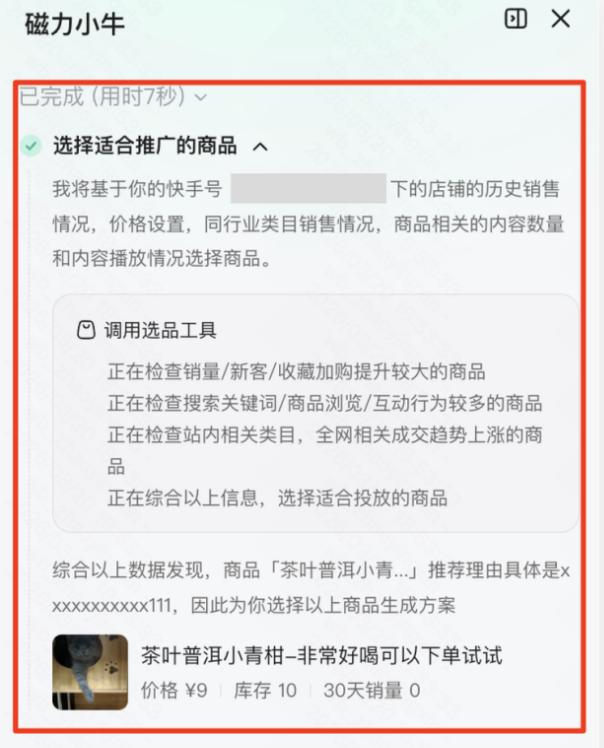
KS's Magnetic Taurus "AI One-Click Promotion" Shows the Complete Thinking Chain Step by Step
JD.com has also launched the "Steady Profit Plan," promising a 100% return on investment guarantee. If it fails to meet the standard, the platform will compensate. Its core is also to use AI algorithms and platform guarantees to address the placement concerns of small and medium-sized merchants.
Free access, effortless use, and visible results - after these three steps, small and medium-sized merchants without professional marketers, trial budgets, or technical reserves can finally stand on the same big promotion stage as leading players because of AI.
Under the Same Direction, Different Platform Genes Determine Different Focuses
Although all platforms are talking about AI, if we look closely at each platform, their focuses on AI this year still have certain differences. This difference essentially stems from the platforms' own genetic attributes.
Taotian's most notable move during this year's 618 is the integration with the Tongyi Qianwen app. Users can select products, compare prices, and place orders in Tongyi Qianwen without opening Taobao. Inside Taobao, users can also activate the Tongyi Qianwen AI Shopping Assistant to use functions such as AI-assisted shopping, AI virtual try-on, AI discount calculation, and AI-assisted low-price grabbing.
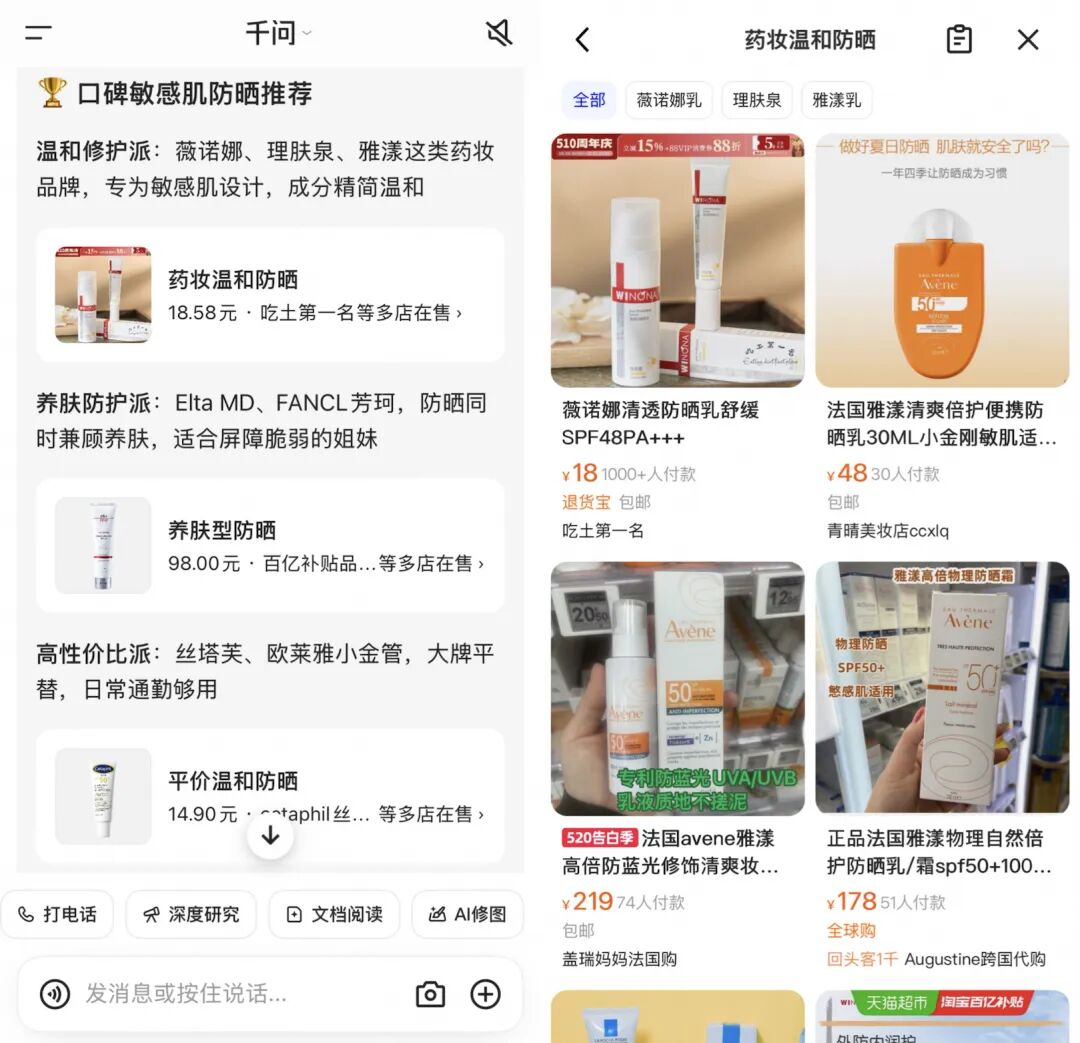
Taotian Integrates with the Tongyi Qianwen app
Of course, Taotian is not the only one trying this. ByteDance's Doubao has also launched the "Help You Choose" function and integrated it with the Douyin Mall. Douyin users can directly see AI-recommended products and detailed comparisons in Doubao and then directly pay and place orders.
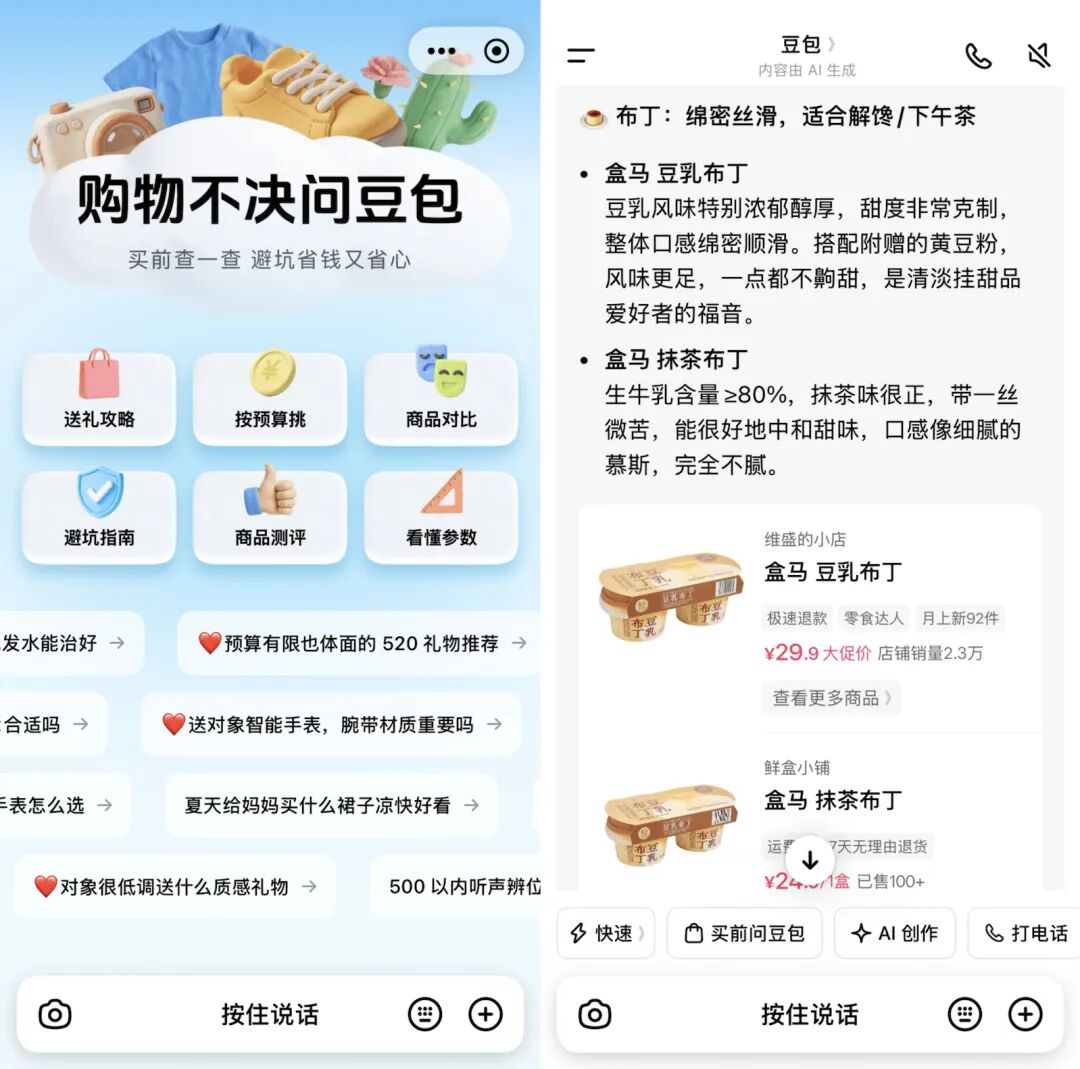
Doubao's "Help You Choose" Function
Compared with the functional upgrades, the industry significance behind this move is more worthy of discussion. In the past, the standard path for e-commerce platforms was "keyword search → product list → price comparison → order placement." However, the imagination space opened up by Tongyi Qianwen and Doubao is completely different: users don't need to know the product name or compare prices themselves. After explaining their needs, AI directly gives the results. The shopping path is compressed to "conversation → transaction." Regarding what AI e-commerce might look like in the future, the platforms are currently presenting a kind of speculation and judgment.
JD.com has a different approach. It integrates AI into various aspects such as operational diagnosis, product operation, marketing placement, live-streaming conversion, customer service and after-sales, and logistics, directly participating in operational decision-making. While the industry generally focuses on how AI can be effective in the sales process, JD.com has also extended AI to the delivery process. JD Logistics' "Super Brain Large Model" will also be put into full use during this year's 618 promotion. This choice also comes from JD.com's genetic advantage. Its supply chain and logistics are its moats, and AI is now deepening them further.
