Chinese AI no longer wants to be confined to CUDA.
On May 14th, after the Sino-US business community meeting, Jensen Huang, the founder of NVIDIA, was surrounded by reporters. Someone pressed him, asking, "Will NVIDIA sell chips to Huawei?" Jensen Huang looked surprised and just left a meaningful remark: "Your question is so strange..."
After all, against the backdrop of the continuous tightening of Sino-US chip controls, the relationship between NVIDIA and the Chinese market has long been involved in a more complex competition in technology, industrial substitution, and geopolitics. And Huawei is precisely that powerful competitor that has "been forced to grow."
Recalling last month, also regarding the chip issue, Jensen Huang was angered during a podcast. The host, following the MAGA ideology, claimed, "The United States should completely stop selling any advanced chips to China to fundamentally curb the development of China's artificial intelligence industry and prevent being overtaken by China in the AI field in the future." Jensen Huang directly said that this idea was "short-sighted and dangerous" and pointed out that Chinese AI researchers account for 50% of the global total. Meanwhile, the chip ban would only force China to develop its own chips, and China is indeed capable of doing so.
One moment of silence and one moment of anger indicate that Jensen Huang's considerations go beyond just commercial interests. He has a deeper understanding of the global AI competition landscape.
"The Five - Layer Cake" Determines the Future of Artificial Intelligence
At the beginning of 2026, Jensen Huang first introduced the "five - layer cake" metaphor at the Davos Forum and later published a long - signed article to elaborate on it. From the bottom up, these five layers are: energy, chips, infrastructure, models, and applications.
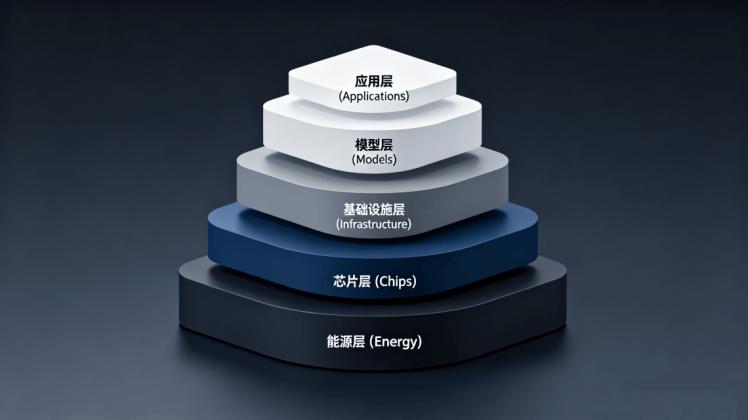
In Jensen Huang's "five - layer cake" theory, energy is the most fundamental layer of the AI system. Without stable power, even the most powerful models cannot operate. Chips are the core engine that converts electricity into computing power, namely AI accelerators, which determine the efficiency of training and inference. Above that is the infrastructure layer, including data centers, cooling systems, and network communications, which is responsible for hosting large - scale computing clusters. Above the infrastructure layer are the algorithm capabilities of large models, multi - modality, etc. And at the top are the application scenarios such as autonomous driving and industrial robots, which truly determine whether AI can be transformed into real productivity and commercial value.
In Jensen Huang's view, AI competition is a systematic collaboration of these five layers, and progress in each layer will drive the others. The value of this framework lies in that it redefines AI from a "chip issue" to a "whole - society infrastructure issue." Meanwhile, Jensen Huang's view also exposes the fundamental flaw of the US export control policy: the chip ban can only affect the second layer.
NVIDIA's Setback in China Has Ripened China's AI Ecosystem
The US chip blockade did not start in the era of large models. As early as 2018, the US began to pressure the Netherlands to restrict ASML from exporting advanced lithography machines to China. From 2021 to 2023, the chip ban policy expanded from "entity list sanctions" to "comprehensive technological blockade." Jensen Huang once revealed that this ban almost completely halted NVIDIA's high - end business in China.
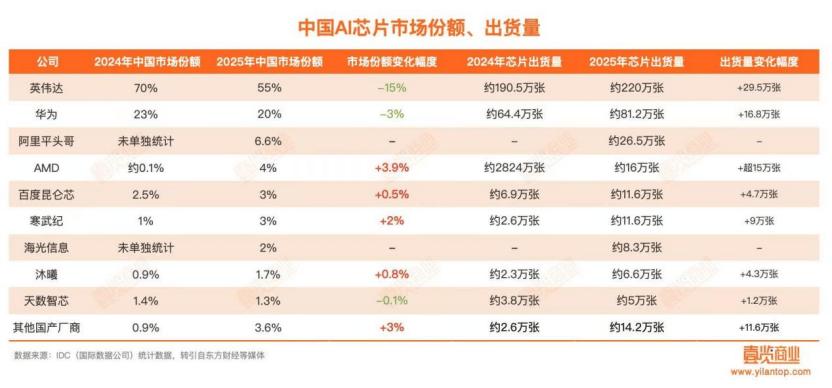
However, as Jensen Huang said, "putting pressure on China" will only accelerate the process of domestic self - research. In the past few years, domestic AI chip manufacturers have been continuously iterating their product architectures and computing power performance. Future Technology Media has compiled data on the flagship products of major domestic AI chip manufacturers in 2026. Generally, domestic AI chips are evolving towards higher computing power, larger cluster scales, and more complete software adaptation capabilities.
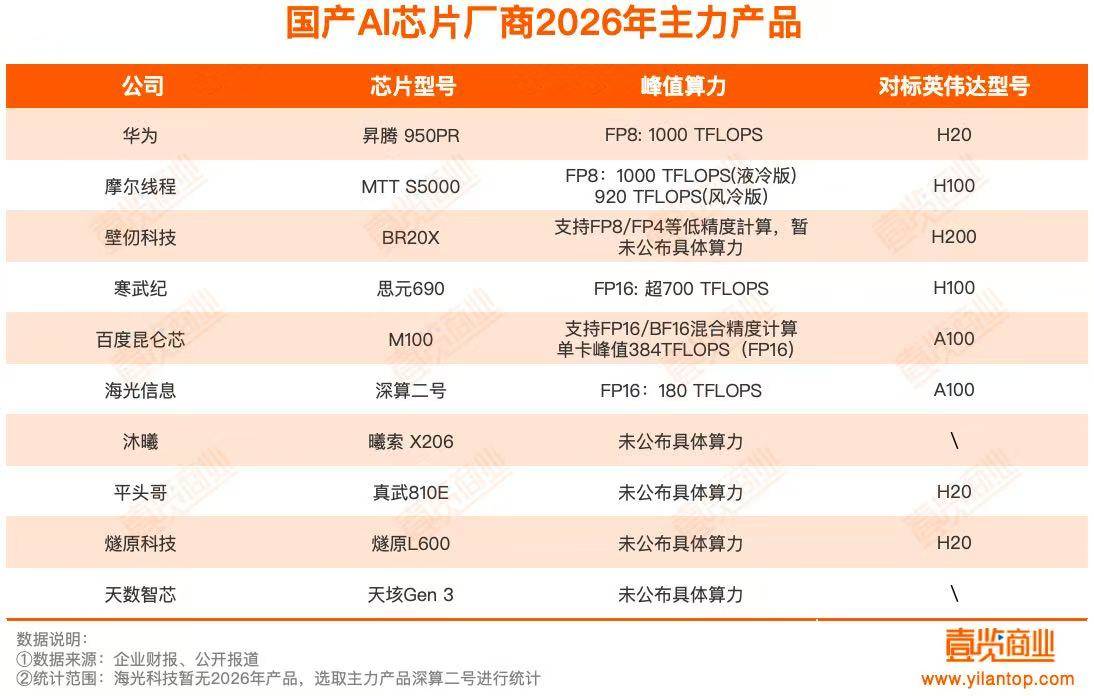
In addition to the products with announced parameters, new products such as the Zhenwu 810E (PPU) by T-Head, the Xisuo X206 by Muxi, the Suiyuan L600 by Suiyuan Technology, and the Tiangai Gen 3 by Daysci have also been unveiled one after another. On May 20th, at the 2026 Alibaba Cloud Summit, T-Head launched its new generation of integrated training and inference AI chip, the Zhenwu M890. The domestic AI chip ecosystem continues to expand.
Besides chips, China's advantages in the other four layers - energy, infrastructure, models, and applications - are "lifting" the entire AI system in reverse.
First is energy. Jensen Huang once said, "When you have abundant energy, it can make up for the shortage of chips." And China happens to have the world's strongest power supply capacity. According to the National Bureau of Statistics, in 2025, China's power generation reached 9.7 trillion kilowatt - hours, ranking first in the world. The "Global Data Center Report" released by IDCA in May 2026 shows that while the electricity consumption of US data centers accounts for about 6% of the country's total power, approaching the grid's carrying capacity, this ratio in China is only about 0.8%, leaving a huge margin. After the implementation of the "East - to - West Computing" project, the low - cost electricity and green energy resources in the western regions are also reducing the cost of AI training.
Second is infrastructure. AI competition is not only about computing power but also about cooling and data center capabilities. With the explosion in demand for liquid - cooled servers, China's liquid - cooling industry chain is maturing rapidly. After 3M exited the fluorinated fluid market, domestic enterprises quickly filled the gap. Manufacturers such as PetroChina Karamay Petrochemical have achieved localization of immersion cooling fluids, and the self - sufficiency of AI infrastructure is improving.
The model layer is a variable that the US cannot afford to ignore. Jensen Huang publicly stated this year, "If DeepSeek runs on Huawei's platform first, it will be a disaster." In March 2026, the monthly download share of Chinese open - source models on the Hugging Face platform reached 41% for the first time, exceeding the 36.5% of the US. For example, the Tongyi Qianwen series has nearly one billion global downloads, with more than 200,000 derivative models. The scale of its developer ecosystem has surpassed that of Meta's Llama.
What really determines the long - term competitiveness of AI is still the application layer, which happens to be the strength of Chinese companies. According to data from the China Academy of Information and Communications Technology, the average penetration rate of AI in various industries has reached 39.2%. In the medical field, 68% of primary - level hospitals in the country use AI for auxiliary diagnosis. In the high - end manufacturing sector, 62.3% of enterprises are using AI to optimize production processes. In the financial industry, the AI penetration rate has reached 58.7%, widely applied in risk control and intelligent customer service.
These rich application scenarios have given rise to a huge demand for computing power, directly boosting the market share of domestic AI accelerator cards. A report from market research firm IDC shows that in the Chinese AI accelerator server market in 2025, domestic GPU and AI chip manufacturers accounted for nearly 41% of the market share, and the total shipment of AI accelerator cards reached about 4 million units.
This is what Jensen Huang is really worried about: Chinese chip manufacturers may not be able to catch up with NVIDIA in the short term, but an AI ecosystem that can self - circulate and self - iterate has begun to take shape.
DeepSeek Runs Successfully on Domestic Chips
On April 24th, the preview version of DeepSeek V4 was released, and this model achieved deep compatibility with domestic chips such as Huawei's Ascend. This marks a crucial step for China's AI industry in reducing its dependence on NVIDIA's CUDA ecosystem.
Over the past decade or more, NVIDIA's real moat has never been just its GPU hardware itself but the software ecosystem formed by "CUDA + hardware." Millions of developers around the world have long been accustomed to CUDA's programming model, toolchains, and debugging systems. A large number of AI frameworks, operators, and industry models are also built on CUDA. To some extent, the AI industry has long assumed that top - tier models must run in the CUDA ecosystem.
The collaboration between DeepSeek V4 and domestic chips has shaken this assumption for the first time. This means that a complete closed - loop of "top - tier model + domestic computing power + domestic software stack" has emerged in China - not only are the chips being localized, but the training frameworks, compilers, operator libraries, and development tools are also gradually reducing their dependence on the CUDA system.
This is why the key to future AI competition is no longer just the performance of a single card but who can truly build a developer ecosystem. Because the core of the ecosystem is always the developers: every developer who migrates from CUDA to a domestic platform will take away some of the stickiness of the original ecosystem. And the operators, tools, and industry models they develop on the new platform will further improve the domestic ecosystem, attracting more enterprises and developers to join, ultimately forming a positive cycle.
According to public data compiled by Future Technology Media, the developer ecosystems of domestic AI chip manufacturers have initially taken shape.
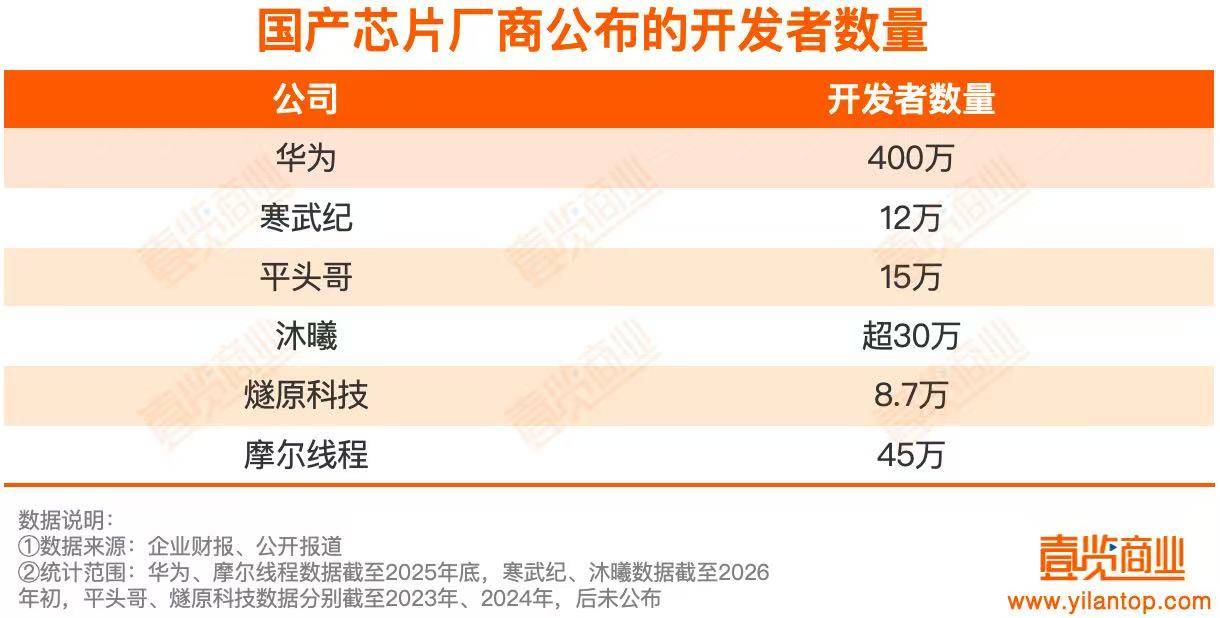
Among them, the scale of Huawei Ascend developers has reached about 4 million, accounting for nearly 80% of the total in the domestic AI chip camp, and the "leading effect" is emerging. Meanwhile, manufacturers such as T-Head and Moore Thread are also continuously increasing their investment in toolchain and community building. The domestic AI ecosystem is evolving from "single - point breakthroughs" to "system - level competition."
Conclusion
Technological blockades have never truly stifled innovation; they just redraw the competitive landscape.
China, a country with a population of 1.4 billion, has the world's most complex industrial scenarios, the largest group of engineers, and a market environment most willing to quickly implement new technologies. Once these capabilities are deeply integrated with domestic computing power platforms, the development path of AI may gradually shift from "catching up with the US" to "developing its own technological paradigm."
Jensen Huang has actually seen this trend. In the short term, NVIDIA's leading position in the CUDA ecosystem, GPU performance, and system capabilities remains undeniable. However, in the AI era, leading in a single technology does not mean leading forever. What truly determines the industry pattern is whether the ecosystem can continuously expand and self - evolve.
NVIDIA's walls are still thick, but the line of people in China trying to break them down is almost as long as the distance to Paris.