Behind 900 million clicks: The real landscape of AI applications | 2026 China AI Application Panoramic Atlas Report
There is a question worth asking seriously in 2026:
Was the last time you used an AI application to have it answer a question or to have it complete a task?
There is an era between these two actions.
In 2026, the product paradigm of AI applications is shifting from "chatting" to "doing things."
This is not a prediction but an already occurring reality.
What is the underlying data from "answering" to "executing"? What are the driving forces? Which are the representative enterprises?
To answer these questions, QbitAI Think Tank released the 2026 China AI Application Panoramic Map Report.
In the report, we attempt to record the cross - section of the current moment of AI application transformation through the 2026 China AI Application Panoramic Map.
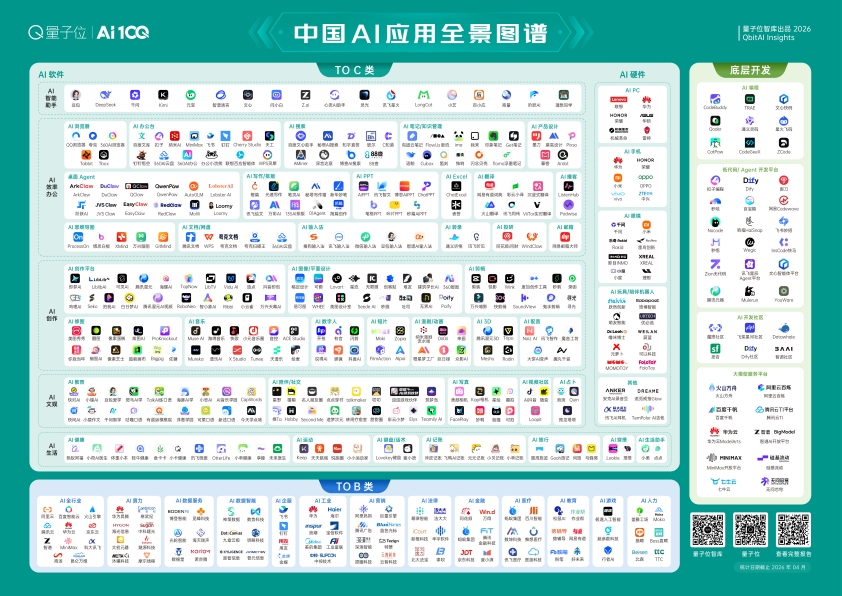
The map spans three major dimensions: ToC software and hardware, ToB applications, and underlying development, covering hundreds of products and forming a complete AI value transmission chain.
As technology penetrates downward and application scenarios grow upward, a complete AI industrial ecosystem has taken shape.
The numbers tell the true size of the ecosystem
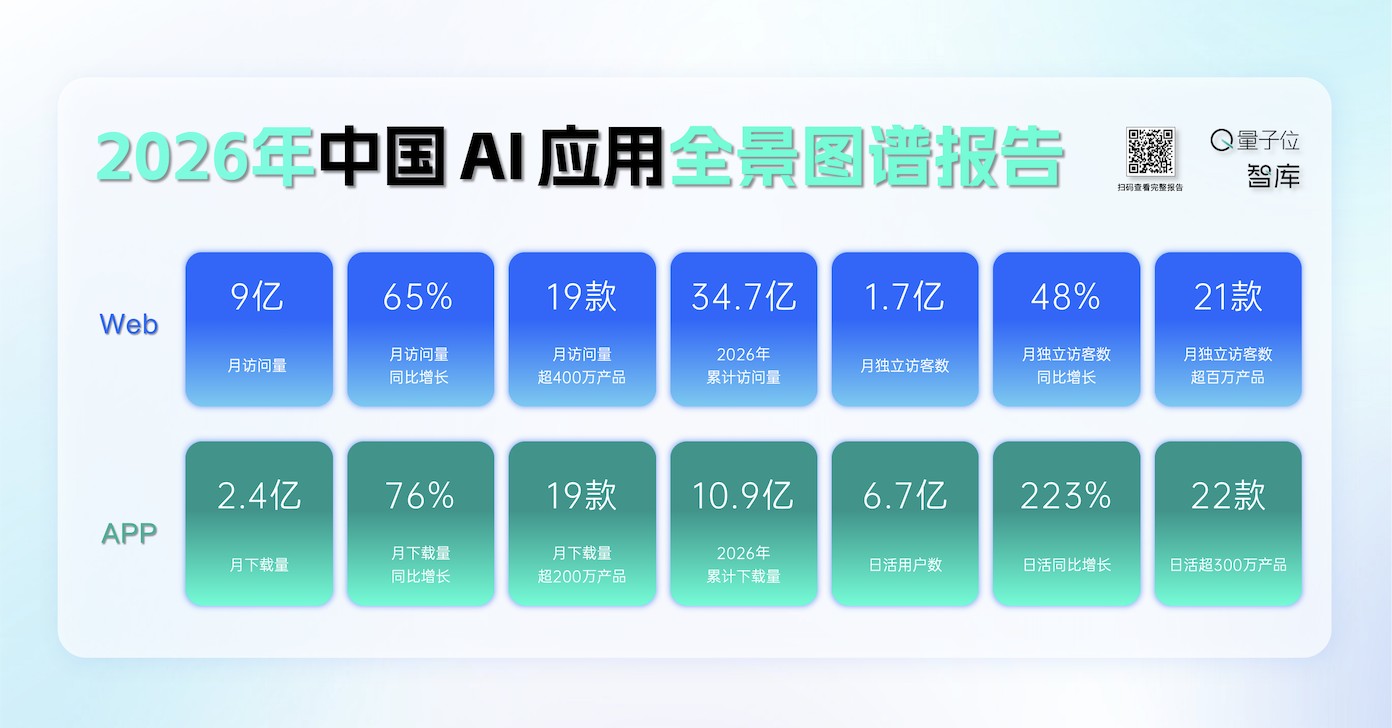
According to statistics from QbitAI Think Tank, in April 2026, the monthly web - based traffic of domestic AI applications exceeded 900 million, the monthly downloads of AI applications on the APP side exceeded 240 million, and the daily active users increased by 223% year - on - year.
Data from the National Bureau of Statistics shows that the daily average Token calls in China exceeded 140 trillion in 2026, a growth of more than a thousand times in two years.
China is already the country with the highest activity in AI applications globally.
However, what is more worthy of attention than the total volume is the change in the structure.
QbitAI Think Tank divides domestic AI applications into four major tracks: AI intelligent assistants, AI entertainment and life, AI efficiency office, and AI creation.
In terms of the two key indicators of user activity and user retention, the performance of different tracks has shown obvious differences:
In terms of user activity, the user activity share of the AI efficiency web - based platform exceeded 70%, and the daily active users of the AI creation APP increased by 449% year - on - year, showing excellent performance.
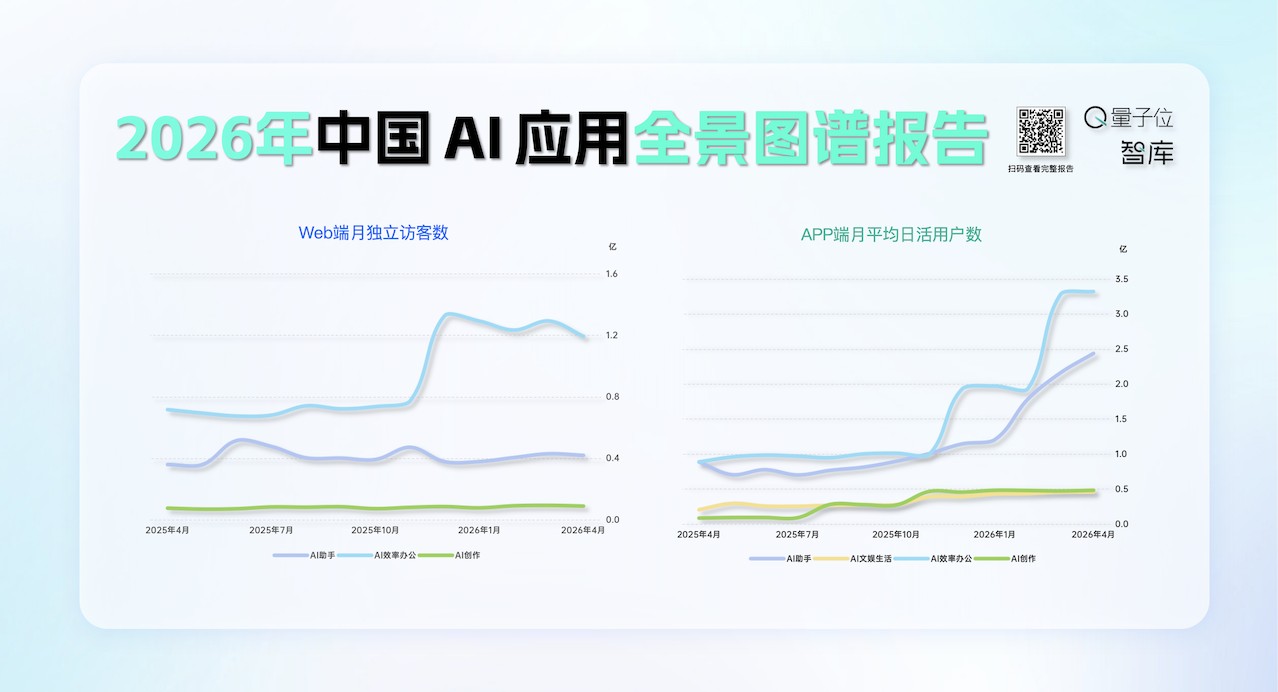
Behind the soaring traffic, there is a more cruel test waiting: retention.
In terms of user retention, intelligent assistants have the highest retention rate, and the AI entertainment track shows a polarization of stickiness.
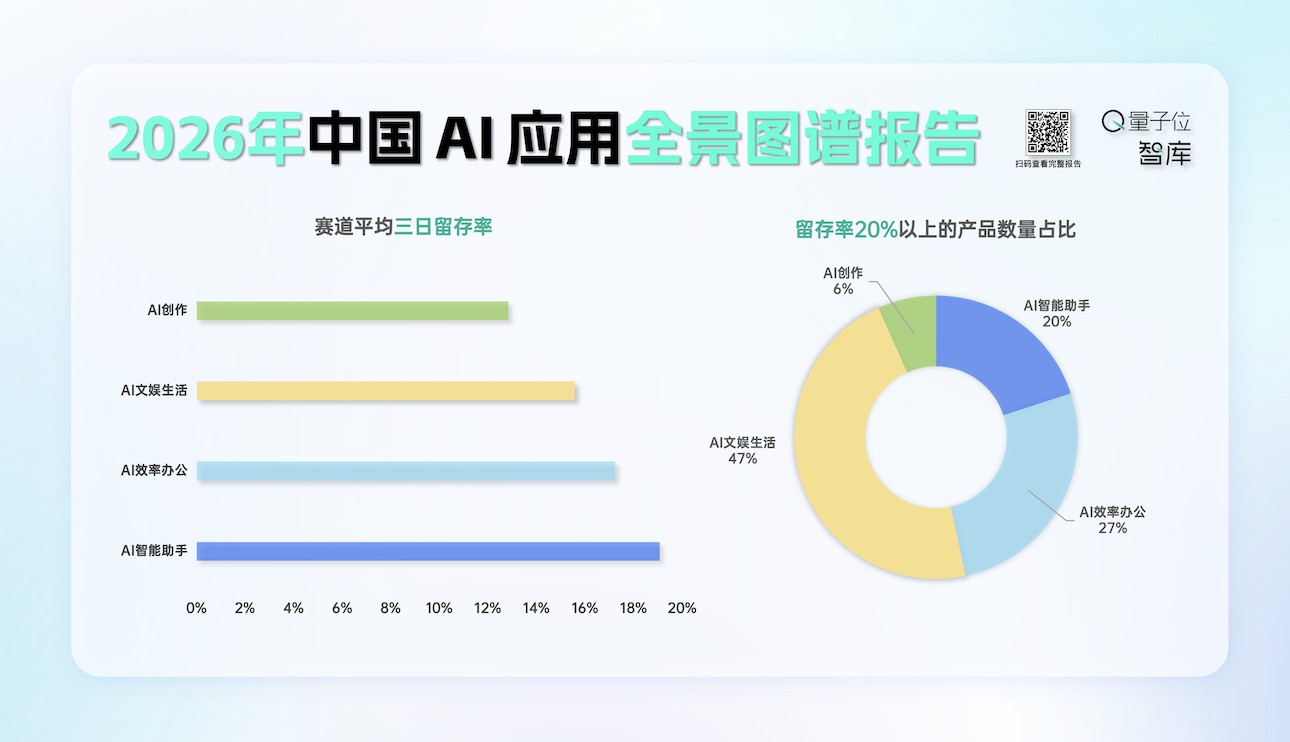
Users won't come back every day just because it's "fun." But if AI is embedded in the user's daily workflow, they will hardly leave.
This is the most important watershed in 2026: from "fun AI" to "indispensable AI."
Five trends reshaping the industry
Beyond the data cross - section, there are five trends reshaping the industry.
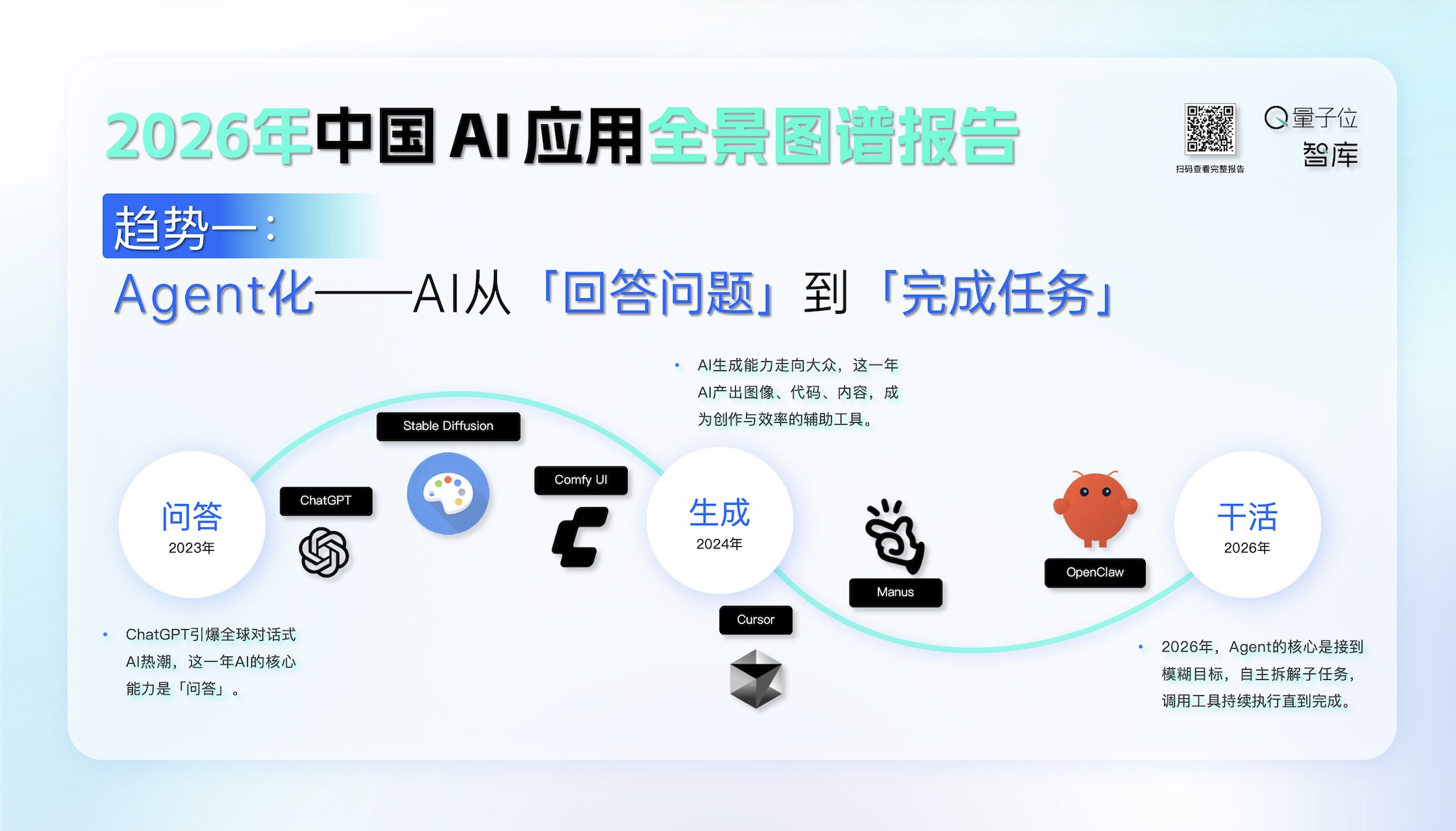
1. Agentization - AI evolves from answering questions to completing tasks.
Statistics show that a single Agent consumes 100 times more Tokens than traditional AI.
In 2026, AI applications are no longer satisfied with being just answer machines in dialog boxes. Instead, they gradually achieve active planning, tool - calling, and execution of multi - step tasks.
The focus of competition has shifted from "who can develop an Agent first" to "who can go deeper in vertical scenarios and retain users."
2. Model popularization - The technological dividend is shifting to the application layer
For Agents to function, another factor is crucial: the cost has decreased while the capabilities have increased.
The price of the DeepSeek V4 - Pro API is only 0.025 yuan per million tokens, one - seventh of that of GPT - 5.5.
Meanwhile, the breakthrough in the capabilities of visual multi - modal generation models represented by Seedance2.0 has also opened up new imagination and product space for generative products.
The reduction in cost and the increase in the upper limit mean that more people can enter the market.
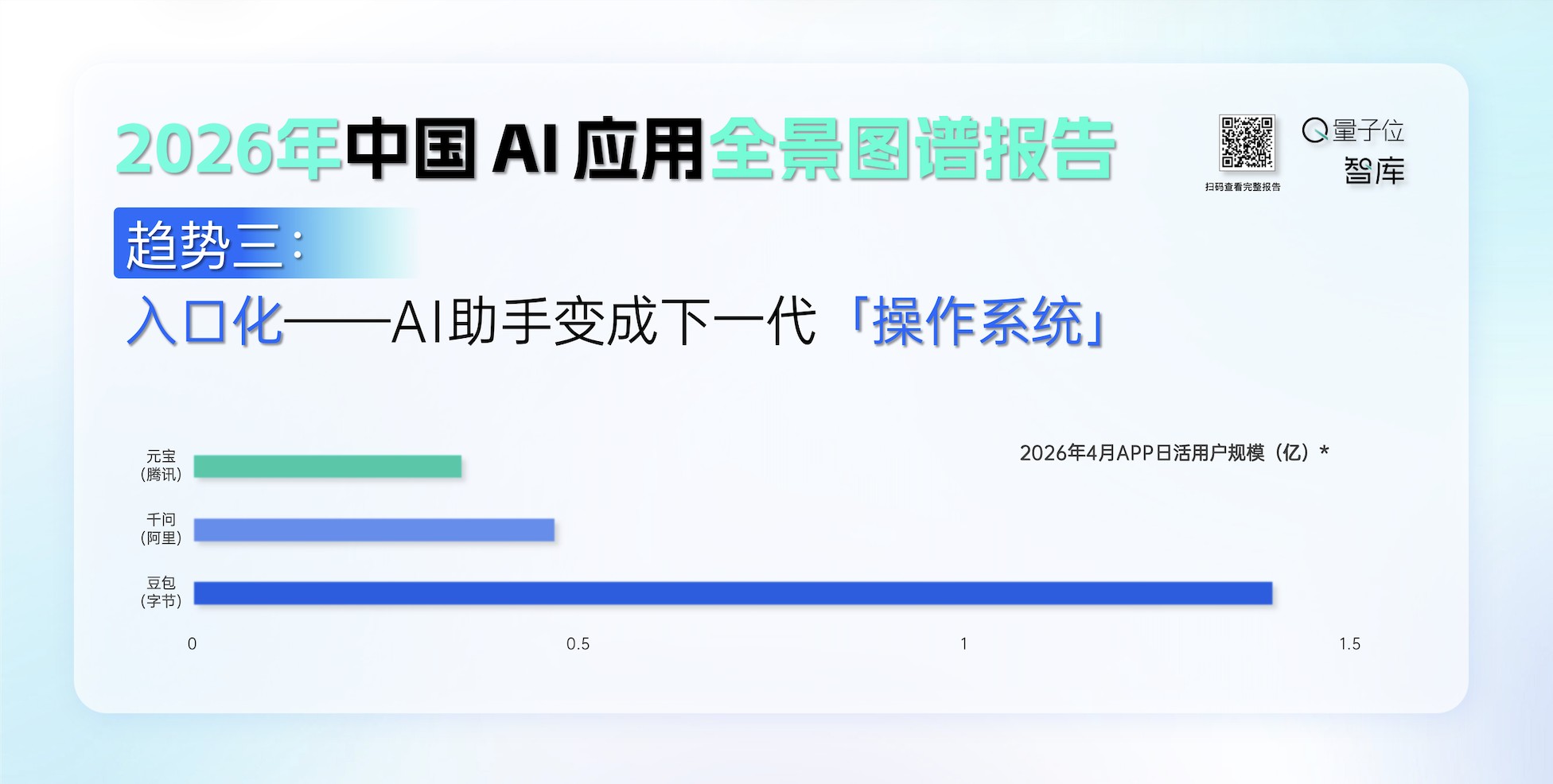
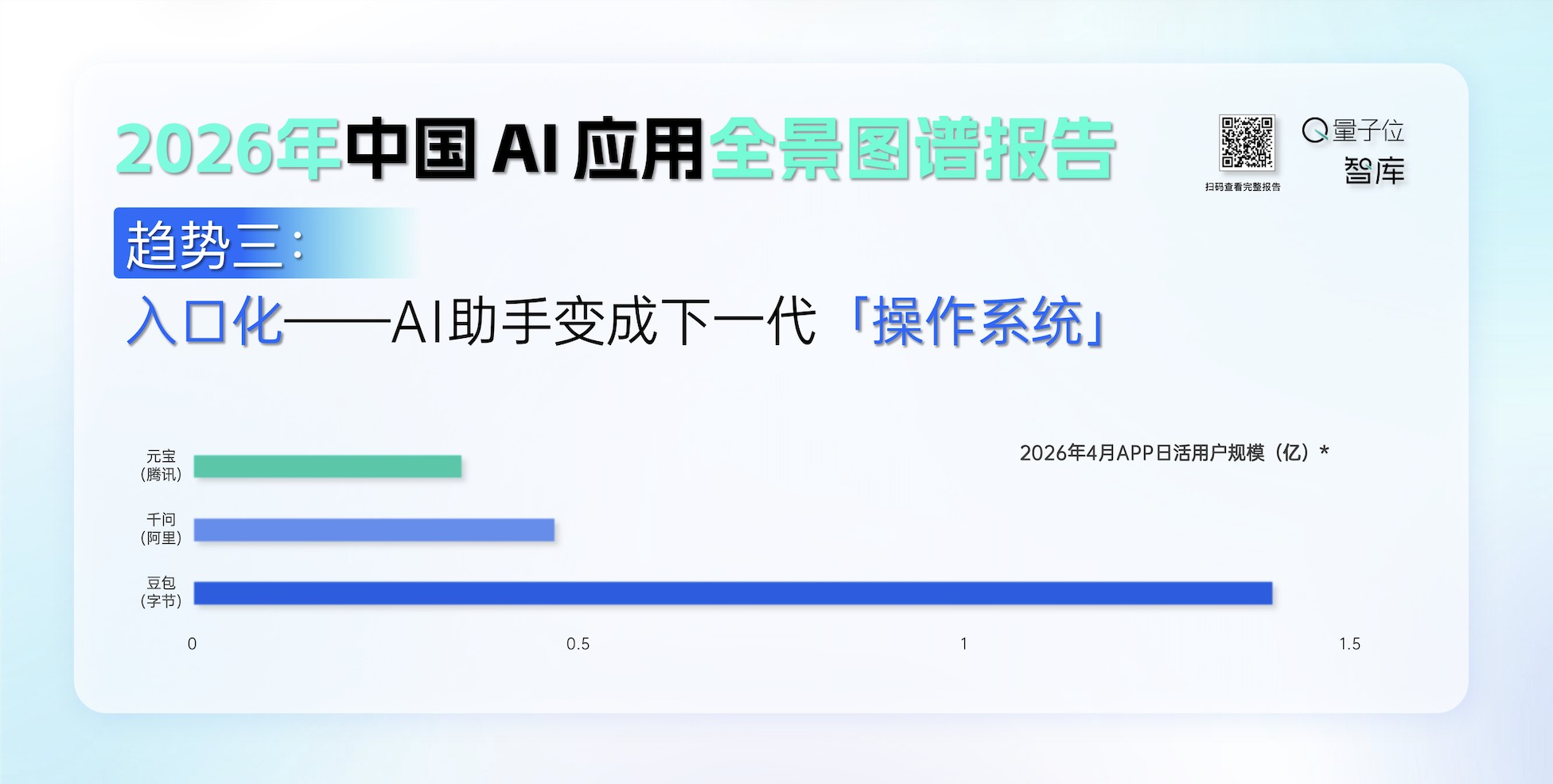
3. Entrance - AI assistants are becoming the next - generation "operating system"
During the Spring Festival this year, four model giants, ByteDance, Alibaba, Tencent, and Baidu, collectively spent over 4.5 billion yuan. What they were competing for was not users, but the instinct of "who to open first when AI is needed."
Whoever wins the users' default habits will win the next decade.
The large - scale investment in competing for the entrance makes people wonder: Can the money be recouped?
4. Monetization - The business model of AI products has been initially established
Less than 20 days after the release of Kimi K2.5, its revenue exceeded the total revenue of 2025. After the price increase of the Zhipu API, the number of calls increased instead. Doubao launched a paid model.
The occurrence of these landmark commercialization events indicates that when AI is truly embedded in the workflow, users don't need to be persuaded, and paying is a natural result.
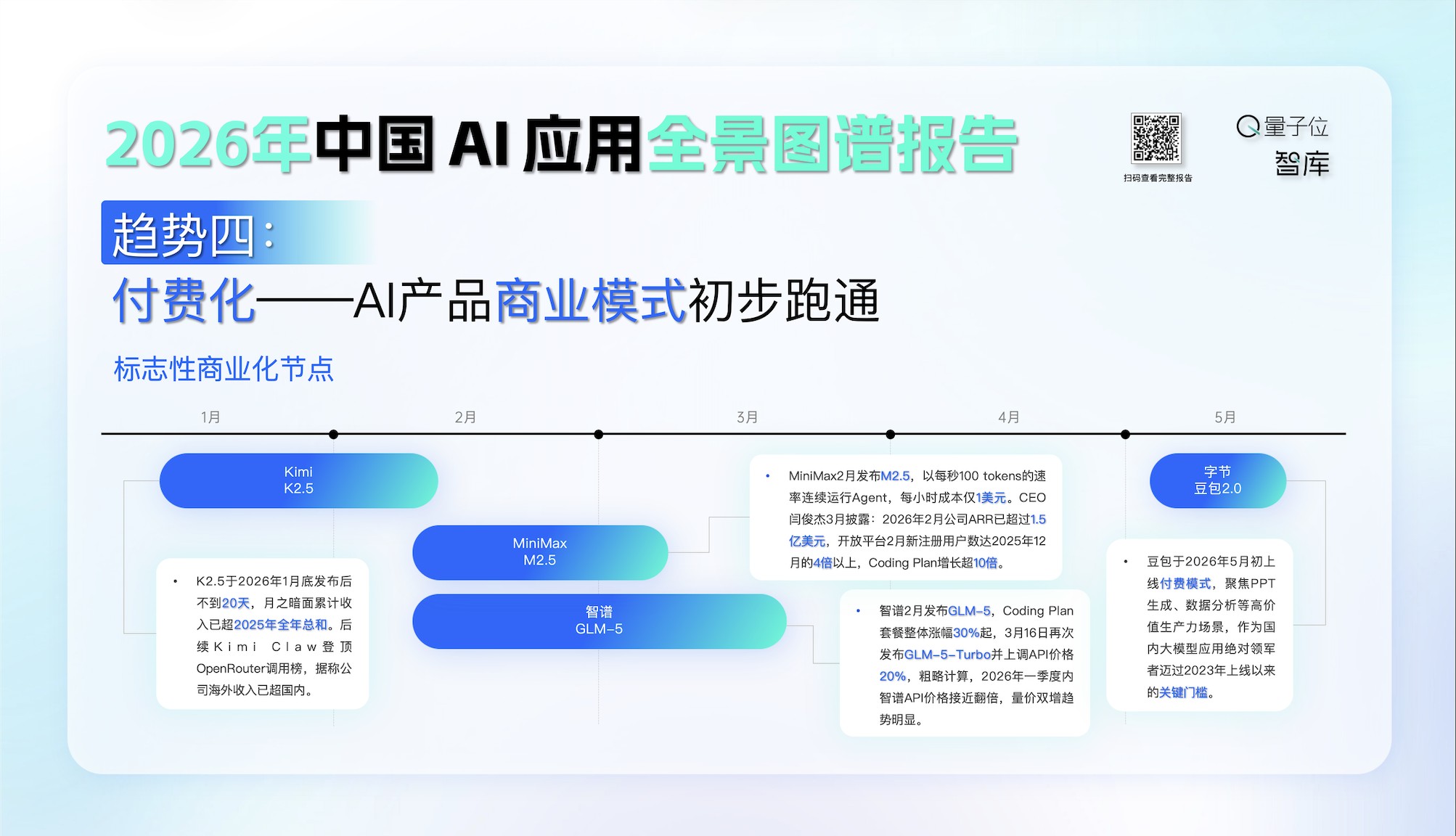
The monetization logic for the C - end has just been established, while the story for the B - end is deeper, slower, and more difficult to change.
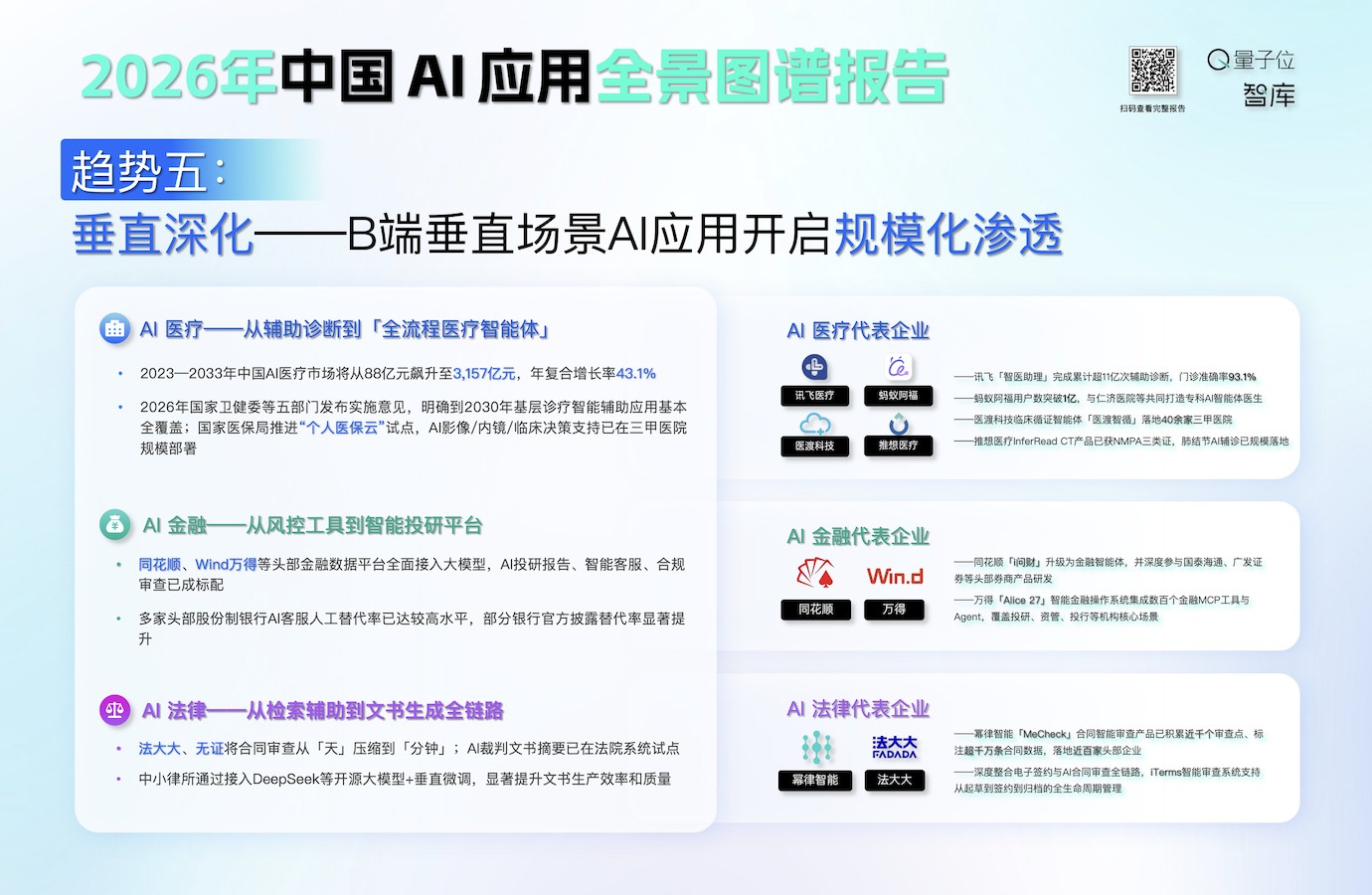
5. Vertical deepening - The large - scale penetration of AI applications in B - end vertical scenarios has begun
Medical, finance, and law may be the three high - value battlefields with the fastest penetration.
The data flywheel and private knowledge graph are making the moats of established players deeper and deeper. The later one enters the market, the more difficult it may be to catch up.
From chatting to "working," from trying out to "being indispensable."
This year for AI applications is not the end but the beginning.
In the next decade, who will become the entrance, who can establish a monetization model, who can penetrate the scenarios, and what will the next wave of trends be?
The answers are left to time and users.
Get the full report
Since 2024, QbitAI Think Tank has built a self - developed AI product library, conducted long - term tracking of thousands of domestic AI products, and launched in - depth content such as monthly data reports, rankings, interviews, and salons.
Through the annual "2026 China AI Application Panoramic Map Report," we hope to analyze and present the product landscape and data performance, reveal the trend of the domestic AI industry's transformation into the deep waters of product and commercialization, and provide key decision - making anchors for readers.
Download link for the full report: https://jkhbjkhb.feishu.cn/wiki/W5D7wuDcbiPXDLkaRLQcAJpOn8f