NVIDIA's financial report comprehensively exceeded expectations.
NVIDIA's revenue and profit in the first quarter both exceeded analysts' expectations, and its outlook for the second fiscal quarter was also better than expected. The quarterly revenue of its data center business reached $75.2 billion, nearly doubling compared to the same period last year and surpassing the expected $73.47 billion.
After the U.S. market closed on Wednesday, NVIDIA released its financial results for the first fiscal quarter. Not only did its revenue and profit exceed analysts' expectations, but its outlook for the second fiscal quarter was also better than expected.
After the release of the financial report, NVIDIA's after - hours stock price soared briefly, but the upward trend did not last long. As of press time, NVIDIA's after - hours stock price fell 1.6%.
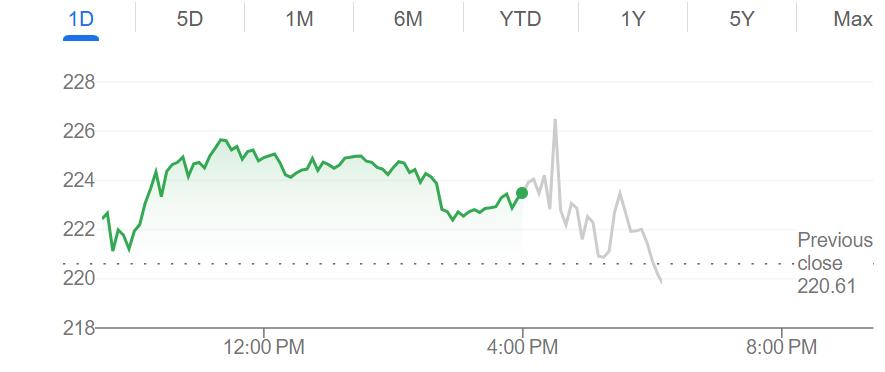
After - hours trend of NVIDIA's stock price
This situation is actually not uncommon. Looking back, in the trading days following the release of NVIDIA's previous five financial reports, the stock price fell four times.
The financial report shows that in the first fiscal quarter of this year,
NVIDIA reported an earnings per share (EPS) of $1.87, exceeding analysts' expected $1.77;
Revenue was $81.62 billion, surpassing analysts' expected $79.18 billion, a year - on - year increase of 85%.
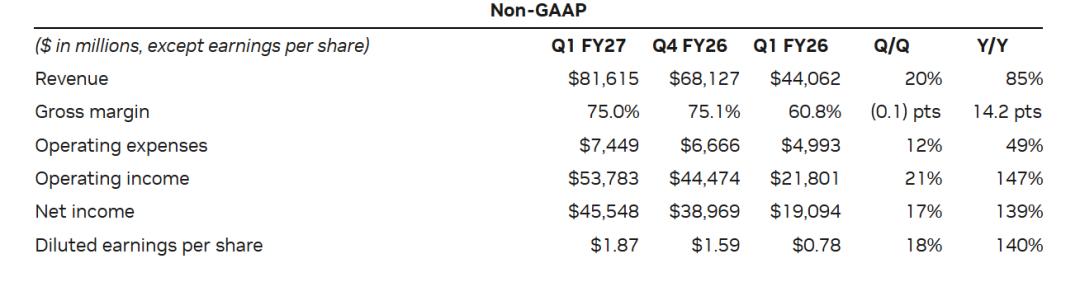
For the second fiscal quarter, NVIDIA expects revenue to be between $89.1 billion and $92.8 billion. Wall Street's previous expectation was $87.3 billion.
The company returned $20 billion to shareholders through stock buybacks and dividends in the first quarter. NVIDIA also announced a new stock buyback authorization of $80 billion and raised its quarterly dividend to $0.25 per share.
Strong growth in the data center business
NVIDIA's data center business contributed the majority of its revenue. The quarterly revenue of this department reached $75.2 billion, not only higher than the $73.47 billion previously expected by Wall Street analysts but also nearly doubling compared to $39.11 billion in the same period last year.
NVIDIA's Chief Financial Officer Colette Kress said that the hyperscale data center business accounted for 50% of the total data center sales revenue in this quarter. The remaining 50% came from various channels, including "artificial intelligence cloud, industrial, enterprise, and sovereign customers".
Kress said that the construction of artificial intelligence factories is accelerating, and the infrastructure value of chip manufacturers is rising. She mentioned that the rental price of the H100 has increased by 20% so far this year, and the cloud pricing of the A100 has also increased by nearly 15%. She pointed out that customers are using resources beyond the remaining service life of GPUs to generate profitable revenue.
Kress said that the company's newly launched Vera CPU "opens up a new $200 - billion market for NVIDIA" and added that "all major hyperscale data centers and system manufacturers are collaborating with us to deploy this processor". She expects the total CPU revenue to reach $20 billion this year.
Kress also said that NVIDIA's corporate goal is to become "the world's leading CPU supplier". Currently, this field is dominated by competitors Intel and AMD.
Vera Rubin to start shipping in the second half of the year
Jensen Huang said in the earnings conference call that the production and shipment of the next - generation rack - level artificial intelligence system Vera Rubin are expected to start in the second half of this year.
Jensen Huang said, NVIDIA is confident in its prediction that the Blackwell and Rubin chips will achieve $1 trillion in revenue between 2025 and 2027. NVIDIA expects its Vera Rubin to be "more successful than Grace Blackwell".
NVIDIA is facing increasingly fierce competition in the field of artificial intelligence processors, including competition from the up - and - coming Cerebras (CBRS), which conducted its initial public offering last Thursday. In addition, the chip businesses of customers such as Amazon and Google are also developing rapidly.
Change in the way of reporting earnings
NVIDIA also announced that it will change the way it reports its quarterly earnings. The company will now divide its revenue into two parts: data center and edge computing.
The data center part will include hyperscale data centers, artificial intelligence cloud, industrial, and enterprise customers. Edge computing will consist of devices, proxy systems, and physical artificial intelligence. The company said this will include "personal computers, game consoles, workstations, artificial intelligence wireless access network base stations, robots, and cars".
Jensen Huang told analysts in the earnings conference call: "Regarding business segmentation and description, we want you to have a better understanding of our business."
Jensen Huang pointed out that artificial intelligence is the core of the company's overall business, but there are significant differences in technical methods and initiatives between some companies. He said:
"This is the simplest way to understand our business. They each have different technology stacks in many aspects. They use different operating systems. They operate differently, and our market strategies on each platform are also quite different."
This article is from the WeChat official account "Science and Technology Innovation Board Daily", author: Liu Rui. It is published by 36Kr with authorization.