The policy of direct connection of green electricity for multiple users has been introduced, eliminating the need to go through the public power grid. Can the direct connection of green electricity end the "carbon anxiety" of export enterprises?
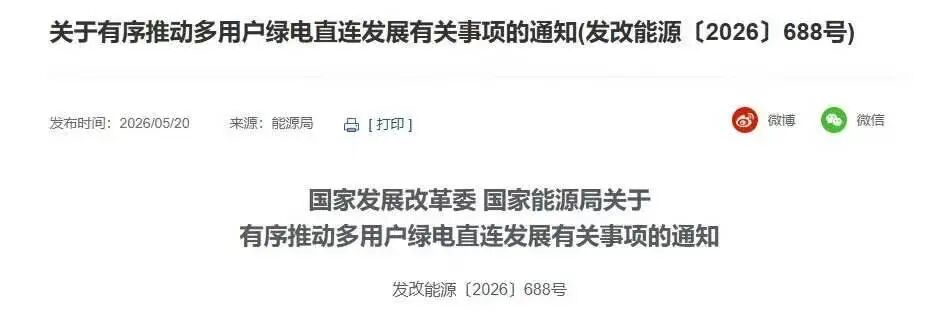
Yujian Energy learned that on May 20, 2026, the National Development and Reform Commission and the National Energy Administration issued the "Notice on Promoting the Orderly Development of Direct Connection of Green Electricity for Multiple Users" (No. 688 [2026] of the NDRC on Energy), officially upgrading the direct connection of green electricity from "one-to-one" to "one-to-many" - new energy power is directly supplied to multiple enterprises in industrial parks through dedicated lines without passing through the public power grid.
When the EU's Carbon Border Adjustment Mechanism (CBAM) officially entered the charging stage in 2026, Chinese export enterprises bear an average carbon tariff cost of 340 euros per ton of aluminum products, and the scope will be expanded to about 180 downstream products such as machinery and automobiles in 2028. Carbon anxiety has escalated from an environmental issue to a survival proposition. Meanwhile, China's new energy installed capacity has been surging, but the amount of curtailed wind and solar power reached as high as 251.8 billion kWh in 2025, and the power grid's consumption capacity is approaching its limit. The contradiction of "able to generate but unable to use" is becoming increasingly acute.
This policy path attempts to connect the physical outlet for new energy consumption, the solution to carbon tariffs for export enterprises, and the new investment scenario for power generation enterprises all at once. The ledger of direct connection of green electricity has only truly begun to be opened this year.
Double pinch! The dilemma of new energy consumption and the carbon tariff survival line for export enterprises
In the past decade, China's new energy installed capacity has been surging. Yujian Energy's data analysis shows that by the end of 2025, the total installed capacity of renewable energy nationwide reached 2.34 billion kilowatts, accounting for 60% of the total national power installed capacity. Among them, the newly installed photovoltaic capacity was 317 million kilowatts, a year-on-year increase of 14%.
However, on the other side of the installed capacity, the power grid's consumption capacity is reaching its ceiling.
In 2025, the amount of curtailed wind and solar power nationwide reached 251.8 billion kWh, with a wind curtailment rate of 5.7% and a solar curtailment rate of 5.2%. The utilization rate of photovoltaic power generation fell below 95% for the first time. The photovoltaic utilization rates in Qinghai, Tibet, Gansu, and Xinjiang dropped below 90%. The spot market of the southern Hebei power grid once had zero electricity prices for several hours, and Shandong had negative electricity prices for more than 1,300 hours throughout the year. The annual utilization hours of wind power nationwide decreased by 148 hours year-on-year, and the annual utilization hours of solar power decreased by 113 hours year-on-year. Gui Xiaoyang, the deputy director of the Department of New and Renewable Energy of the National Energy Administration, admitted that the consumption problem brought about by the large-scale and high-proportion access of photovoltaic power is becoming increasingly prominent.
Meanwhile, the EU's carbon barrier has suddenly tightened. On January 1, 2026, the CBAM officially ended its transitional period and entered the substantial charging stage. Chinese aluminum products exported to the EU bear an average carbon tariff cost of 340 euros per ton, which is equivalent to an 8.3% increase on the original export amount. More pressingly, the EU has proposed a legislative draft, planning to expand the scope of the CBAM to about 180 downstream products such as mechanical equipment, automobiles, and auto parts from 2028. Yujian Energy believes that for export enterprises, this is no longer a distant environmental compliance issue but a survival proposition that determines whether they can stay in the game.
The pain point where the two meet lies in the deadlock of traceability of green electricity consumption.
Under the traditional consumption model, enterprises purchase green electricity through the public power grid. However, after green electricity enters the grid, it is mixed with thermal power for transmission, resulting in insufficient traceability. The CBAM requires hour-level precise traceability. Enterprises need to prove to the EU that: the electricity used to produce this batch of aluminum products was generated by the neighboring wind farm at 10 a.m. and did not mix with a single kilowatt-hour of thermal power. The domestic green electricity trading is mainly based on annual and monthly periods, and the traceability granularity does not meet the requirements of the CBAM. Moreover, the trading of green electricity environmental rights and interests is disconnected from consumption verification, posing a risk of repeated certification.
Zhong Baoshen, a deputy to the National People's Congress and the chairman of LONGi Green Energy, said bluntly at this year's Two Sessions that the EU's CBAM excludes Chinese green certificates, resulting in high carbon costs for export enterprises. "The international mutual recognition of Chinese green certificates is insufficient, and there is an urgent need to make double breakthroughs in technical standards and data transparency." On one hand, green electricity cannot be sent out and is wasted. On the other hand, export enterprises urgently need traceable green electricity but cannot obtain it. The direct connection of green electricity has opened a gap in this broken link.
A dedicated line ends the traceability dilemma. How does Document No. 688 reshape the logic of green electricity consumption?
Document No. 688 provides a clear path: New energy power is directly supplied to multiple enterprises in industrial parks through dedicated lines without passing through the public power grid. This means that green electricity bypasses the dilemma of mixed transmission and unclear traceability at the physical level.
Fan Pengfei, the dean of the Energy Policy and Market Research Institute of the Power Planning and Design Institute, pointed out that industrial parks account for more than 66% of China's total energy consumption. In the future, the dual-control policy on carbon emissions will gradually cover more high-energy-consuming industries. The logic of direct connection of green electricity is to send new energy power to enterprises in the park locally and nearby without passing through the public power grid for transit, so as not to occupy the consumption space of the large power grid, providing a physical outlet for the contradiction of "able to generate but unable to use".
The hard nut of traceability has been precisely cracked by the policy with technical means. Document No. 688 requires power grid enterprises to install two-way time-sharing metering devices at various power generation, power consumption, and energy storage ports within the project, determine the green electricity consumption of each user according to the proportion of electricity consumption in each period, achieve hour-level matching of new energy power generation and consumption, and directly push the traceability results to the national green certificate issuance and trading system. This realizes the "physical traceability" of enterprises' green electricity consumption, solving the pain point of "unclear and hard to explain" from the source. The direct connection of green electricity enables enterprises to truly produce evidence of green electricity consumption that meets the requirements of the CBAM.
The real killing power of the "one-to-many" model lies in its ability to enable the entire industrial chain to decarbonize together. Pei Shanpeng, the director of the Strategy Department of the State Power Investment Corporation's Economic Research Institute, explained by taking the lithium battery industrial chain as an example: The carbon emissions of various raw materials such as cathodes, anodes, separators, and electrolytes in the upstream of the lithium battery will be included in the carbon emissions of the final finished battery. The direct connection of green electricity for multiple users is more economical, and the carbon emission accounting is also more convenient. The policy clearly gives priority to supporting emerging industries and future industries such as computing facilities and green hydrogen, ammonia, and alcohol.
In May this year, the country's first large-scale "computing-power and electricity coordination" direct green electricity supply project - the 500,000-kilowatt photovoltaic power station of China Datang Zhongwei Cloud Base was put into operation, with an annual power generation of 970 million kWh. It is directly sent to the nearby computing power park through four dedicated transmission lines without being connected to the public power grid, becoming a real pioneer. After the subsequent 1.5 million-kilowatt wind power project is completed, the annual power generation will reach 4.3 billion kWh, meeting the 2.29 billion kWh electricity demand of the Zhongwei Cloud Base. Wang Kun, a senior project manager of China Mobile's Computing Power Office, said: "The electricity generated by the photovoltaic power station is directly sent to the computing power center in Zhongwei, which can save about 100 million yuan in electricity costs annually compared with the eastern coastal areas."
As one of the first national-level zero-carbon parks, Shenyang Sino-German Industrial Park has gathered more than 4,400 high-end manufacturing enterprises such as BMW. In March this year, it innovatively proposed the "one-to-many" direct connection model of green electricity, built new dedicated transmission lines to integrate nearby new energy resources, and planned to increase the proportion of renewable energy consumption in the park to more than 90% by 2027. Envision Energy has also introduced an AI-driven source-grid-load-storage coordination system in the park to make minute-level forecasts of wind and solar power generation, dispatch energy storage and load-side response, making green electricity consumption more perceptible and controllable.
The new ledger for power generation enterprises: Risk spreading, cost reduction, and new investment scenarios
Document No. 688 sends the most practical signal to power generation enterprises: Don't worry that the whole project will fail if one customer withdraws. The direct connection of green electricity is a heavy-asset project. The service life of wind power equipment is 20 years, and that of photovoltaic equipment is 25 years. Under the single-user model, once that enterprise withdraws, the power station will face the risk of being stranded. Under the multi-user model, "if a single user withdraws, it will not have a significant impact on the overall operation of the project, and the investment risk can be greatly reduced." Pei Shanpeng pointed out. This fundamentally changes the risk assessment model of power generation enterprises.
The policy also encourages flexible investment models. The main responsible unit of the project can be jointly established by the power source side and the load side, or invested in separately by one party. The park model can be established by the management committee or a third-party institution. It clearly excludes public power grid enterprises that operate power transmission business, but incremental distribution network operators and power distribution and sales enterprises are not restricted. Sun Jie, the chief sustainability officer of Envision Energy, believes that this reserves institutional space for the entry of diversified market players and allows more third parties with technical and financial strength to participate in the direct connection project of green electricity.
On the cost side, by optimizing the peak capacity demand of the dedicated line for direct connection of green electricity, the cost per kilowatt-hour can theoretically be reduced by about 0.2 to 0.4 yuan. Enterprises can enjoy the exemption of system standby fees and cross-subsidies for the self-generated and self-used part, and the power cost is expected to be reduced by 10% to 20%.
From single-user to multi-user, Yujian Energy believes that the essence of this step is far more than just an increase in the number of users. It means that an entire industrial park can decarbonize, dozens of enterprises in an industrial chain can share the same green electricity dedicated line, and small and medium-sized enterprises can also group together to purchase green electricity, no longer being blocked by the cost threshold. When the direct connection of green electricity connects the physical outlet for new energy consumption, the solution to carbon tariffs for export enterprises, and the new investment scenario for power generation enterprises, the previously difficult situations are being re-integrated by a dedicated line.
As the supporting detailed rules of each province are gradually introduced, the direct connection of green electricity is changing from an experiment of a few pioneers to an option for more industrial parks and export enterprises. The end of carbon anxiety may start from this direct connection line that does not pass through the public power grid.
This article is from the WeChat official account "Yujian Energy", author: Zhao Jianan. Republished by 36Kr with permission.