Intel counterattacks MacBook Neo
In March this year, Apple created a big hit with the MacBook Neo, bringing the price of high - quality entry - level laptops down to a starting point of 4,599 yuan.
One and a half months later, the annual sales of this entry - level Mac equipped with the A18 Pro processor increased from 7 million units to an incredible 10 million units. The delivery cycle was once pushed back to five months later... Apple urgently placed additional orders with suppliers such as Hon Hai and Quanta.
Well - known supply - chain analyst Ming - Chi Kuo gave even more eye - catching figures: Against the backdrop of an expected year - on - year decline of over 10% in the global Windows laptop market, the shipment volume of the MacBook series is expected to reach 25 million units in 2026, a year - on - year increase of 20% - 25%.
How will Intel, the core representative of the Windows camp, respond to this challenge?
Today, Intel officially launched the 3rd - generation Core processors, codenamed Wildcat Lake, in China. At the same time, it initiated the "Firefly Project" in cooperation with industry chain partners.
Intel's response revolves around one thing:
It is to apply the most advanced Intel 18A process to low - end, entry - level, or what we might call the "mainstream" price segments.

Wildcat Sets Its Sights on New Prey
The code name "Wildcat Lake" emerged in the industry at the end of last year.
During this year's CES, Intel high - profilely launched its high - end product line: the Core Ultra Series 3, which uses the Panther Lake architecture. On the same day, Wildcat Lake was also quietly revealed. You can think of it as a streamlined version of Panther Lake.
The industry generally regards it as a product launched by Intel to compete with Apple's MacBook Neo, targeting the affordable entry - level PC market.
The words "direct competition" are not just empty talk.
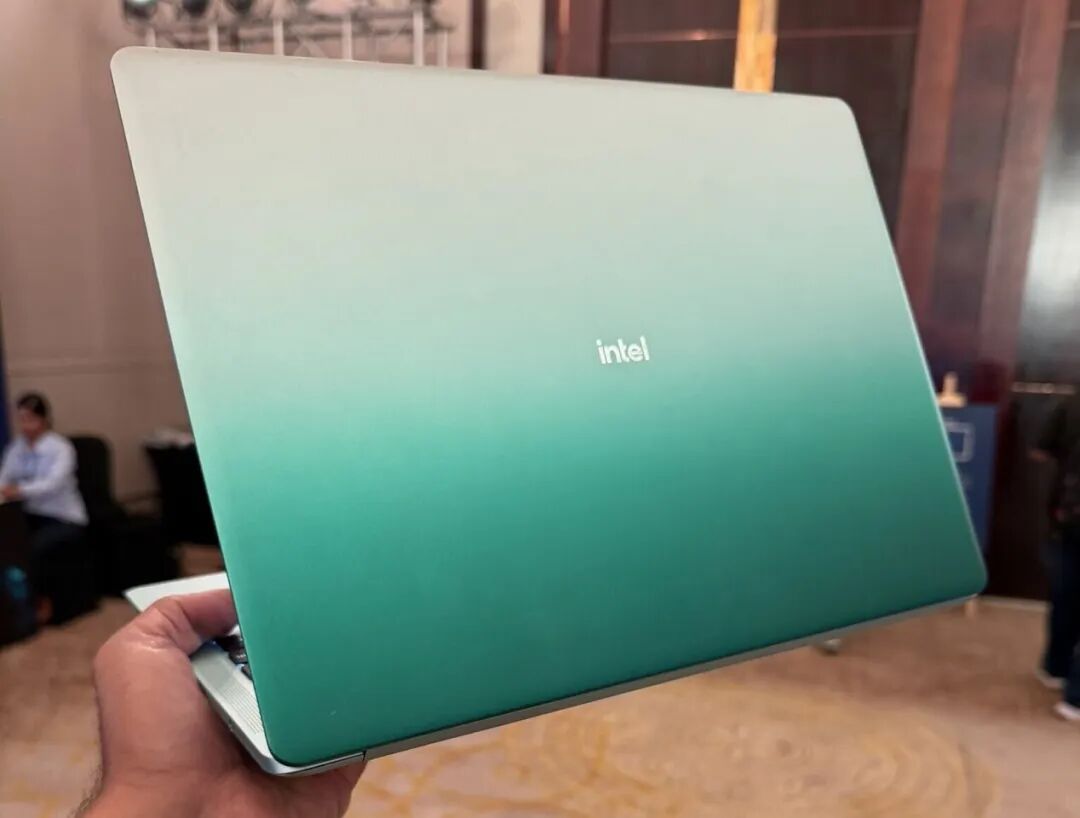
At the end of April, the public reference design for Wildcat Lake was exposed. It features a gradient color scheme, an all - in - one aluminum alloy body, a narrow - bezel keyboard, speaker openings on both sides of the keyboard, and no air outlets on the D - side.
This design language needs no further explanation. It is using Apple's usual design language to respond to Apple's popular colorful color schemes and lightweight aluminum alloy body strategies.
Apple got one thing right with the MacBook Neo: It made the entire industry realize again that in the era of "RAMmageddon", the entry - level price segment has become a goldmine.
By using an A18 Pro chip that was originally in the inventory - clearance stage, paired with 8GB of memory and 256GB of storage, and priced at 4,599 yuan, the MacBook Neo has become a worthy alternative to the MacBook Air.
Intel and the entire Windows PC camp cannot continue to cede this user group. And this is (almost) the entire reason for the existence of "Wildcat Lake".
18A Process Applied to the Entry - Level Segment for the First Time
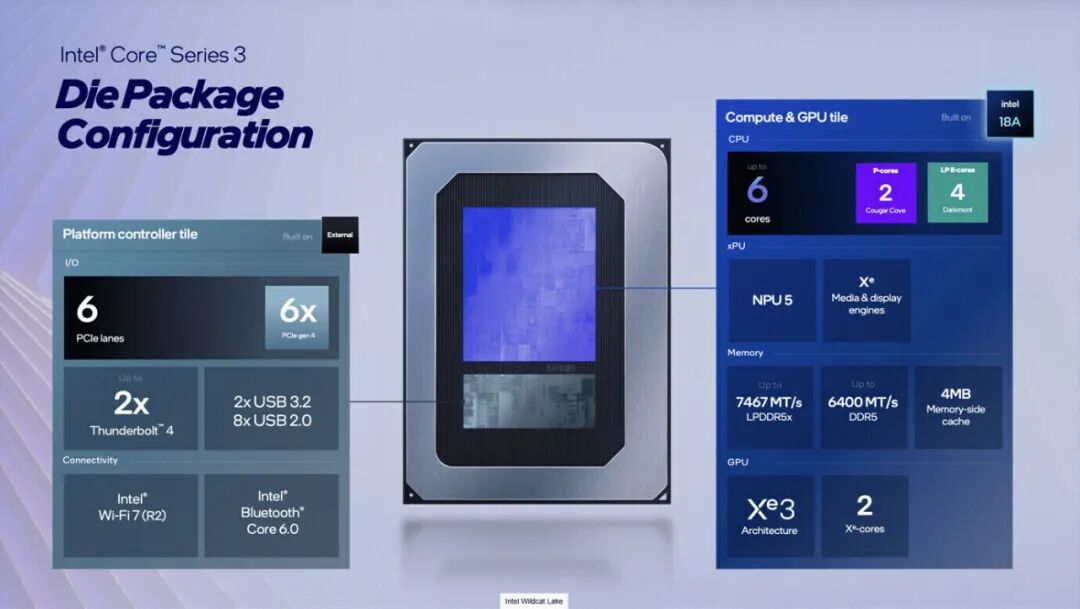
The technical parameters of the 3rd - generation Intel Core processors are not complicated. The CPU has 2 Cougar Cove performance cores and 4 Darkmont ultra - low - power efficiency cores, totaling 6 cores and 6 threads. The GPU is equipped with 2 Xe3 cores, and the NPU computing power can reach up to 18 TOPS. The basic TDP of the whole machine is 15W, with a maximum of 35W. On laptops without active cooling, it can even operate at a low power of 11W.
According to Intel's official statement today, the power consumption of this chip has been reduced by more than 60% compared to the previous generation, the graphics AI performance has increased by nearly 3 times, and the total computing power of the platform has reached 40 TOPS.
Of course, considering that the NPU computing power of the "Wildcat Lake" processor is only 17 TOPS, far lower than the so - called "AI PC" in the Windows camp, that is, the 40 TOPS threshold defined by Microsoft for Copilot + PC. Strictly speaking, Wildcat Lake cannot be directly compared with Apple's high - quality neural network engine of the A18 Pro and its unified memory architecture.
However, it is more than sufficient to drive local small models with a relatively small number of parameters and perform some AI inference tasks.
What's more interesting is that when Google recently launched its own AI laptop, the "Googlebook", it also confirmed an alliance with Intel. Overseas industry insiders generally believe that Wildcat Lake will become the core platform for the Googlebook.
If Google thinks it's sufficient, there should be no major problem, right?
The real key lies not in these parameters, but in the fact that "Wildcat Lake" uses the Intel 18A process technology.
You know, the previous two generations of Core Series 1 and 2 have been using the Raptor Lake - U architecture and the Intel 7 process, which is essentially an evolved version of the 10nm SuperFin process.
As mainstream chips are generally moving towards 5nm or even 3nm, the technological gap is quite obvious.
When the MacBook Neo enters the price segment of over 4,000 yuan with the A18 Pro using the genuine 3nm process (although it's old inventory), Intel's previous entry - level strategy of "reducing costs with old processes" is outdated. Therefore, we are glad to see that Intel has applied the 18A - a 2nm - level process - to an entry - level chip. This means that Intel is fully willing to bear the higher initial unit cost to safeguard a market that cannot be lost.
System: Applying Mobile Phone Supply - Chain Ideas to PCs
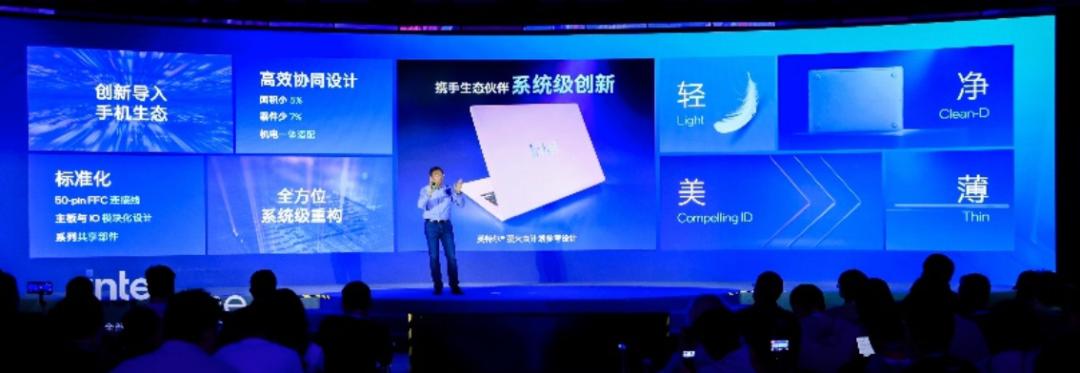
The "Firefly Project" is equally important for defending the market, as Gao Song, the vice - president of Intel and the general manager of the Software Engineering and Client Product Division in China, said:
Although the computing power of the chip itself is important, "dual innovation at the chip and system levels" is the source of the leap in the experience of this generation of mainstream PCs. Zong Ye, the general manager of the Client and Platform Sales Business Department in China, believes that PCs are also evolving from tools to "intelligent experience entrances".
According to internal data provided by Intel, compared with the previous generation, the PCB area of the "Wildcat Lake" products has been reduced by 5%, and the number of components has been reduced by 7%. At the same time, standardized motherboard and I/O board connections have been formulated and promoted according to the characteristics of the 3rd - generation Core platform, promoting the further modularization, miniaturization, and low - power consumption of the motherboard's core circuits.
The essence of this approach actually comes from the mobile phone industry. The supply - chain collaboration methods developed by the mobile phone industry over the past 10 years - highly integrated components, modular motherboards, and unified interface standards - have been applied by Intel to entry - level PCs.
The result is lighter, thinner, and cheaper products.
Partners participating in the "Firefly Project" include, but are not limited to, ASUS, Colorful, Honor, HP, Lenovo, etc. Intel expects that global partners will successively launch more than 70 products based on the Wildcat Lake platform.
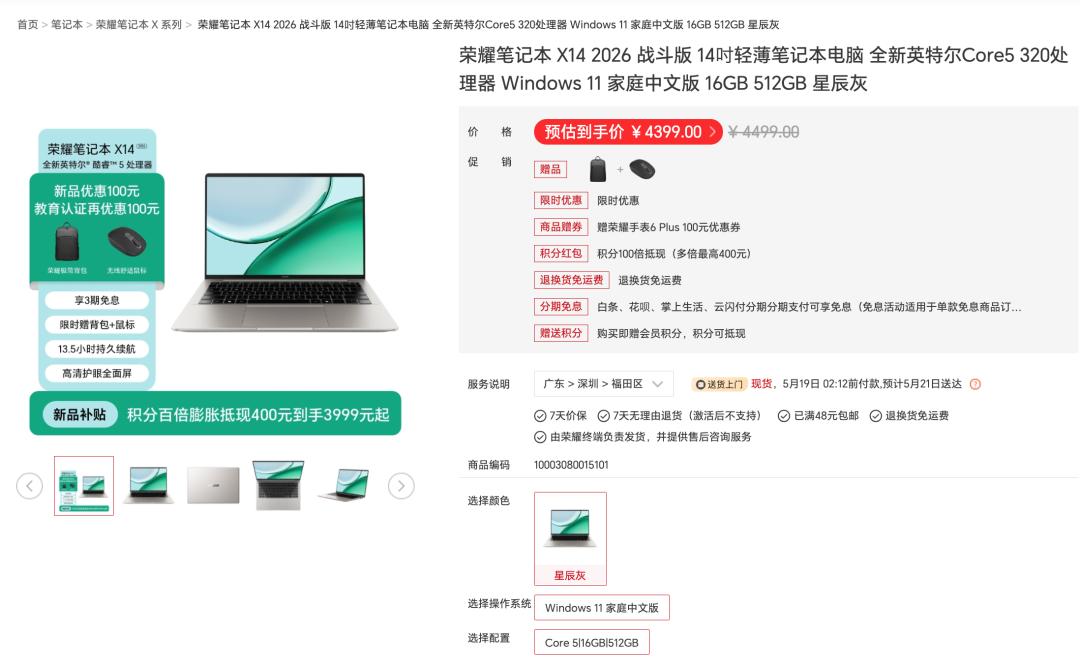
Currently, the Honor MagicBook X14 2026 has been the first to be put on the market, equipped with the Core 5 320 processor of this platform, using a 16GB + 512GB storage configuration, and priced at 4,399 yuan.
User Profile: Completely Targeting MacBook Neo, but with More
Intel has listed five types of target users for the Wildcat Lake platform products: parents who help their children with homework, students who are at school all day, new employees in the workplace, entrepreneurs of "one - person companies", and the elderly.
There is nothing surprising about these user groups and scenario descriptions themselves. However, it is worth noting that this user profile almost completely overlaps with the main recommended groups for the MacBook Neo in offline stores.
The MacBook Neo has taken away the customer group of entry - level Windows laptops. Intel's response is to create entry - level laptops with better value propositions and regain the consumers' trust.

Intel also repeatedly emphasizes the local AI inference computing power of the Wildcat Lake platform. For users with limited purchasing budgets who are unlikely to pay for high - quality cloud - based model computing power, this is a correct approach.
Finally, Wildcat Lake seems to be a qualified entry - level chip platform. Combined with the Firefly Project, it forms a sincere combination of strategies. With light, thin, and cheap AI laptops, Intel has now returned to the competition.
The only remaining question is how low the OEMs can set the retail price.
At the price point of the MacBook Neo, Apple offers a system ecosystem, a unified memory architecture, and various trendy color schemes. However, for Intel to compete with Apple with the Wildcat Lake, having just the 18A process and excellent industrial design is not enough.
The real battleground of this war will probably not be the technology itself, but whether the first batch of laptops equipped with the Wildcat Lake can really defeat the supply - constrained MacBook Neo during the upcoming 618 Shopping Festival.
This article is from the WeChat official account “ifanr”. Author: One Who Discovers Future Products. Republished by 36Kr with authorization.