Wang Huiwen has set a boundary for AI investment.
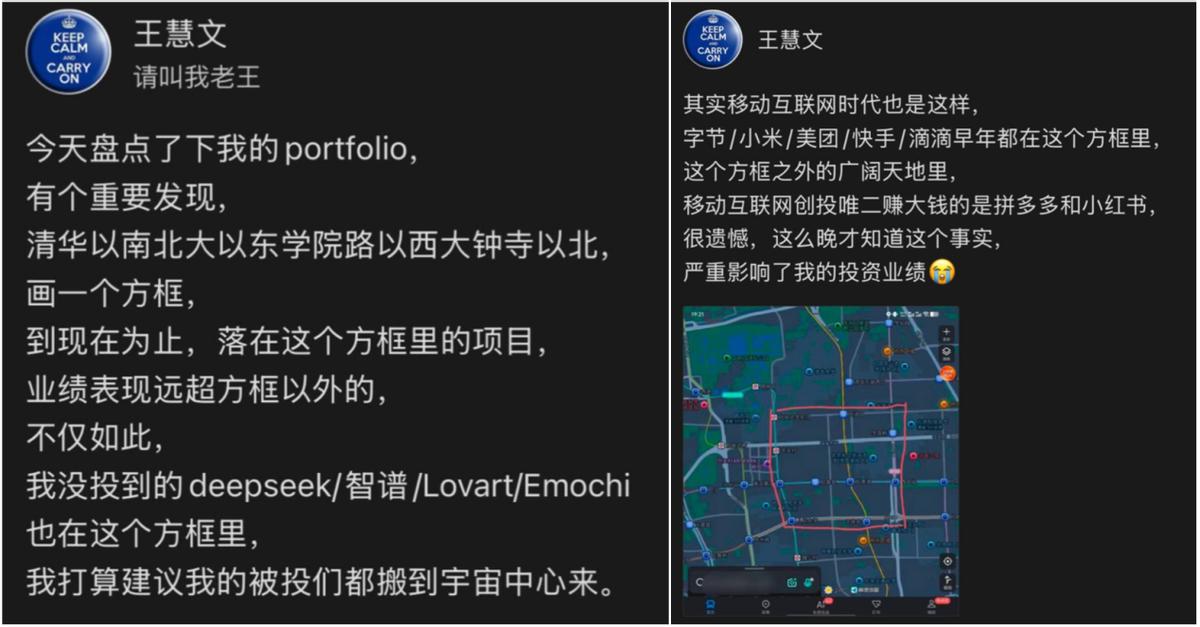
I find Wang Huiwen's recent post quite interesting.
He said that after reviewing his portfolio, he noticed a phenomenon: On the Beijing map, if you draw a box south of Tsinghua University, east of Peking University, west of Xueyuan Road, and north of Dazhongsi, so far, the investment returns of projects within this box are significantly better than those outside.
What's even more interesting is that when he extended this logic backward, he found that the same was true in the mobile - internet era. ByteDance, Xiaomi, Meituan, Kuaishou, and Didi were all in this box in their early days. Of course, there are also big players outside the box, such as Pinduoduo and Xiaohongshu. But his regret lies here: In the mobile - internet venture capital field, it was precisely Pinduoduo and Xiaohongshu that made him miss out on big money.
In the AI era, he reviewed again and found that DeepSeek, Zhipu, Lovart, and Emochi, which he didn't invest in, are also in this box. So he came to a straightforward conclusion: He suggests that his investee companies move to the "center of the universe" in the future.
On the surface, this sounds like a joke, or even a bit of "Haidian, Beijing, metaphysics." But I think the real value of this lies not in the map or the joke, but in bringing to the surface a long - standing but seldom - mentioned rule in Chinese technology investment: In the early pricing of technology assets, density is often priced first.
The density of talent, information, products, and capital, as well as the speed at which entrepreneurs stimulate, compete, and learn from each other.
In the mobile - internet era, people made money from user migration. With the popularization of smartphones and the maturity of mobile payment, traffic shifted from PCs to mobile phones, and consumption moved from offline to online. Those who could quickly understand the changes in user behavior, develop products, secure financing, and organize resources would get the valuation premium first.
In the AI era, this logic has a new form. In the past, we looked at DAU, GMV, fulfillment efficiency, and customer acquisition cost. Now, we look at model capabilities, token cost, agent retention, corporate payment, inference gross profit, and workflow substitution rate. The indicators have changed, but the essence of early - stage competition remains the same: Those closer to the densest information field are more likely to get the first wave of expected differences.
Wang Huiwen's map is, in fact, not a geographical question but an investment question.
I. What makes this box truly valuable is the "density dividend" left over from the mobile - internet era
Many people's first reaction when seeing Wang Huiwen's post might be: Here we go again, hyping up Haidian.
But if we put aside our emotions and look back at the mobile - internet era, we'll find that a group of the most valuable Chinese technology companies are indeed highly concentrated in a few areas with extremely high startup density.
Meituan, ByteDance, Kuaishou, Xiaomi, and Didi seem to be in completely different businesses. One is in local life services, one in content distribution, one in short - video, one in mobile phones and IoT, and one in transportation.
But the dividends they reaped in the early days actually came from the same underlying cycle: Smartphones became the largest entry point, mobile payment completed the transaction loop, algorithmic recommendation improved distribution efficiency, and local fulfillment digitized offline supply.
What's really remarkable about these companies is that when there were just the slightest signs in the industry, they started to bet with their organizations, funds, and products. By the time most people realized the trend, they had already achieved scale, secured financing, accumulated data, and won the trust of users.
This is the most valuable thing in investment: It's not just about seeing the trend correctly, but seeing it earlier than others and having the ability to turn that judgment into reality.
Why does this box have an advantage? Because in the early days of startups, the most valuable thing is not the office or the servers, but information.
A product manager might hear people at the next table in a coffee shop talking about recommendation algorithms one day, learn about a company's growth model at a friend's dinner the next day, and find out which track is heating up from an investor the day after. These things may seem intangible, but in early - stage primary - market investment, they are alpha.
I've always thought that in the past decade or so of the Chinese internet, many projects failed not because of the wrong direction, but because of slow reaction. By the time you see others' DAU rising, the valuation has already gone up; by the time you find a profitable model, the leading companies have already completed three rounds of financing; by the time you start recruiting, the best talents have already been snatched up by neighboring companies.
So when Wang Huiwen says that projects within the box have better returns, it's not that there's some kind of "feng shui" in this area. It's because the information transmission speed is faster here, the efficiency of talent recombination is higher, and the cycle for capital to reach a consensus is shorter.
Of course, there are counter - examples to this logic.
Pinduoduo and Xiaohongshu are two very important examples outside the box. Pinduoduo proves that truly profound business innovation doesn't necessarily occur in the narratives most familiar to Beijing's internet elites. It focuses on the sinking market, supply - chain efficiency, and social fission. Xiaohongshu proves that consumer communities, lifestyles, and the minds of female users can also generate a completely different product logic.
So this box is not a one - size - fits - all formula. It's more like a high - probability area. The capital market never pursues absolute correctness; it pursues a probability advantage.
In my opinion, the most interesting thing about Wang Huiwen's post is that it clearly explains the concept of the "high - probability area." Investment is not about making moral judgments or ranking cities. It's about constantly looking for expected differences and the soil where big companies are more likely to emerge.
II. With the arrival of the AI era, this box has re - entered the sight of traders
Now the question is, why is this topic worth discussing today?
Because AI startups are entering a crucial transition period.
In the past two years, the focus was on the large models themselves. Whoever had larger parameters, higher rankings, cheaper inferences, and longer contexts was favored. At that time, the market's valuation anchor was more on model capabilities, and the financing logic was more like an arms race.
But now, the capabilities of the basic models are spreading, open - source models are constantly catching up, the call cost is continuously decreasing, and large companies are continuously investing in computing power and model infrastructure. At this time, capital starts to ask a different question: With all models getting stronger, who can turn AI into a truly usable, payable, and renewable product?
This is why the AI application layer is heating up.
In my opinion, the main line of AI investment is shifting from "who has the model" to "who can integrate the model into real - world workflows." This change is very crucial. Because model companies require huge capital expenditures, computing power, and top - notch research teams, with a long cycle, high burn rate, and high risk. Application companies, if they can find high - frequency scenarios, may achieve profit elasticity in a lighter way.
For example, design agents, office agents, programming agents, marketing agents, video generation, AI companionship, and corporate knowledge bases. These directions may seem scattered, but they all point to one thing: Breaking down the processes originally done by humans into tasks that AI can execute.
At this time, the advantages of areas like Haidian come into play again.
AI startups rely more on talent density than mobile - internet startups. In the mobile - internet era, the most scarce skills were in product, operation, growth, ground promotion, and supply - chain organization. In the AI era, what's scarce are model engineering, infrastructure, inference optimization, multi - modality, interaction design, industry data, and understanding of corporate customers.
These things are hard to achieve through a single - point breakthrough by a genius. It requires an ecosystem: High - level universities, research institutes, large companies, investment institutions, entrepreneurs, early - stage customers, and media influence, all interacting frequently.
This is also why Wang Huiwen includes names like DeepSeek, Zhipu, Lovart, and Emochi in his observation framework. They are not exactly the same type of companies, but they are all in positions on the AI industry chain that are most likely to be re - priced by capital: either close to model capabilities, or close to agent products, or close to the next - generation AI content and productivity tools.
Of course, I don't think AI opportunities will only occur in Beijing.
The narrative behind DeepSeek in Hangzhou is very typical. Hangzhou has Alibaba, strong industrial clusters, an e - commerce ecosystem, and a special path for quantitative funds to enter AI. Shanghai has global talent and corporate customers, and Shenzhen has a hardware supply chain and a foundation for robotics. The geographical centers in the AI era will surely blossom in multiple places.
But from an investment perspective, Haidian's advantage is that it is still China's most typical "early - stage consensus generator."
Many projects may not have revenue yet, the products are not fully formed, and the business models are still being tested. But once a consensus is formed here, financing, talent, media attention, and customer resources will quickly follow. This process is the emotional repair and the recovery of risk appetite in the primary market.
Put more in capital - market terms: The box drawn by Wang Huiwen is one of the places where the early - stage valuation switch of AI assets is most likely to occur.
III. The real story that can be told to the market is not "being in the box," but how to realize growth
However, the map cannot replace the business model.
The most dangerous thing for many AI startups now is that it's easy to tell a good story but hard to deliver on it.
If you say you're in Haidian, your team is from Tsinghua or Peking University, has a background in large companies, strong model capabilities, is in the agent direction, and has a global product, it sounds really attractive. The primary market is willing to give a premium for this combination because it represents talent density and thematic flexibility.
But in the real language of the capital market, it still comes down to several hard questions.
Is user retention good? Is the payment conversion rate high? Will corporate customers renew? Can the inference cost be controlled? Will the customer acquisition cost get out of control? Can revenue growth be translated into cash - flow quality?
There is a big difference between AI applications and traditional internet tools: More user activity doesn't necessarily mean more profit.
For traditional SaaS or internet products, the marginal cost usually decreases as the scale expands. But AI applications are different. Especially for multi - modality, video, image, and agent - execution products, every time a user uses the product, there is an inference cost. As DAU increases, token consumption and server fees also increase. If user payment doesn't keep up, the larger the scale, the greater the loss may be.
So I think the valuation stratification of AI applications in the future will be very brutal.
The first type of companies can only talk about concepts and rely on financing to survive. Their valuations rise quickly when the theme is hot, but they are likely to see their valuations plummet when risk appetite declines.
The second type of companies can create popular products, but their revenue models are not stable yet. They have trading opportunities and the chance to become well - known, but the market will continuously monitor their retention rate, payment rate, and cost structure.
The third type of companies can integrate AI into real - world workflows and turn it into a productivity tool that companies or individuals use every day. Only these companies may complete a real valuation switch.
Take Lovart, a design agent, as an example. What makes it attractive is not just image generation, but the attempt to break down the design process into tasks that AI can understand and execute. If this direction succeeds, the valuation anchor will no longer be "an AI drawing tool," but "a design productivity platform." The difference between the two is huge.
The former looks at monthly active users, generation times, and subscription revenue. The latter looks at workflow substitution rate, team collaboration, corporate customers, repurchase, and renewal. The former is a tool - based valuation, while the latter has the opportunity to tell a platform - based story.
This is also what I pay most attention to when looking at AI applications: Is it just for users to have fun, or is it helping users save money, reduce the need for staff, shorten processes, and increase the output of a position?
Only the latter can tell a real capital story.
Wang Huiwen's map actually provides us with a good observation entry point. It tells us that the next round of AI investment is likely to emerge from high - density areas first. But investors can't just watch the show and get excited at the keywords like "Haidian," "Tsinghua and Peking University," "former employees of large companies," and "agent."
What really matters is whether a company can turn talent density into product density, then turn product density into revenue density, and finally into cash - flow quality.
Only when this chain is completed can it be called asset re - valuation. Otherwise, it's just a thematic trading round.
Conclusion: What Wang Huiwen drew is not a map, but an AI investment screening form
So, going back to the beginning, why is Wang Huiwen's post worth writing about?
Because it's not just a joke in the startup circle or self - indulgence about the "center of the universe." Behind it is a very real investment question: In the AI era, where will China's next batch of high - return technology assets emerge?
My judgment is that there will still be high - probability opportunities within the box, but new species will also emerge outside the box. Haidian provides an information advantage and talent density, but it doesn't guarantee success. Hangzhou, Shanghai, and Shenzhen will also form their own valuation anchors in different directions.
But for investors, Wang Huiwen's box is still useful. It reminds us that in AI investment, we can't just look at technical terms, but also at industry density; we can't just look at the founder's resume, but also at business implementation; we can't just look at model capabilities, but also at which workflow the model has entered.
In the mobile - internet era, capital invested in user migration and platform network effects. In the AI era, capital invests in intelligent migration and productivity reconstruction.
In the last round, those closer to users got the valuation premium. In the next round, those closer to top - notch talent, real - world scenarios, model capabilities, and business closures are more likely to achieve expected differences.
So what Wang Huiwen drew is not just a box on the Beijing map.
In my opinion, it's more like an investment screening form for the AI era: Where the information is the fastest, the talent is the densest, and the product iteration is the most intense, there is a higher chance of being the starting point for the next round of asset re - valuation.