36Kr Exclusive | Pet health large model company secures two consecutive rounds of financing, implements a hardware-software integrated strategy, and has served over 200 pet hospitals
Author | Qiao Yujie
Editor | Yuan Silai
Yingke learned that Chongqing Qlalgorithm Technology Co., Ltd. (hereinafter referred to as "Qlalgorithm"), a large - model health company focusing on pets and an ecological enterprise of Zhipu's "Z Plan", recently completed a financing of tens of millions of yuan. The investors are Qifu Capital and Juheng Venture Capital. The funds from this round will be mainly used for product iteration, model ability deepening and market expansion.
Qlalgorithm was founded in July 2022. It is a large - model technology company focusing on the pet health field. Relying on the multimodal large - model ability, the company has created a pet health brand that integrates online and offline and coordinates software and hardware.
Chen Li, the founder of Qlalgorithm, graduated from King's College London. He is a researcher at Qlalgorithm Lab and a serial entrepreneur. Liu Yudong, the technical partner, is a doctor from the University of Pennsylvania and has long been engaged in AI medical research. Another technical partner, Deng Zihao, graduated from the University of Pennsylvania and focuses on the new - generation edge computing technology.
Previously, with the support of Zhipu's professional model ability and the business resources of "Xiaonuan Doctor", the company has built a set of vertical and implementable AI model systems around the pet medical scenario.
In the pet medical field, due to the lack of systematic evidence - based data and the fact that pets cannot actively express their symptoms, the diagnosis is quite difficult. Chen Li introduced that Qlalgorithm trains its model based on tens of millions of pet medical records, medical images and behavior data. Compared with general large models, it better understands the breed - specific individual differences, symptom expressions and diagnosis and treatment logic in pet medicine. The model can not only output the diagnosis results but also provide the diagnosis basis, risk warnings, decision - making paths and solutions, which is closer to the needs of real medical scenarios.
At the same time, the company adopts a software - hardware integration solution of "cloud - based large model + edge - end NPU deployment", enabling AI capabilities to truly enter pet hospitals, pet smart wearable devices and family scenarios, rather than remaining at the simple question - answering level.
In terms of business promotion, the company has completed the application for multiple large - model - related patents, filings and Internet hospital licenses, and has made phased progress in terms of compliance and professional qualifications.
Currently, Qlalgorithm's auxiliary consultation system has realized the function of assisting doctors in receiving patients and is open to pet doctors for free use. Chen Li introduced that the platform has served over one million times in total, cooperated with more than 200 hospitals, and about 3,000 doctors have registered and used it. The daily active users of the platform are close to 5,000, and a relatively stable closed - loop of data feedback and model training has been formed.
Specifically, doctors can use the AI consultation model to improve the efficiency of daily patient reception, and the data generated during use will continuously feed back to the model training. Meanwhile, the company's cooperation with pet hospitals not only stays at the system access level but also extends to the recommendation of diagnosis and treatment services. After users complete the consultation, the platform can provide subsequent services such as drug recommendation and hospital referral for users based on its Internet hospital license, thus forming a complete link of "consultation - diagnosis and treatment - medication - data feedback".
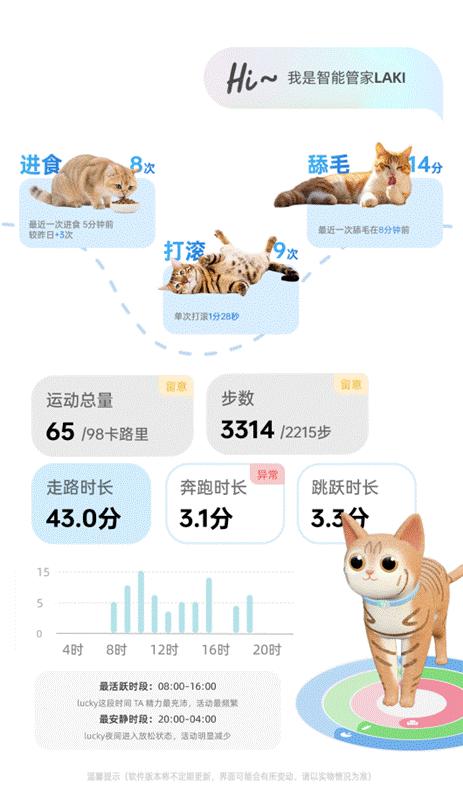
In terms of hardware, the company launched the Pachi Pet AI Smart Collar in the early stage, and it has now been iterated to version 3.0. Compared with the previous solution, the new - generation product can run on the entire edge side without additional host devices, and has been optimized in terms of edge computing power consumption control and algorithm stability.
The collar weighs only 19 grams, mainly targeting cats and dogs. It is "the world's lightest pet smart wearable device", and the cumulative sales have been close to 20,000 units. The product can automatically complete functions such as pet positioning, real - time posture prediction, status recognition, movement, eating and sleep tracking, and users can obtain basic health data without additional operations.
(Image source/Enterprise)
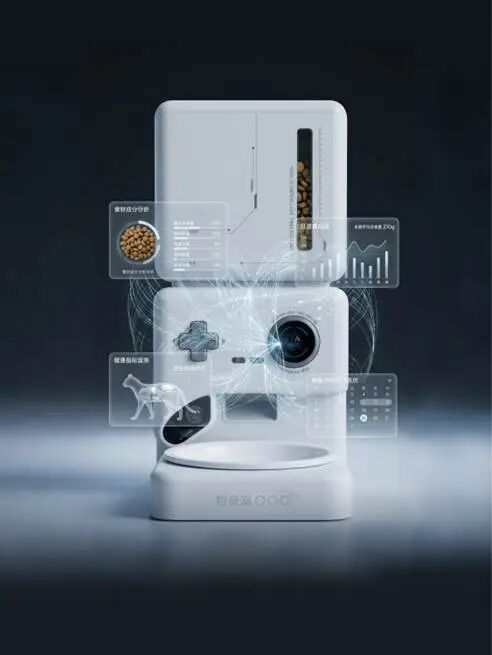
In addition to the smart collar, the company's AI feeder has completed the pre - sale of 1,000 units, realizing exclusive scientific feeding. Products such as the AI ICU, which features AI automatic early warning and monitoring, have also begun to be gradually implemented in more than 30 pet hospital scenarios.
(Image source/Enterprise)
In addition, in the emotional companionship scenario, the company has also reached a cooperation with OPPO. Taking OPPO's official theme store as an example, its AI pet desktop wallpaper function uses the relevant interface capabilities provided by Qlalgorithm, covering more than hundreds of thousands of users.
Next, Qlalgorithm plans to further build a Q&A search and recommendation engine for the pet industry, hoping to become an infrastructure platform in the pet health management field and provide exclusive health management and services for every furry friend.
The following is an excerpt from the interview (slightly edited):
Yingke: There are a wide variety of pet breeds. Will the "thousands of pets, thousands of faces" situation make it difficult to establish the generalization ability of the model?
Chen Li: We currently have two main solutions. First, as the user scale continues to grow, our basic model will become more and more accurate. Because the data coverage of pet behavior, breed and living environment will continue to increase, the generalization ability of the model will also continue to be enhanced.
We support users to conduct personalized AI training. For example, if some pets' behavior habits are different from the standard data, users only need to upload a video for feedback, and we can quickly complete targeted behavior learning and generate a dedicated model for the user within a few minutes.
Yingke: What are the core differential advantages of Qlalgorithm in the pet smart hardware industry?
Chen Li: First of all, it is the team background and technical accumulation. Our core team has long been engaged in research in the fields of AI medical, multimodal models and edge computing, which is relatively rare in the pet AI track. The company does not simply integrate solutions but realizes independent research and development from the underlying algorithm, framework optimization to hardware design. At present, except for the chip, the software and hardware, algorithms, frameworks and edge - side deployment capabilities are all self - developed by the team.
More importantly, in the field of pet models, which has a relatively low cost - effectiveness in terms of input and output, we have established a complete closed - loop from behavior data collection, analysis and interpretation, health report generation, to drug recommendation, hospital connection and medical data feedback. We have established a high technical barrier, which is difficult for new start - up companies to replicate.
Many companies in the industry may only stay at single - point functions. We hope to build a truly sustainable pet health infrastructure.
Yingke: What are the company's future plans?
Chen Li: In the future, we will focus on building a Q&A search and recommendation engine for the pet industry, hoping to become the core entrance and infrastructure in the pet health management field. Currently, the pet nutrition industry still lacks evidence - based medicine support, and many product formulations rely more on experience. We hope to gradually establish a more scientific and data - driven pet health recommendation system through long - term data accumulation. For example, by analyzing behavior data such as pet eating duration, frequency and activity status, we can provide users with more accurate health and nutrition advice.