The once world-leading Japanese robots are approaching their "twilight hour".
Recently, the humanoid robots of Unitree and Ubtech went to Tokyo Haneda Airport in Japan to conduct actual tests for freight ground handling, which has attracted a wave of attention.
Ten years ago, this would have been unthinkable. Japan, once the country with the strongest global robot atmosphere, has long been at the forefront of the world in terms of technological accumulation, industrial support, and market penetration.
Among the four well - recognized major robot manufacturers in the world, Japan occupies two seats, namely Fanuc and Yaskawa Electric. These two Japanese robot companies, together with ABB from Switzerland and KUKA from Germany, account for about 50% to 70% of the global industrial robot market.
Thus, a contrast emerges: Why is Japan, a country with first - class robot technology, absent from its own core transportation hubs, while Chinese companies are seizing the opportunity? Behind this is not technological backwardness, but a deeper - seated mindset of rigidity.
It is reported that the International Federation of Robotics divides robots into two major categories: industrial robots and service robots. The former are mainly used in production lines, while the latter cover multiple fields such as professional services, medical assistance, and household equipment. Japan has always been deeply involved in the industrial robot industry.
Perhaps, it is the over - reliance on the industrial track that has made Japan miss more opportunities and markets.
Currently, the global robot industry is at a critical turning point. The industry competition is rapidly shifting from traditional industrial production lines to urban public services and civil and commercial scenarios. Service - type robots are replacing industrial - type robots as the new industry trend. Japan, which has long focused on industrial robots and has inherent hidden shortcomings in this field, is gradually losing its position as a major robot - producing country.
The "Japanese Robot Family" Has Declined
When it comes to Japanese robots, it is necessary to link them with the country's manufacturing industry.
In the 1970s, Japan's manufacturing industry (automobiles, electrical appliances, precision machinery) rose. At the same time, Japan officially entered an aging society, with the proportion of people aged 65 and above in the total population exceeding 7%. This has put the manufacturing industry under the dual pressure of labor shortage and the need to improve production efficiency.
As a result, industrial robots came into being.
Looking back at the development history of Japanese robots, it is basically to better develop the manufacturing industry:
In 1969, Kawasaki Heavy Industries' first industrial robot in Japan, which was a copy, was applied in the automotive manufacturing field; in the same year, Nachi - Fujikoshi entered the field of hydraulic industrial robots; in 1974, Yaskawa Electric launched Japan's first electric industrial robot, "MOTOMAN", laying the technical foundation for servo motors and motion controllers...
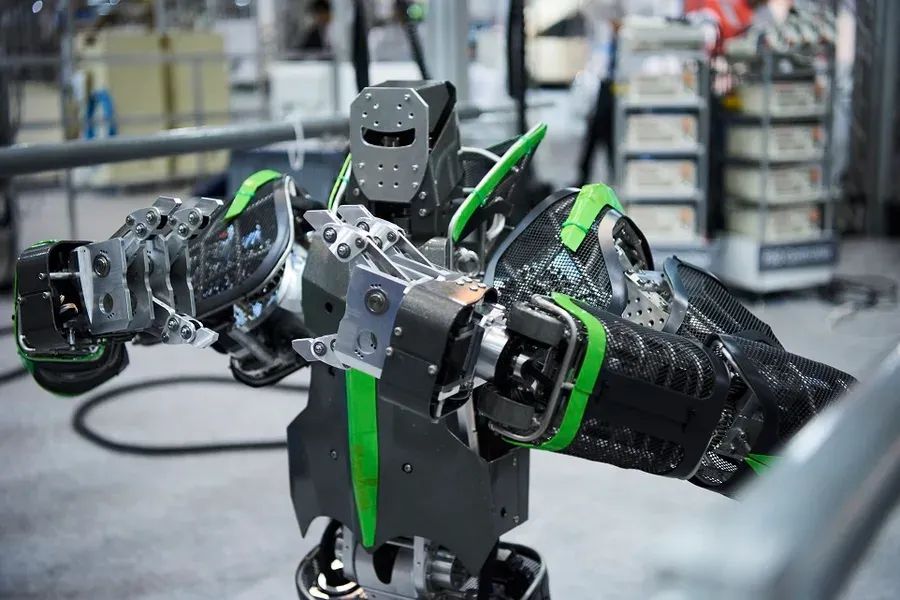
The eighth - generation robot of Kawasaki Heavy Industries
In 1980, Japan's automobile production reached 11 million vehicles, exceeding that of the United States and becoming the world's largest automobile - producing country for the first time. This led Japanese manufacturing giants to "collectively" enter the robot track. For example, Honda, Nissan, Mitsubishi, Toyota, Sony, and Seiko Epson mainly produced industrial robots for welding, logistics, and assembly.
In 2024, a research report by Grand View Research showed that the market size of Japan's industrial robots was about $3.33 billion, and it is predicted to grow to about $5.2 billion by 2030. Fanuc, Yaskawa Electric, Kawasaki Heavy Industries, etc. account for more than two - thirds of the global industrial robot market share. However, these companies are far from as glorious as before. There is even a strange contrast where the more enthusiastic the global robot atmosphere is, the more desolate the old - fashioned Japanese robot companies become.
Statistics from foreign media show that during the period from 2010 to 2020, the annual net profit of Fanuc, one of the "Big Four" robot manufacturers, declined negatively four times. Similarly, Yaskawa Electric's net profit declined for three consecutive years from 2014 to 2016. Kawasaki Heavy Industries' net profit decreased by 133% year - on - year in half a year, so much so that it wanted to withdraw from the railway business.
Along with the decline in profits, sales have also decreased.
In recent years, the global robot market has exploded, but the performance of Fanuc and Yaskawa Electric is in jeopardy. The mid - term financial report data shows that in 2024, Fanuc's sales once decreased by 2.7%, and the net sales of its robot business decreased by 15.30% year - on - year. Yaskawa Electric's revenue decreased by 9.5% year - on - year, and the revenue of its robot business decreased by 0.2%.
Since 2025, Japan's position in the global robot camp has been much weaker.
In fact, the rise and fall of Japanese robots are both related to the manufacturing industry.
The decline of leading robot companies such as Fanuc and Yaskawa Electric is, on the one hand, due to the rapid decline of Japan's domestic manufacturing industry, including automobiles, home appliances, semiconductors... According to the statistics of the World Bank, as of February 2025, Japan's manufacturing PMI index is still below the 50 - point threshold.
On the other hand, there have been huge changes in the global industrial robot track from the production end to the application end.
First, look at the application end. In the early days, while filling the domestic labor gap, Japanese robots were also exported overseas in large quantities. Japanese robots can be found in the global manufacturing field. According to the data of the International Federation of Robotics, in 1980, the export volume of Japanese - produced robots accounted for 3% of the global total, which rapidly increased to 20% in 1984 and reached 48% by 2002.
The turning point probably occurred in 2024.
In this year, the application of global industrial robots increased sharply. The World Robot Statistics shows that the annual installation volume of industrial robots in 2024 was the second - highest level in history, only 2% lower than the all - time high two years ago. Industrial digitization and automation have driven huge demand growth. The total number of industrial robots in operation globally reached 4.664 million, a 9% increase from the previous year.
However, in the first three quarters of 2024, the market share of Fanuc and Yaskawa decreased by 1.2 percentage points compared with the same period of the previous year. In the first quarter, the new orders for Japanese industrial robots decreased by 24% year - on - year, showing a decline for six consecutive quarters.
On the contrary, the export of China's industrial robots has begun to increase.
According to the data of Zhiyan Consulting, in 2019, the export volume of China's industrial robots exceeded the import volume for the first time, with the export volume reaching 105,604 units. In 2023, the export growth rate of China's industrial robots reached 86.4%. In 2024, the market shares of Estun and Inovance, Chinese companies, increased by 1% and 2.4% respectively.
Failing to hold on to its good - at niche market and allowing the global industrial robot dividend to shift is the first step in Japan's long - standing regret in the robot field.
Second, look at the production end.
Today, the "high - margin era" of industrial robot manufacturing has come to an end. It is reported that with the increase in production volume, intensified competition, and supply - chain fluctuations, the average revenue per unit (ARPU) of global industrial robots has decreased significantly, from about $31,100 in 2018 to $25,600 in 2024.
To put it bluntly, the profitability of industrial robots has declined significantly, and the profit space for enterprises is narrow. The end of the high - margin era means that the industry has entered a stage of earning hard - won money.
This not only affects Japanese robot companies but also global industrial robot companies. According to a relevant report on China Report Hall Network, in 2025, the annual operating income of China's leading industrial robot companies reached 4.888 billion yuan, a year - on - year increase of 21.93%, with the growth rate higher than the average level of the manufacturing industry. However, the net profit attributable to the parent company reached 45 million yuan, a year - on - year decrease of 105.5%.
Facing this situation, Chinese companies have accelerated their transformation. Unfortunately, Fanuc and Yaskawa Electric are still in their "comfort zones".
Is the Japanese Robot Trapped by the "Industrial Mindset"?
In fact, when the global robot track is booming, the boundaries of the segmented application markets are becoming more and more distinct. Industrial robots and service robots have clearly taken different paths.
In terms of market size, the overall scale of industrial robots is indeed larger than that of service robots. According to the "2026 Global Robot Industry's Overall Scale, Market Share and Ranking of Major Enterprises at Home and Abroad" by CRI, in 2025, the global industrial robot market size reached $93.5 billion.
During the same period, the global service robot industry's market size was between $41 billion and $43 billion.
However, in terms of growth slope, penetration ceiling, profit structure, capital enthusiasm, and future growth space, the market development of service robots is not inferior to that of industrial robots. At present, the global robot track's bet on service robots cannot be underestimated.
It is reported that in the field of service and medical robots alone, China has 107 relevant enterprises, ranking second only to the United States.
However, Japan has been stuck in the field of industrial robots for a long time and has actively "ignored" the future growth of service robots. Media reports show that in the general perception of Japanese society, "robots are just mechanical arms for screwing screws".
This has led to Japan, a major robot - producing country, being absent from the huge market of service robots.
Instead, other companies have stepped in. For example, Chinese robot manufacturers pay special attention to the penetration of service robots in global application scenarios. According to data from the International Data Corporation, currently, Chinese manufacturers dominate the global commercial service robot market, accounting for up to 84.7% of the shipment volume.
A thought - provoking question then arises: Facing the era's trend of service robots, why is Japan so "persistent" in industrial robots?
This is still related to the manufacturing industry.
Although the halo of "Made in Japan" is fading rapidly, Japan is striving to revive its manufacturing industry. As of 2025, the manufacturing industry still accounts for as high as 22% of Japan's GDP. In November, Japan approved a comprehensive economic package of 21.3 trillion yen, designating 17 important manufacturing fields such as semiconductors, artificial intelligence, aerospace, defense industries, important mineral products, and shipbuilding as "strategic investment fields".
For example, the shipbuilding industry has replaced the automobile industry as the "hope" for Japan to revitalize its manufacturing industry.
In December 2025, Japan announced the "Shipbuilding Industry Revival Roadmap". It plans to invest a total of 1 trillion yen (about 44.9 billion yuan) nationwide to double Japan's domestic shipbuilding volume by 2035, that is, to increase the shipbuilding volume from 9.07 million gross tons in 2024 to 18 million gross tons.
The involved enterprises include Mitsubishi Heavy Industries, Imabari Shipbuilding, Nippon Yusen, Mitsui O.S.K. Lines, Kawasaki Kisen, JMU (Japan Marine United, the second - largest shipbuilding enterprise in Japan), and Japan Dock (a ship design company)... Unfortunately, this plan has not gone smoothly. In April 2026, "Nikkei Chinese Net" reported that the order volume of Japan's shipbuilding industry has decreased for four consecutive years.
The main reason for this is the labor shortage.
It is reported that Japan's current labor force cannot meet the over - loaded shipyards.
The operating rate of Tsuneishi Shipbuilding has decreased by 40% compared with the peak period. In 2026, the number of new graduate employees at JMU was 1.4 times that of 2025, but there is still a shortage of manpower. Imabari Shipbuilding maintained a high - level recruitment of about 100 people in 2025 and 2026. Ohshima Shipbuilding introduced a system to re - employ retired employees.

To solve the labor problem, installing robots has become the best solution. For example, JMU independently developed welding robots; Imabari Shipbuilding connected multiple robots to reduce manual work; Shin Meiwa Shipbuilding launched an empirical test to introduce robots. In March 2026, Japan approved 14 projects of shipbuilding and robot - development enterprises.
In other words, Japan's "revival plan" for the manufacturing industry needs industrial robots to support it.
Of course, another core reason for Japanese robots to miss a larger market is the overall lag in the development of software and AI ecosystems.
Service robots are different from industrial robots. Precise hardware and mechanical processes are secondary. They place more emphasis on operating systems, AI development frameworks, multi - modal large models, and cloud - based intelligent collaboration... However, Japan focuses on hardware and lags significantly in the fields of robot underlying systems, general AI frameworks, embodied intelligent large models, and cloud - service ecosystems.
Anyway, Japan, once a major robot - producing country, has been trapped by the "industrial" mindset.
Does Japan Temporarily Not Need More Robots?
It is true that Japan will need more industrial robots in the future. So, what is the penetration rate of service robots in Japan?
In fact, apart from the workshops in the manufacturing industry, scenarios like the "Tokyo Haneda Airport" where robots are introduced are not common in Japan. It is worth noting that, like most developed countries, the service industry accounts for the highest proportion of Japan's GDP, reaching about 62% as of 2025.
Logically, against the background of the country's labor shortage and population aging, the speed of robots being introduced into the service industry should be increasing. However, the reality is the opposite. Some foreign media have found through empirical analysis using a fixed - effects model that in the manufacturing industry, for every 1% increase in the proportion of workers over 50 years old, the probability of adopting manufacturing robots increases by 0.32, but this is not significant in the service industry.
Similarly, media reports indicate that in China, the use of robots in scenarios such as delivering water and serving food in restaurants and providing hotel room services is very common. In Japan, however, the presence of robots in similar scenarios is not as strong as expected. The mass - production and application of service - type humanoid robots are far less developed than in China.
So, why is the implementation of service robots in the Japanese service industry slower than in the manufacturing industry?
First of all, the Japanese service industry, which also "lacks workers", cannot leave too many jobs for robots because there are still countless workers in this scenario eager to find employment: the silver - haired group in Japan who are re - entering the workforce. At the end of 2025, 42% of people in Japan over 70 years old still continued to work.
In 2024, the proportion of people aged 65 and above in the total employed population in Japan was 13.7%, and most of them were distributed in the service industry. In some news, Japan today seems to be full of elderly people: white - haired old people clean tables and chairs in McDonald's, 60 - year - old clerks operate cash registers in convenience stores, and in nursing homes, it is even "the elderly taking care of the elderly"...
It is no exaggeration to say that the jobs in the Japanese service industry have been filled by silver - haired workers.