DAU exits the stage, and tokens are not the ultimate solution. Baidu wants to rewrite the value metric in the AI era with DAA.
In the past year, more and more people have felt the temperature difference in the large model industry.
On the one hand, there is a "deflationary" frenzy in large model technology. With the localization of the underlying computing power architecture and the exponential leap in algorithm efficiency, the price of Tokens has dropped significantly, and the arms race of model parameters has entered the deep - water area where the marginal effect is diminishing.
On the other hand, after three years of technological baptism, the industry still faces a soul - searching question: Although everyone is using AI, how can we measure how much work AI has actually helped us accomplish?
The root of this confusion lies in the misalignment of measurement standards. In the era of mobile Internet, many people were superstitious about DAU (Daily Active Users) because it represented the harvesting and secondary distribution of attention.
However, in the Agent era of 2026, the relationship between humans and AI can no longer be simply described by the "spectating" in the Internet era. The term "collaboration" is being mentioned more and more frequently. The value of a user spending an hour listening to an AI chat may be far less than an Agent independently running for five minutes and delivering a complex business result.
The old measuring stick can no longer measure the depth of the new world.
At the just - opened Baidu Create 2026 Conference, Baidu put forward a highly impactful "non - consensus" indicator: DAA (Daily Active Agents). This is not just the birth of a new term, but also Baidu's attempt to open the door to the explosion of Agents by reconstructing the value coordinates.
"When humanity enters the Agent era, to measure the prosperity of a platform and ecosystem, we should pay more attention to the DAA indicator, focusing on how many Agents are working for humans and delivering results. This is closer to value and essence than the meaningless consumption of Tokens." Robin Li, the founder of Baidu, described DAA at the conference.
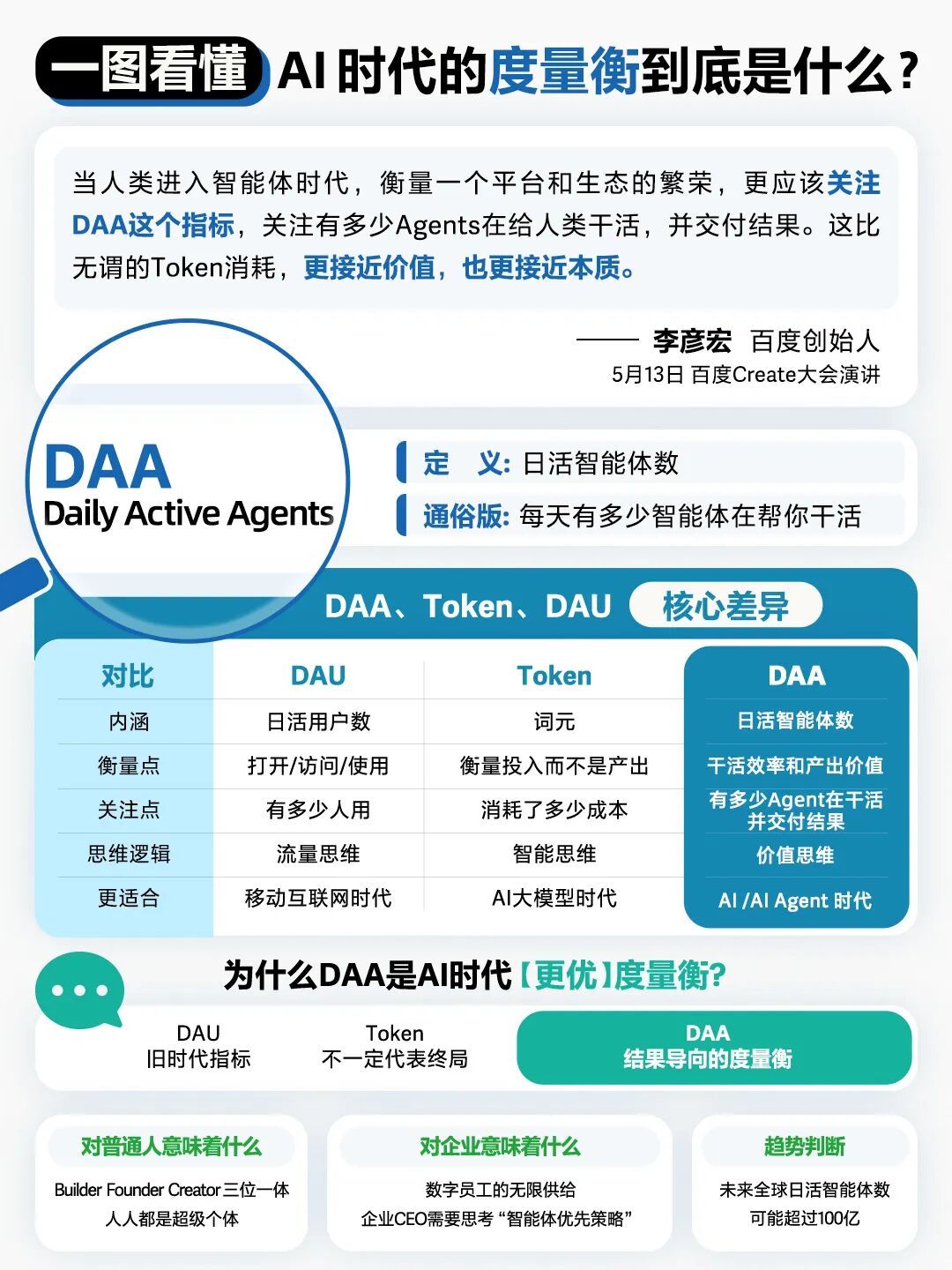
DAU represents the past, a carnival of eyeballs; Token represents the exploration in the transitional period. In the long run, it only means power consumption; DAA may represent the future, a closed - loop of productivity.
01
Why must DAU fade out? Why doesn't Token represent the end - game?
In the old paradigm, we had a very mature formula for success. However, in 2026, this formula is becoming ineffective.
For a long time, DAU has been regarded as the lifeline of Internet products. But in the Agent era, the traffic logic is experiencing a severe collapse.
The most typical case is the "revenue singularity" between Anthropic and OpenAI.
Although the overall user scale of Claude is far lower than that of ChatGPT, the commercial growth rate of Anthropic is extremely rapid. At the beginning of 2026, its run - rate revenue had reached about $14 billion. In the past, no one believed that there would be software that could make users willingly pay $200 per month until Claude turned the impossible into the norm.
In the Agent era, the ability to deliver high - value tasks starts to be more important than the simple user scale. In the era of consumer Internet, free market expansion meant network effects; but in the AI era, a larger user scale often means higher inference costs. If real task delivery cannot be achieved, DAU is no longer an asset but a heavy liability.
Most people have realized that DAU is no longer effective, and "Token" seems to have become the new consensus in the AI industry. Model capabilities, inference costs, training scales, and context lengths almost all revolve around Tokens.
However, in fact, Token can only be used as a temporary transition. Token is actually a basic indicator when large models process information, similar to "power consumption" in the era of electricity. In the early stage of AI development, it has reference value, but consumption does not equal output. Writing more code does not mean higher software quality; consuming more Tokens does not mean that the task has been completed.
For enterprises and individuals who focus on ROI (Return on Investment), they have realized that measuring by Tokens cannot evaluate the actual value of the business. The focus is undergoing a fundamental shift - from "how many resources I have consumed" to "how many problems I have solved".
As Robin Li shared at the conference: "Token does not necessarily represent the end - game. Token represents cost, not revenue; it measures input, not output. Token itself cannot answer whether its consumption is efficient and what value it has produced."
Based on the reflection on the previous two, Baidu's proposed DAA - Daily Active Agents - has become a better measuring stick.
DAA measures how many Agents complete a 'task closed - loop' in real scenarios every day. The core change behind this is to shift the measurement standard from "interaction" to "delivery", from "process consumption" to "result output".
In the Chatbot era, AI solved the problem of human information acquisition. In the Agent era, people expect AI to directly complete tasks. Robin Li shared his observation at the scene: "Chatbots and general - purpose Agents will become two types of entrances: Chatbots represented by ChatGPT are the first - generation entrances, mainly solving the problem of information acquisition; the second - generation entrances are general - purpose Agents, solving the problem of task completion. The value ceiling of general - purpose Agents is higher than that of chatbots."
DAA is targeted at the end - game of general - purpose Agents completing tasks.
The proposal of DAA essentially provides a coordinate system for the productivity in the AI era, which in turn triggers the reconstruction of production relations:
For the industry, it calibrates the real level of AI implementation. Only when DAA becomes the measurement standard can the industry be prevented from falling into "PPT intelligence" or "dialogue box illusion", and resources can be directed to high - frequency and high - difficulty task scenarios that truly generate value.
For enterprises: It shifts from simply "cost - reduction" to "seeking optimization". The organizational form is undergoing a transformation, and every company will become an "Agent company" in the future. DAA can enable enterprises to see the real increment brought by digital labor - for example, the automated terminal of Qingdao Port, relying on the scheduling of the "Famo" Agent, has increased the efficiency of the A - TOS system by 10.21%, which is the real profit brought by DAA.
For individuals: It is the "timesheet" of super individuals. A case of the code Agent "Miaoda" impressed many practitioners. An 8 - year - old primary school student used Miaoda to generate the campus mutual - assistance umbrella - sharing applet "Dada Umbrella". Compared with traditional development tools that focus on "how many lines of code are written", Miaoda emphasizes whether the task has been truly completed. DAA becomes the key to judging whether AI has truly improved efficiency.
When the value is no longer over - inflated, the growth logic in the AI era has completely shifted from user - driven to result - driven.
02
The non - consensus that penetrates the cycle: Why can Baidu always'see in advance'?
In the torrent of technological evolution, the players who can truly cross the cycle are often not the ones who run the fastest, but those who dare to continuously delve into the "non - consensus" jungle.
Looking back at Baidu's AI journey, it is almost a history of "non - consensus" being gradually verified.
As early as 2010, when the mobile Internet in China had just entered the stage of high - speed growth and the entire industry was still immersed in traffic expansion and platform competition, Baidu was already one of the largest search engine companies in China and the most core traffic entrance in the PC Internet era. However, instead of continuing to immerse in the existing traffic advantage, Baidu chose a more arduous and slower path - establishing the Natural Language Processing Department and starting systematic AI investment.
In 2013, Baidu established one of the earliest domestic research institutions with systematic investment in deep learning - the Institute of Deep Learning (IDL), and Robin Li personally served as the dean. This almost paranoid technological obsession at that time planted the first batch of seeds for Baidu. It was not until 2017, when the Apollo autonomous driving platform and the DuerOS conversational AI system were successively released, that the outside world began to gradually realize: Compared with simply regarding AI as a technological ability, Baidu is trying to regard AI as the next - generation infrastructure.
In the following four years, Baidu entered the shaping period of the full - stack architecture. In an era when large models had not yet become popular, Baidu had already started to build a full - stack layout of "chips, cloud, and models". From the release of Wenxin ERNIE 1.0 in 2019 to the mass production of the self - developed chip "Kunlun Chip 2" in 2021, Baidu completed a highly forward - looking project. Baidu gradually formed a complete AI infrastructure ability from chips, frameworks to models and cloud services, and established an autonomous and controllable AI foundation.
Strategically planning ahead - At this time, Robin Li had predicted that AI would cross the experimental stage and move towards large - scale application.
When the large - model craze swept the world in 2023 and the entire industry quickly entered the competition centered around model parameters, inference ability, and Token consumption, Baidu began to emphasize a path of "application - driven". After the release of Wenxin Yiyan, Robin Li publicly stated: "The value of a model lies in its application." At that time, this was not the most mainstream view in the industry. Because at that time, the entire AI industry was still more concerned about whose model was stronger.
In 2024, Robin Li further proposed that "being super - capable is more important than having a super - high DAU" and began to continuously discuss the Agent direction, believing that Agents would become the most important application form in the next stage. At that time, these judgments seemed a bit ahead of the times. However, looking at the long - term, as global technology companies such as OpenAI, Google, Microsoft, and Anthropic began to collectively bet on Agents, these views began to be gradually verified by the industry.
After entering 2026, as the Wenxin model further moved towards native full - modality unity and search became fully AI - enabled, the AI industry began to gradually cross the critical point from "intelligent emergence" to "effect emergence". The industry began to pay more and more attention to whether AI had truly created results.
In this era of Agent explosion, the reason why Baidu can put forward DAA at this node is essentially because it has completed a long - distance expedition from technology seeding to full - stack migration in the past decade.
Ultimately, this evolution returns to humans themselves. In Robin Li's definition of "self - evolution", the evolution of Agents and organizations will ultimately lead to the re - expansion of human ability boundaries.
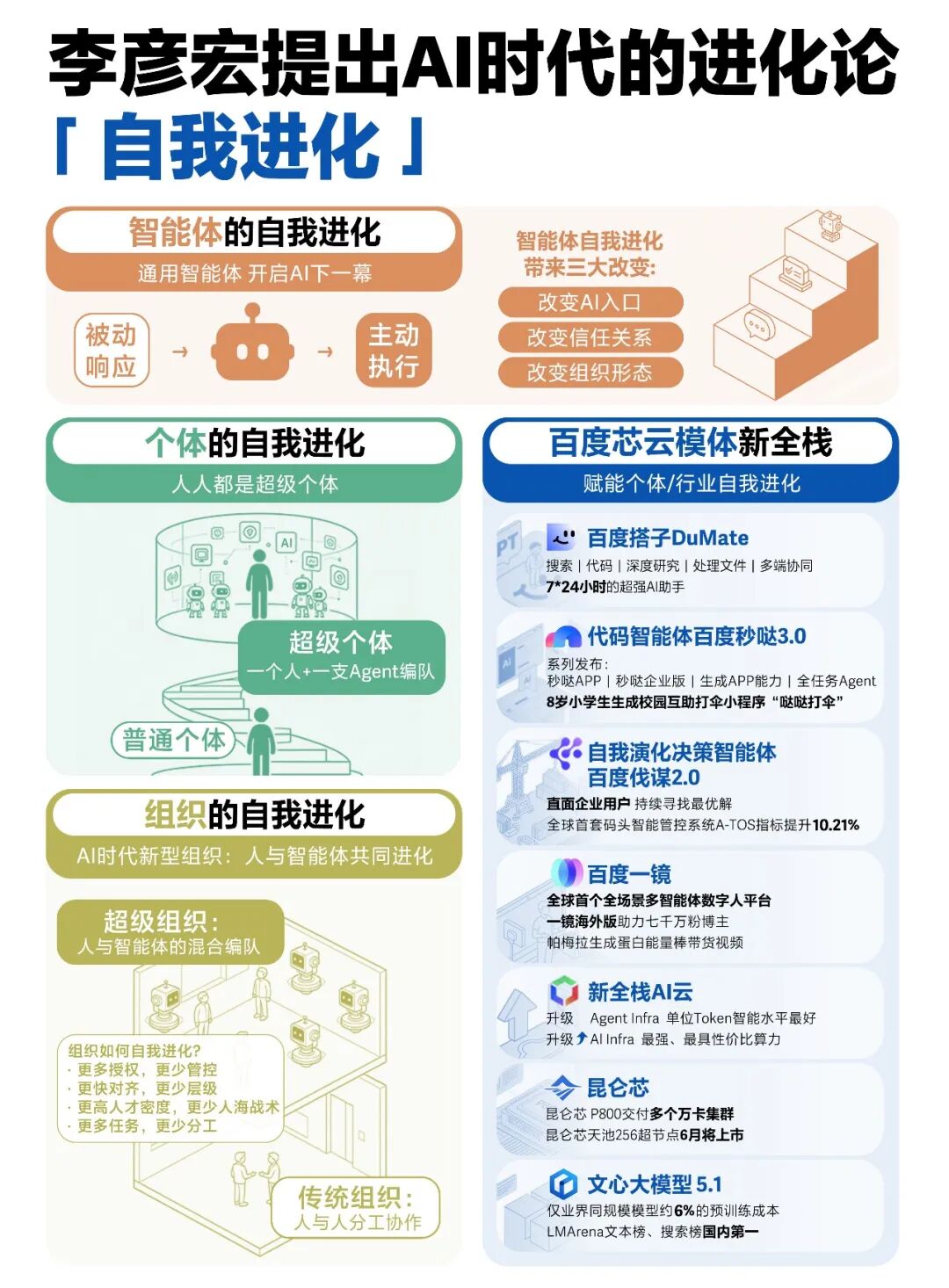
What supports all this is a new set of "new full - stack" infrastructure that Baidu is rebuilding, backed by the powerful support of the collaborative evolution of "chips, cloud, models, and Agents". "When we provide Baidu AI services to customers and developers, we provide a complete set of systems including chips, intelligent cloud, models, and Agents, as well as all tools and capabilities optimized end - to - end." Robin Li said at the conference.
At this year's Create 2026, Shen Dou, the executive vice president of Baidu Group, announced that Baidu Smart Cloud will be comprehensively upgraded to a "new full - stack AI cloud for large - scale Agent applications".
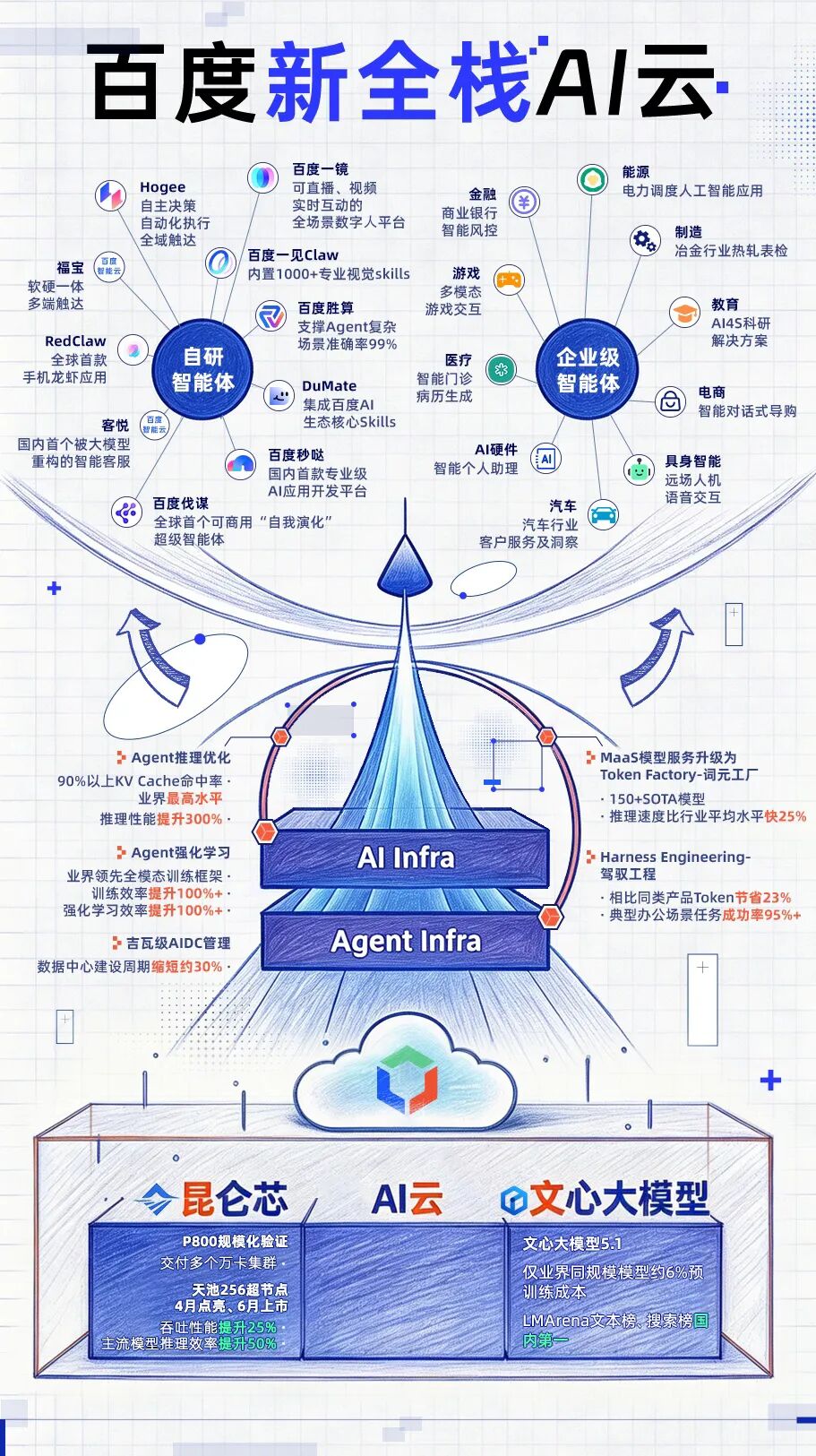
The previous AI infrastructure mainly served model training and inference; in the Agent era, the underlying system is redesigned around "Agents". Because in the future, in addition to humans, Agents will also actively call APIs; it will also be Agents that independently select models, query data, call tools, and schedule other Agents. This means that the core goal of AI infrastructure has also begun to shift from "generating more Tokens" to "enabling Agents to complete tasks more stably".
Therefore, Baidu began to further reconstruct Agent Infra and AI Infra.
For Agent Infra, Baidu proposed the concept of "Harness Engineering". Compared with only focusing on the model ability itself in the past, Baidu now emphasizes more on how to enable Agents to complete more complex tasks with fewer Tokens and fewer dialogue rounds through long - context management, persistent memory, tool calls, sub - Agent scheduling, and Runtime.
For AI Infra, Baidu tries to push the "Token efficiency" to the extreme:
Upgrade MaaS to "Token Foundry";
Improve the context reuse rate to a higher level through KV Cache hierarchical pooling;
Optimize the long - link Agent inference performance;
Accelerate the continuous evolution of Agents with a full - modality training framework and reinforcement learning.
Meanwhile, Baidu is also extending to a more underlying level. From the Kunlun Chip P800 to the Tianchi 256 - card super - node, and then to the gigawatt - level AIDC, Baidu begins to further reconstruct the data center and ultra - large - scale cluster architecture in the entire AI era. Traditional data centers are centered around power supply and distribution, while in the Agent era, network and inference efficiency have become the new centers.
In Baidu's view, China's complete industrial system, a large number of real scenarios, and the knowledge, processes, and experience accumulated in enterprises will ultimately become the capabilities that Agents can undertake and amplify.
From the prediction of "being super - capable" in 2024 to the current interaction between DAA and the new full - stack, Baidu has made the non - consensus become the consensus through more than a decade of long - distance running.
03
When Agents explode...
The proposal of DAA marks that the AI narrative has officially bid farewell to the inexperienced period of self - indulgence in "consumption volume". Resource competition is just a transition, and value delivery is what should be focused on in the mature stage.
Time and real usage scenarios will eventually filter out the pseudo - intelligence that only has conversations but no delivery, making DAA, this non - consensus, precipitate as the "measurement standard" for measuring the future social productivity.
In this redirection of AI value, Baidu once again plays the role of the "prophet" who breaks the tranquility. Looking back on this journey, from the awareness that competing in applications is better than competing in models to the inverted pyramid structure of AI industry value proposed at last year's World Conference - that is, the underlying large models will eventually tend to be homogeneous due to open - source and price cuts, while the top - level applications and Agents will grow into a lush ecological jungle.
These judgments, which were chewed over and even once questioned by the industry at that time, have all been verified as iron laws deep in the industry.
While the industry is still arguing about whose model can solve more difficult math problems and write more code, Baidu has built a measurable and sustainable incremental path for every enterprise and individual through the closed - loop of DAA and the new full - stack.
This forward - looking vision is not only Baidu's own strategic determination but also paves the way for innovation in the entire technology industry.
In the new cycle of 2026, the value coordinate system has been rewritten. Those who are the first to understand the logic of DAA and see the essence of "productivity delivery" will have a better chance to seize the real growth opportunities in the new world built by Agents.
Because in the world of AI, great innovations never emerge from the consensus of following the crowd, but often germinate from the "non - consensus" verified by time.