Deeply cultivating the foundation of "Embodied AI + Construction Large Model" to reshape the trillion-dollar construction industry, Fangshi Robotics has completed a nearly 100 million yuan Series A financing | Exclusive report by 36Kr
36Kr learned that Beijing Fangshi Robotics Co., Ltd. (hereinafter referred to as "Fangshi Robotics"), a developer of intelligent construction robot bodies, recently announced the completion of a nearly 100 million yuan Series A financing, jointly invested by institutions such as Beijing Kechuang Yizhuang Direct Investment Fund and AECC Fund. The funds will be mainly used for the R & D iteration of core products, the construction of mass production and delivery capabilities, and the layout of the overseas market system.
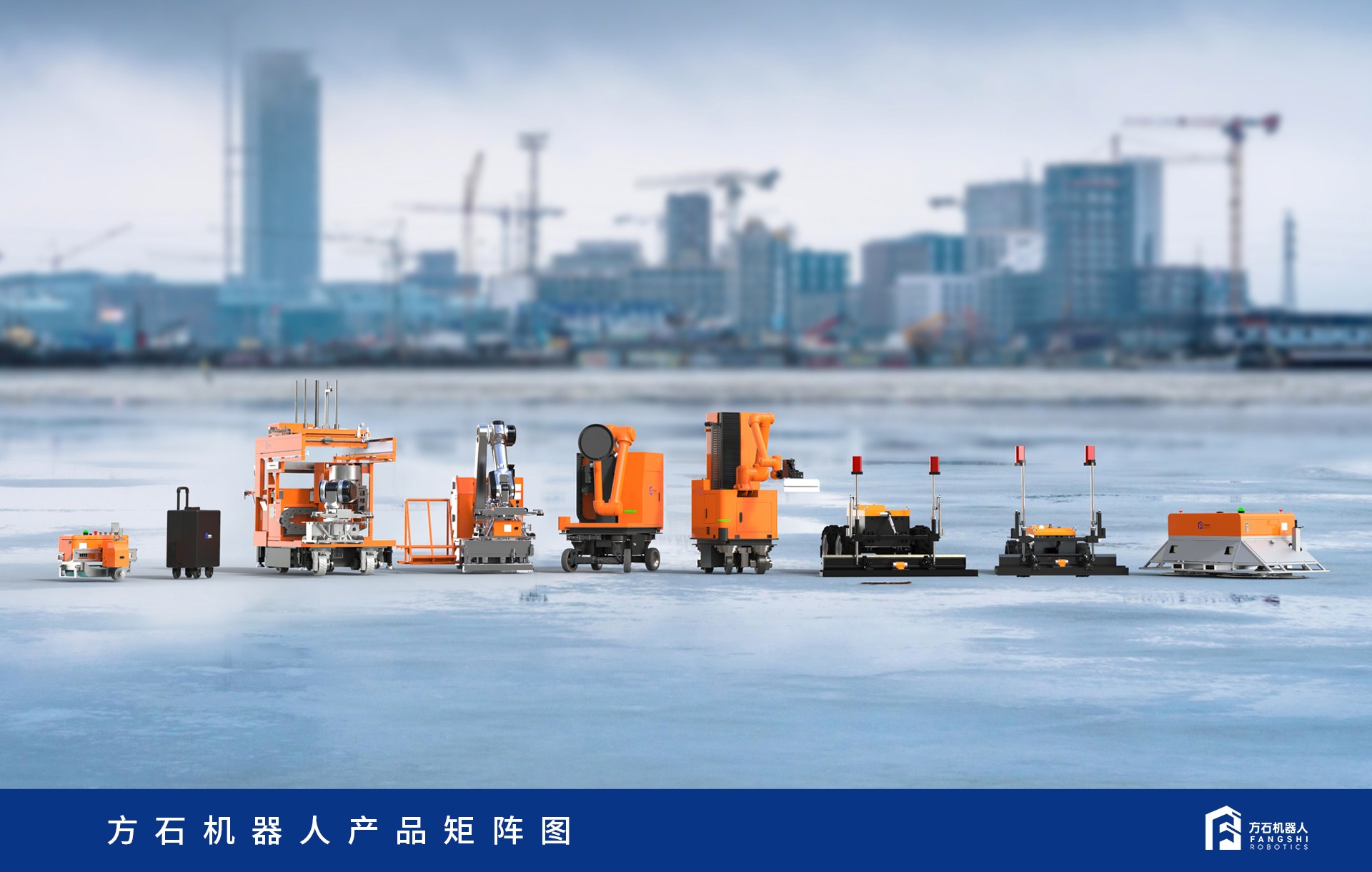
Product matrix of Fangshi Robotics
Founded in 2019, Fangshi Robotics is committed to solving the pain points in the construction industry, such as the aging workforce and the high - risk and inefficient working environment. By creating a full - stack self - developed AI solution of "embodied intelligence + construction large model", it promotes the transformation of the traditional construction industry to the intelligent construction model. At present, the company has deeply served more than 100 leading construction enterprises such as China State Construction Engineering Corporation and China Railway Construction Corporation, implemented more than 500 benchmark projects, and the cumulative construction area has exceeded 15 million square meters.
Since 2023, Fangshi Robotics' products have gradually entered the markets of more than a dozen countries and regions in the Middle East, Southeast Asia, and East Asia, and it is setting up regional service centers and spare parts warehouses in the Middle East and Southeast Asia.
Driven by market demand, balancing the universality of the capability base and the differentiation of product functions
In the construction industry facing a "labor shortage", "replacing humans with machines" has become an inevitable choice for the industry. Data from the National Bureau of Statistics shows that in the past decade, the number of migrant workers in the construction industry in China has decreased by 15 million in total. It is normal for construction sites to "fail to recruit and retain workers". With the sharp departure of the labor force, the aging problem of practitioners has become increasingly serious. Li Siqiao, the founder of Fangshi Robotics, shared that in 2025, the proportion of workers over 45 years old in the construction industry has exceeded 60%, and there is a serious shortage of young practitioners under 30 years old.
At the same time, long - standing pain points such as harsh construction environments and high safety risks are also forcing the industry to transform to intelligent construction. The "Guidelines for Intelligent Construction Technology (Trial)" (Document No. 14 [2025] of the General Office of the Ministry of Housing and Urban - Rural Development) clearly requires the promotion of the application of construction robots in dangerous and heavy scenarios such as high - altitude operations, concrete construction, and steel structure installation, and promotes the replacement of humans with machines at construction sites.
However, there are hundreds of application scenarios for construction robots, and not all of them are suitable for large - scale introduction of robot operations at present. Based on long - term practical experience, Li Siqiao summarized that scenarios with implementation conditions usually have three characteristics: the market capacity of a single application scenario is large enough to support the large - scale investment and return of products; the construction process has a high degree of standardization, and the solution can form a replicable delivery model; and it involves heavy physical labor, with a rigid demand for "replacing humans with machines".
Based on the above judgment, Fangshi Robotics follows the business expansion logic of "driven by on - site demand, measured by market capacity, and based on technical feasibility" to gradually build a modular product matrix covering the entire construction cycle.
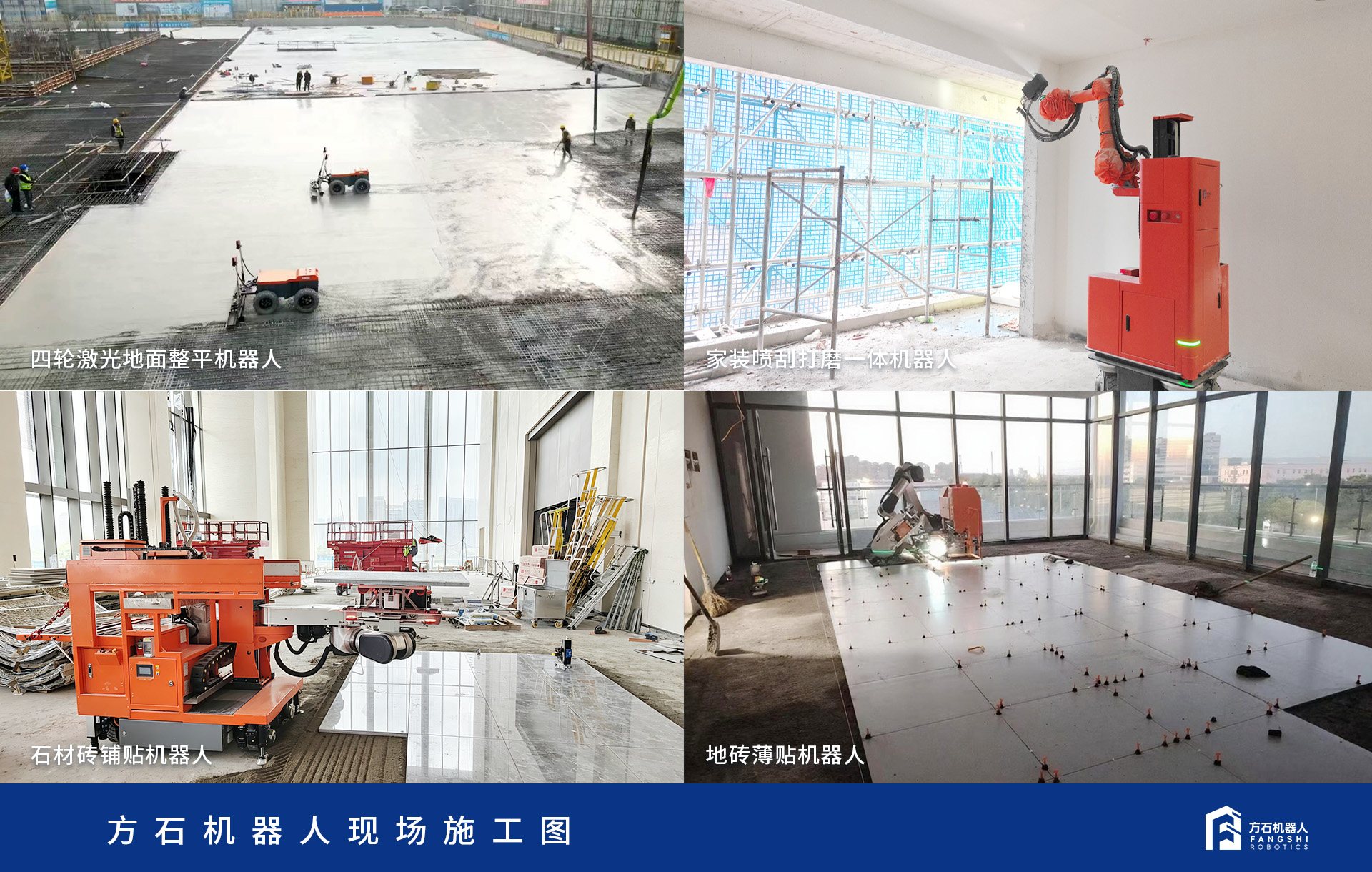
On - site construction drawing of Fangshi Robotics
Concrete floor construction is the first niche scenario that Fangshi Robotics chose to enter. The market space is large enough. It is a standard work type involving heavy physical labor, large - area, and high - repetition, which is naturally suitable for robot intervention. It is also easy for customers to intuitively see the effects, and the team has accumulated a lot of engineering experience before.
Fangshi Robotics' four - wheel laser floor leveling robot and double - disc troweling robot use intelligent laser leveling algorithms and wire - controlled chassis technology, enabling unmanned and autonomous high - precision construction. The construction efficiency can reach 400 - 600 square meters per hour, and the flatness deviation is controlled within 5 millimeters.
In the process of cooperating with customers, Fangshi Robotics has continuously received new work type requirements, explored other pain points in actual construction sites, and gradually expanded product R & D to work types such as spraying and scraping, and tiling. It has successively launched products such as home decoration spraying, scraping and grinding integrated robots, floor tile thin - pasting robots, and stone tile paving robots.
In Li Siqiao's view, the product competitiveness of Fangshi Robotics lies in two aspects:
One is the product model of "standardized products + parameterized adaptation". Each standardized product for a specific application scenario has the ability to adapt to a variety of raw materials and construction technologies. For example, the home decoration spraying, scraping and grinding integrated equipment can complete tasks such as wall putty spraying, scraping, grinding, and latex paint spraying by switching different end - effectors. In addition, standardized products can adjust process algorithm parameters according to the material models specified by customers, ensuring the large - scale production and rapid delivery of products and flexibly responding to the specific needs of different customers.
The other is the technical architecture of "platform generalization, application scenario - based". Since the core components of multiple application scenarios are highly universal, the product R & D of new work types does not need to start from scratch. Instead, modular incremental development is carried out on the general algorithm and motion platform, thereby shortening the R & D cycle and the mass - production ramp - up time.
"The ultimate goal of Fangshi Robotics is to build a modular product matrix covering all - cycle links such as structural construction, secondary structure and decoration, and auxiliary inspection." Li Siqiao said.
Redefine construction robots with "embodied intelligence + construction large model"
In the past, limited by environmental perception and motion control capabilities, construction robots could only be used as semi - automated tools and required continuous human intervention to complete operations, which restricted the efficiency improvement and implementation scale of robots.
"In essence, it is still the logic of industrial robotic arms, performing preset actions at fixed workstations and in fixed processes." In Li Siqiao's view, the key difference between construction sites and industrial production lines is that the former has an unstructured and dynamic environment, and obstacles and working conditions change at any time during the construction process. This requires robots to have the ability of autonomous perception, autonomous decision - making, and autonomous adaptation. The rapid development of large models and embodied intelligence makes it possible for construction robots to break through the capability bottlenecks.
Fangshi Robotics proposes a technical route of "embodied intelligence + construction large model". By connecting the processes of digital asset generation, digital space generation, and robot model pre - training, it builds an end - to - end reinforcement learning closed - loop. At the same time, it uses the large model for space generation and semantic recognition capabilities specific to construction scenarios to provide a technical foundation for the adaptability, coverage, and function generalization of robots in complex scenarios.
Compared with general large models, the construction large model collects data on manual operations and remote operations in real scenarios, integrates upstream and downstream data in the construction sub - fields, and tunes the pre - training results based on simulation data. As a result, the model has a deeper understanding of industry "know - how" such as construction technology, construction specifications, and on - site working conditions, and the model accuracy and engineering deployment efficiency are higher.
The concept of "embodied intelligence + construction large model" is specifically reflected in the self - developed software - hardware integrated intelligent system "Argos System" of Fangshi Robotics .
According to Li Siqiao, the Argos System is equipped with the Lingguang K1 three - dimensional reconstruction module and a high - performance planning host, integrating multi - line lidar, 4 - camera vision technology, and self - developed neural network algorithms. In actual construction, through 360° full - field mobile scanning, it realizes high - precision spatial digitization of the construction site (relative accuracy of 1.2 cm and absolute accuracy of 3 cm). It can complete the full - process intelligent planning of a single - unit apartment in 15 minutes and directly generate an executable construction plan, which is sent to the robot terminal for execution.
"This system greatly reduces the planning threshold and deployment difficulty at the construction site, realizing the effective coordination of 'real - scene perception - intelligent planning - robot execution'. In the past, the work that required experienced technicians to spend a lot of time on on - site surveys and plan compilation can now be completed efficiently and standardly through the Argos System." Li Siqiao said.
More than 500 engineering projects have been implemented, and products have entered more than a dozen overseas markets
At present, Fangshi Robotics has completed business layout in more than 80 cities across the country, serving more than 100 leading construction enterprises such as China State Construction Engineering Corporation, China Railway Construction Corporation, Shanghai Construction Group, and Shaanxi Construction Engineering Group. The implemented projects cover more than 500 project engineering projects such as Guangzhou Baiyun International Airport, the Science Center for Autonomous Intelligent Unmanned Systems of Tongji University in Shanghai, and the Taicang Alpine Ice and Snow World.
In the commercialization path, Fangshi Robotics adopts a combined model of "robot body sales/leasing + complete construction service solutions". Specifically, mature users who have a certain understanding of the product performance and construction performance of Fangshi Robotics generally purchase robot equipment directly and incorporate it into their own construction systems. New customers who want to try or have short - term construction service needs can choose to rent first and then buy. Customers of construction service types hope to introduce the overall robot construction plan, and Fangshi Robotics provides an integrated delivery of "equipment + operation + technical support".
"The decision to purchase and use construction robots mainly lies with the project parties in specific construction. Customers at different levels have significantly different focuses on the demand for construction robots." Li Siqiao introduced that the core demands at the general contracting level are stability and reliability, as well as the improvement of system - level efficiency such as construction efficiency and quality pass rate. Labor teams are more concerned about the ease of use, entry threshold, and economy of products. "But ultimately, it points to the same direction. Only by passing the tests in the three dimensions of product reliability, operation convenience, and economy can it be truly accepted by the market."
Li Siqiao believes that the construction industry is essentially a traditional industry that is highly sensitive to cost - reduction and efficiency - improvement. "Customers mainly calculate the economic account: on the premise of ensuring the construction period and construction quality, is it cost - effective to use robots?" He said that the key for Fangshi Robotics' products to quickly open up the market before is that the pay - back period after equipment purchase is short, with an average investment pay - back period of less than 12 months, and subsequent construction projects can also continuously create cost savings for customers.
In addition to continuing to deepen the domestic market, Fangshi Robotics is also actively expanding overseas markets.
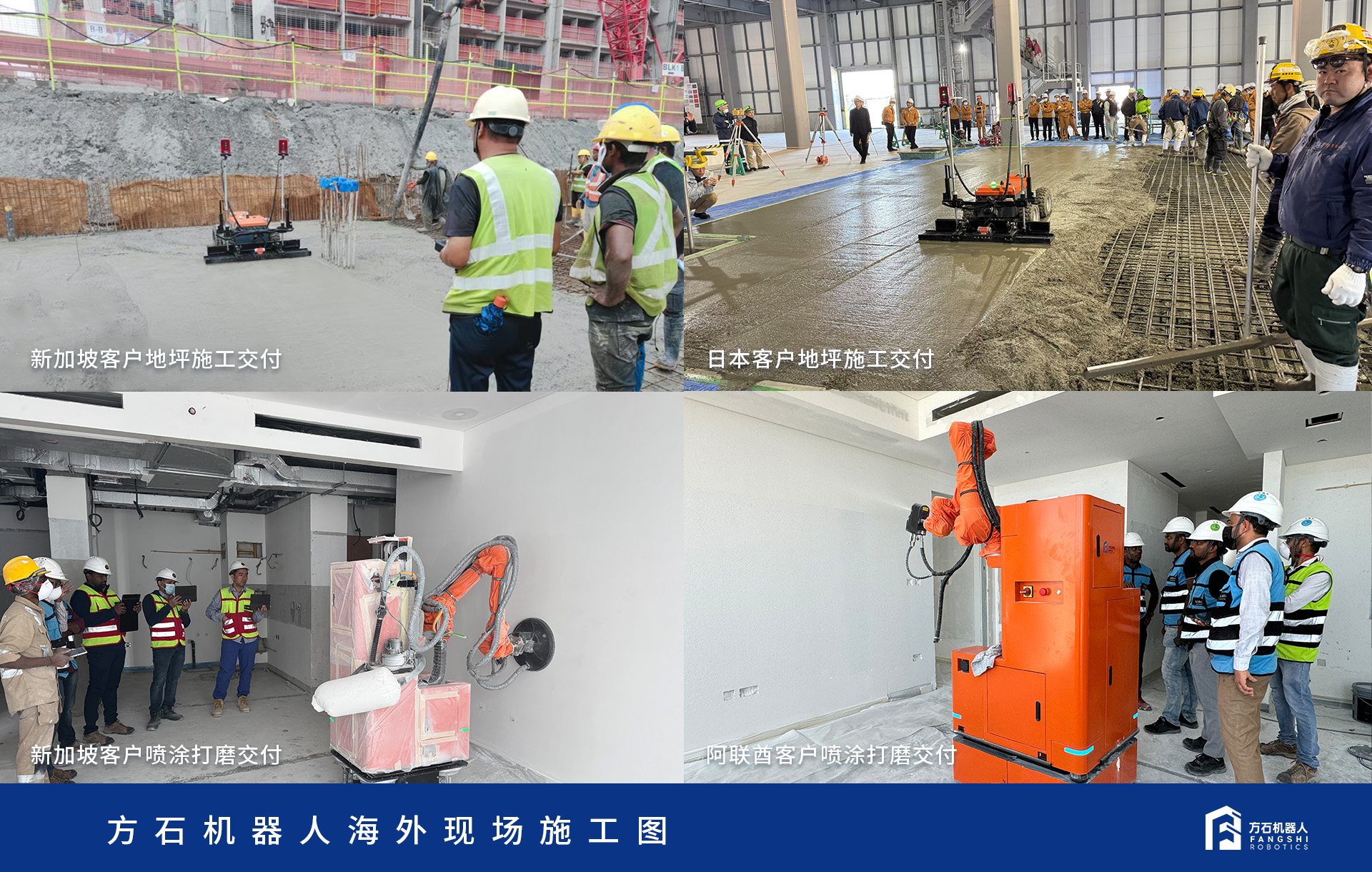
Overseas on - site construction drawing of Fangshi Robotics
Since the labor cost in overseas is generally higher than that in China, the demand for "replacing humans with machines" is more urgent. Since Fangshi Robotics first entered the Australian market in 2023, its products have covered more than a dozen countries and regions in the Middle East, Southeast Asia, and East Asia, and it has established close cooperation with leading local construction contractors. It is also accelerating the establishment of regional service centers and spare parts warehouses in the Middle East and Southeast Asia, promoting the leap from product export to local operation.
For local adaptation in different regions, Fangshi Robotics adopts a three - step approach of "customer research - on - site debugging - equipment iteration": first, research the construction technology standards, material systems, and regulatory requirements of the target market; then bring the equipment to the local construction site for actual debugging; finally, carry out iterative optimization based on on - site feedback to form a product version for that market.
When talking about the company's future direction, Li Siqiao gave the strategic priority as follows: first, deepen and refine the existing product capabilities to ensure a stable cash flow and good customer reputation. "The company has a strict evaluation system for new R & D project approval. New product approval requires multi - dimensional evaluation such as market capacity, technical feasibility, and customer demand verification, and will not blindly pursue the breadth of work - type coverage."
At the technical level, while continuously accumulating core assets such as digital assets and construction large models, Fangshi Robotics is also exploring the generalization possibility of humanoid robots in specific application scenarios in the construction industry. "When the hardware maturity of humanoid robots meets the reliability requirements of construction sites, our AI capabilities in the vertical construction field will become a very valuable software layer." Li Siqiao said.