36Kr Exclusive | A Singaporean doctoral team secures seed-round financing for their startup, with the first product being a "flying household butler"
Author | Qiao Yujie
Editor | Yuan Silai
Yingke learned that Shenzhen Entropy Intelligence Technology Co., Ltd. (hereinafter referred to as "Entropy Technology") recently completed a seed - round financing of millions of US dollars. This round of financing was exclusively invested by First Heart Capital.
Entropy Technology was co - founded by Zeng Wu, a doctor from Nanyang Technological University in Singapore, Kuang Weijie, a doctor from Universiti Sains Malaysia, and Wan Haocheng, a researcher at the Tsinghua Institute for Artificial Intelligence and Computing. The core team members come from universities and enterprises such as Tsinghua University, Huazhong University of Science and Technology, Nanjing University of Aeronautics and Astronautics, ByteDance, and BYD. Their backgrounds cover artificial intelligence, theoretical physics, and micro - drone systems.
Currently, Entropy Technology's first product is designed for home spaces. It is the world's first home flying robot, Flyer O1.
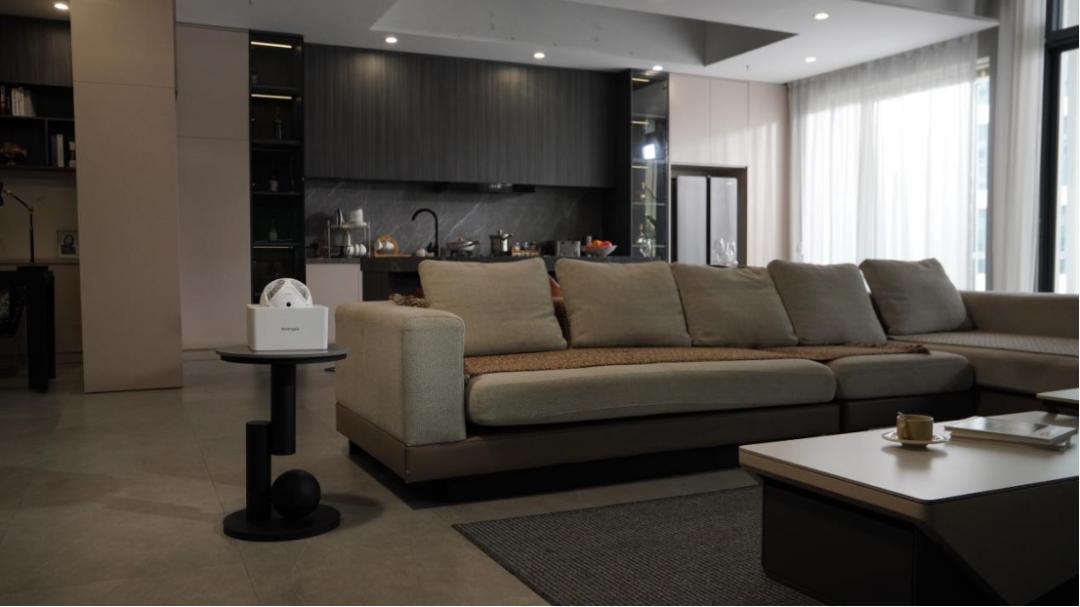
(Image source/Enterprise)
Zeng Wu introduced: "In the home environment, the ground environment actually has many obstacles, which limits the movement of equipment; while the air space is relatively open, so we chose to start from the flying form."
Flyer O1 is mainly targeted at the European and American home markets. It is designed for families with multiple members and large living spaces, and is positioned as an "intelligent butler". The product does not require remote control. It can cruise autonomously in the area specified by the user and complete inspections and task executions when it senses abnormal movements or is remotely dispatched by the user. Its functions cover the recognition and coordination of family members' schedules, the inspection of the sanitation status, the recognition of missing items, and the linkage of multiple devices, and it supports voice interaction.
In specific applications, Flyer O1 can learn the storage locations and purchasing habits of household items through continuous use and actively remind users when supplies are in short supply. At the same time, the device supports multi - member schedule management. Users can input to - do items by voice, and the device will remind at key time nodes and provide dynamic coordination feedback on the time arrangements of different members.
In terms of software - hardware collaboration, Flyer O1 is deeply linked with the mobile application. Zeng Wu introduced: "For example, users can issue tasks on the mobile phone. For instance, if they need to pick up their children at 6 o'clock, the system will automatically analyze the schedules of family members and assign the task to the most suitable executor, thus realizing the automatic coordination and closed - loop management of household affairs."
In terms of privacy, Flyer O1 stores users' habits and memory data on the device side. It only completes voice interaction and part of the decision - making analysis in the cloud. The image data is not uploaded to the cloud and will be automatically deleted after being saved locally for 7 days. Users can also manually clear it at any time.
In product design, Flyer O1 adopts a non - intrusive structural design to adapt to the complex co - existence of people, pets, and furniture in the home environment. At the same time, through its autonomous flight and obstacle - avoidance capabilities, it can operate indoors without complex manual intervention. The overall interaction emphasizes "low interference" and "understandability", with event - driven as the core, and builds a product closed - loop around tasks, devices, and the rhythm of family life.
It is understood that the product is expected to be officially launched at the end of this year, and the business model is "hardware sales + software subscription".
The following are excerpts from the interview:
Yingke: Why did you choose to start from the home scenario?
Zeng Wu: Artificial intelligence is reshaping product forms and human - machine interaction methods. The family is the most basic social unit. We believe that "group intelligence" is more valuable than "individual intelligence". In the family, smart devices need to coordinate the schedules of multiple people, handle trivial affairs, and improve the collaborative relationship among family members to a certain extent. However, most of the existing products, such as smart speakers, calendars, and cameras, are mostly at the stage of passively executing single commands and lack the ability to understand the overall family status and provide active services.
Yingke: Why did you choose the flying form?
Zeng Wu: Ground devices in the home are easily restricted by crowded spaces and obstacles, making it difficult to achieve efficient coverage. Flying can reach the target location in a shorter path, reducing the complexity of path planning and improving "passability". In addition, flying devices have a higher - dimensional perspective and can cover areas that are difficult to reach for ground devices, such as desktops and high places, thus achieving more complete environmental perception.
Yingke: What are the advantages of your flying technology?
Zeng Wu: Our flying technology is based on cognitive robotics. Since I used to do research on artificial intelligence multi - modality, and our co - founder studies micro - drones. In the field of aircraft, there has been little exploration of hardware + intelligence. Our cognitive learning ability based on flight is one of the core technological advantages. In the home scenario, the key to many tasks lies in "judgment" rather than "execution". For example, it is necessary to identify dirty areas before cleaning. Existing devices mainly provide execution capabilities, while we hope to create a "butler - type intelligent agent" with judgment and decision - making capabilities, which can not only handle housework but also complete schedule coordination and resource management.
Yingke: Would you define this product as a home companion product?
Zeng Wu: We prefer to define it as a "butler". And we believe that real companionship comes from in - depth service and continuous interaction, rather than mechanical dialogue or emotional projection. Through services such as autonomous judgment, schedule coordination, and task reminders, user dependence will be naturally established. When the device can remember habits, predict needs, and actively coordinate household affairs, trust and intimacy may naturally arise.
Investor's View
Max from First Heart Capital: Entropy is the pioneer of the home flying robot category. With the high - altitude global perspective provided by the flying form, it solves the perspective and terrain limitations of ground - moving robots. As a young and composite team, it has profound multi - modality AI accumulation in fields such as VLM lightweight, acoustic signals, and drone control. The team shows high potential, high growth iteration, and high - speed execution ability, and has the opportunity to become a high - degree - of - freedom 3D mobile platform and an entrance to family data.
Zhang Wei from First Heart Capital: The home is a scenario that seems to be filled with smart hardware but actually has many needs that have not been well addressed. Most existing products are at the stage of responding to commands, but what the family really needs is a "judgment - type" role that can actively understand the dynamics of multiple people and coordinate daily affairs. This is where Entropy's entry point lies - the flying form is a means, and the underlying cognitive ability is the core. Flyer O1 is targeted at multi - member families in Europe and America, which is a market with real demand for active smart devices but no good products so far. We have high expectations for the product potential and market space in this direction.