YC CEO: Stop saving tokens. What you really need to save is your time.
“A decisive question is: Do you control your tools, or do your tools control you?” This quote is from Gary Tan, the CEO of Y Combinator. In the past few months, he has written hundreds of thousands of lines of code using AI tools such as Claude Code and OpenClaw. He proposed the development philosophy of “Token Maxing” and firmly believes that we are standing at the critical point of the “Personal AI Revolution.” In this interview, he shared without reservation the workflow that has transformed him from “not writing code for 13 years” to having “400 times the efficiency.” This article is compiled from the content of the Y Combinator blog.
1
Writing code again is not for showmanship but a real - world problem
Gary Tan's “return to programming” didn't start as a technical experiment but as a specific and pressing public issue. He mentioned that his long - term observation of public affairs in California made him particularly sensitive to educational issues. For example, in San Francisco public schools, students in the seventh and eighth grades have great difficulty learning algebra. For someone who graduated from a public school in the East Bay, entered Stanford through early math education, and later became an engineer, this is not just an educational controversy but a personal sense of unfairness. He wanted to organize a group of people with similar judgments to promote discussions on public issues, which led to the creation of Gary’s List.

However, Gary’s List is not a “blog website” in the traditional sense. On the surface, it is a publishing platform, but in fact, it is an automated content production system. It not only publishes articles but also crawls Internet information, retrieves relevant materials layer by layer, integrates social media clues, conducts cross - verification, and generates long - form investigative reports. According to him, work that used to take human researchers weeks to complete can now be accomplished at a model call cost of just a few dollars.
In Gary Tan's view, the significance of AI writing is not “helping journalists with typesetting” or “assisting in creation,” but rather turning the research, organization, summarization, citation, and comparison processes, which were originally high - intensity knowledge - based labor, into a software system. That is to say, software is no longer just a tool for people to use, but has begun to directly undertake the execution process of high - quality knowledge work.
2
Stop saving tokens; what really needs to be saved is human time
Gary Tan repeatedly emphasized a concept in the interview: token maxing. In a nutshell, its core is not “making the model smarter,” but pushing the context, information, verification, and workload to the limit. In the past, when humans did research, they always made compromises due to limited time: only reading a few articles, extracting only a few clues, and conducting only limited cross - comparisons. However, a fundamental change in the agent system now is that it can “boil the ocean” - not just looking at 1 source but 20; not simply summarizing but putting contradictory evidence together for the system to compare and analyze.
In Gary Tan's view, many people today underestimate the real power of AI programming and AI knowledge work because they are still using the cost - thinking of the old era to understand new tools: regarding tokens as API cost control items rather than production factors. However, if a task would originally take you a week or a month to complete, spending a few hundred more dollars to obtain large - scale parallel research, testing, and execution is not a high cost, but rather extremely low. He used a typical analogy in the YC context: it's like when entrepreneurs first arrive in San Francisco and think the rent is too high, but the really expensive thing is not living in San Francisco but not living there. For today's builders, the really expensive thing is not tokens but not using the model to its fullest and thus continuing to waste their own time.
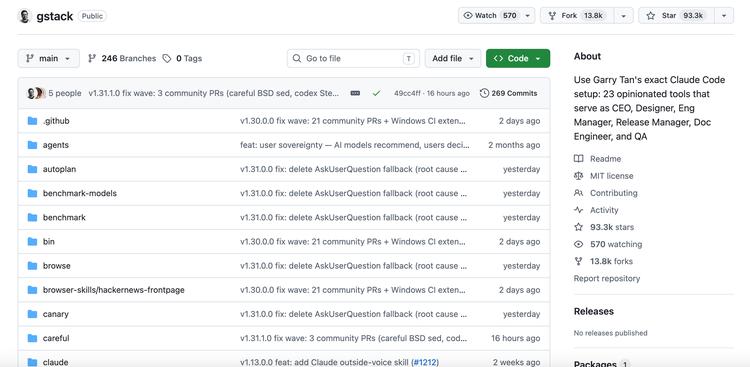
Gary Tan's second important project is GStack. It was not initially designed as a product but evolved from a bunch of prompts he used repeatedly. The initial scenario was simple: when using Claude Code, he found himself repeatedly entering similar instructions - first making a plan, then conducting a review, then testing, and then manual confirmation. So he organized these high - frequency operations into Apple Notes and gradually developed a set of structured workflows. Later, these workflows became “skills” and further evolved into a reusable system, which is GStack.
This process itself well illustrates the changes in agent engineering today: people are no longer just competing on prompt copywriting but are constructing a “composable cognitive process.” Gary Tan especially emphasized that what he increasingly relies on is not a single magic prompt but a whole set of work sequences: first, let the model create an ASCII diagram to clarify the data flow, state machine, dependencies, and error paths; then let it conduct an architecture review; then perform a code quality check; then complete the testing; and finally, enter the execution phase.
He mentioned a very representative experience: many people complain that the output of vibe coding is “sloppy.” In essence, it's not that the model can't write, but that the engineering constraints are insufficient. Especially test coverage has become even more important in the era of AI programming. Because once the code generation speed far exceeds the human review speed, without sufficient and solid unit tests, integration tests, and end - to - end verification, the system will quickly shift from “efficient” to “fragile.” In other words, AI has not eliminated software engineering but has shifted the focus of software engineering from “hand - written implementation” to “process design and quality control.”
3
Thin Harness, Fat Skills
Gary Tan's summary of the agent engineering architecture: thin harness, fat skills.
The so - called harness can be understood as the most basic running loop: accepting user input, calling the model, triggering tools, executing commands, and returning results. Systems like Claude Code and OpenClaw can essentially be regarded as a type of harness. Gary Tan's judgment is that there is no need for each team to reinvent this layer repeatedly. What really deserves attention is the upper - layer skills - that is, how to express task processes, experiences, strategies, standards, and review methods in natural language and structured documents.
This is also why he insists that “Markdown is also code.” In the agent era, a large amount of judgment logic that used to require hard - coding is actually more suitable to be written in Markdown: how to plan tasks, how to judge completion standards, how to think about 10x value, how to check risks before QA, and how to examine the same function from the perspectives of a CEO, a designer, and a developer experience leader. Writing these things in traditional code would be very rigid, but when written in skill documents, the model can better understand the intention, handle special cases, and cover complex scenarios.
This means that a new layer has emerged in software development: actions that are deterministic, verifiable, and must be stably executed should still be written in code; however, a large amount of high - level strategies, fuzzy decisions, and process experiences are increasingly suitable to be precipitated in “text protocols that can be understood by the model.” The work of human engineers is no longer just organizing functions and classes but organizing the boundary between latent space and deterministic code.
4
OpenClaw is like a Ferrari
Gary Tan said that using OpenClaw today is like driving a Ferrari: it has amazing speed and a thrilling experience, and there are many things so powerful that it's hard to believe a machine can do them. However, at the same time, it's like a Ferrari that you have to be able to repair yourself - it will break down when you need it most, forcing you to open the engine hood and repair it with a wrench. Behind this analogy actually contains two levels of judgment.
First, the capabilities are already quite amazing. OpenClaw represents not just simple “code completion” but is closer to an agent that can independently explore, call tools, and complete complex tasks across multiple tasks. For those who are already familiar with Claude Code, this means taking another step forward: from “I ask, you answer, and I copy and paste” to “the system automatically executes, repairs, and links more steps.”
Second, the engineering maturity is still far from complete. OpenClaw is very powerful now, but it is fragile, consumes a lot of context, and is error - prone, requiring continuous human intervention for repair. Gary Tan mentioned that in many cases, it's actually another agent - such as Claude Code - that helps him repair OpenClaw itself. That is to say, today's agent system has entered a state similar to the early PC era: it is not a polished consumer product but more like a “kit car,” a system assembled by technology enthusiasts that can actually run but also needs to be maintained at any time.
This is also why he compares the current situation to the Homebrew Computer Club moment: people have already seen what the future looks like, but the future has not yet been packaged to a level where everyone can use it without barriers.
5
The unit of programming is changing
Gary Tan also specifically talked about a controversial topic on social media: what does it mean to write hundreds of thousands of lines of code in a few months. He admitted that simply using the number of lines of code to measure the value of a programmer is not rigorous, but in the context of agent programming, this indicator should not be completely ridiculed. The reason is not that “the more lines of code, the better,” but that the unit of work has changed today: it's not about how many lines you type alone in an IDE, but about whether you can simultaneously dispatch multiple agents to work on features, fix bugs, complete tests, and run QA in parallel, and then organize the results into a deployable system.
He mentioned that his current daily work mode is very much like a dispatcher of a micro - software organization: different branches and pull requests are lined up in different windows, and function development, testing, and manual acceptance are advanced simultaneously. For humans, the bottleneck is no longer “whether you can write” but “whether you can accurately plan, check in a timely manner, and make quick judgments.” In this sense, AI does not make programmers unemployed but amplifies excellent programmers into a system with higher throughput. Therefore, what is more worthy of attention is not “how much the model has replaced humans in writing” but how much human agency has been amplified. If you have judgment, taste, and clear goals, today's tools are like wings for you; if not, even the most powerful agent will only generate a bunch of products that you can't really take responsibility for.
6
The most critical fork: Personal AI or Platform AI?
Gary Tan further extended the discussion from “how to write code” to a larger proposition: the ownership issue of personal AI. He believes that by this time next year, almost everyone will have their own personal AI. However, the question is what form this personal AI will take. It could be a “personal tool” where the user controls the prompts, data, integration interfaces, and knows what the system is doing on their behalf; or it could be a “pseudo - personal AI” that is hosted by a platform, has an algorithm black box, and has opaque business motives, similar to a social media feed controlled by a company.
In his view, this is the most worthy - of - vigilance watershed today. Many people discuss AI as a unified product category, but in fact, the core difference in the future may not be the number of model parameters but who has control. Do you write your own prompts, define your own workflows, and decide which data the agent can access; or do you always live within the boundaries designed by a product manager and a platform?
This is also why Gary Tan emphasizes that builders should start using these tools as early as possible. Because once you don't master them yourself, you can only use ready - made products packaged by others. And once this spreads like the personal computer revolution back then, control determines not only your work efficiency but also your thinking autonomy and even how you understand the real world.
This interview, although about Gary Tan's own projects, also addresses the most realistic concerns of entrepreneurs: Are these tools too expensive? Are they unstable? Can only the top engineers use them? Gary Tan's answer is quite straightforward: These issues are valid today, but they are not the most important ones. The real question is whether you are willing to admit that a new mode of production has emerged and actively transition to it.
Today's agent programming is indeed expensive, fragile, and chaotic, far from the stage of a mass - market product. However, it is already strong enough to upgrade a person from an “executor” to a “commander” and compress tasks that originally took a team weeks to complete into a shorter time. Many people see its instability, while Gary Tan sees its leverage. The most impactful thing he said is not about code but about time: Humans can't get more time out of thin air, but they can borrow the machine's time. Once you accept this, you will understand why token spending is no longer a cost center but a purchase of time capital.
This article is from the WeChat official account “Silicon Star GenAI”, author: Big Model Mobile Team. Republished by 36Kr with permission.