After investing in so many AI companies, what will Meituan become?
Recently, the large model circle has been awakened by a huge influx of money.
Kimi (Dark Side of the Moon) is in the final stage of a new round of financing. This time, it's a staggering $2 billion.
With this round, within less than half a year this year, this domestic large model startup has carried out four rounds of financing, with a total scale of over $3.9 billion (approximately 37.6 billion RMB).
Although financing news has become commonplace in the AI track. From the explosion of ChatGPT to DeepSeek, and then to Kimi, money has become just a series of numbers that are hard to count.
However, the market still believes that the biggest highlight of this round of financing is not Kimi itself, but the investor. This round was led by Meituan, a company you interact with every day, rather than a Silicon Valley VC or a sovereign wealth fund.
In the public's perception, Meituan is mainly engaged in the food delivery business, dealing with riders and merchants. It seems far from the realm of "technology." Even during the intense competition in the large model field in the past few years, Meituan's self-developed AI product series didn't have a high profile among consumers.
But in fact, Meituan is a major player in the AI investment circle that cannot be ignored.
In the eyes of industry insiders, although Meituan's self-developed AI products are not very noticeable among ordinary users, by being an "investor," Meituan has achieved great success.
Meituan "Monopolizes" the Physical World
On May 6th, according to LatePost, Beijing Dark Side of the Moon Technology Co., Ltd. is about to complete a new round of $2 billion financing, with a post-investment valuation exceeding $20 billion. The round was led by Meituan Longzhu.
In a sense, Kimi's long-text understanding and Agent capabilities can help Meituan optimize its intelligent customer service and personalized recommendations. It can directly call Meituan's API to recommend restaurants, book tickets, and plan routes, which can deeply integrate Meituan's local life services into users' decision-making processes.
This precisely matches Meituan's investment philosophy.
In March this year, at Meituan's management communication meeting, Wang Xing set a very unique tone for AI.
He believes that the difference between AI and the Internet is like the difference between a monkey and a flower, with a huge gap in magnitude. Then, he said a crucial sentence, "The digitalization of the physical world will be a very important foundation for AI."
How to understand this? Wang Xing gave an example, "Even if Einstein were your secretary and you asked him to book a restaurant, he still wouldn't know if there were any available seats. This is not an issue of intelligence, but of information."
That is to say, no matter how smart the "brain" of a large model is, if it is not connected to the real world, it is just a castle in the air that cannot be implemented. And this is exactly Meituan's trump card.
Meituan has the largest and most complex local life service network in China, covering everything from the dispatch of food delivery riders, the POI (point of interest) information of millions of offline physical merchants, to the route planning for instant delivery.
Further analysis shows that Meituan's investment logic is essentially an infrastructure logic. It is not only about finding smart algorithm teams but also about building an ecosystem for AI in the physical world. Looking at Meituan's investment map, it has almost covered the entire hard technology field in recent years.
In the large model field, in 2023, Meituan Longzhu led Kimi's Series A1 financing. In 2024, with its long-text capabilities, Kimi became one of the first domestic C-end AI applications to gain wide popularity. In the same year, Meituan also participated in Zhipu AI's Series B2 financing. In January this year, Zhipu AI was listed on the Hong Kong Stock Exchange, becoming the "first large model stock in the world."
In the robotics field, Meituan has also reaped rich rewards.
From 2023 to the beginning of 2024, Meituan participated in Unitree Robotics' Series B+ financing. Unitree Robotics became famous overnight after its robot performance at the Spring Festival Gala and applied for listing, becoming the most popular unicorn in the industry. According to the prospectus, Meituan and its affiliates hold approximately 9.6488% of the company's shares, making it the second-largest shareholder.
In terms of underlying computing power and chips, Meituan has invested in Moore Threads (with a market value of approximately HK$300 billion on the first day of listing), Muxi Semiconductor (with a market value of approximately RMB 280 billion on the first day of listing), and also made arrangements in chip companies such as Unisoc and Aixin Yuanzhi.
In addition, Meituan has also heavily invested in several leading companies in embodied intelligence and intelligent driving perception, such as Yinhe Tongyong and Xinghai Tu.
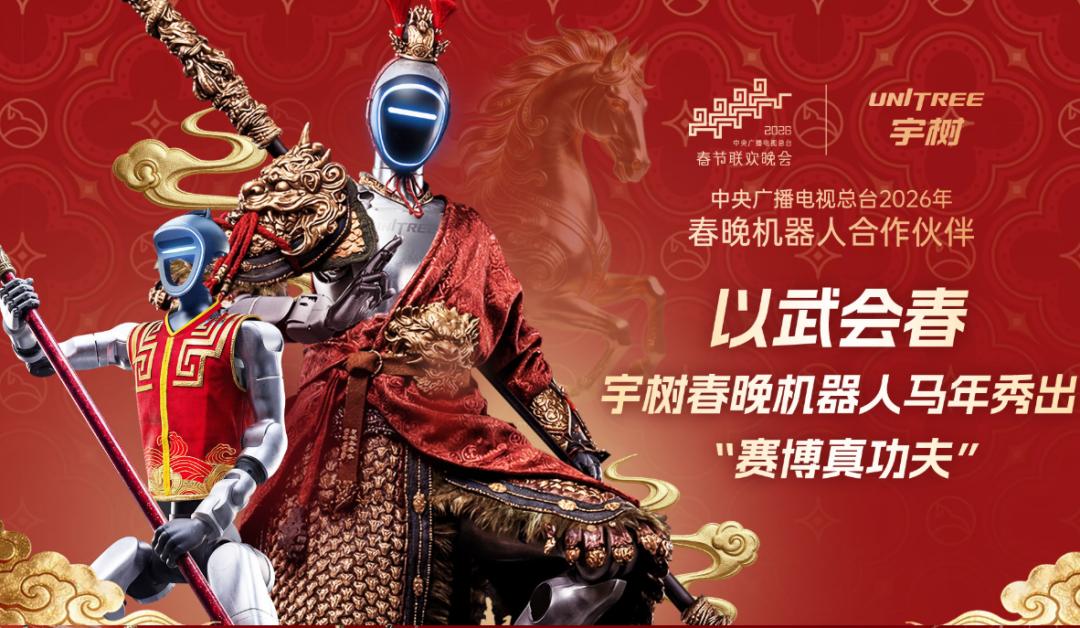
Image: Product image of Unitree Robotics invested by Meituan. Source: Unitree Robotics official website. Screenshot from "Tingtong Tech."
Meituan's investment strategy is very clear. It is willing to invest in any technology that can help technology better understand and serve the "physical world."
For example, investing in large models is to make the AI assistant in the APP truly able to help you order food and book hotels like a human being, rather than the current ineffective customer service.
Investing in robots is to enable them to complete deliveries in more high-risk and difficult scenarios, such as using drones to deliver food across mountains and seas, solving the delivery problems that human labor cannot reach. And investing in lidar is to make the "eyes" of drones and unmanned delivery vehicles more accurate.
Moreover, Meituan often makes early investments, often starting to bet in uncharted territories. For instance, Meituan led the investment in Unitree Robotics when its valuation was only 1 billion RMB, at a time when humanoid robots had not yet become a trend.
"Investing early, investing in small companies, and monopolizing the market is Meituan's unique investment approach, which has allowed Meituan to build a core circle of friends in the AI era," an industry insider said.
Is Meituan's Own AI Inconspicuous?
In the view of many industry insiders, even though Kimi has become relatively low-key compared to its former glory, Meituan Longzhu will still lead the investment. Because in Meituan's eyes, as long as Kimi's technology stack remains in the first echelon, it is worth investing in.
Besides the consideration of financial returns, another reason is that, according to some analyses, Meituan's own AI products have a relatively low profile among consumers, and it needs a ticket like Kimi to secure its position in the ecosystem.
While Alibaba, Tencent, and ByteDance have all unveiled their self-developed large models, made large-scale acquisitions, and carried out high-profile promotions, Meituan's response has been relatively subdued.
Although Meituan's 2025 financial report shows that its R & D investment reached 26 billion RMB, a year-on-year increase of 23%, compared with the slogans of other companies, the investment amount seems to be on a different scale.
Moreover, Meituan's AI goals are more complex than the current mainstream ChatBot and Agent, especially considering the extremely low "error tolerance rate" of its business.
This is a point that many analyses tend to overlook.
Understood in this way, Meituan's business should feature "second-level response, physical world delivery, and long-chain collaboration."
If an AI recommends the wrong restaurant, users may give a negative review. If an AI dispatches the wrong rider, the food may get cold. If an AI misses a mouse during a kitchen inspection, it could lead to a food safety incident. This is different from other large model concepts. For example, users may not care much if a chatbot says something wrong.
As an industry insider said, "Meituan's large model faces the challenge of extremely low error tolerance, which forces it to be extremely cautious and difficult to fully delegate core decision-making to AI."
Therefore, Meituan's AI development is slow not because it doesn't want to be fast, but because it can't.
Perhaps for this reason, Meituan's self-developed AI has its own obvious characteristics. Compared with other Internet giants, Meituan is more like a science student or a "factory worker," good at turning its own territory into an AI testing ground.
Looking closely, since last year, Meituan has done several things.
First, it launched its self-developed "LongCat" large model. This series of models, codenamed LongCat, is not aimed at being an "AI painter" but at building an AI foundation for the physical world, enabling AI to understand real road conditions and products, and is suitable for Meituan's business scenarios such as autonomous driving, intelligent customer service, and merchant services.
According to the latest news, currently, LongCat - 2.0 - Preview has entered the testing stage. The total parameter scale of this model has exceeded one trillion, supporting a 1M context window and capable of processing millions of words of input in a single inference, with a processing capacity equivalent to the newly released GPT - 5.5.
However, obviously, LongCat has less influence among consumers compared to other mainstream large models.
In February this year, Meituan upgraded its AI assistant "Xiaotuan." Xiaotuan is not a chatbot. Its positioning is very focused, aiming to help users solve problems related to food, entertainment, and other aspects. If you ask on Meituan, "Where can I see cherry blossoms and bring my dog on the weekend?" it will directly give you the answer without you having to read through the reviews.
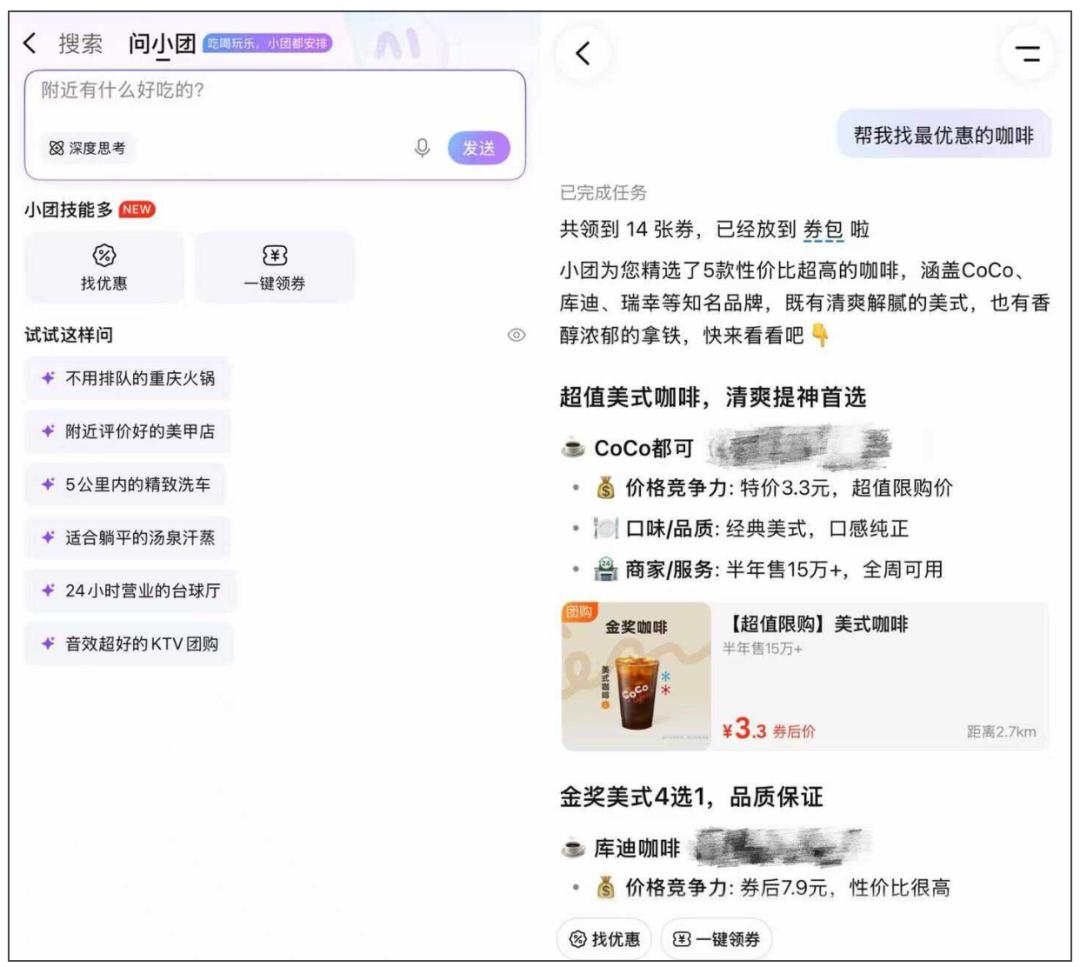
Image: Page of the AI assistant "Xiaotuan." Source: Meituan APP. Screenshot from "Tingtong Tech."
Meituan also upgraded its "Xingmou" vertical multi-modal large model and the hardware - software integrated service system during the same period, accelerating its deployment and coverage in core business scenarios such as catering and retail to better meet the needs of food safety management and last - mile delivery.
Overall, Meituan's series of actions to some extent explain Meituan's AI logic, which is to apply technology to solve ecosystem problems.
This is also Meituan's special feature, using AI to reduce costs and increase efficiency in its own ecosystem.
But the problem is that these things are useful for Meituan as a company.
However, for the general public, its service capabilities are "invisible." This is also Meituan's biggest embarrassment, as ordinary users don't have a strong perception of its AI.
Is Just "Investing" Enough?
However, the question is, even though Meituan has an advantage in AI investment, is just "investing" enough for Meituan?
Especially in 2026, AI has become a form of social currency.
People are comparing whose model can write poems, whose model can solve math problems, and whose digital human is more lifelike. In this regard, Meituan is like a "silent person."
"Meituan has a very strong tool - oriented nature and lacks the genes of a super C - end application. For example, people open Meituan to order food or book hotels, not to discuss philosophy. That is to say, no matter how good Meituan's AI is, in users' minds, it is still just a tool, not an intelligent entity," Qiang Ge, an Internet observer, said frankly.
However, Wang Xing insists that Meituan's strategy for AI is "offensive." But Wang Xing also said directly that Meituan will not blindly pursue becoming a "Token factory" but will regard AI as a strategic opportunity to better enhance consumers' real - world service experience.
Meituan's business scenarios determine that in the AI era, its strength lies in being a connector between the digital world and the physical world.
Perhaps for this reason, in order to explore an AI strategy suitable for Meituan, Meituan has chosen to invest in order to discover and support excellent "sword - makers" to create sharp "swords."
This logic is actually quite common in the Internet circle. For example, Tencent invested in JD.com when it couldn't do well in e - commerce on its own, and invested in Didi when it couldn't do well in the transportation field.
What Meituan is doing now is essentially paving the way for its "retail + technology" strategy. Therefore, Meituan's investment portfolio is gradually expanding.
However, it cannot be denied that investment cannot solve all problems, and this model also has its shortcomings.
Qiang Ge said, "Meituan's biggest risk is that it is difficult to grasp future user and consumption habits. After all, today's users are very lazy. For example, when I'm looking for a restaurant, I may first check the reviews on Dianping or directly ask Qianwen. If AI can directly give me the answer, why do I need to read those long and tedious text and image reviews?"
Qiang Ge also emphasized that although Meituan Longzhu invested in Kimi to secure a position, Kimi is not what it used to be. Once it loses its external traffic entrance, Meituan will need to find new "cards."
In addition, investment can buy technology, but it can't buy users' minds.
Going back to the original question, investment is a crucial part, but it is still difficult for Meituan to build a moat in the AI era just through external investment.
In fact, Wang Xing is very clear about all these.
Wang Xing recently emphasized that Meituan should become an "AI - Powered App," which means that the Meituan APP itself should become an AI application.
This is why Meituan is now investing heavily in external large model companies like Kimi while also focusing on developing its own LongCat large model. This is a double - insurance strategy.
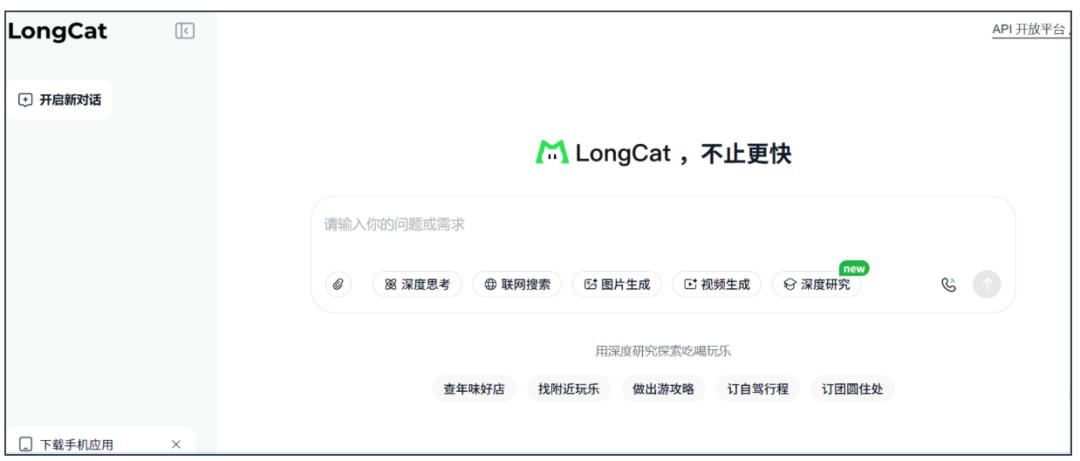
Image: Meituan's LongCat large model. Source: LongCat large model official website. Screenshot from "Tingtong Tech."
In Qiang Ge's view, LongCat is for "defense," ensuring that the core delivery, dispatch, and recommendation systems are not left behind by the times. And investing in Kimi is for "offense," connecting with cutting - edge algorithmic brains through capital.
Investment supplements the ecosystem, and self - development supplements capabilities. According to Meituan's logic, the technology of the invested companies can empower Meituan's business, and Meituan's data and scenarios can help the invested companies grow. Once this flywheel effect starts, it will be very powerful.
But this game will take at least five years, or even ten years. Taking the maturity cycle of embodied intelligence as an example, it may be as long as that of autonomous driving, a "long season."
In this process, Meituan may have to endure the embarrassment of its C - end AI products and face continuous pressure from Alibaba, ByteDance, and other companies.
However, if "physical AI" is the main battlefield in the next decade, the market will still understand what Meituan is doing.
It's just that Meituan's offensive is doomed to be a slow one.
(The header image is from Meit