Has Seres hit the bottom?
|GUIDE|
■ Why is there an increase in revenue but not in profit?
■ The two sides of being tied to Huawei
■ After the scarcity premium fades
The stock price of Seres has been falling for a long time. Since its listing on the H - share market in November 2025, the stock price has almost been on a one - way downward trend, dropping from HK$131.5 to around HK$70. The A - share price has also nearly halved from its peak in September 2025.
It is a fact that the new - energy vehicle sector as a whole is under pressure. Since September 2025, the stock prices of Li Auto, XPeng, and Leapmotor have not performed well. Industry - wide problems such as reaching the peak of penetration rate, price wars, and slowing growth rates affect all players equally.
However, Seres' stock price is weaker and has fallen deeper. This cannot be simply explained by the "general environment".
So, why does a high - end new - energy vehicle company with an annual revenue of 165 billion yuan and a gross profit margin close to 29% have a stock price that underperforms its peers? Why does the increasing sales volume and average selling price (ASP) fail to drive up the market value? This article attempts to answer this question from three aspects: fundamentals, business model, and valuation and pricing logic.
01 Has the profitability declined?
A gross profit margin close to 29% is a quite impressive figure among vehicle manufacturers.
In 2025, the gross profit margin of Seres' new - energy vehicles reached 28.76%, an increase of 2.55 percentage points compared to the previous year. Including fuel vehicles and other businesses, the overall gross profit margin was 26.88%.
Horizontally, focusing on the automobile sales business, the gross profit margin of Xiaomi Auto in the same period was 24.3%, BYD's was around 20%, Li Auto's was around 18%, and both Tesla and NIO's were around 14%.
It can be said that Seres' gross profit margin is in a league of its own.
However, what the market is more concerned about is that Seres' high gross profit margin has not naturally translated into an increase in net profit.
In 2025, against the backdrop of a 10.1% increase in the sales volume of Wenjie vehicles and a 3.7% increase in the ASP per vehicle, Seres' revenue was 165.054 billion yuan, a year - on - year increase of 13.69%.
However, the net profit almost remained stagnant. The net profit attributable to the parent company was 5.957 billion yuan, only a slight year - on - year increase of 0.18%, and the non - recurring profit and loss adjusted net profit decreased by 7.8%. The most significant factor in the non - recurring profit and loss was government subsidies.
In other words, with a 13.69% increase in revenue and an increase in the gross profit margin, Seres actually earned less from its main business.
Coupled with the fact that the growth rates of sales, management, and R & D expenses are all greater than the revenue growth rate, which significantly consumed the incremental profit brought by the increase in gross profit, the conclusion that the profitability has deteriorated is obvious.
However, this conclusion is somewhat unfair to Seres, at least not objective enough for its performance in 2025.
Under the net profit caliber, Seres (the listed company) had net profits of 4.74 billion yuan and 6.15 billion yuan in 2024 and 2025 respectively, with net profit margins of 3.27% and 3.72% respectively.
Seres Automobile Co., Ltd., the most important subsidiary, accounted for about 94% of the total revenue. Its net profits in 2024 and 2025 were 5.12 billion yuan and 6.997 billion yuan respectively, with net profit margins of 3.72% and 4.5% respectively. The non - recurring profit and loss adjusted net profit in 2025 was 6.25 billion yuan, a year - on - year increase of 24.69%, and the net profit margin under the non - recurring profit and loss adjusted caliber was also increasing.
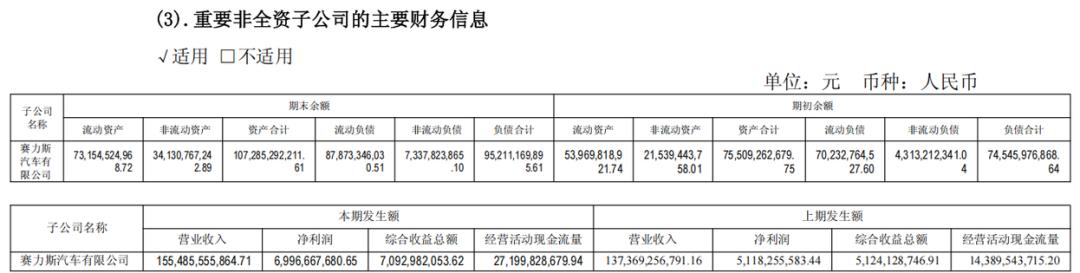
The problem lies in the equity structure. In 2024, minority shareholders bore a loss of nearly 1.3 billion yuan, and in 2025, the profit and loss became a positive 190 million yuan.
This does not deny Seres' situation of "increasing revenue but not increasing profit" in 2025. It should be said that this is a complex situation where the fundamentals have not deteriorated, but the equity structure has been diluted.
Of course, this is only about 2025.
In the first quarter of 2026, Seres' profitability did experience a substantial decline.
In Q1 2026, the revenue was 25.75 billion yuan, a year - on - year increase of 34.5%, an impressive increase. The total sales volume was 88,400 vehicles, a year - on - year increase of 29.4%. Among them, the sales volume of new - energy vehicles was 78,500 vehicles, a year - on - year increase of 43.9%.
However, regardless of which profit caliber is considered, the performance is relatively poor. The net profit decreased by 17.6%. The net profit attributable to the parent company was 754 million yuan, with a year - on - year increase of less than 1%. The non - recurring profit and loss adjusted net profit decreased by 73.87% year - on - year, being compressed to 103 million yuan.
One of the core indicators for observing profitability, the gross profit margin, decreased by 2.4 percentage points quarter - on - quarter and 1.4 percentage points year - on - year. The reasons are affected by the sales structure of vehicle models, the decline in the proportion of high - end vehicle sales, Wenjie covering part of the vehicle purchase tax for orders, and the increase in raw material prices.
The period expense ratio increased by 2.6 percentage points compared with the first quarter of 2025, which together with the decline in the gross profit margin constituted the pressure for the decline in net profit. Among them, the most significant change was the R & D expense, which will be detailed below.
Beyond the income statement, the cash flow statement is also sending an alarm.
In the first quarter of 2026, the net cash flow from operating activities of Seres was - 20.95 billion yuan, compared with - 7.63 billion yuan in the same period last year, and the net outflow more than doubled. The company explained that this was mainly due to the increase in inventory, channel financing, and accounts receivable.
02 Tied to Huawei: The dividends received and the costs paid
The cooperation between Seres and Huawei is a turnaround story worthy of being written into business school cases in any industry.
In 2020, Seres (then named "Xiaokang Co., Ltd.") had an annual revenue of only 14.3 billion yuan and a net loss of more than 1.7 billion yuan. It was a third - tier automobile company struggling in the fuel - vehicle field.
With Huawei's all - round empowerment, Seres achieved a miraculous brand leap: the Wenjie brand quickly gained popularity after its launch, with the price per vehicle firmly standing at 300,000 yuan. The M9 model has occupied the top position in the sales of luxury cars priced over 500,000 yuan for many consecutive months, and the monthly sales once exceeded 18,000 vehicles. In 2025, the total revenue reached 165 billion yuan, a ten - fold increase in five years.
Huawei has brought brand premium, product definition ability, high - level intelligent driving technology, and high - quality sales channels covering the whole country to Seres. It is a market consensus that without Huawei, there would be no Seres today, and there is no need to avoid this fact.
However, everything has two sides.
Every resource that Huawei invests in Seres comes with a price.
According to the prospectus of Seres' H - shares, from 2022 to 2025, the amounts paid by Seres to its largest supplier were 5.8 billion yuan, 7.2 billion yuan, 42 billion yuan, and 56 billion yuan respectively, accounting for 14.5%, 17.4%, 30.2%, and 33.78% of the total procurement amount respectively.
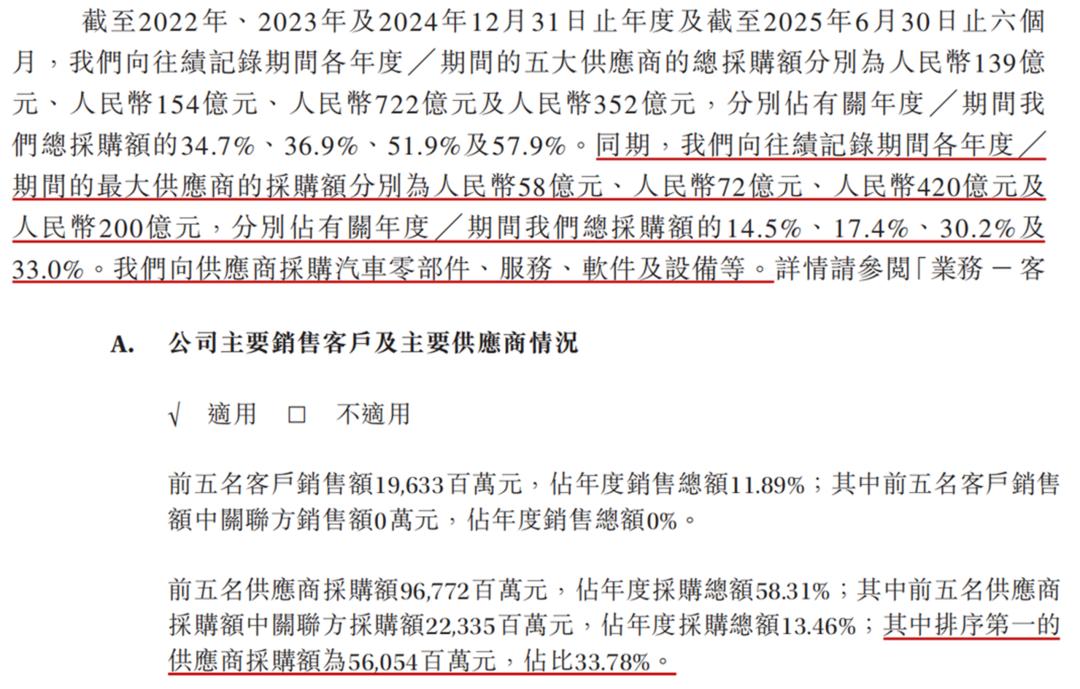
This largest supplier is generally considered to be Huawei.
The 111 billion yuan paid in four years was used to purchase software and hardware such as intelligent cockpits and autonomous driving assistance systems, as well as the service of Huawei's store channels covering the whole country and brand marketing support. What Seres bought was not only hardware but also the "ability to sell cars".
Although it is different from what many people think of as "profit sharing", Huawei has indeed taken a large share from Seres' operating revenue as a supplier and channel service provider.
This cooperation model, especially the cooperation model in sales, is also reflected in the income statement.
In 2025, Seres' sales expenses were as high as 24.19 billion yuan, of which advertising, image store construction, and service fees accounted for 22.95 billion yuan. One of the main destinations of this money was the Wenjie exhibition car promotion, store order promotion, and brand marketing services within Huawei's channel system.
Whether it is the sales expense ratio or the expense structure, Seres is significantly different from other new - energy vehicle companies.
Since Hong Kong - listed companies such as Li Auto and XPeng list sales expenses and management expenses together, only the sum of the two can be used to evaluate the impact of the cooperation with Huawei on expenses.
In terms of the sales expense ratio and management expense ratio, in 2025, the ratios of Seres, NIO, Li Auto, and XPeng were 17.6%, 18.4%, 9.5%, and 12.3% respectively.
Calculated on a per - vehicle basis, the sales expenses + management expenses per vehicle were 56,000 yuan, 49,000 yuan, 26,000 yuan, and 22,000 yuan respectively.
In other words, even though Wenjie's gross profit margin is in a league of its own in the industry, the high channel cost has significantly consumed the profit margin released by the gross profit, and there is limited profit left at the net profit level.
This is a typical case of exchanging sovereignty for efficiency.
The story doesn't end here. What has a greater impact on Seres is that the market expectations are undergoing a fundamental change.
Xiaokang, which used to suffer losses year after year and struggled on the verge of survival, considered it a win just to stay alive. However, for Seres, a high - end new - energy benchmark enterprise with an annual revenue of 165 billion yuan and a gross profit margin far exceeding that of its peers, the outside world's scrutiny standards are naturally much higher.
In the past, the question was "Can Huawei save Seres?" Now, the question has become another version: "Can Seres obtain more independent value from its super - dependence on Huawei?"
During the in - depth cooperation with Huawei, how much autonomy does Seres have in terms of product definition ability, terminal pricing ability, and channel control ability? This is a deeper concern of investors. This makes the company's profit more like the "residual claim" after Huawei's technology and channel empowerment, rather than the inherent profitability of an independent vehicle manufacturer.
Therefore, some investors directly asked on the interactive platform: "Does the company consider negotiating with Huawei to reduce the so - called 'Huawei tax'?"
03 The change in valuation logic
This concern has been reflected in Seres' valuation.
Originally, due to the deep cooperation, the capital market regarded Seres as a symbol of "Huawei's vehicle - making".
When the one - millionth Wenjie vehicle rolled off the production line in September 2025, Seres was still regarded as a "technology growth stock of Huawei Hongmeng Smart Mobility concept" in the A - share market, and its dynamic price - to - earnings ratio once exceeded 40 times.
However, the "circle of friends" of Huawei Hongmeng Smart Mobility is expanding rapidly. Wenjie has changed from being the only one to "five brands running in parallel", and Seres has changed from being the sole beneficiary to "one of N", and the scarcity premium has been gradually peeled off by the market.
The A - share price has nearly halved from its peak in September 2025, and the H - share price has dropped from HK$131.5 to around HK$70 within six months of listing, which is largely a direct manifestation of this change in valuation logic.
The decline in scarcity has a clear data trajectory.
According to estimates, the sales volume proportion of Wenjie within Hongmeng Smart Mobility has been declining, from about 87% in 2024 to about 72% in 2025, and it once dropped to less than 70% in the first quarter of 2026.
Huawei's Vehicle BU has been independent as Yinwang Smart Company, with Seres and Changan each holding 10% of the shares. This means that the relationship between Huawei and vehicle manufacturers is shifting from "deep - level partners" to "suppliers open to the whole industry".
Meanwhile, the cooperation between Huawei and Chery's Zhijie, BAIC's Xiangjie, Jianghuai's Zunjie, and SAIC's Shangjie is in full swing. It is expected that Huawei will launch multiple new models in 2026. The prime positions in Huawei's offline stores, marketing resources, and the right to be the first to launch new technologies are no longer exclusive to Wenjie.
From an industrial perspective, the overall penetration rate of new - energy vehicles has entered a high - level plateau period, and the extended - range route, in particular, is facing disputes over reaching the peak of its golden cycle.
Citibank has clearly warned of the risk that "the golden cycle of extended - range vehicles is coming to an end" and has lowered its sales forecast for Seres. When the decline in scarcity and doubts about growth occur simultaneously, the downward shift of the valuation center is not just a temporary adjustment of market sentiment, but a switch in the pricing basis.
This is also the driving force for Seres to increase its R & D investment. As mentioned earlier, among the expenses, the R & D expense has the largest change.
In 2025, Seres' R & D expenses were 7.954 billion yuan, a year - on - year increase of 42%. The R & D investment increased even faster, with a year - on - year increase of 77.4% to 12.51 billion yuan, and the proportion of R & D investment in revenue increased from 4.9% in 2024 to 7.6%.
Li Auto, XPeng, and NIO only disclose their R & D expenses. According to multiple sources, they probably treat R & D investment as expenses. If this is the case, then according to the 2025 data, Seres' R & D investment scale has exceeded that of NIO, XPeng, and Li Auto.
In the first quarter of 2026, Seres' R & D expenses increased by more than 70% year - on - year, which was the single item with the