Altman personally crowned GPT-5.5 as the "autistic genius", and a team of 16 people canceled their subscriptions to Claude overnight.
Just now, Altman personally gave GPT-5.5 a nickname that set the whole internet abuzz - "Autistic Genius".
He couldn't help but exclaim that he couldn't believe they had created such an AI!

Half a month after GPT-5.5 was launched, Altman repeatedly and undisguisedly expressed his excitement on social platforms.


In Altman's own words, the "raw intelligence" of GPT-5.5 has created a huge gap:
It crushes in benchmark tests, saves tokens like crazy, and maximizes the aesthetics of brute-force performance.
AI circle bigwigs have voted with their feet for GPT-5.5. Even AI professor Derya Unutmaz said bluntly that it could completely be called GPT-6!
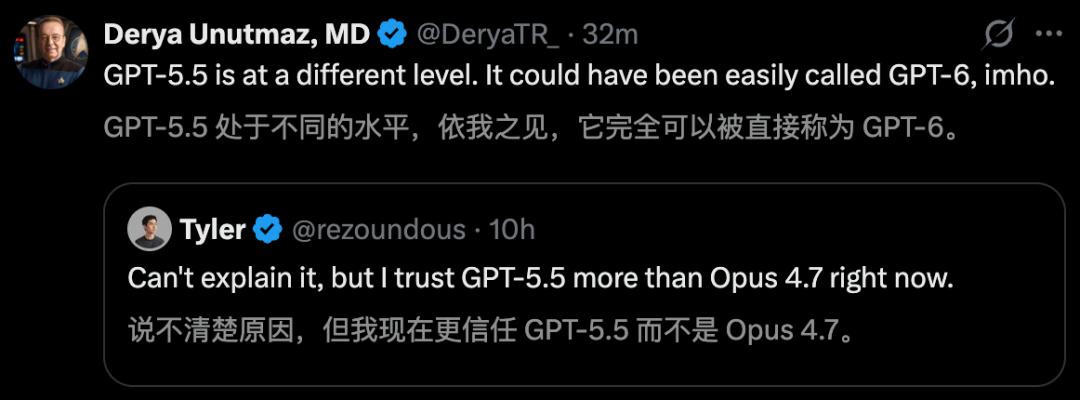
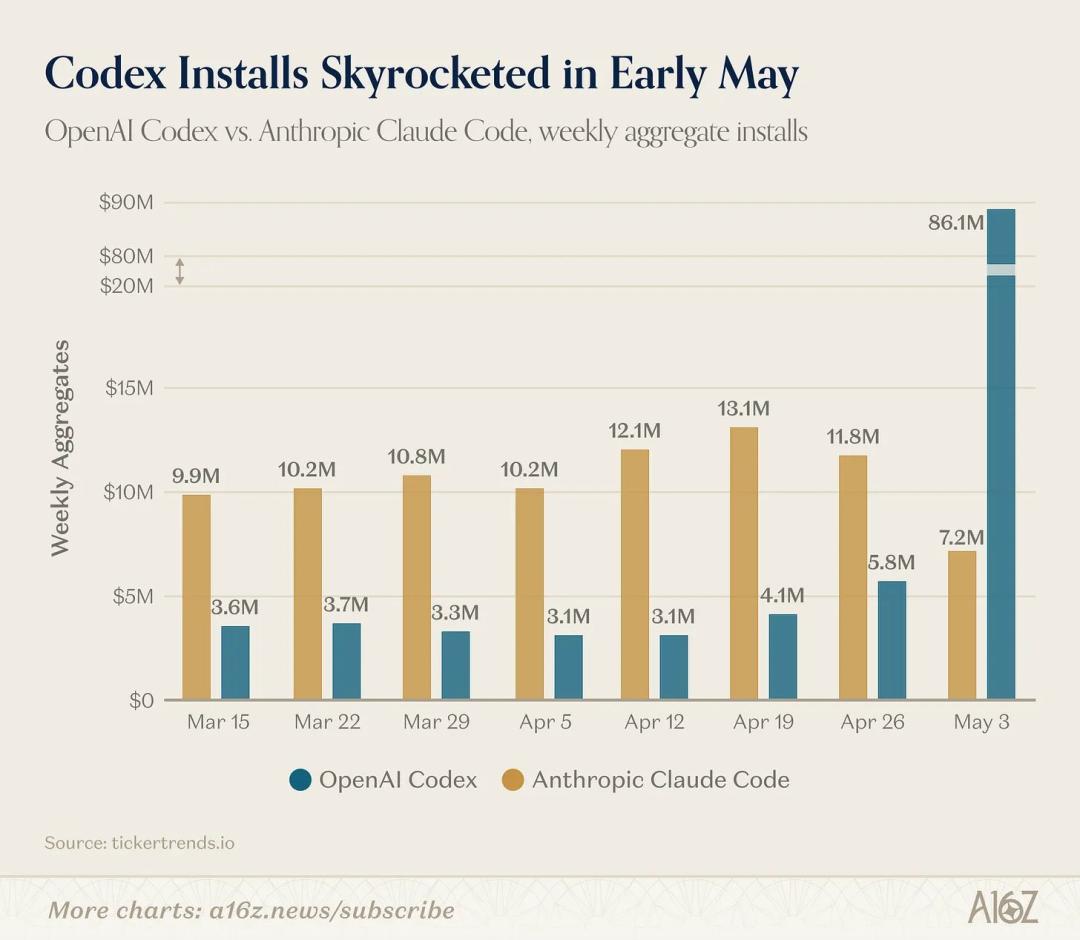
Also today, a chart went viral across the internet. The downloads of Codex powered by GPT-5.5 soared in May, reaching 86.1 million, far exceeding Claude Code.
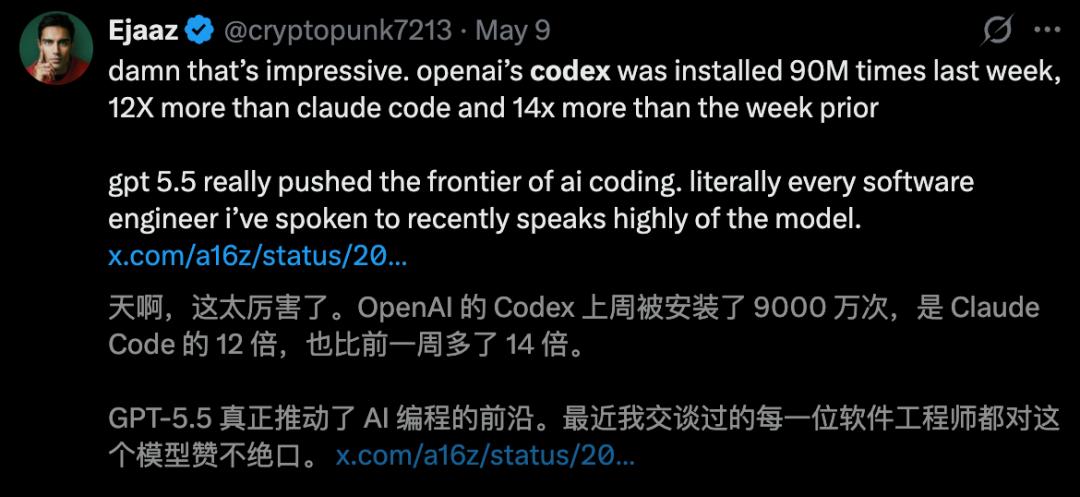
In just the past week, the download volume exceeded 90 million, 12 times that of Claude Code.
Meanwhile, the feedback from developers is also strongly validating this point.
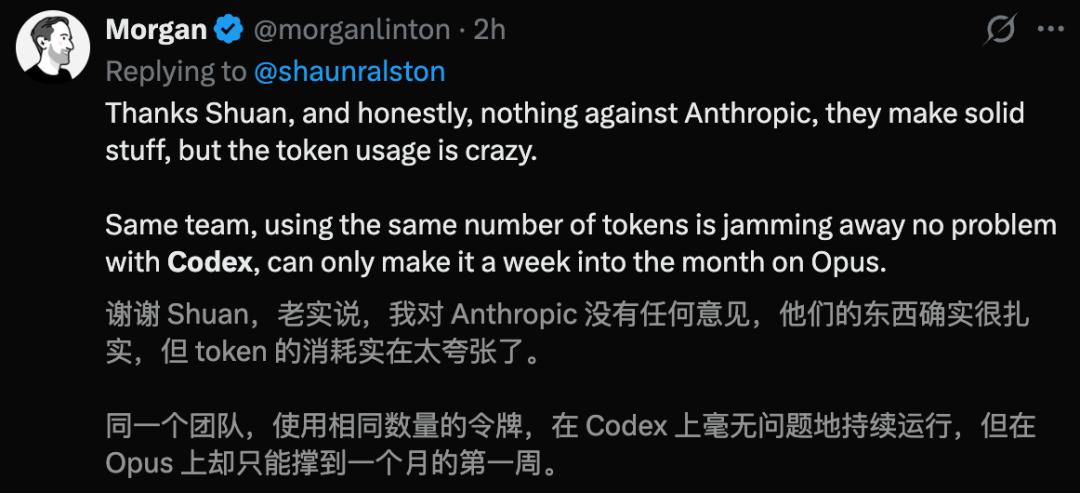
Many people publicly stated that in actual coding tasks, the performance of GPT-5.5 has surpassed Claude Opus 4.7, especially in terms of token consumption.
For the same task, GPT-5.5 uses nearly 40% fewer tokens than Claude.
It has to be said that the metaphor of "Autistic Genius" is so accurate that it's a bit heartbreaking.

16-person team cancels Claude subscription, saving $32,000 per month
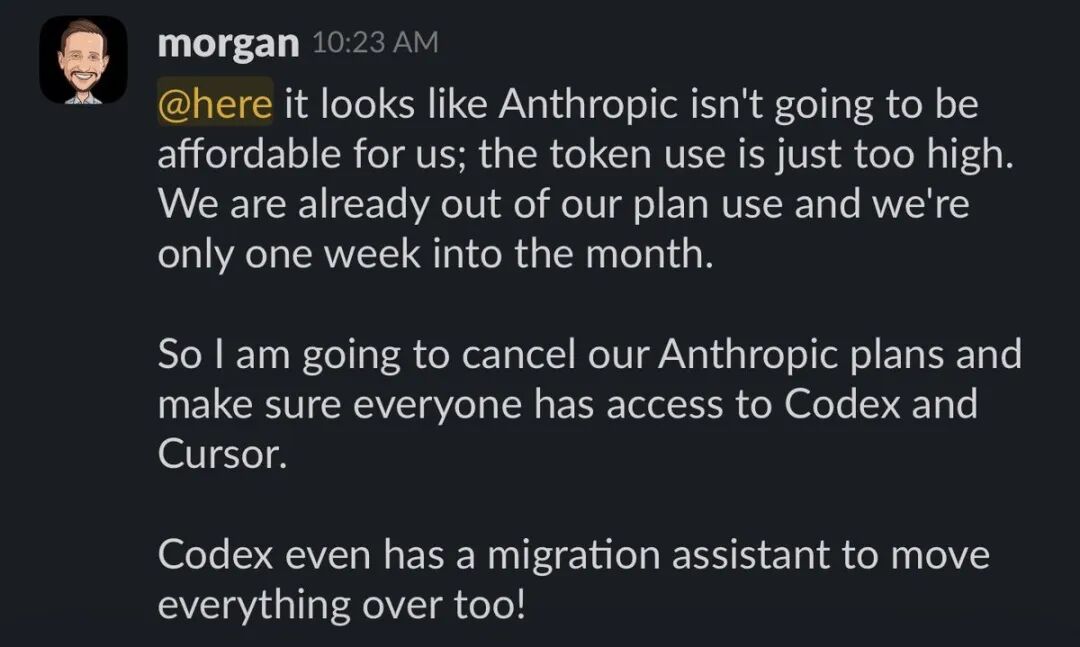
Morgan Linton, the founder of a startup called Bold Metrics, posted a message with a calm tone but explosive content:
Farewell to Anthropic officially!
For my small 16-person engineering team, the combination of Codex + Cursor has completely replaced the original solution.

The reason is simple and straightforward: Claude Code is too expensive!
In contrast, with the support of GPT-5.5, Codex's recent performance has been amazing, and its token utilization rate is extremely high, which is very cost-effective.
In actual work, Bold Metrics still frequently uses Cursor for code review.
The most important thing is that the team has never hit the table limit when using Cursor, and its built-in Composer 2 function is sufficient to handle most development scenarios.

Regarding Claude's token consumption, Linton did some calculations -
Each engineer burns more than $2,000 per month, and for 16 people, that's an expense of over $32,000 per month.
After switching to Codex + Cursor, the token efficiency of GPT-5.5 has caused the cost to drop sharply, and the performance remains the same.
What's even more disheartening is his prediction that more and more engineering leaders will make similar decisions.
It has to be said that this post is like a depth charge, hitting Anthropic right where it hurts - The product is good, but the token consumption is just like robbing money.
And what about Codex? The data has already given the answer.
90 million downloads in a week, Codex becomes a myth
According to TickerTrends data, as of May 3, the download volume of Codex reached an astonishing 86.1 million times, a week-on-week increase of 1397%.
By May 8, this number further climbed to 90 million in a single week.
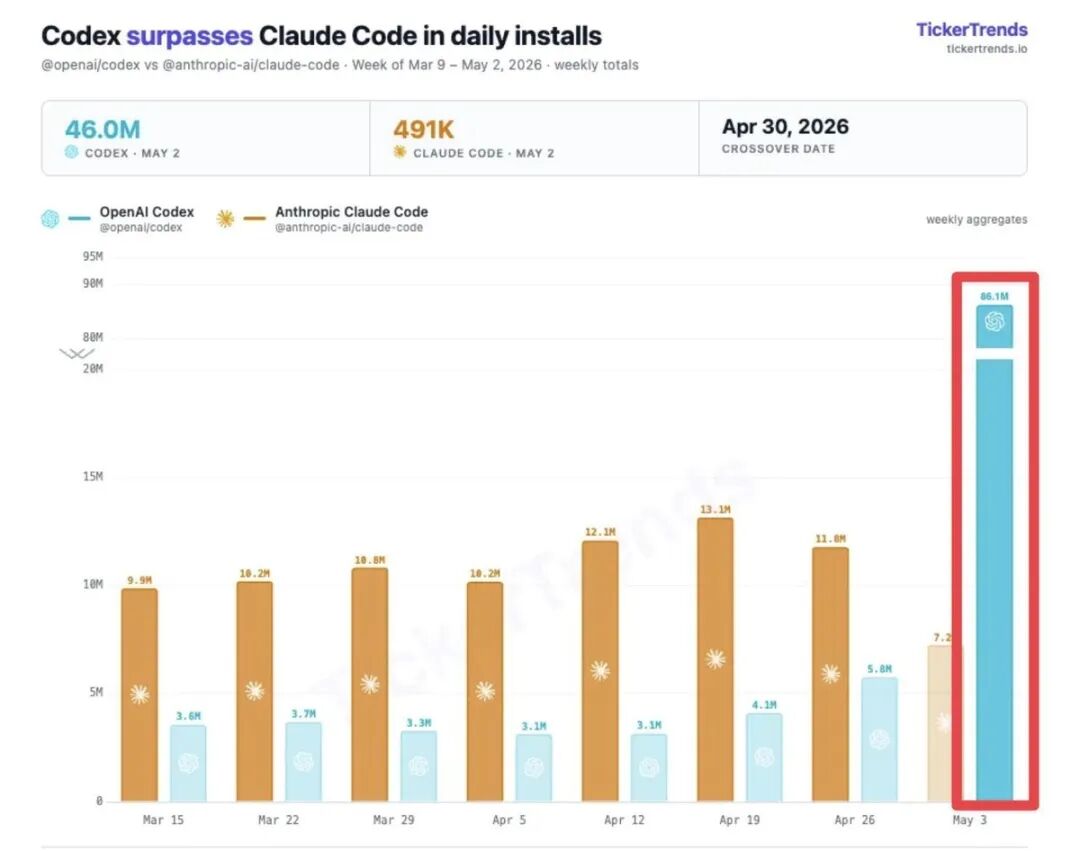
Meanwhile, the download volume of Anthropic's Claude Code during the same period was 7.2 million times, a week-on-week decrease of 38%.
One is soaring, and the other is bleeding. The speed of this seesaw effect is breathtaking.
The trigger point for this wave of growth is clear -
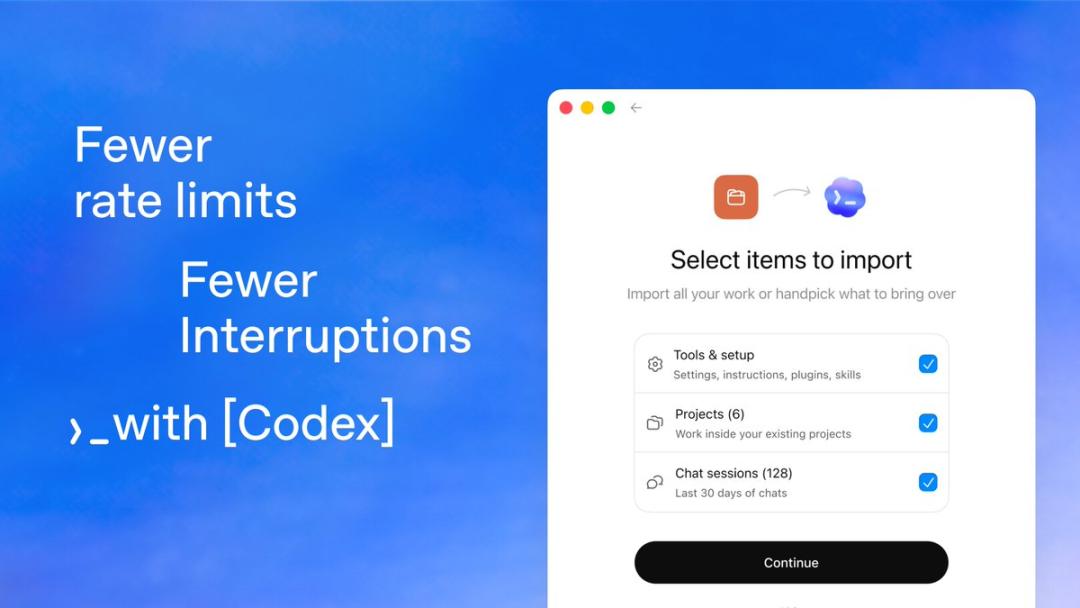
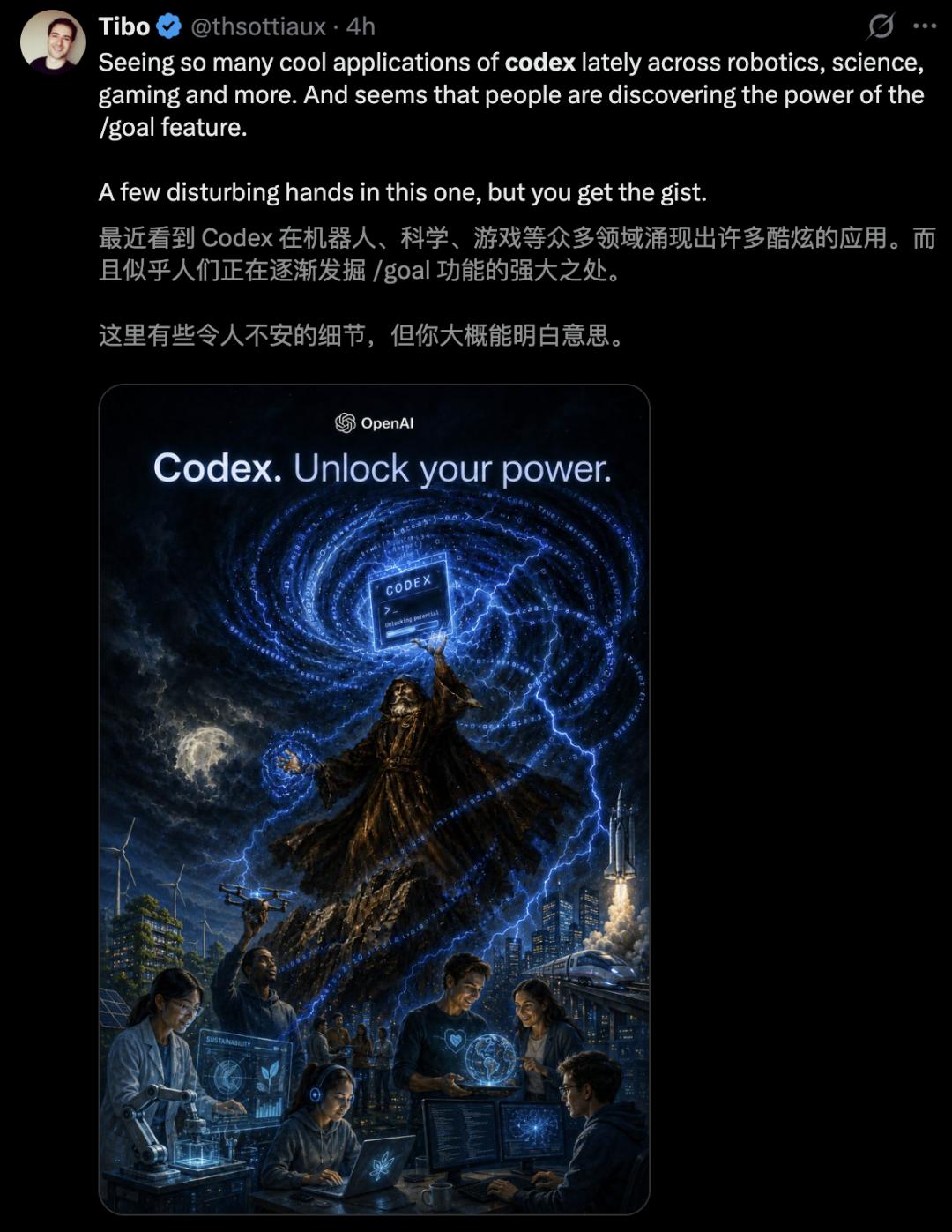
On April 30, Codex released version v0.128.0, introducing a persistent /goal workflow that supports multi-step task planning across sessions.
Coupled with the million-token context brought by GPT-5.5 and a 40% increase in token efficiency, developers' voting with their feet is more honest than any evaluation.
Altman himself also used the word "crazy" in an internal letter to describe Codex's growth.
Microsoft's vice president, Omar Shahine, couldn't help but praise, "Codex performs exceptionally well in creating Swift iOS applications."
With just one prompt, Codex directly generated an application, solving 95% of the work, and it's much better than Claude Code.
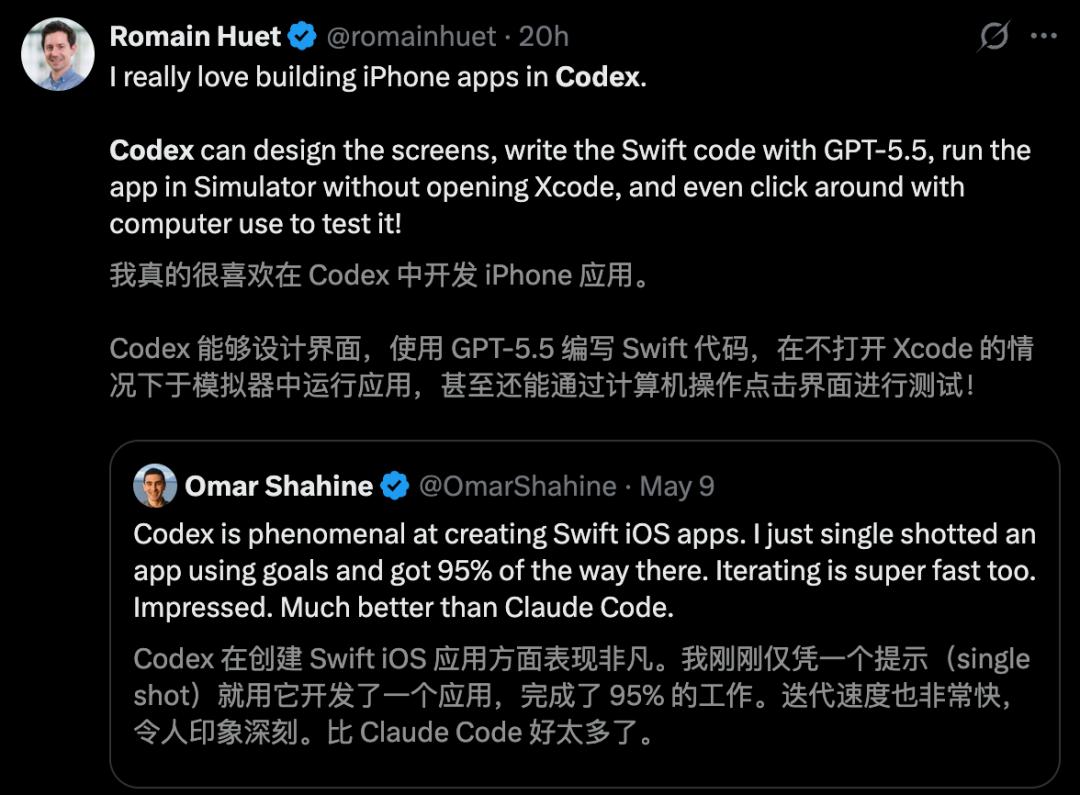
Subsequently, Romain Huet, the head of OpenAI's developer experience, said -
Codex can design interfaces, write Swift code with GPT-5.5, run apps directly in the simulator without even opening Xcode, and even perform tests by "controlling the computer" to click around!
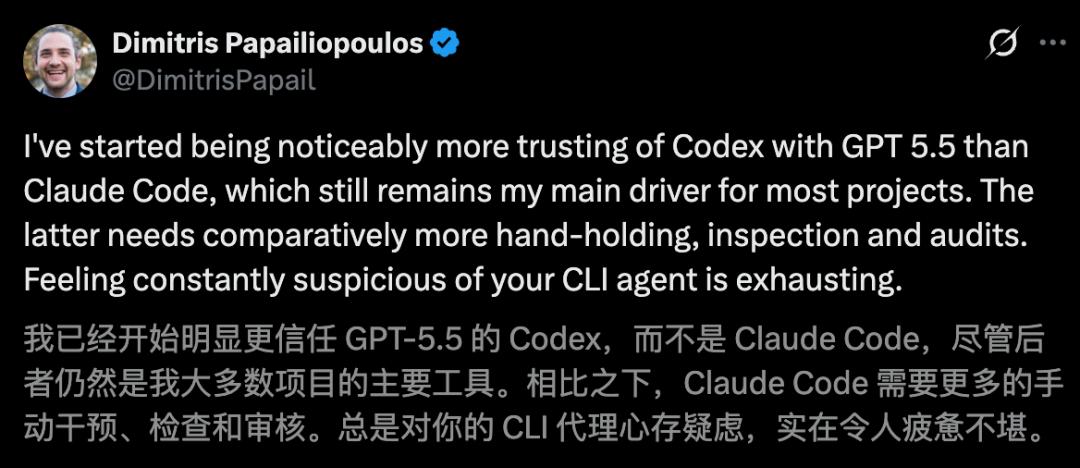
Developer Dimitris Papailiopoulos also said that he clearly trusts Codex more.
Now, with Codex, Altman says he has more free time.

Altman's "heart-to-heart" late at night, comment section goes crazy
Also today, Altman started soliciting opinions online, asking, "What do you most hope to see improved in OpenAI's next-generation model?"

For a moment, the comment section was flooded with suggestions.
A highly upvoted comment pins OpenAI to the wall
The response from Will Depue, a former OpenAI researcher, became the focus of attention.
GPT-5.5 has narrowed the gap with Claude, but it has lost miserably in terms of "human touch".
He gave an example. When you want to learn astrophysics, GPT-5.5 will immediately throw out a bunch of cold abbreviations and formulas, leaving you confused;
While Claude is like a knowledgeable and elegant tutor, who can lead you into various knowledge rabbit holes, which is both interesting and well - organized.
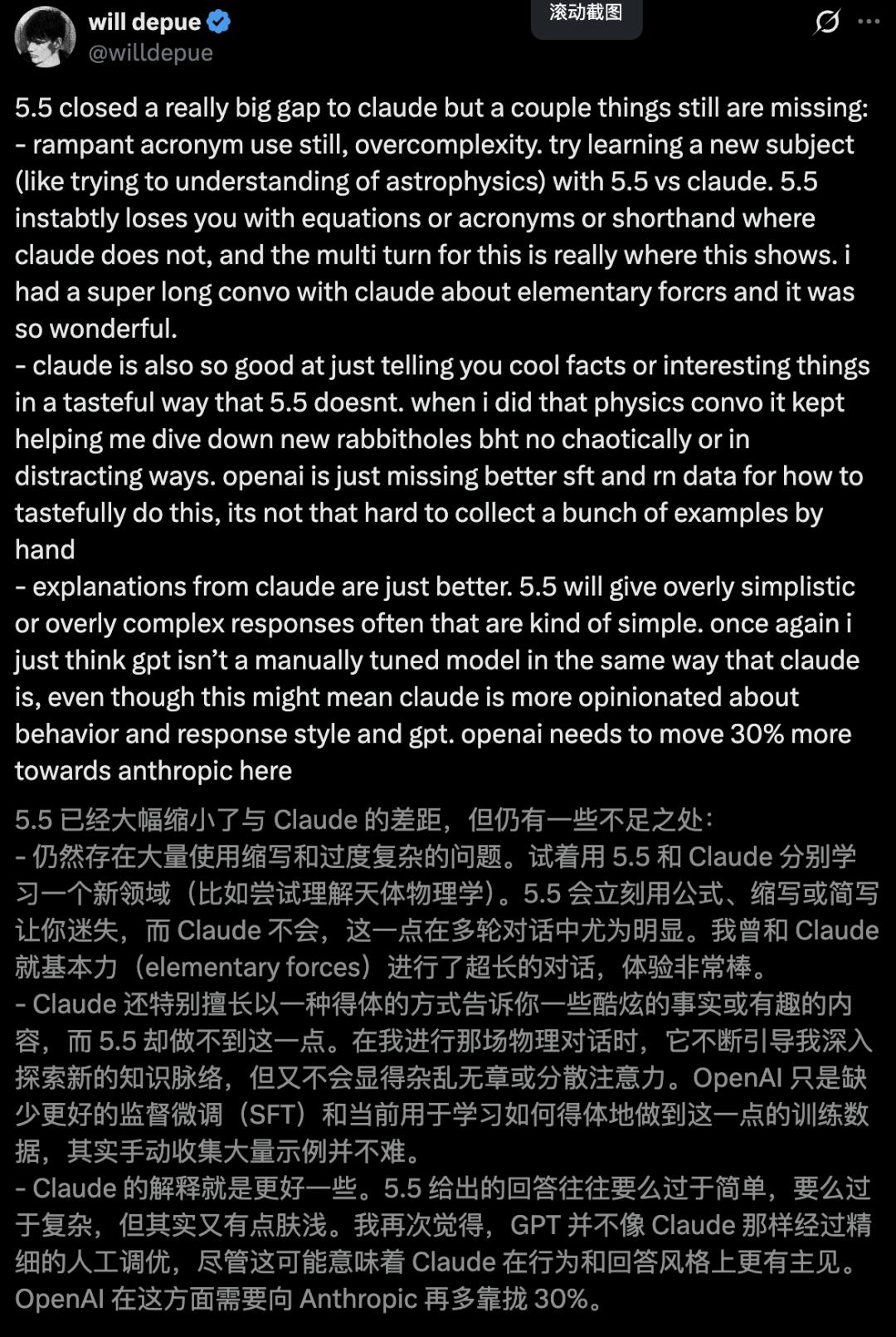
Moreover, he shouted that OpenAI's data tuning is too mechanical, and it should learn from Anthropic and pull back the "personality" and "explanation ability" of the model by 30%.
The most powerful model in the world has actually been criticized for not being "human - like".
Some people also hope that ChatGPT can improve its ability to follow instructions and write.
