7.5 billion, a popular unicorn goes bankrupt
The self-heating hot pot brand that once sold 1 billion worth of products in a year is on the verge of bankruptcy.
The official website of the People's Court of Yuhang District, Hangzhou, shows that in May this year, the bankruptcy liquidation ruling of Hangzhou Jinglyang Enterprise Management Consulting Co., Ltd. (hereinafter referred to as "Hangzhou Jinglyang"), an affiliated enterprise of "Self-Heating Hot Pot", was officially finalized, with the amount to be executed exceeding 140 million yuan. The first creditors' meeting was held on the afternoon of May 14 in a combination of online and on-site meetings.
The venture capital circle should still remember that the self-heating hot pot became popular in the era when new consumption was at its craziest. At that time, a bowl of noodles could easily be valued at 1 billion yuan, and the self-heating hot pot caught the wave - 5 million barrels were sold out in just 10 minutes, and its valuation soared to 7.5 billion yuan. However, once the wave passed, everything suddenly fizzled out. Now, this former star company has reached the verge of bankruptcy, which is really sad.
The tide has turned, and the FOMO sentiment that once pervaded the new consumption industry is repeating itself - large models, embodied intelligence, quantum computing, nuclear fusion... The crazy investment in hard technology is still fresh in our memory.
The fall of a popular brand
Once valued at 7.5 billion yuan
This is a consumer brand founded by Cai Hongliang from Jinhua, Zhejiang.
Actually, as early as ten years ago, before the self-heating hot pot came into being, Cai Hongliang, who came from humble beginnings, was already a little famous. In 2016, he sold "Baicaowei", which he had built from scratch, to "Haoxiangni", a snack giant, for a transaction price of 960 million yuan, and successfully cashed out and left.
Two years later, Cai Hongliang came back with the "Self-Heating Hot Pot". Without the need for fire or electricity, you could enjoy a hot pot in just 15 minutes with a cup of cold water. It accurately targeted the "single-person dining" and "home economy" of young people. At that time, the self-heating food market was not very crowded. Haidilao only entered the market in 2017, and Moxiaoxian was also newly established.
Soon, the self-heating hot pot launched a phenomenal marketing campaign. It signed a large number of top celebrities, once causing a situation where "half of the entertainment circle was eating self-heating hot pots". In addition, it sponsored variety shows, placed elevator advertisements, and engaged in live streaming sales. It didn't miss any exposure that could be bought with money. Its sales exceeded 100 million yuan in just three quarters, and later it successively launched self-heating rice, self-heating flour porridge, instant flour and other products.
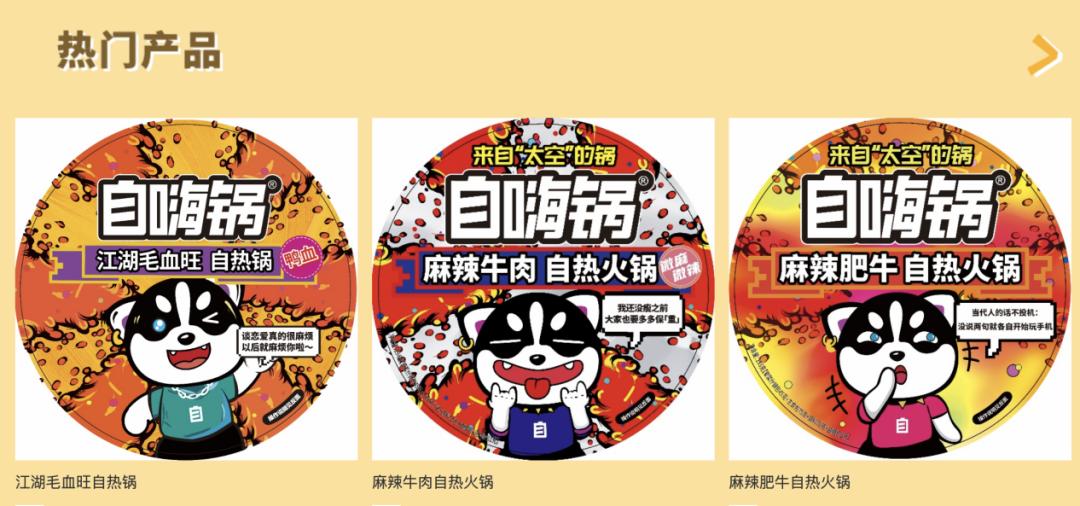
An even greater explosion happened in 2020. At that time, the sudden outbreak of the epidemic restricted dine-in services, and stockpiling at home became a necessity. A self-heating hot pot priced at more than 30 yuan overnight changed from a novelty product to a must-have in daily life. During that year's Double Eleven, the self-heating hot pot's sales exceeded 100 million yuan in just 21 minutes, and 5 million barrels were sold out in 10 minutes during a live streaming sales event. The annual revenue was approaching 1 billion yuan.
At the same time, the self-heating hot pot caught up with the era when new consumption investment was at its craziest. From 2019 to 2021, the self-heating hot pot completed five rounds of financing in a row, and became a unicorn in just two years. Its valuation was pushed all the way up to 7.5 billion yuan.
But the bubble soon began to burst.
Accustomed to maintaining its scale through money-burning marketing, the self-heating hot pot has long maintained a distorted cost structure: the marketing expenses once accounted for more than 40%, while the R & D investment was less than 1.3%. This approach was initially very effective, but it was destined to be unsustainable. Public data shows that the repurchase rate of the self-heating hot pot has long been below 15%, while the repurchase rate of traditional instant noodles is about 65%. The company's losses have been expanding year by year.
In 2022, after cutting nearly 260 million yuan in sales expenses, the self-heating hot pot finally turned a profit. But the market had already changed. At that time, investors began to turn to the hard technology track, and new consumption suddenly cooled down. The self-heating hot pot lost external financing, and its business gradually fell into trouble.
Finally, in May this year, the People's Court of Yuhang District, Hangzhou, announced that Hangzhou Jinglyang had entered the bankruptcy liquidation process, putting an end to a business myth.
The tide has ebbed
A number of popular brands have disappeared
The story of the self-heating hot pot is not an isolated case.
Remember in 2021, the new consumption track was extremely popular. At that time, there was a popular saying: Every traditional consumer category is worth being redone.
So, from ramen, dim sum, fried skewers, coffee, to beauty, skincare, and clothing, the track was crowded with consumer investors. According to statistics, there were more than 800 investment and financing events for new consumer brands that year, with a total financing amount of more than 90 billion yuan, and 239 projects with a financing amount of over 100 million yuan. On average, more than two brands received financing every day, and one brand received financing of over 100 million yuan every four days.
But the spotlight only belongs to a very small number. Most brands quietly disappeared when the tide ebbed.
Recently, there has been the latest news about "Zhongxuegao", the "ice cream myth": On May 7, 508 intangible assets under the name of Zhongxuegao Food (Shanghai) were auctioned and sold for 21.1 million yuan, which is really sad. Lin Sheng, the founder of Zhongxuegao, comes from the advertising consulting industry and has personally planned the marketing of Madieer and Zhongjie 1946. It started on Tmall in 2018 and sold an ice cream for 15 to 66 yuan. At its peak, its valuation was once approaching 4 billion yuan.
Since 2022, the trend has changed. Consumers are no longer willing to buy, and Zhongxuegao has been labeled as an "ice cream assassin". Its sales have shrunk sharply. Coupled with the withdrawal of capital, Zhongxuegao was applied for bankruptcy in mid-2025.
People suddenly found that those popular brands that became famous around 2021 have gradually disappeared. Hutouju, which received hundreds of millions in financing, fell into debt and business troubles in 2024, and its parent company was applied for bankruptcy liquidation; Momol Dim Sum, with a single-store valuation of over 100 million yuan, closed a number of stores and retreated to its base in Changsha; "Huanniu Cake House", a popular cake brand in Hangzhou, announced the termination of its operation in June 2025. Similar scenes are also playing out in other categories, and the fallen new consumer brands are lining up.
Looking back, their rise and fall almost followed every beat of the new consumption god-making cycle: they rose with the wave, were pushed to high valuations by capital, and burned money to achieve short-term scale growth. Once the wave stopped, the bubble without barriers fell.
This rings an alarm bell for all entrepreneurs: A company that simply relies on capital pursuit and money-burning may enjoy temporary glory, but without a solid product foundation and a healthy business model, it will eventually be abandoned by the market.
A similar scene is repeating itself
Ring the alarm bell
"Today's hard technology track is very similar to the craziest period of consumer investment in 2021." Recently, a state-owned LP in Shanghai shared his experience with us.
This is not an exaggeration. Take embodied intelligence for example. In 2025, it was rare for a single financing in the track to exceed 1 billion yuan, but this year, a financing of over 1 billion yuan has become the "standard" for top projects, and the valuation often starts at tens of billions. In the past two months, 39 financings have been completed in the field of embodied intelligence, and 21 of them have an amount of over 1 billion yuan. The financing rhythm and scale of star projects are amazing.
The frenzy is not limited to embodied intelligence. As we can see: Xinghuan Jueneng, a start-up company in controllable nuclear fusion, has just announced a 500 million yuan Series A+ financing, and its valuation has exceeded 1 billion US dollars; Jieyue Xingchen in the large model track will complete a 2.5 billion US dollars financing. Even the once obscure quantum computing has completed at least 6 transactions in less than 60 days this year.
In this situation, the FOMO sentiment that once pervaded the consumer market is now sweeping the hard technology field.
"Now, to invest in some star hard technology projects, you have to invest in at least two rounds, and some projects don't even allow due diligence." With the soaring popularity of the track, an AI investor is faintly worried. "There is a start-up company working on an embodied large model. I haven't talked to them for just half a month, and its valuation has risen so much that I can't afford to invest."
Along with this, the decision-making time window for investment institutions is rapidly shrinking. Some investors admit that in the past, it took at least three months to evaluate a project, but now the project parties think three weeks is too long - because if you don't invest, the share will be gone. "Now, we're not investing in projects, but competing for them," said an early-stage hard technology investor helplessly.
With the overheated track, sky-high valuations in the tens of billions, unproven business models, and infinite bets on the "next era" - will the tuition fees paid in the consumer track be paid again in the hard technology track?
No one wants to see the story repeat itself. But in places where hot money is flowing, rational voices are often easily drowned out. Although hard technology has technical barriers, which are quite different from ramen and dim sum back then. But between the barriers and the business closed-loop, there is still a long industrialization cycle, high implementation costs, and most importantly - the real willingness to pay.
After all, we should always stay in awe. Hot money will disperse, the wave will stop, and all businesses are inseparable from the most basic things: orders, cash flow, the real needs of customers, and the ability to stay in the game.
This article is from the WeChat official account "Investment World" (ID: pedaily2012), written by Zhou Jiali and published by 36Kr with authorization.