Dressing robots is growing into a diversified business.
Embodied intelligence now requires a "social shell," and this shell reflects business opportunities from multiple perspectives.
Different from the embodied intelligent robots with a "mechanical style" in previous years, the robots presented at various events recently have started to wear clothes. From 1X, Fourier, to Figure, Xiaomi CyberOne V2, Kai, and even the somewhat mysterious Optimus V3, they have all regarded "wearing clothes" as a norm.
This is an unnoticeable but extremely important turning point.
In laboratories, factory enclosures, and press conference stages, exposed joints, cables, actuators, and metal skeletons used to be the most direct display of technological capabilities. They represented precision, power, and speed, and also constituted the most typical "technological sense" of robots. However, once robots start to enter shopping malls, healthcare facilities, exhibition halls, and even attempt to enter households, the situation changes. When people encounter them, their first reaction is whether the robot looks approachable, feels harsh to the touch, and would seem too obtrusive in their lives.
For the first time, appearance is not just about looks but has become part of the product definition. When a robot wears clothes, it first becomes a "relationship issue."
This is not a strange phenomenon in the context of industrial evolution. After the popularization of smartphones, mobile phone cases quickly grew into a huge accessory market; when cars transformed from means of transportation into new living spaces, car wraps, color-changing films, and interior parts have been on the rise; once trendy toys have the ability to be dressed up and modified, the business outside the main body quickly becomes bustling. When products transition from technological items to consumer goods and from functional entities to social relationships, they almost always develop such a "shell economy."
Robots have also reached this stage. Today, clothes, soft packages, skins, and outer coverings may seem like peripheral issues, but what they entail goes beyond aesthetics. It involves safety, affinity, scene adaptation, brand expression, commercial monetization, and even future tactile perception and functional protection.
In a sense, when a robot learns to wear clothes, it also means it is learning how to integrate into the crowd, spaces, and society.
When this turning point occurs, we can see a variety of new business models emerging.
01 Who Needs This "Skin" the Most?
The robots that have the strongest demand for "wearing clothes" are those that need to be seen and accepted by people.
For example, Figure.
Recently, Brett Adcock, the founder of Figure, high - profilely demonstrated the "robot fashion" of Figure 03 through various clothing combinations on social platforms. He also claimed that Figure's design team consists of automotive and fashion designers. This shows the importance of the "skin" of robots in the product system.
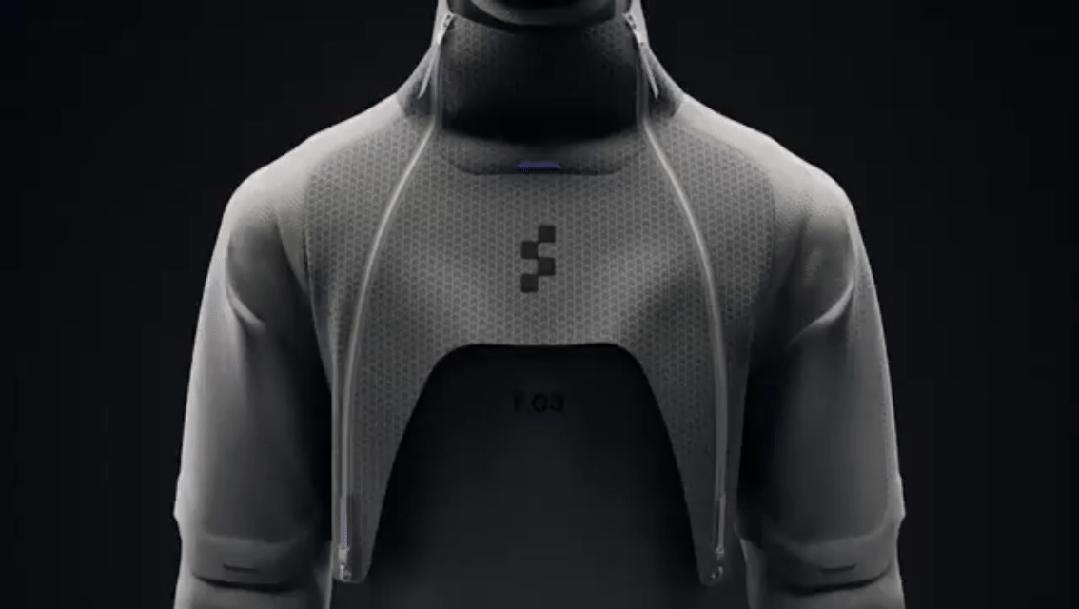
Image source: Figure AI
Figure represents the most typical type of robots designed for households, healthcare facilities, reception areas, shopping malls, exhibition halls, and front desks. These scenarios have one thing in common: before the robot starts working, people have already established a perceptual relationship with it. Whether it feels cold, hard, and sharp, or soft, approachable, and less intrusive determines whether many subsequent relationships can be developed.
In these scenarios, safety needs to be given special consideration. Here, safety is not just about algorithms and control systems; it also includes a very specific "passive safety." When users come into close contact with the robot, whether they touch a hard shell, whether there is buffer protection in the contact area, and whether the joints and driving parts are more softly covered will directly affect the human - robot co - existence experience.
In this regard, Fourier and 1X are very typical examples. In the design of the new - generation NEO, 1X links soft covers with the safety narrative of the home scenario; the new - generation GR - 3 of Fourier also emphasizes soft covering materials, gentle touch, and interactive safety. It can be seen that some companies that entered the human - close scenarios earlier in the industry no longer regard the outer layer as a simple decoration but as a necessary process before entering the daily environment.
This is the "first encounter" between robots and humans.
Of course, in terms of safety, future robots may also need to wear "protective gear" in certain situations to protect themselves. Currently, there are relatively few players in this field, and it is yet to be developed.
The second category that highly needs this "skin" is the performance, rental, exhibition, and brand event markets.
In these scenarios, robots are often not efficient laborers but more like moving, interactive, and attention - attracting media. They naturally have viewing and communication value. Just standing there, they can attract traffic. Their bodies are advertising spaces, and their actions are attention - grabbers.
Under this logic, clothes and appearance are directly related to commercial value. What the robot wears, in what style it appears, and whether it can undertake brand co - branding and theme expression are no longer insignificant accessories but part of the delivered content. For shopping mall activities, brand pop - ups, and exhibition displays, a robot that can be dressed up, themed, and visually customized is obviously more likely to be chosen than a robot that always maintains its original body state.
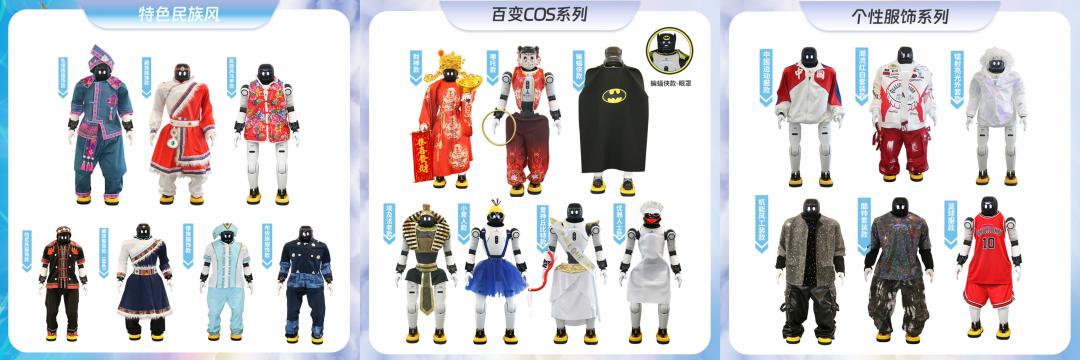
Image description: Qingtianzu's "skin peripherals"
This has been confirmed by leading robot rental manufacturers. The product operation staff of Qingtianzu told the Embodied Intelligence Research Institute, "For robot performances, customers often have special requirements. Generally speaking, customers prefer robots with clothes and a sense of character. For example, when a fortune - god robot wears the corresponding clothing, its sense of character and interactivity will be stronger, and it is more likely to attract the attention and love of on - site audiences." People hope that "through the 'skin' that fits the scenario better, the robot can present a more diverse image, and customers will not feel that all robots look the same." It is understood that Qingtianzu's "skin peripherals" have received more than a hundred orders per month. With the continuous entry of urban partners in the future, the number of relevant orders is expected to continue to grow.
Under this logic, in the early days, people generally rented a "technological device," but now there is a shift towards "characters." In the future, it may even become a media spectacle, and the machine characteristics will be more diluted.
The third category that will take this matter to a deeper level is the industrial and special - operation scenarios.
In this context, the term "clothes" is actually not very accurate. It is more appropriate to call it an outer covering system or a protective system. Requirements such as high - temperature resistance, corrosion resistance, dust prevention, oil resistance, anti - static, and even future addition of tactile perception, pressure feedback, and collision detection are pulling the robot's outer layer from an aesthetic decoration to a functional device.
That is to say, in consumer and service scenarios, it mainly caters to psychological acceptance and visual expression; in industrial and special scenarios, it starts to undertake environmental adaptation and ability extension. Going a step further, it may even become the "perceptual surface" of the robot, such as the various "electronic skins" we see today. At this point, clothes are no longer just clothes.
02 The Robot Clothing Market is Growing into an Independent Industry
Just as we focus on people's "clothing, food, housing, and transportation," for robots, what is really worth studying is whether a new additional chain will emerge.
In the view of the Embodied Intelligence Research Institute, the trend is clear. This chain will not appear as a flimsy "robot fashion" for a long time. It will grow in a more substantial form - outer coverings, soft - package systems, functional protective layers, branded appearance parts, replaceable parts, perceptual skins, and even new functional components combined with flexible materials and electronic skins.
In the short term, this market will not be large enough to become a prominent discipline. However, its growth path is already very clear.
The first to benefit from this may be cross - functional teams that understand both clothing patterns and fabrics, as well as joint movement, functional working conditions, assembly logic, and maintenance requirements. The conformal nature of humanoid robots to humans means that there is indeed room for the transfer of clothing design, knitting technology, flexible production, and rapid prototyping. However, if it only stops at "making a human - like piece of clothing," this endeavor will soon hit a wall. What really matters is to create something that is both like a piece of clothing and a structural part, and even has perceptual capabilities.
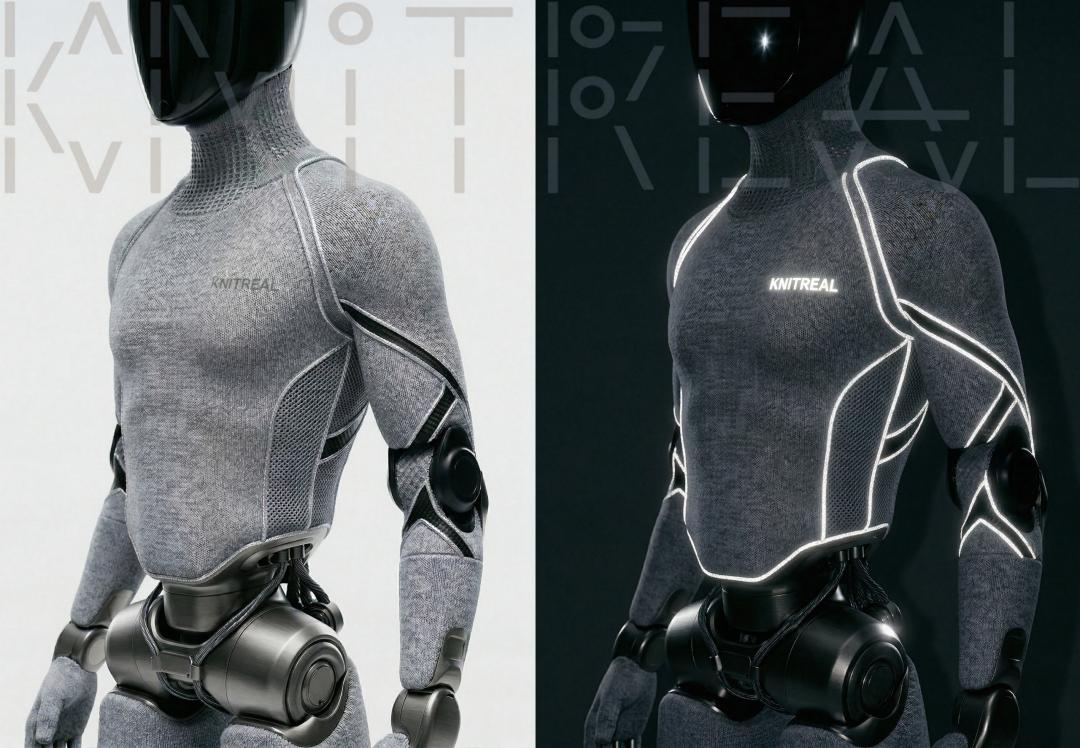
Image source: KNITREA
This judgment is in line with the view of KNITREA, a company founded by a knitting designer that has collaborated with multiple robot companies in the field of "Roboskin" (robot skin). In an interview with the Embodied Intelligence Research Institute, Han Qing, the founder of KNITREA, said that robot skin should involve three dimensions: basic functions (physical properties such as heat dissipation, wear resistance, and protection), social attributes (anthropomorphic touch and visual affinity), and forward - looking technologies (integration of flexible sensing, environmental interaction, and multi - modal perception capabilities). On this basis, robot skin is not only for decoration and protection but also becomes an important carrier for robots to perceive the outside world and empathize with humans.
As for the size of this market, it is difficult to draw a conclusion at present. However, Han Qing provided a possible stage division of the market. The first stage is the market driven by the rigid demand for appearance and function, where people pay for good looks and certain functionality. The second stage is about identity identification and scene - based applications. As robots enter various scenarios, "Roboskin" in this stage is more like a symbol, used to distinguish the robot's occupation and identity. The third stage is the consumer - product stage, including but not limited to various forms such as trendy toys, co - branding, and peripherals. This stage will open up the fashion - consumption market.
KNITREA represents just a slice of the independent market. As more and more robot manufacturers start to incorporate the outer layer into their product definitions, especially those targeting household, healthcare, companionship, display, and front - desk scenarios, they will increasingly care about affinity, safety, and scene adaptation. On the other hand, there is already a market for protective parts in industrial and special - operation scenarios. In the middle, there are also the more communication - and visual - oriented demands from rental, performance, exhibition, and brand - marketing scenarios. A more systematic cross - market spanning aesthetics, materials, machinery, and business operations is gradually emerging.
Its first barrier lies in kinematics.
Robots are not humans. Even humanoid robots cannot simply have human clothes scaled up or down and put on directly. The range of motion, movement trajectory, and rotation mode of joints such as shoulders, elbows, hips, and knees, as well as sensor openings, cable avoidance, heat - dissipation channels, and maintenance efficiency, will all affect whether an outer layer can be used in the long term. Although it looks like a piece of cloth, it is actually more like a soft structural part. Currently, sports brands have a head - start advantage in this aspect. For example, Li Ning has established a "Joint Laboratory for Humanoid Robot Sports Science" with the Beijing Humanoid Robot Innovation Center, and Anta has established a "Joint Research Base for Humanoid Robot Sports Science" with Unitree Robotics and the Nanjing Technology Innovation Institute of the Hong Kong Polytechnic University, integrating sports science into robot clothing.
The second barrier lies in materials.
In scenarios involving humans, what is needed is softness, approachability, quietness, and comfort, and it is best to reduce the coldness of machines. In industrial and special - operation environments, high - temperature resistance, flame retardancy, tear resistance, chemical - corrosion resistance, antibacterial properties, washability, and low dust emission are required. These two types of requirements correspond to completely different material routes and supply - chain capabilities. In the future, if tactile sensing, flexible electronics, and pressure perception are added, the technical threshold of this "clothes" will be further raised. Currently, some manufacturers that focus on robot interaction have gradually recognized the importance of "full - body sensing," and skin clothes with sensing capabilities obviously have great potential. This demand has given rise to companies like Juqiao Industry, which focuses on flexible sensors, and various established "new materials" companies such as Lushan New Materials, Fulai New Materials, Tian'an New Materials, and Jinghua New Materials are accelerating their layout in the field of flexible electronic skin and tactile sensing technology.
The third barrier lies in scale and standardization.
Many related businesses today still have a strong project - based nature, similar to studio services. However, if humanoid robots really move towards large - scale production in the future, this line will eventually shift from "customized appearance for individual projects" to a "market for standard parts, modular parts, and upgrade parts." By then, what really matters is not just those who are good at making beautiful clothes, but the teams that are the first to establish flexible manufacturing links and have the capabilities of template - based pattern making, rapid adaptation, modular installation, batch consistency, and post - maintenance. Therefore, the opportunities for OEM/ODM manufacturers in the future are obvious. Currently, leading intelligent manufacturing manufacturers such as Lingyi Manufacturing have started to pre - layout the so - called "Softgoods" modules.
In a conversation with the staff of Lingyi Manufacturing, the Embodied Intelligence Research Institute learned that the "Softgoods" modules they emphasize are a kind of "flexible exoskeleton skin + human - robot interaction interface" for robots. Currently, leading humanoid robot customers have gradually changed their attitude towards soft textile skins from optional appearance parts to standard functional parts. They also agree that the technical difficulties of "soft textile skins" mainly focus on the following four points: difficult motion adaptation, difficult balance between touch and appearance, difficult precision and consistency, and challenges in reliability and lifespan.
The first two points are consistent with the first and second barriers we mentioned. The latter two point to scale and standardization, which are also the unique barriers of Lingyi Manufacturing. Relying on decades of experience in soft packaging for consumer electronics, the advantage of collaborative design of "skin - structure - whole machine," and large - scale manufacturing experience, it can quickly achieve stable delivery of large - scale and consistent skin structural parts.
03 The Robot Wears a Social Shell
Every new machine will eventually face the same question: in what form will it enter the human world?
Mobile phones initially competed in terms of chips, systems, and industrial design. Later, mobile phone cases, screen protectors, accessories, and aesthetic ecosystems emerged. Cars were originally mechanical products, and later car wraps, color - changing films, ambient lights, interior parts, and a whole set of consumer culture centered around "car life" developed. Trendy toys were initially just standardized products, but once co - branding, dressing up, and secondary creation were allowed, they evolved from toys to cultural interfaces.
Robots are now on a similar path.
It starts as a technological product, then becomes a commodity, and in the future, it is likely to become a new species with labor, consumption, and media attributes. By then, what people will discuss about it will not only be "what it can do" but also "what it should look like," "what role it should play," and "how it can be accepted in different scenarios."
So, the matter of clothes becomes interesting.
Because although it seems light, it actually has a lot of weight behind it. It is related to people's psychology and the robot's structure; it is connected to safety engineering and brand expression; it is linked to performance rental and advertising business, as well as future tactile perception and functional outer layers. It is both an aesthetic issue and an industrial problem; it is both a peripheral detail and may be the first sign of a new track.
Therefore, what a robot wears is, on the surface, a piece of clothing, but in essence, it is a social shell.
When a machine starts to need to be presentable, have a role, and have a more suitable face to enter real life, it means that it is no longer just a technological prototype in the laboratory or a visual spectacle on the stage. It is starting to claim a place in society.
The maturity of many industries often does not start from the complete solution of the