Shenzhen Capital Group Bets on the Global Leading Plant Fiber Leather Brand, Super Leather PEELSPHERE® Completes Nearly Hundred-Million-Level Financing | Exclusive Report by 36Kr
36Kr learned that Shenzhen Pufei Biology (hereinafter referred to as PEELSPHERE®), a company specializing in plant fiber leather fabrics, has completed a new round of financing. It was exclusively strategically invested by Shenzhen Capital Group Co., Ltd. (SCGC), a leading venture capital institution. The funds from this round will be mainly used for new product R & D and team expansion.
PEELSPHERE® is a company focusing on plant fiber leather fabrics. The scenario it targets is clear and pure: Against the backdrop of consumer brands' higher requirements for material performance, design expression, health, environmental protection, and comprehensive empowerment, how to use green technology to transform agricultural waste such as coffee grounds, orange peels, and apple peels into new fabrics with leather performance, texture, design expressiveness, and large - scale manufacturing potential, and provide brands with more diverse and product - powerful sustainable overall solutions.
Its technical approach is an advanced achievement that balances technological performance and industrial implementation. The company uses its self - developed "Deep Eutectic Solvent Technology System Platform" to precisely extract cellulose from plant waste, and then forms materials with high - quality fabric textures through innovative recombination and compounding processes. This approach does not simply copy the appearance of traditional leather. Instead, it takes plant fibers as the structural basis and reorganizes the touch, surface, strength, and processing adaptability of the materials to form a sustainable, designable, and scalable plant fiber material platform.
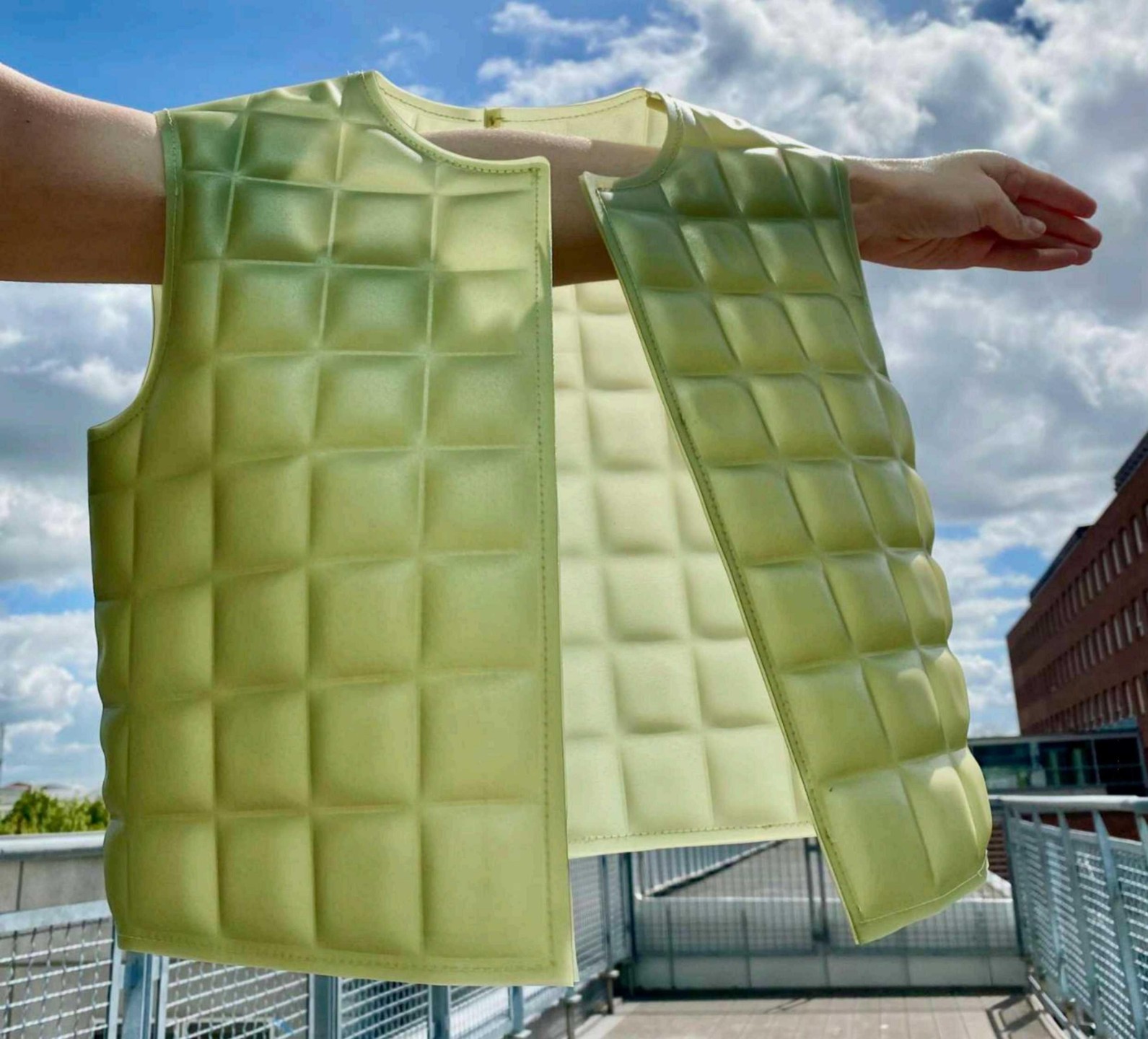
Jacket co - developed by PEELSPHERE® and a leading luxury brand
In the market landscape where genuine leather, PU synthetic leather, functional coated fabrics, and new bio - based materials are developing together, the value of PEELSPHERE® lies in providing brands with a new material language. That is, it not only retains the high - quality and differentiated product power required by consumer brands but also meets the long - term needs of the supply chain for low - carbon sources, stable delivery, and raw material traceability.
In the past few years, new sustainable fabrics have been one of the most concerned sustainable tracks in the global consumer investment market.
Materials are becoming an increasingly important part of consumer brands. It is not just a covering layer on the product surface but also related to brand expression, differentiated product power, and supply chain responsibility. Genuine leather, PU synthetic leather, and functional textile fabrics all have mature markets, but brands are also looking for new material solutions that can provide new material languages, brand narratives, and meet consumers' new pain points: They should have both texture and performance, be able to supply stably, conform to the direction of being more healthy and environmentally friendly, and preferably provide unique differentiation for their own products.
In 2021, the global new sustainable materials and plant - based leather materials track entered a peak financing period. According to the statistics of the Material Innovation Initiative, the total financing of relevant start - up companies that year exceeded $1.1 billion. Also during this period, mycelium leather, recycled fiber materials, and other bio - based composite materials gradually came into the view of brands. PEELSPHERE® chose the plant fiber composite route, hoping to promote sustainable materials into large - scale applications in a way closer to the existing industrial system. The company aims to solve the problem of providing brands with a new material solution that can be used for a long time, delivered stably, and whose value can be perceived by consumers, rather than replacing anyone.

Polar cold - resistant leather co - developed by PEELSPHERE® and a Nordic brand
PEELSPHERE® was also founded during this period. The founder, Song Youyang, established PEELSPHERE during her study in Berlin, Germany. In 2020, with the support of the Berlin government, she assembled a top - notch interdisciplinary team composed of designers and material scientists. In the same year, she continuously won a series of top - level technology and art awards from the EU, Germany, the University of Oxford, and the Kering Group.
In Song Youyang's view, the importance of these awards is not just industry exposure but means that the company's material system has passed the comprehensive evaluation from the design, technology, and business levels. "It actually represents a deep - seated industry recognition," she told 36Kr. "It includes whether the technology really exists, whether the materials can be scaled up, and whether the products have real commercial value."
With the change of the consumption environment and the strengthening of the supervision of "greenwashing" in the fashion industry by European and American regulatory agencies, after 2022, the financing enthusiasm in the new sustainable materials industry began to decline, and the financing scale was almost halved. At the same time, many star companies, including Bolt Threads and Piñatex, have successively withdrawn or even gone bankrupt, which also made the market re - examine this track. In the past few years, many sustainable material companies have emphasized the "conceptual advancement" but ignored the problems of technology scaling and cost control. Although some materials have prominent environmental protection attributes, their production efficiency is low and the cost is too high, so it is difficult for them to really enter the large - scale consumer market. This has also gradually formed a clearer consensus in the industry that the next - generation materials cannot stay only in the laboratory and samples but must be feasible in terms of performance, price, production capacity, supply stability, and aesthetic freedom at the same time.
But in Song Youyang's view, the market demand has not disappeared; it's just that the industry standards have changed.
"In the past, people would pay for the 'environmental protection concept', but now customers value more whether the materials can really be used in products and whether they can really bring positive help to products, brands, and growth." She believes that the sustainable materials industry has entered the market stage from the technology stage.
In other words, in the current environment, enterprises must have a competitive cost structure and the ability to help brand customers create additional value.
Therefore, PEELSPHERE® did not choose a material route that only serves the narrative but a plant fiber composite solution closer to industrial needs.
In fact, most of the sustainable leather enterprises with relatively rapid commercialization progress globally have adopted similar paths. For example, companies such as Desserto and NFW have entered the market through plant fiber composite materials and have completed multiple rounds of financing. Although this route is not as "ideal" as laboratory technology, it is considered one of the solutions closest to large - scale production and economic benefits at present.
Currently, PEELSPHERE® has launched three different material product lines, corresponding to different application scenarios. Among them, Algaeskin is made from seaweed and is mainly used in high - end customization, space decoration, and art creation; Bestwaste uses a nanofiber system and can be applied to footwear, clothing, bags, automobile interiors, and some consumer electronic products; Celtex adds plant components such as straw fibers, soybean oil, and sawdust, emphasizes functions such as wear resistance and waterproofness, and is suitable for strong - function scenarios such as smart wearables and automobiles.
This refined strategy of "splitting materials according to application scenarios" has also enabled PEELSPHERE® to gradually establish a material matrix for different brand needs.
According to Song Youyang, the product line with the largest shipment volume of the company at present is Bestwaste, accounting for about 85% of the total shipment volume. Its main raw materials come from the coffee grounds of Starbucks stores in South China and Maotai distiller's grains. The raw material acquisition channels are stable and have extremely high ecological synergy value. The company's expenditure is more concentrated on logistics and refined processing. At the same time, the company has built a cooperative factory in the Yangtze River Delta region, and the current production capacity can basically meet the development needs for the next 2 to 3 years.
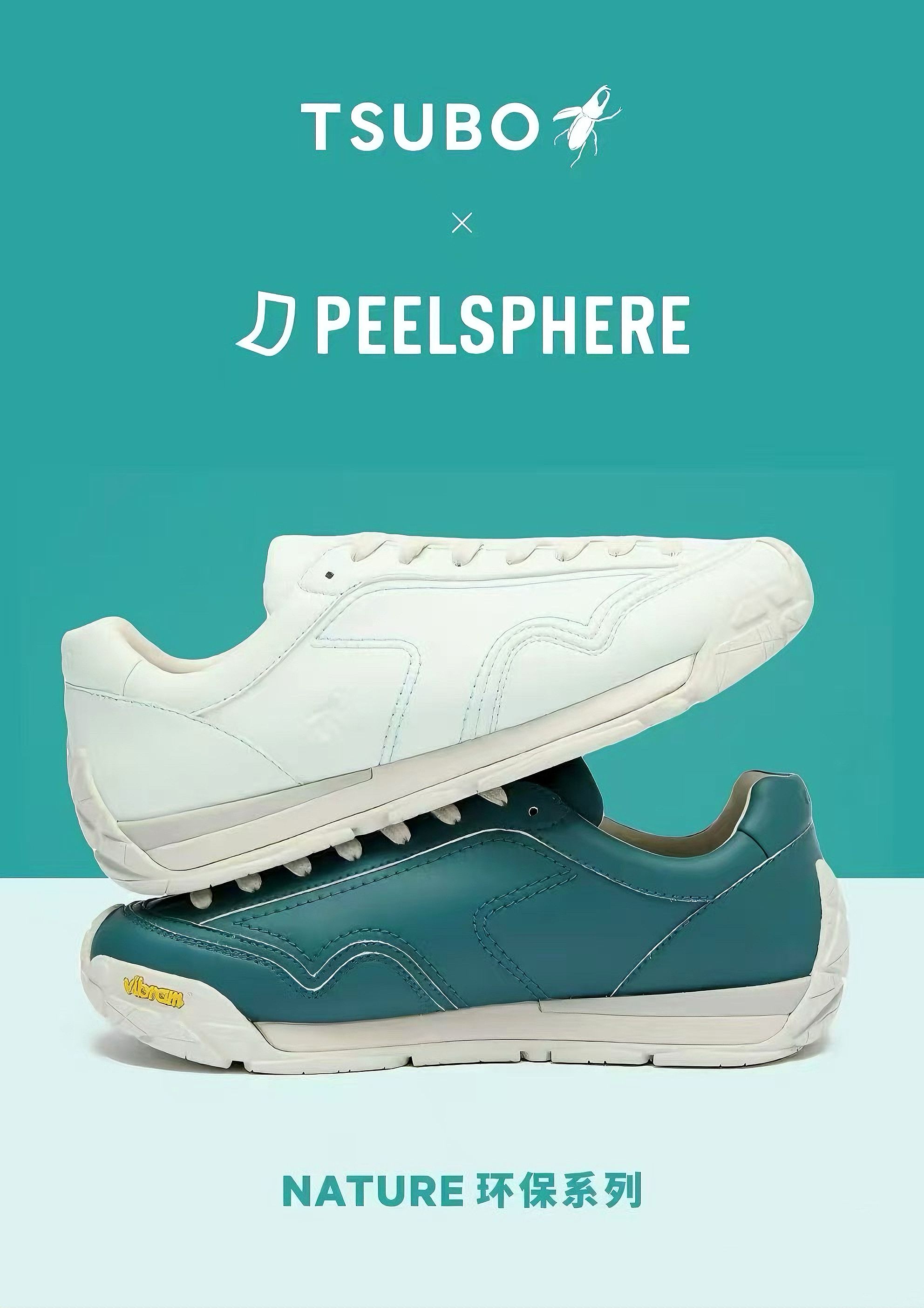
Outdoor hiking shoes co - developed by PEELSPHERE® and TSUBO
In terms of commercialization progress, PEELSPHERE® has become a global fabric supplier for more than 30 fashion groups and maintains close cooperation with many first - tier brands such as Boucheron, BALENCIAGA, Mercedes - Benz, and BMW.
In Song Youyang's view, the cooperation with big brands such as Kering is not a one - time "purchase" but a long - term relationship established after years of continuous verification. "Big brands are very cautious about new materials," she said. "From performance testing to supply chain stability and finally to the presentation of the final product, the entire verification cycle is actually very long."
To some extent, this also reflects the reality of the current sustainable materials industry: Brands are no longer paying for "novel concepts" but are more concerned about whether the materials can really enter the long - term supply chain system. In the future, PEELSPHERE will still focus on supplying large customers and expand into fields such as automobiles and consumer electronics.
"In this industry, the bio - based content, performance, and cost of materials are often considered an impossible triangle," Song Youyang finally told us. "Fabric manufacturers actually don't need to consider the full - cycle value of end - products, but we believe that sustainable materials are not just an environmental protection concept but a new material that can really bring growth to brand customers."
For many years in the international fabric market, Chinese enterprises have mainly played the role of production and manufacturing rather than technology and brand exporters. In this industry long - dominated by overseas fabric brands, PEELSPHERE® is becoming a Chinese fabric brand with global influence.