Solid-state transformers have become a new turning point for chip manufacturers.
For a long time in the past, transformers have always been the most stable and traditional type of equipment in the entire power system. Whether in large substations on the outskirts of cities or between industrial parks and energy facilities, those traditional transformers that rely on iron cores, copper windings, and operate at power frequency have undertaken the core tasks of voltage conversion and power transmission for decades. They are bulky, have extremely long lifespans, and high reliability, and at the same time, there have been almost no fundamental changes.
Today, the entire power infrastructure is entering a new evolution cycle. The large-scale popularization of new energy vehicles continues to increase the load density of the power grid. Photovoltaic, wind power, and energy storage systems have begun to be connected to the power grid in a distributed manner. The rapid expansion of AI data centers is pushing the power demand of a single station to the gigawatt level. For the power grid, the change is not just an increase in power demand, but also changes in the power supply structure, energy flow mode, and power management logic.
A technology that has been studied for decades and has long remained in the laboratory and verification stage has also re-entered the core of the industry.
This is the Solid-State Transformer (SST).
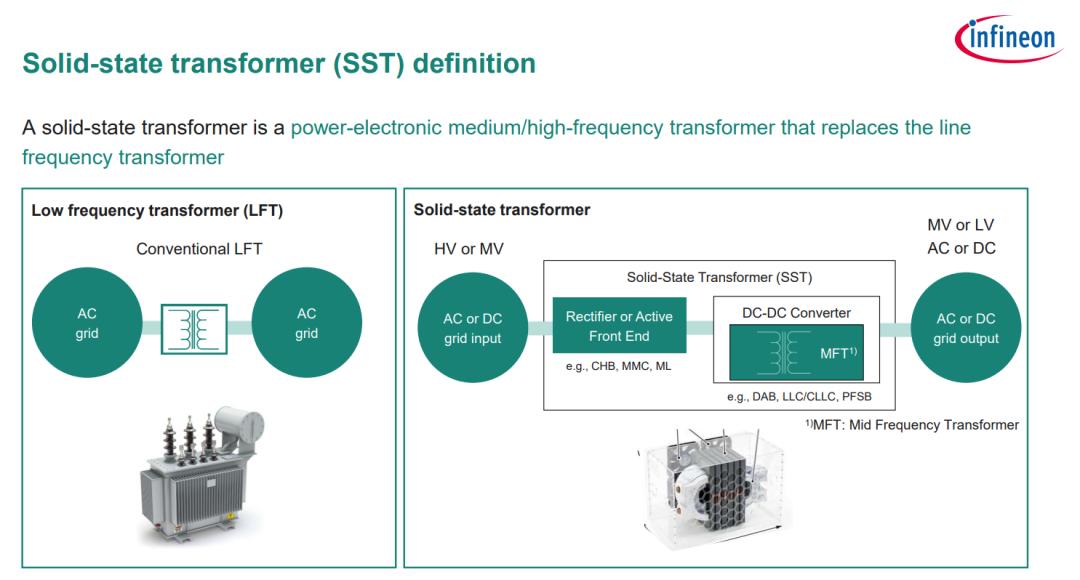
Valerio Zurello, the global application leader in charge of solid-state transformers and UPS business at Infineon, mentioned that SST is not a new concept. The relevant patents for electronic transformers can be traced back to around 1970. Between the 1980s and 1990s, many universities and research institutions explored the possibility of using high-frequency power electronics to replace traditional power-frequency transformers.
In the past few decades, SST has never really entered the industrialization stage. The core reason is that power semiconductor technology has long been unable to meet the requirements of medium-voltage power grids.
EEWorld observed that not long ago, Infineon and Xi'an Weiguang Energy officially reached an in-depth cooperation to jointly open a new chapter in energy technology innovation. The two parties will rely on Infineon's leading 1200V TRENCHSTOP IGBT7 and CoolSiC MOSFET G2 silicon carbide discrete device technologies to empower Weiguang Energy to develop more compact and efficient general solid-state transformer (SST) products.
The medium-voltage power grid is the real threshold for SST
Traditional transformers work directly on the medium-voltage power grid side, and their input ends often need to face high-voltage environments of thousands or even tens of thousands of volts. If SST wants to achieve high frequency and electronization, it must rely on high-voltage power devices that can operate stably under medium-voltage conditions for a long time.
In the past, silicon-based power semiconductors were difficult to balance high voltage resistance, high frequency, high efficiency, and long-term reliability at the same time. The entire industry has long lacked the device foundation that can really support the implementation of SST.
With the gradual maturity of a new generation of wide-bandgap semiconductors represented by silicon carbide (SiC), this situation has begun to change.
What really brought SST to the industry inflection point is not the change in the concept itself, but that high-voltage power semiconductors finally have practical availability. Especially the emergence of high-voltage SiC power switches enables the system to achieve high-frequency, high-efficiency, and high-reliability power conversion in a medium-voltage environment, which is the key ability that SST has been lacking for decades.
In the SST system, devices are no longer just "switches", but have begun to become the core basic units in the entire power grid energy dispatching system.
In essence, SST is electronizing the power grid
From the perspective of the system structure, SST is essentially evolving the traditional "copper and iron" transformer system into a new energy node based on power electronics and digital control.
Traditional transformers rely on power-frequency magnetic devices to complete energy transmission, and their core is large iron cores and a large number of copper windings. SST begins to adopt a high-frequency power conversion architecture and completes energy conversion through power semiconductors, high-frequency magnetic components, and digital control systems.
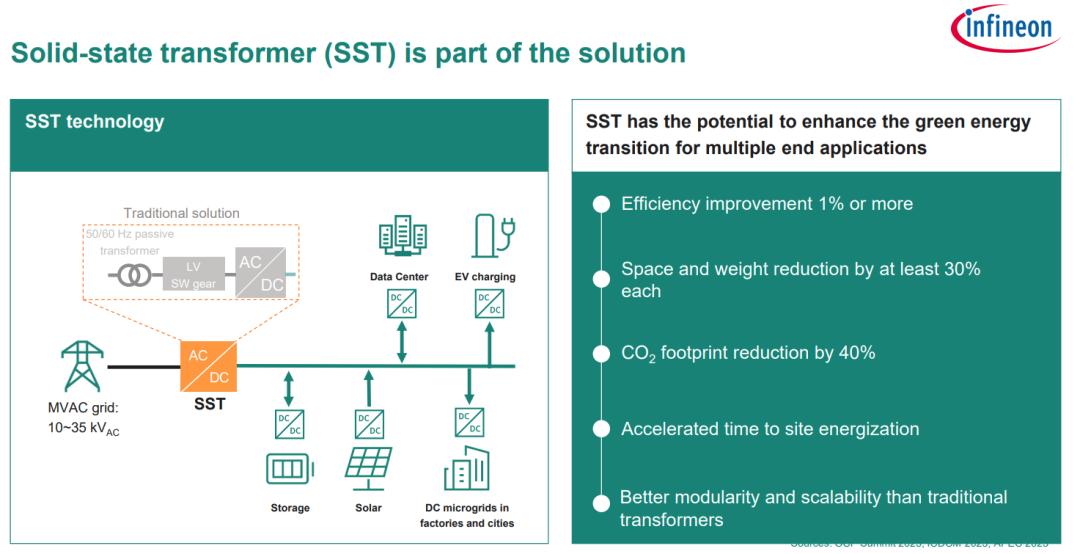
The high-frequency power conversion system has verified its efficiency advantages in multiple application fields. Even if SST only improves the efficiency by about 1% compared with the traditional system, for megawatt-level or even future gigawatt-level systems, the final result is still extremely considerable energy savings.
Especially in the scenario of AI data centers, power efficiency has begun to directly affect the overall operating cost. As the scale of AI training continues to expand, the power demand of a single station in some data centers may even reach the 1GW level in the future. For such a large power supply system, as long as the efficiency is improved by one percentage point, it corresponds to a huge optimization of power and heat dissipation costs.
The changes brought by SST do not only come from the efficiency itself, but also from the changes in system capabilities.
Traditional transformers are essentially passive devices. They can stably complete voltage conversion, but they do not have the ability to actively manage power quality and dynamically adjust. SST begins to have the ability to actively control voltage, power quality, and the direction of power flow.
One of the most important features is the bidirectional power flow.
In the future, the power grid will no longer be just a one-way power transmission system, but will gradually evolve into a dynamic energy network that can connect energy storage systems, photovoltaic systems, electric vehicles, and large data centers at the same time. SST will become an important interface between these distributed energy sources and the medium-voltage power grid.
AI data centers, electric vehicles, and energy storage are promoting the implementation of SST
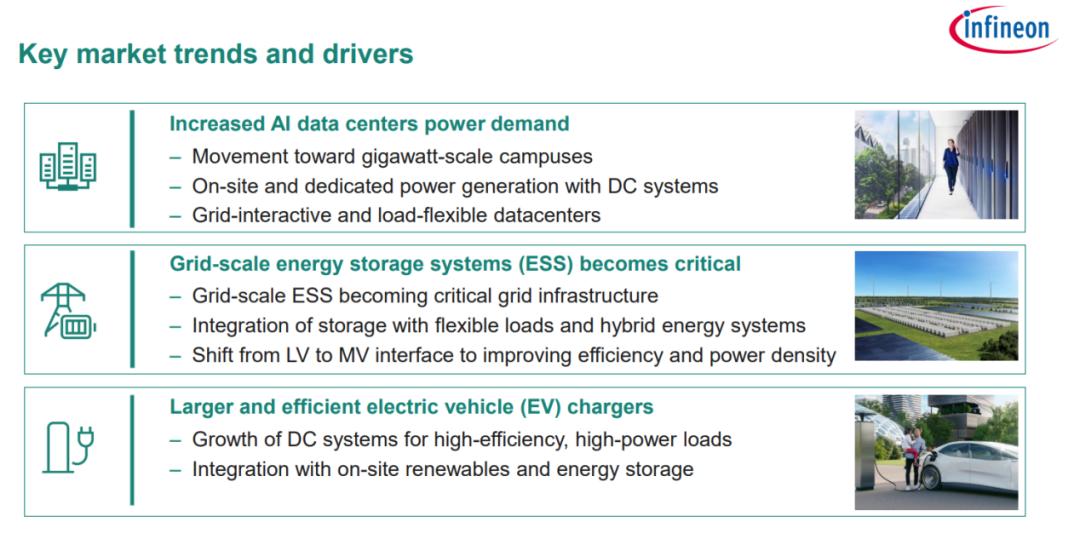
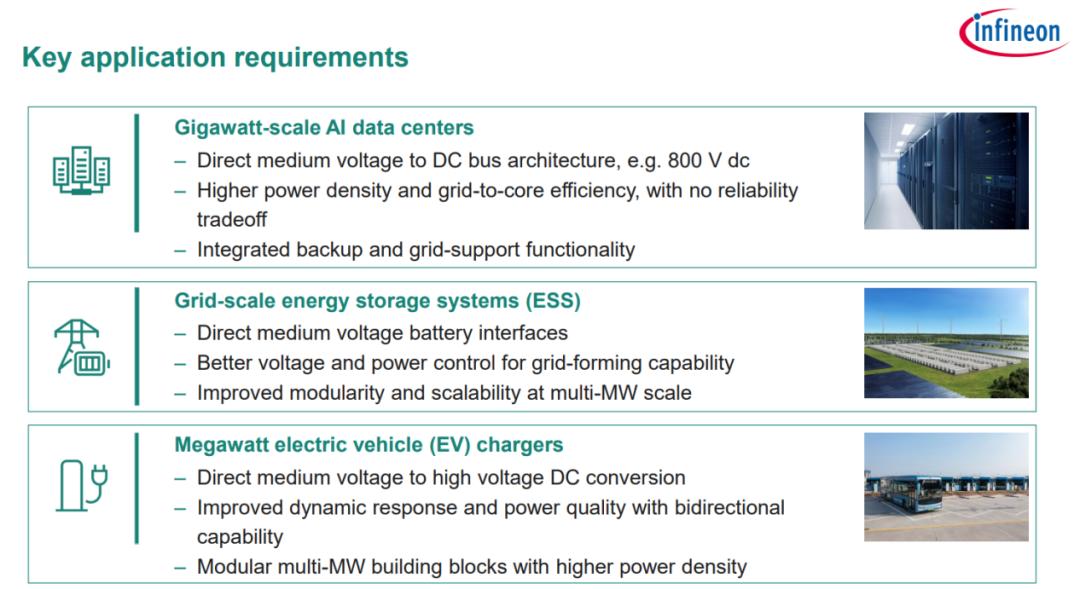
AI data centers are becoming one of the most concerned new application directions for SST.
In the past, data centers were essentially still traditional IT facilities, and their power supply systems were mainly built based on AC architectures. As the scale of AI computing power continues to expand, the entire industry has begun to re-discuss the high-voltage direct current (HVDC) power supply path, because in ultra-large-scale power systems, reducing the level of energy conversion itself means higher efficiency and lower losses.
SST can become an important bridge between the medium-voltage power grid and future DC data centers.
Infineon has previously cooperated with SolarEdge to jointly explore the DC power supply architecture for AI data centers, and SST is an important part of it.
In addition to AI data centers, the ultra-fast charging system for new energy vehicles and the energy storage grid-connected system are also becoming the earliest implementation directions for SST. Whether it is ultra-high-power fast charging or large-scale energy storage access, in essence, they are promoting the power grid to gradually move from a traditional static structure to a dynamically adjustable power network.
SST is no longer just responsible for voltage conversion, but also undertakes the role of dynamic dispatching in the entire energy network.
SiC is changing the entire system structure
Among all the core technologies supporting SST, silicon carbide is undoubtedly one of the most critical underlying devices.
SST operates in a medium-voltage environment and needs to face the requirements of high voltage, high frequency, and high efficiency at the same time, and SiC can achieve these capabilities on the same device.
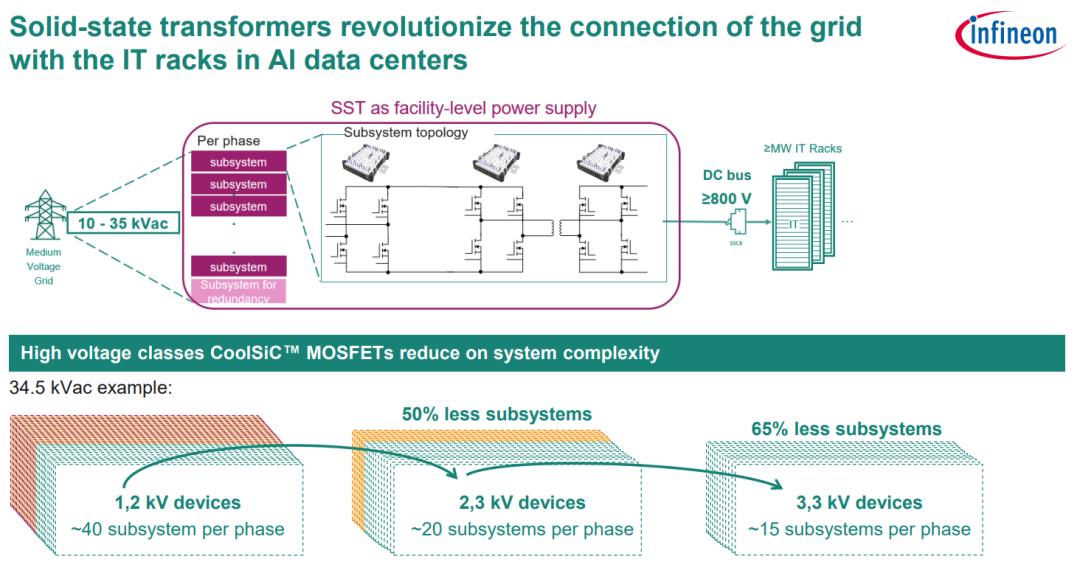
Valerio mentioned that the emergence of 3.3kV SiC devices is significantly changing the entire system architecture. In the past, many high-voltage systems often needed multiple devices in series to meet the voltage resistance requirements, while SiC devices with higher voltage levels can directly reduce the number of series connections, thereby reducing system complexity.
This change not only brings a reduction in the number of devices, but also means that the drive circuit, control system, and protection design can be simplified synchronously.
For a complex power electronics system like SST, the reduction of system-level complexity is very crucial.
High frequency also brings a reduction in size.
Traditional medium-voltage transformers rely heavily on iron cores and copper windings, so they are usually bulky, while high-frequency power conversion systems can significantly reduce the size of magnetic devices.
Compared with traditional solutions, SST will show a very obvious reduction in volume and space occupation. This change means higher power density, lower material consumption, and lower carbon emissions.
From the perspective of industrial logic, SST is not just an upgrade of transformers, but more like a reconstruction of the basic architecture of the future energy system.
Reliability is still the biggest challenge for the entire industry
The entire industry is currently still in the early deployment stage of SST. The ultra-fast charging system for new energy vehicles, the energy storage grid-connected system, and AI data centers have begun to become the most active implementation scenarios.
The industry is promoting more field verifications and commercial pilots to verify the long-term stability of SST in the real power grid environment.
Reliability is still one of the most core topics in the entire industry.
One of the greatest advantages of traditional medium-voltage transformers is their extremely long lifespan. Many systems can operate stably for more than 20 to 30 years with very low maintenance requirements.
If SST wants to truly enter the mainstream power grid infrastructure, it must achieve the same level of long-term reliability.
SST is not just a power device system. It also involves high-frequency power conversion, digital control, high-frequency magnetic components, drive systems, and complex software control architectures.
How to make such a highly electronic system achieve the same level of reliability as traditional transformers in a medium-voltage environment is one of the most core engineering challenges in the entire industry at present.
Cost is also a problem that the industry must face.
In the past, many medium-voltage systems needed a large number of devices in series to meet the voltage resistance requirements, which would simultaneously increase system complexity, control complexity, and material costs. The maturity of SiC devices with higher voltage levels is helping the industry reduce the number of series connections and at the same time reduce drive and control complexity.
This is also one of the key reasons why SST is beginning to gradually have commercial feasibility.
From devices to systems, SST becomes complete
The rise of solid-state transformers is not just a breakthrough in a single power device, but the entire power electronics industry chain is gradually forming a complete supporting ability. As SST begins to enter the actual deployment stage, industrial competition is gradually shifting from the performance of single-point devices to system-level collaborative capabilities, including power devices, isolation, drive, control, communication, monitoring, and security architectures.
In addition to manufacturers like Infineon that focus on SiC power devices, another type of semiconductor company is cutting into the SST market from the perspective of system control and analog links.
Texas Instruments (TI) is one of them.
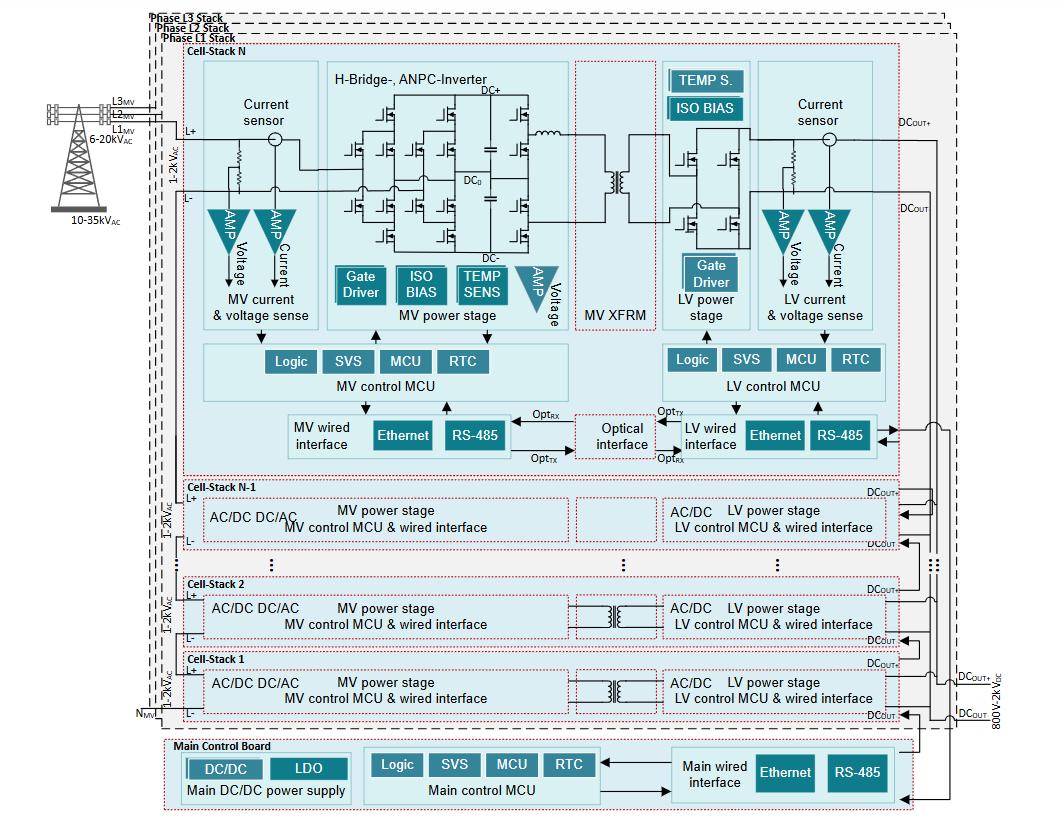
From the SST solution announced by TI, it can be seen that its entry point is not just a single power chip, but to build a complete system-level reference design and control architecture around the solid-state transformer. TI believes that the next-generation SST system needs to achieve higher power density, higher efficiency, and stronger real-time monitoring capabilities at the same time, so its solution focuses on high-precision sensing, real-time control, and modular safety design.
In the SST system, the measurement accuracy of voltage, current, and temperature will directly affect the operating state of the entire system. Many traditional power grid devices still rely on a slow state feedback mechanism, while SST, due to its high-frequency power conversion, puts forward higher requirements for real-time sensing capabilities. Especially in a medium-voltage environment, any local abnormality, thermal drift, or transient fluctuation may quickly affect the stability of the entire system.
TI emphasizes in the solution that SST needs to have the ability to accurately measure voltage, current, and temperature, and at the same time needs to achieve real-time communication, real-time status monitoring, and fault identification and processing capabilities.
The logic behind this is highly consistent with the "electronization of the power grid" direction of SST itself.
Traditional transformers are essentially more like passive energy devices, while SST is becoming more and more like an intelligent energy node with the capabilities of sensing, computing, control, and communication. In the future power grid, transformers will not only complete voltage conversion, but also need to continuously monitor the system status, dynamically optimize the power flow, identify abnormal situations, and maintain real-time communication with the entire energy network.
TI also mentioned that the SST system also needs to support a modular fail-safe power supply architecture.
This is especially important for medium-voltage power electronics systems. As SST begins to use a large number of high-frequency power devices and digital control systems, the natural reliability achieved by traditional mechanical structures is gradually shifting to electronic redundancy and software control reliability. The system not only needs to have fault detection capabilities, but also needs to maintain the overall operation ability when some modules fail.
This design idea is also highly similar to the development direction of the power supply architecture of current AI data centers.
The entire industry is gradually evolving power infrastructure from a "fixed hardware system" to an electronic system that can be monitored, managed, and dynamically dispatched.
SST is turning the entire power grid into a digital system
At the end of the interview, Valerio used a very interesting metaphor.
He believes that SST is very similar to the process of the information industry moving from analog to digital in the past. In the past, information could only be passively transmitted and stored, but after digitalization, information began to be able to be processed in real-time, dynamically managed, and intelligently optimized.
Today, a similar change is happening in the power system.
In the past, the power grid was essentially more like a large-scale analog energy network; in the future, the power grid will gradually evolve into a digital energy system that can sense, control, and dispatch in real-time.
What SST promotes is not just an upgrade of the power supply architecture, but the beginning of the electronization and digitalization of the entire energy infrastructure.
This article is from the We