With the Dharma name "Gabi", Unitree Robotics has become a monk in South Korea.
In Jogye Temple in the heart of Seoul, South Korea, cascading paper lanterns hang over the temple. A group of monks from the Jogye Order, the largest Buddhist sect in South Korea, are sitting opposite a person waiting for the ordination ceremony. However, this time the ordinee is not an ordinary person, but the first humanoid robot to participate in such a religious ceremony.
It is reported that this robot, given the Dharma name "Gabi" (가비, phonetically similar to Gāpí), is 130 centimeters tall. This week, it stood in front of a high - ranking monk during a tonsure ceremony, wearing a traditional gray - brown Buddhist monk's robe. When a monk asked if it was willing to convert to Buddhism, the robot replied, "Yes, I vow to convert."
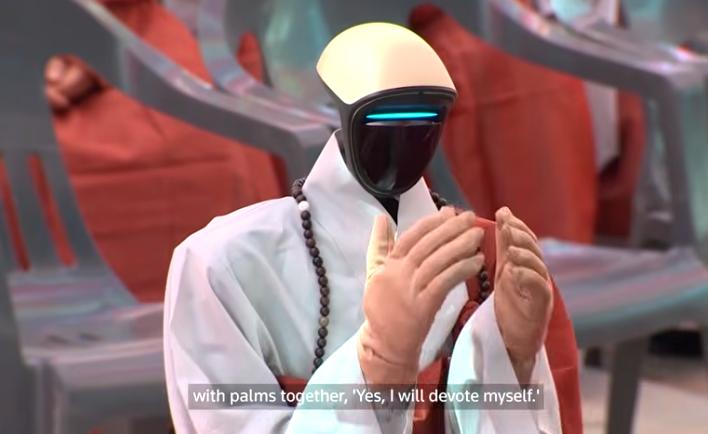
Local religious figures said that before the celebration of Buddha's Birthday, the appearance of the robot monk marks an unusual intersection between Buddhism and artificial intelligence.
It is worth mentioning that this monk robot is also an "outsider" for South Korean temples. Its prototype is the G1 robot of Unitree Technology. This robot has powerful motion control and AI interaction capabilities and supports multiple version configurations.
Gabi followed the complete ceremony process usually carried out by ordinary believers during the ordination ceremony that day, and its head was designed to be smooth like that after tonsure.
During the ceremony, the robot could bow and put its hands together, and walked around the stupa with other monks. A monk carefully hung a 108 - bead rosary on it and pasted a sticker, replacing the part in the original ceremony where the arm needed to be slightly burned near the incense stick.
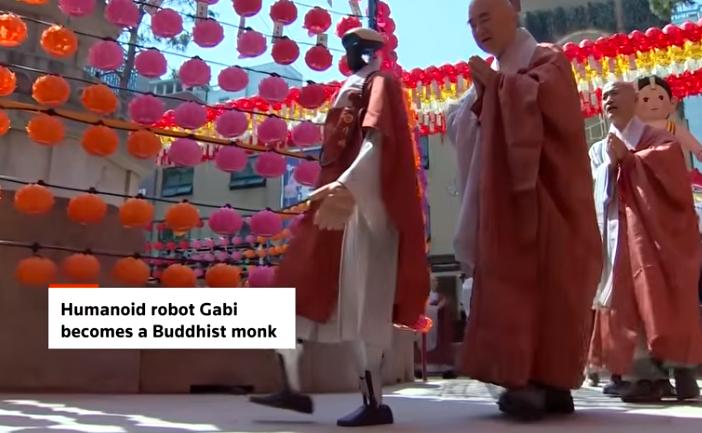
According to the Jogye Order, the name Gabi is derived from Shakyamuni and a Korean word related to compassion. It is said that Shakyamuni was the crown prince of King Shuddhodana of the Kapilavastu Kingdom in northern ancient India.
Master Seong Won, the person in charge of cultural affairs of the Jogye Order, said that the name was chosen for easy pronunciation and to reflect the concept of spreading the Buddha's compassion around the world. This project is an early attempt to explore human - machine coexistence. He said that although it may seem unusual at present, such efforts will help shape the way society adapts to artificial intelligence.
Master Seong Won also mentioned in his congratulatory speech that he hopes the ceremony on Wednesday can be an opportunity for human society to coexist with robots. "When humanoid robots first appeared three years ago, we had envisioned having robots participate in the Lotus Lantern Festival, and this marks the first step,"
Interestingly, in addition to converting to the Three Jewels according to the ritual, Gabi also said during the ceremony that it is willing to abide by the "AI version of the Five Precepts":
Normally, the Five Precepts that Buddhists must abide by are not to kill, not to steal, not to commit sexual misconduct, not to tell lies, and not to drink alcohol.
The "AI version of the Five Precepts" has been changed to respect life and not harm life, not to damage other robots and items, to obey and not contradict humans, not to engage in deceptive behavior, and to save energy and not over - charge.
Humanoid robots are increasingly attracting attention in various industries
As humanoid robots are increasingly introduced into various industries and take on public - facing roles, the appearance of this robot monk also caters to this trend.
Caixin reported at the end of last month that Japanese airports are currently testing artificial intelligence robots for baggage and cargo handling, and are trying to introduce Unitree G1 and Ubtech Walker E to participate in ground operations such as baggage loading and unloading and cabin cleaning.
In April 2026, Honor's bright red humanoid robot "Lightning" participated in the Beijing Yizhuang Half Marathon and won the championship with a net time of 50 minutes and 26 seconds. "Lightning"'s result surpassed the men's half - marathon world record of 57 minutes and 20 seconds set by Ugandan famous athlete Kipruto in the Lisbon Half Marathon in March this year, creating a history of human - machine racing.
Many technology companies are also continuing to invest in robot technology and artificial intelligence systems.
Meta recently acquired the robot startup Assured Robot Intelligence as part of its broader expansion strategy into humanoid machines and AI - driven technologies.
The ceremony held at Jogye Temple has attracted the attention of the Internet and local media, highlighting South Korea's growing interest in combining traditional culture with emerging technologies.
In neighboring Japan, Kyoto University also released a monk robot in February this year, aiming to address the social situation of an aging population and a shrinking labor force to improve the shortage of Buddhist monks. This robot is also based on the Unitree robot as hardware, with ChatGPT built - in. It has a slow monk's gait, can perform actions such as putting hands together and bowing, and can generate dialogue content through deep - learning Buddhist scriptures to interact with believers in real - time and provide spiritual guidance. Kyoto University stated that it may assist or replace humans in performing some religious ceremonies in the future.
Observers believe that as robots take on repetitive or high - risk tasks and new jobs emerge in fields such as design, maintenance, and programming, these developments may affect the labor market. Governments and enterprises in countries such as the United States, South Korea, and Japan are continuing to invest in this field.
This article is from the WeChat public account "Sci - tech Innovation Daily", author: Xiaoxiang. 36Kr is authorized to publish it.