6G: Reaching from the Ground to the Sky (Part 2)
Mobile communication technologies iterate at a rhythm of one generation per decade.
The sixth - generation mobile communication technology (6G) targeting 2030 has entered a critical window period —
By 2026, the key technologies of global 6G are being verified, standards are being established, and prototype devices are being tested. All these indicate that 6G is moving towards engineering reality.
The global competition around 6G technologies, standards, and industries has fully commenced.
As the fourth installment of the "Prospects of Modern Communication and Intelligent Network Technologies" series in "Starship Knowledge Manufacturing", we invited Dr. Qian Hongsheng, a professor - level senior engineer in the communication industry, to write "Research on the Leap - forward Evolution of 6G from Conceptual Blueprint to Engineering Test".
In "Part One", we mainly discussed "Where are the boundaries of 5G; what can 6G unlock that 5G cannot?" —
The 10Gbps peak rate, 1ms latency, and ground - base - station networking mode of 5G seem inadequate when facing future scenarios such as holographic communication, remote precision control, and coverage of blind spots in oceans and deserts: mainly because it is not fast enough, not widespread enough, and not smart enough.
6G is not a simple upgrade of 5G but an all - around reconstruction. Its core goals are:
From "ground coverage" to "full - domain coverage of air, space, land, and sea": It will break through the limitations of the ground and send signals into the sky, deep into the sea, and into those corners where 5G cannot reach.
From "single communication" to "integration of communication, sensing, computing, and intelligence": It will no longer be just a simple connection but a fusion of connection and sensing — base stations can not only communicate but also "see" the environment; the network can not only transmit data but also perform intelligent computing.
The mission of 5G is "Internet of Everything". While the vision of 6G is "Intelligent Internet of Everything".
This is Part Two. We mainly focus on the following issues:
1. Scenarios that 6G will deeply reshape and current industrial challenges
2. Technical reserves and patent layout from 5G to 6G
01 Eight Scenarios and Industrialization Challenges
The extreme performance of 6G supports a batch of application scenarios covering fields such as consumption, industry, transportation, medical care, aviation, energy, and urban governance. Some have completed small - scale demonstration applications and have the foundation for large - scale implementation.
1. Low - altitude economy and autonomous drone scheduling
The integrated air - space - land - sea network provides accurate positioning and real - time scheduling for large - scale drone fleets, supports collaborative operations and beyond - visual - range flight, promotes the large - scale application of drones in fields such as logistics, inspection, rescue, and plant protection, and activates the value of the low - altitude industry.
2. Industrial digital twin and unmanned manufacturing: From "machine replacement" to "intelligent factory"
The sub - millisecond latency, centimeter - level sensing, and native AI capabilities of 6G will promote the transformation of industrial digital twin from concept to reality. Real - time data collection, remote precision control, predictive maintenance, and flexible production will become standard features.
3. Intelligent connected vehicles: The "last piece of the puzzle" for L4 - level and above autonomous driving
One of the core bottlenecks for the current difficulty in commercializing L4 - level autonomous driving is communication latency and reliability. The sub - millisecond latency, centimeter - level positioning, and vehicle - road - cloud integration capabilities of 6G will truly enable real - time interaction between vehicles, between vehicles and roads, and between vehicles and the cloud.
4. Holographic communication: The "killer - level experience" on the consumer side
The ultra - high speed, low latency, and native AI capabilities of 6G make real - time transmission of holographic 3D content possible. Cross - city holographic conferences, remote holographic teaching, and immersive entertainment become a reality, breaking the connection barriers of physical space.
5. Smart energy: The "intelligent scheduling center" for power sources, grids, loads, and storage
The volatility of wind and solar power requires the power grid to have real - time sensing and intelligent scheduling capabilities. 6G supports real - time monitoring, intelligent scheduling, and fault early warning of the energy Internet, realizes intelligent interaction among wind power, solar power, and the power grid in terms of power sources, grids, loads, and storage, improves energy utilization efficiency, and promotes the transformation of the energy system towards cleanliness, intelligence, and high efficiency.
6. Telemedicine: The "scalpel" to break barriers
The ultra - high - definition, low - latency, and highly reliable 6G network supports remote precision surgery and cross - regional medical collaboration. Top - level experts can provide real - time guidance for grass - roots surgeries, effectively narrowing the regional gap in medical resources and realizing the sharing of high - quality medical resources.
7. City - level digital twin and smart city
By comprehensively perceiving the physical entities of the city, a digital twin city that is synchronized with the physical city is constructed, realizing intelligent regulation of traffic signals, automatic early warning of security incidents, and predictive operation and maintenance of municipal facilities, and promoting the refined and intelligent upgrading of urban governance.
8. Air - space - land - sea emergency communication: The "lifeline" in extreme scenarios
In extreme scenarios such as earthquakes, floods, and typhoons, a full - domain emergency communication network can be quickly established to achieve full - coverage of disaster - stricken areas, ensure the stable transmission of command and dispatch and rescue information, greatly improve the efficiency of emergency rescue, and protect people's lives and safety.
However, for 6G to truly reach large - scale commercial use, it still needs to overcome a series of challenges such as technical difficulties, uneven maturity of the industrial chain, and security and compliance issues.
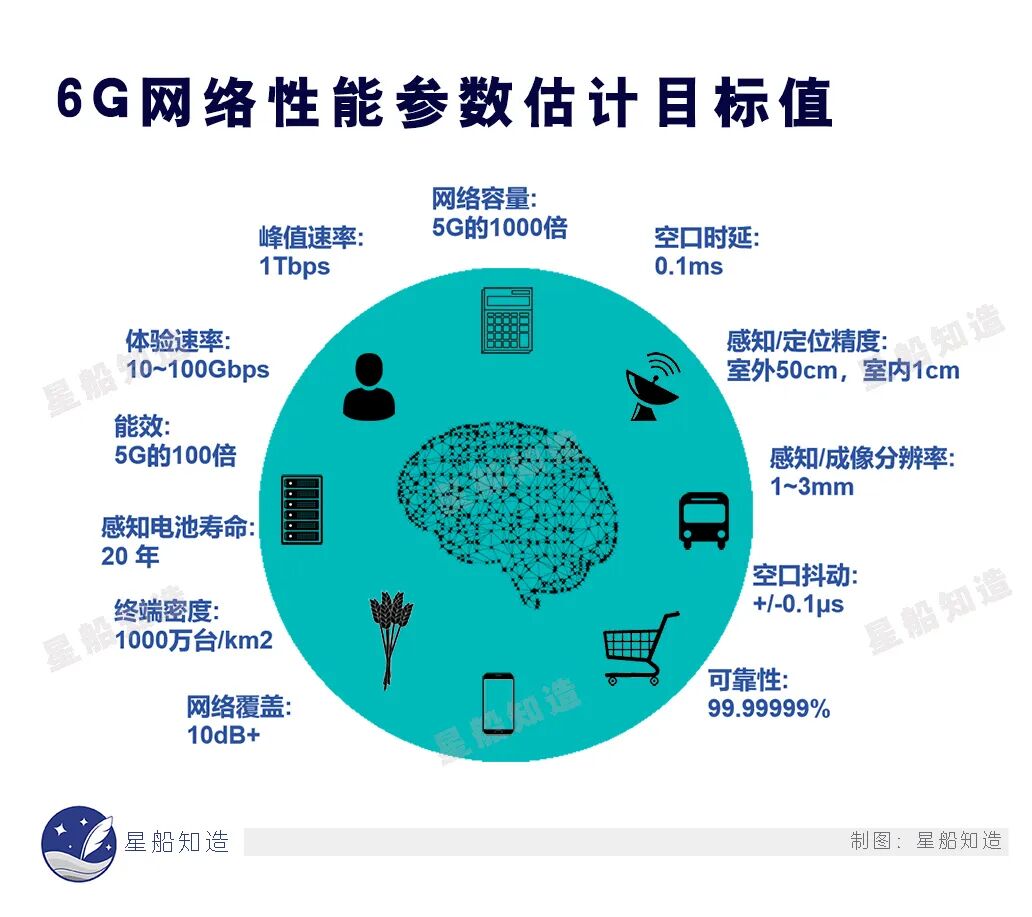
Estimated target values of 6G network performance parameters
The series of technical difficulties brought about by the extreme performance and new architecture of 6G are the primary obstacles to its commercial implementation.
Firstly, the coverage ability in high - frequency bands is weak. Terahertz and millimeter - wave signals are easily blocked, have large transmission losses, and it is difficult and costly to achieve wide - area coverage.
Secondly, the performance of core devices does not meet the standards. Terahertz chips and high - performance power amplifiers still have gaps in power, efficiency, and power consumption, which restricts engineering applications and makes it difficult to meet commercial requirements.
Thirdly, the system complexity increases exponentially. The integration of air - space - land - sea and the fusion of communication, sensing, computing, and intelligence bring high complexity to the network architecture and scheduling algorithms, and it is difficult to achieve collaborative optimization.
Fourthly, there are problems in the synchronization and interference of satellite - ground integration. High - dynamic satellite links are prone to signal interruptions and increased interference, and the precise synchronization and handover technologies still need to be broken through.
Fifthly, the energy consumption pressure is huge. 6G networks have more nodes and stronger functions. How to control energy consumption while achieving extreme performance and realize green and low - carbon communication is still a key problem.

source: giphy
From the analysis of the maturity of the industrial chain, the 6G industrial chain is divided into five layers: chip devices, network equipment, terminal modules, software platforms, and industry applications. All links develop collaboratively to jointly support the industrialization of 6G.
By 2026, network equipment has made the fastest progress. Multi - generation prototype devices such as macro - base stations, small - base stations, and core network equipment have been developed, and their performance indicators meet the test requirements. Chips and devices are gradually making breakthroughs. Core chips such as terahertz, radio frequency, and baseband have completed tape - out, and the level of domestic production continues to improve.
At the same time, terminal modules, satellite terminals, vehicle - mounted terminals, etc. are being promoted synchronously to adapt to the capabilities of the 6G network; software platforms focus on directions such as AI network management, communication - sensing - computing - intelligence scheduling, and security management and control, and the technical system is becoming increasingly perfect; industry applications have carried out demonstrations in fields such as low - altitude economy, industrial Internet, and emergency communication, with clear requirements and scenarios — overall, it shows the characteristics of "the network side is faster than the terminal side, the system side is faster than the device side, and industry applications are faster than consumer applications".
It is expected that the entire industrial chain will be basically mature in 2028, with large - scale mass production of core devices, equipment, and terminals, and a significant reduction in costs; in 2030, it will have the conditions for large - scale commercial use, and a complete industrial ecosystem and business model will be formed.
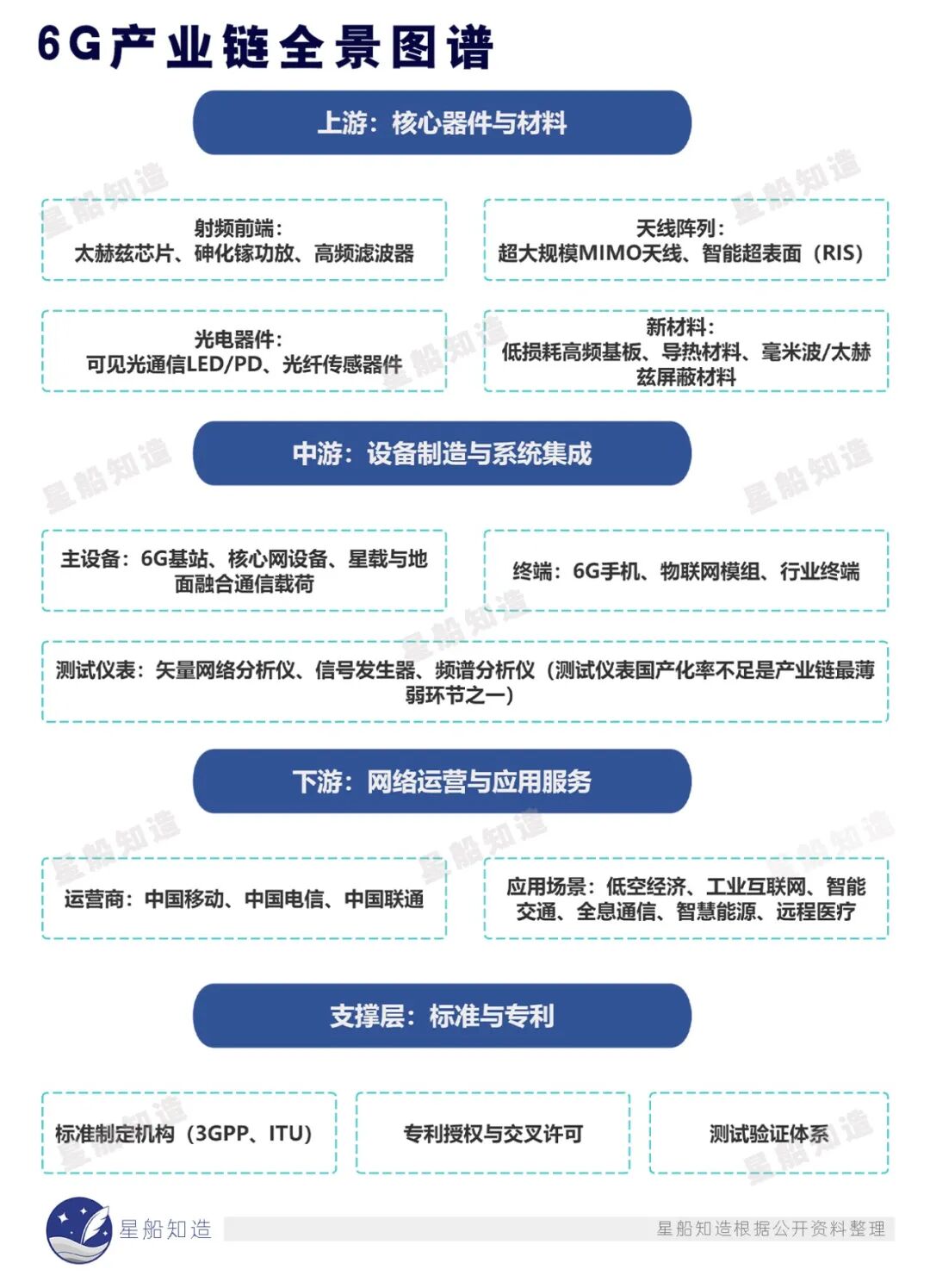
The current problems at the industrial level are mainly the uneven maturity of the industrial chain, showing the characteristics of "the network side is faster than the terminal side, the system side is faster than the device side". The underlying links such as chips and materials are relatively weak, and it still takes time for domestic substitution — for example, some high - end radio - frequency devices and precision sensors in core devices still need to be imported, and there is a gap between the chip manufacturing process and the international advanced level.
High - end test instruments (such as vector network analyzers and signal analyzers) are also a crucial but easily overlooked link in the current industrial chain👇
Test instruments can be regarded as the "ruler" and "eyes" of the entire industrial chain — if you can't measure it, you can't manufacture it; if you can't measure it accurately, you can't make it precisely. The degree of domestic production of high - end test instruments directly determines the depth of independent control of the 6G industry.
In the context of 6G moving towards the terahertz frequency band and ultra - large bandwidth, extremely high requirements are put forward for the frequency, accuracy, and stability of equipment such as vector network analyzers, signal generators, and spectrum analyzers. This field has long been dominated by foreign manufacturers such as Keysight and Rohde & Schwarz, basically forming a monopoly in the high - end product lines.
Domestic manufacturers (such as Siyi Technology, Chuangyuan Xinke, Xinghe Liangdian, etc.) have made key breakthroughs and are gradually taking control of the testing capabilities. However, there is still a systematic gap between domestic manufacturers and foreign leading enterprises in terms of the performance margin, measurement accuracy, and especially the integrity of the software ecosystem of high - end product lines. This gap is also a crucial battle that the 6G industrial chain must win to achieve true independent control.

source: unsplash
Other industrial challenges also include:
The deployment cost is much higher than that of 5G — The integrated air - space - land - sea network requires a large number of base stations, satellites, and high - altitude platform stations, putting great investment pressure on operators.
The business model needs to be clarified — Scenarios such as holographic communication and the metaverse on the consumer side are still in the cultivation stage, and the industry side has not yet formed a replicable cooperation model, with a long investment return cycle.
The cross - industry ecosystem has not been formed — There are problems such as inconsistent technical standards and poor demand docking between communication enterprises and industries such as industry and transportation, making it difficult to achieve collaborative innovation.
The spectrum resource planning needs to be coordinated urgently — There is no consensus on the global high - frequency spectrum allocation, there are differences in the planning of different countries, the spectrum supply is insufficient, and it is difficult to coordinate the spectrum resources of air, space, land, and sea.
From the perspective of security and compliance challenges —
In the 6G era, the network connection range is wider, the number of terminals is larger, and with the development of AI and quantum computing technologies, new security threats are brought, and the compliance difficulty is greatly increased.
Firstly, new - type network attacks are more concealed. With the rapid development of AI technology, AI - driven phishing and DDoS attacks can avoid traditional detection, and quantum computing poses a challenge to traditional encryption algorithms, increasing the risk of data security.
Secondly, it is difficult to comply with cross - border data and satellite communication regulations. The data sovereignty, privacy protection, and cross - border transmission rules of different countries are not unified, and the coordination of satellite communication frequencies and orbital resources is complex, restricting global interconnection.
Thirdly, it is difficult to supervise a large number of terminals. The connection density of 6G reaches 10 million units per square kilometer. Many low - cost IoT terminals lack security protection and are prone to becoming breakthrough points for network attacks.
Fourthly, the global security standards are not unified. The compliance requirements of different countries in terms of network security and data protection vary greatly, increasing the R & D and operation costs of enterprises and affecting the coordinated development of the global 6G ecosystem.
source: giphy
In summary, breaking through the "bottleneck" dilemma is the primary task. Test instruments are the weak link in the current industrial chain. The high - frequency bands, large bandwidth, and new waveforms of 6G put forward new requirements for test instruments. Currently, some high - end vector network analyzers, signal analyzers, etc. still rely on imports (such as Keysight, Rohde & Schwarz, etc.).
Core chips, high - frequency devices, baseband algorithms, and material processes, these most upstream hard nuts must be cracked with concentrated efforts. National - level special research projects should be established to promote collaborative innovation among industry, academia, research, and application. Every step from the prototype in the laboratory to the yield rate on the production line needs to be independently controllable. Only in this way can we avoid being "cut off" and have our throats locked in future global competition.
Standards are the high - ground of discourse power. We will continue to deeply participate in the standard - setting of organizations such as the International Telecommunication Union (ITU) and the 3rd Generation Partnership Project (3GPP), actively submit technical proposals, and strive for a leading or co - leading position in core fields such as