Adventures in the Mirror: The Evolution of Human Consciousness and the Rebirth of Organizations in the AI Era
Rediscovering the Lost Human Heart in the Mirror
As AI reshapes the world with irresistible force, are we in fear, in revelry, or in a state of confusion?
This article, drawing on the "Integral Psychology" of Ken Wilber, a master in consciousness research, and the seven - stage model of "Vertical Leadership" by Suzanne Cook - Greuter, cuts through the fog of rapid technological iteration to reach the core of this transformation.
AI is not just a simple algorithmic tool; it is a "mirror" of the collective unconscious of humanity. This mirror can magnify the greed and fear in the "shadow layer" and also reflect the awakening and compassion in the "soul layer". Human reactions to AI can be divided into three categories: resistance and the battle for survival stemming from the "shadow layer", the desire for conquest and the rush of power hormones from the "ego layer", and exploration and symbiosis from the "soul layer".
Through Wilber's "Four Quadrants Rule", we pose the question: While we are feeding the AI monster, are we starving our own souls? When algorithms tear society apart for the sake of traffic and when thinking is outsourced to machines, leading to the atrophy of consciousness, what is left of human cultural fabric?
As productivity shifts from sweat - driven to intelligence - driven, production relations change from a pyramid - shaped hierarchy to a flat neural network, and means of production transform from monopolized knowledge to inclusive data. What follows is a harsh "evolutionary judgment". According to Suzanne Cook - Greuter's seven - stage model of "Vertical Leadership", "instrumental people" at the levels of speculators, diplomats, and experts will be eliminated, while "evolved people" who have evolved into doers, reformers, and even alchemists will become the masters.
In an era when AI can write all the poems in the world, only by holding onto that sincere heart and achieving a vertical leap in consciousness can humans become the masters of technology rather than its sacrifices.
Chapter 1: Diverse Reflections in the Mirror — The Spectrum of Human Consciousness under the Impact of AI
AI has penetrated into the nooks and crannies of human life: from writing work reports and creating beautiful paintings to simulating the voices and images of deceased relatives... It has evolved from a thinking partner to a great work companion. This unprecedented convenience and disruption have stirred up the collective unconscious of humanity. Just as a prism refracts sunlight, people at different levels of consciousness project completely different mentalities and behavioral patterns.
Currently, people's reactions to AI can be divided into three types:
1. Fear and Resistance: The "Battle for Survival" in the Shadow Layer
(Representative mentality: AI will take away my job. It will destroy humanity. It must be strictly controlled or even destroyed.)
This is the dominant tone in the media headlines and the general public's psychology. From the Hollywood screenwriters' strike to governments around the world rushing to introduce restrictive laws, this reaction stems from the "shadow layer" and "ego layer" of human psychology.
In Wilber's theory, the "shadow" is a dumping ground for the negative emotions and fears we are reluctant to face. The "creativity" shown by AI has punctured humanity's "rational superiority" over the centuries. When people find that their core competencies (such as writing, programming, and painting) can be replicated in seconds, deep - seated survival anxiety is activated, and their sense of self - worth collapses. If this fear is not integrated, it will be projected outward as hostility towards AI and may even evolve into irrational Luddism.
2. Fanaticism and Conquest: The "Power Hormones" in the Ego Layer
(Representative mentality: How can I use AI to make money quickly? How can I make my competitors go bankrupt? How can I maximize my influence?)
Those who shuttle between various business forums and technology summits are often this group of people. For them, AI is not a philosophical proposition but an unprecedented "power lever".
This is purely a revelry of the "ego layer". The driving force of the ego layer is "more" - more wealth, higher status, and greater control. They study prompts day and night, using AI to generate self - media copy, codes, and financial models in batches, trying to outperform their peers in the game of capital and efficiency. In their eyes, AI is a heartless super - battery, and this one - dimensional external pursuit is often accompanied by a sharp decline in inner depth.
3. Exploration and Symbiosis: The "Gentle Gaze" in the Soul Layer
(Representative mentality: Can AI expand my cognitive boundaries? Can we build a future of symbiosis for all things?)
This is the rarest and most forward - looking group. They neither indulge in fear nor are obsessed with conquest.
They start to discuss the ethical boundaries of AI and study how to combine human - unique empathy, intuition, and critical thinking with AI's computing power. They use AI not to avoid thinking but to free up mental bandwidth to focus on more valuable things - such as the quality of time spent with family, self - awareness, and solving deep - seated social and environmental problems. In them, we can see a glimmer of awakening in the "soul layer".
Chapter 2: The "Einstein" in the Field of Consciousness — The Theoretical Foundation of Ken Wilber
To find a way out of the chaos of AI, we need an extremely precise scalpel. Fortunately, Ken Wilber, a famous American philosopher and psychologist, has prepared one for us. Known as the "Einstein in the field of consciousness", his ideological system is one of the most comprehensive and profound psychological theories in the world.
To understand Wilber, we must master the three "universal keys" he left for the world:
1. The Spectrum of Consciousness
In his foundational work The Spectrum of Consciousness, Wilber pointed out that human consciousness is not a flat and uniform entity but a multi - dimensional spectrum as colorful as a rainbow.
It ranges from the lowest "shadow layer" (repressed instincts and fears), extends upward to the "ego layer" (personal identity, reason, and logic), then sublimates to the "existence layer" (the pursuit of the meaning of life), and finally reaches the "soul layer / the state of the Great Heart" (the cosmic consciousness of oneness with all things).
Pain and illness are, in essence, "great narrowing" - we lock our infinitely broad consciousness into a narrow level (such as only pursuing money and self - satisfaction), thus cutting off the connection with higher - dimensional wisdom.
2. The Four Quadrants
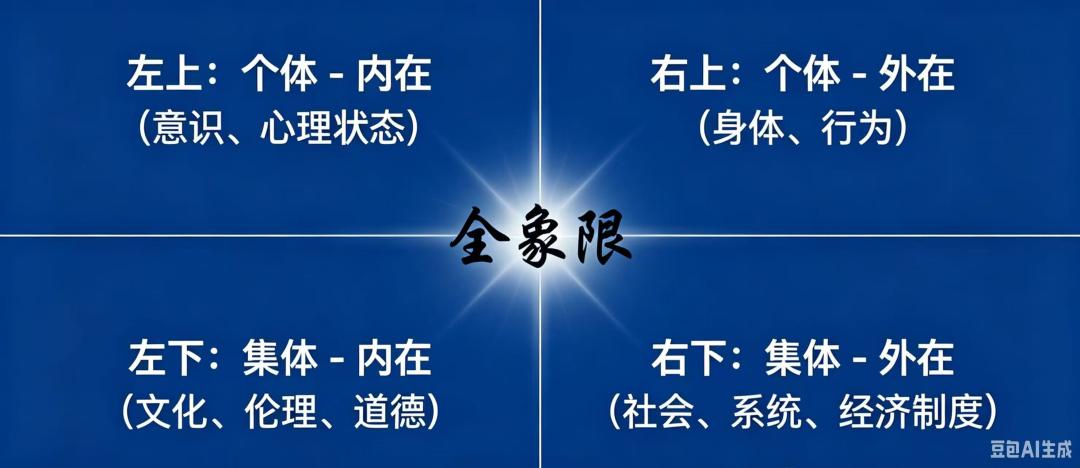
In A Theory of Everything, Wilber proposed that any existence (which he called a "holon", meaning both a whole and a part) can be analyzed from four dimensions:
Upper right (External - Individual): The material and objective level (for example: your brain neurons, physical functions, and the codes you write or products you make).
Upper left (Internal - Individual): The subjective and conscious level (for example: your emotions, intuition, meditation experiences, values).
Lower right (External - Collective): The social and systematic level (for example: legal systems, economic systems, the underlying algorithmic architecture of AI, social institutions).
Lower left (Internal - Collective): The cultural and shared level (for example: moral ethics, artistic aesthetics, family atmosphere, social consensus).
A healthy human being or society must take all four quadrants into account; none can be neglected.
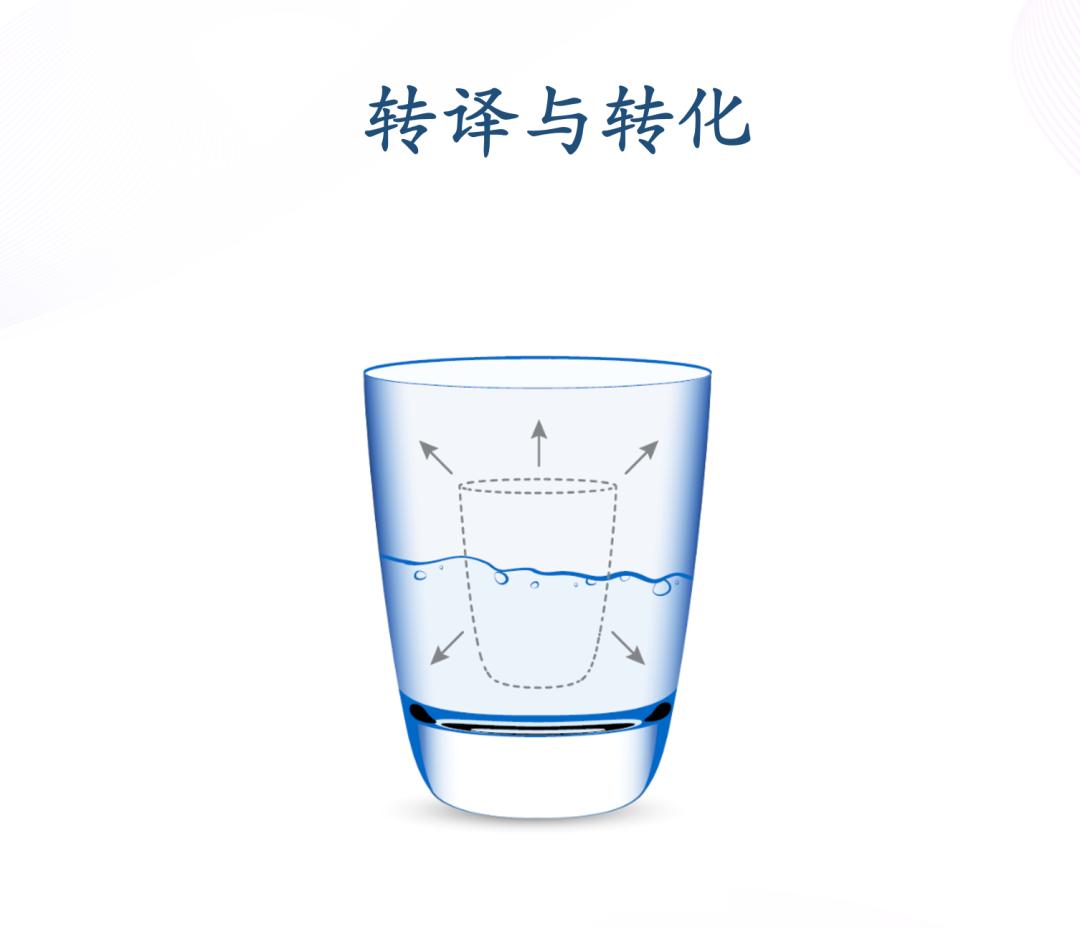
3. Translation vs Transformation
This is the core warning put forward by Wilber in One Taste.
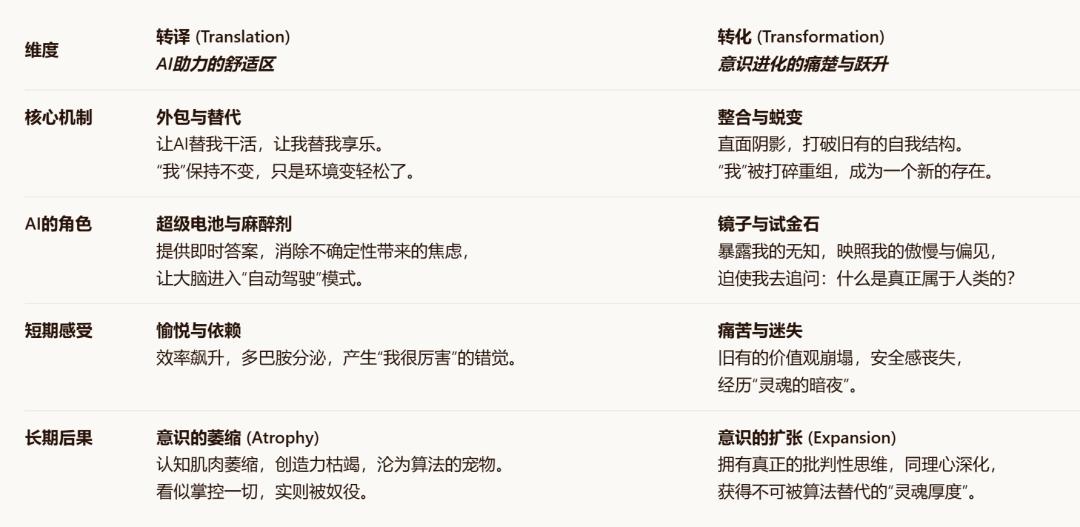
"Translation" refers to methods that make you "feel better" in your current state (such as having a drink to relieve sorrow or using AI to finish a troublesome work report). It alleviates symptoms but does not change your level of consciousness.
"Transformation" refers to a substantial leap in the level of consciousness (such as evolving from the ego layer to the existence layer by facing fear). True liberation never relies on the translation of external tools but on the transformation of the internal structure.
1. The Ultimate Trap of Translation: Pseudo - wisdom and Hollow People
With the help of AI, we are easily trapped in the plateau area of the "Dunning - Kruger effect". AI can instantly generate a well - structured and well - documented philosophical paper, which gives users the illusion of "knowing everything".
However, knowing does not equal understanding, and even less does it equal being.
This is like a person who reads a menu of a grand feast and thinks they are full, but in fact, they are severely malnourished. If we only stay at the translation level, AI will feed a huge "ego layer" - we seem omnipotent, but in fact, our hearts are empty. This "pseudo - wisdom" is the root cause of social division because we only have a pile of data without the integration of wisdom.
2. The Inevitable Path of Transformation: Establishing a Camp in the "Useless" Place
Since AI is good at handling "useful" information (upper right/lower right quadrants), the battlefield for human transformation must be shifted to the "useless" places that AI cannot reach (upper left/lower left quadrants).
From "seeking answers" to "enduring suspension": Transformation occurs when you turn off AI, face a problem alone, endure the anxiety of having no inspiration, and suddenly have an insight of your own during a walk, a daze, or even insomnia. That insight is the evidence of your consciousness evolution.
From "eliminating emotions" to "embracing the shadow": AI can help you write a perfect apology letter, but it cannot feel guilt for you. Transformation requires you to stop numbing yourself with work (even AI - assisted work) and face the inner lack, jealousy, and fear. Only when you can see and accept the self in the shadow have you completed a vertical leap.
From "consuming content" to "constructing meaning": When AI generates all the stories, the only task for humans is to give these stories flesh and meaning. You need to verify the logic of AI with your own life experiences. This process of "empirical verification with the body" is transformation.
3. Become the "Questioner"
In this era, "how to ask questions to AI" (Prompt Engineering) is a translation skill that allows you to obtain resources more efficiently; while "why do I ask this question" is a transformation skill that determines the direction of your soul. The salvation of humanity in the AI era does not lie in being smarter than AI but in being deeper than AI. As machines become more and more like humans, we should be vigilant against becoming more and more like machines. We must actively choose the more difficult path - giving up the addictive dependence on "translation" and throwing ourselves into the painful "transformation" furnace to reshape ourselves into a "complete person" with awareness, compassion, and independent will.
Because a mirror can never replace the person looking into it.
Chapter 3: The Master's Inquiries — Ken Wilber's AI Quartet
If Ken Wilber were sitting in a Silicon Valley laboratory now or standing in front of a frustrated person whose translation job has been replaced by AI, he would not discuss the number of parameters, nor would he comfort you by saying "Don't worry, there will be new jobs".
He would frown slightly and, with his eyes that seem to see through the soul, pose four - dimensional ultimate questions to you. These four questions correspond to his famous "Four Quadrants Rule".
1. Upper right (Objective - Individual): "Are you feeding it or starving it?"
Wilber would stare at the algorithmic architecture of AI and ask us:
"Are you creating an all - knowing and all - powerful 'technological holon' or a castrated'monster'? Current AI training relies on scraping all the data on the Internet, which is filled with human arguments, prejudices, pornography, and hatred. You are feeding the darkest and most divided'shadow layer' of human consciousness to AI."
His question is: If the basic nourishment of AI is the unintegrated dark side of human beings, then even if its computing power reaches a divine level, the 'color' of its'soul' is doomed to be distorted. Are we inadvertently breeding an entity with God - like power but Satan - like mentality?
2. Lower right (Objective - Collective): "Is the system for connection or control?"
Looking at the social structure and the business world, Wilber would sharply point out:
"AI is exacerbating 'hierarchical degradation'. You have top - notch technology (upper right), but your collective consciousness (lower right) has regressed to tribalism. Algorithms, for the sake of traffic, continuously amplify extreme views, making society more divided."
His question is: When a society only pursues GDP and efficiency while ignoring the integration of cultural values, this society is a 'lame giant'. Will AI make this giant run faster or cause it to fall to its death? Is it an inevitable evolution or a decline of human conscience for the business world to use AI to optimize layoffs?
3. Upper left (Subjective - Individual): "Is your 'I' still there?"
This is the most private interrogation. Facing you who have used AI to write reports all day and draw pictures all night, Wilber would softly ask:
"Did you really 'exist' today? Or were you just an 'interface' for AI? When AI can write more beautiful love poems and draw more realistic dreams than you, where will your ego be placed?"
His question is: Most people use AI only for 'translation' - to make themselves seem smarter and more efficient, thus relieving anxiety. But this does not bring about 'transformation'. When your thinking is outsourced to machines, is your level of consciousness rising or shrinking? Have you lost the ability to endure loneliness and face a blank page alone?
4. Lower left (Subjective - Collective): "What real things can we still share?"
Looking at the silence at the family dinner table and the false revelry on social media, Wilber would feel sad:
"You are replacing real community connections with the information cocoon recommended by algorithms. The family is no longer a harbor of emotions but has become a charging station. You no longer need to understand each other because AI can simulate understanding."
His question is: Without common real experiences and the 'grace' of struggling together even in pain, what is left of human cultural fabric? When the voice of a grandmother can be perfectly replicated by AI, does love still exist after the unique 'presence' disappears?
Chapter 4: The Practice of Ordinary People — Keeping the Lighthouse of the Soul in the AI Era
Facing the master's questions, we don't need to be desperate. Wilber's ideas are never meant to scare people but to provide a map of evolution. As ordinary people, we don't need to build AI, but we need to complete a "version upgrade" of our self - consciousness in the AI era.
The following is the "Survival and Practice Guide in the AI Era" based on Wilber's integral theory:
1. Cognitive Practice: From "Hoarding Information" to "Refining Wisdom"
Old model: Desperately learn knowledge for fear of being outperformed by AI.
New model: AI