An excellent product manager must have a side business.
Recently, I've been leading a team in the field of brain-computer interfaces and spatial computing, working on mind typing and mind image recognition.
By leveraging spatial computing, we can work remotely together even when I'm in Sydney. Meanwhile, I've met some local advertising designers in Sydney and product managers from other countries. However, it's a pity that their usage and penetration of AI are still quite low, even though they have the natural network advantage of using ChatGPT and Claude.
Coincidentally, I ran into a former colleague from a big tech company. She worked as a back-end technical engineer at Tencent for 10 years but still received a severance package. She plans to switch to the insurance industry.
The reason is that AI can replace them now, so there's no need to continue in that field.
For me, this is what I call the "wall effect" among product managers in big tech companies. They are indulged in ordinary software and mobile apps, which leads to such a perception.
In the upcoming next iPhone era, spatial computing and brain-computer interfaces are areas that big tech companies lack. So, even a 10-year veteran engineer at Tencent may not know about MR glasses, brain-computer interfaces, or the fact that AI in spatial intelligence is still at a very low level of intelligence or even unusable.
Moreover, development is impossible without the popularization of MR glasses. BCI and spatial computing are the areas where we should invest energy and time now.
This includes many product managers who have worked in big tech companies for many years. They are used to thinking that they are at the forefront in big companies, but they miss the time and opportunities to observe the changes in technology and the real needs of humans.
When I was a product manager, it was said that a product manager was like a CEO. But now, it seems that almost no product managers or industries have such a view. At that time, the job content of product managers was not clear, and it was even overly mythologized because of people like Steve Jobs. Now, the work of product managers is just about implementing tasks, such as writing documents, drawing prototypes, and writing requirement documents, all of which are very routine.
However, product managers are indeed very likely to start software or hardware startups in the tech industry. But due to the loss of the "CEO mindset", they end up being mediocre and become just like programmers and designers, ordinary employees.
As the initiator of the pmtalk product manager community, I've been both an entrepreneurial product manager and have known many ordinary product managers. I think there are significant differences between them.
1. Strong and keen pursuit of cost and business models
Product managers with continuous entrepreneurial experience, no matter what products they are working on, first evaluate the cost and business model. Besides technical requirements, they know how to plan different product versions at different stages and design business models. They can even achieve self-sufficiency without much external financing.
In contrast, ordinary product managers tend to focus too much on emotional metrics like active user numbers and user counts but fail to make the team financially viable.
Survival and generating revenue for the team are the basics; product passion and dreams come second.
2. Ability to ignore distractions and avoid scammers
Entrepreneurial product managers can clearly judge the reliability of partners and the cooperation level of employees. They know which projects, functions, or company businesses are worth investing time and energy in and when to maintain future connections. In the process of product entrepreneurship, from R & D to market launch, they will encounter various people and institutions. Learning how to say no and initiate contact requires social experience.
If they are not careful, they may get into trouble. For example, I once wrote about investment institutions that made founders not only fail to get funding but also pay money.
3. Pursuit of user experience and scenario matching rather than just technology
Although technology is important, all technologies should mainly meet the needs of user scenarios. We can't create a high-threshold user experience scenario just for the sake of technology. Such products won't be used by users, let alone get them to pay.
Someone once asked Steve Jobs about Java-related technical points in public, but Jobs simply replied that he didn't understand. He said he knew what users needed and what the experience should be, and that there could be different technical solutions behind it.
Even in 2026, whether it's AI models, robots, or spatial computing, the underlying technology is also important as it relates to the viability of market competition. But in the early stages of a company and product, user experience must be satisfied. The technology can be continuously replaced. Just like the iPhone used Intel chips at first and then gradually developed its own chips as the business expanded. On the premise of not affecting user experience, the technical foundation can be gradually upgraded.
4. Communication, social skills, and the ability to lead a product manager team with a side business are 10 times stronger
Compared with ordinary product managers who mainly socialize with colleagues about daily life, entrepreneurial product managers can be seen as businessmen in a way, and all their work is for the sake of profit.
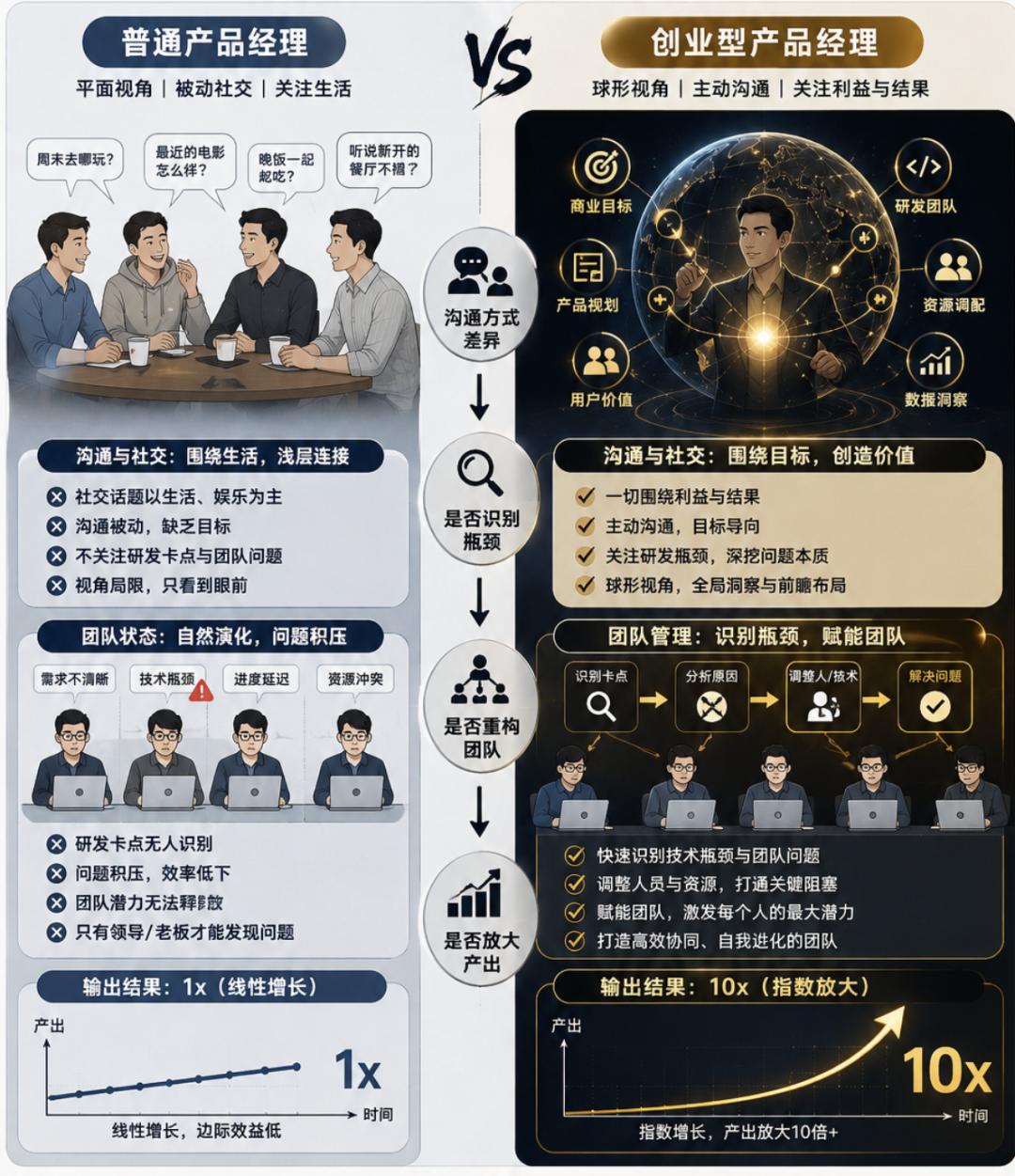
They can unlock the greater potential value of the team, empower the team, and adjust and switch some R & D technical bottlenecks or R & D personnel to solve R & D challenges.
Ordinary product managers may not notice R & D challenges or won't know how to solve them even if they do. They just socialize with friends in their daily life. Usually, only leaders or bosses can notice these issues. This results in a flat perspective for ordinary product managers, while entrepreneurial product managers have a spherical perspective.
These are the differences I think there are between product managers with a side business and ordinary ones.
Of course, it's a pity that this side business doesn't have to be a large company. It can just be a passion as long as it can achieve an economic cycle and allow them to work on products they like with a group of people. It doesn't have to be a large-scale company.
An app or a website can also work, just like when we created pmtalk. All these experiences can make a big difference for product managers.
Unfortunately, big tech companies don't like product managers with side businesses; they only like acquisitions
Ironically, product managers who do well in their side businesses are not welcome in big tech companies. Big tech companies prefer employees who focus solely on their regular jobs.
Or they like product managers whose products can be acquired. However, such product managers are extremely rare. Not every product manager can successfully develop a software and catch the attention of big tech companies.
Especially after the withdrawal of US dollar funds, acquisitions with Chinese funds are almost impossible. So, these product managers with "entrepreneurial" experience can only go to small and medium-sized enterprises, where they are more welcome and can get higher salaries, which is very difficult or almost impossible in big tech companies.
That's all for today's sharing.
This article is from the WeChat official account "Kevin's Little Bits of Changing the World" (ID: Kevingbsjddd). Author: Kevin's Stories. Republished by 36Kr with permission.