Knowledge Management Strategy in the Age of Artificial Intelligence: How to Transform Chaotic Information into Operational Performance
Today's generative AI is not just another layer of software; it can brutally expose the current state of your information assets. If you're still trying to build a centralized "single source of truth" in 2026, you're not doing architecture design; you're doing IT archaeology. The harsh reality is that most failures of generative AI in enterprises don't stem from the choice of large language models (LLMs) but from the mediocre data structures fed into them. Stop those flimsy proof - of - concept (POC) projects that only seek to attract attention; it's time to build an industrial - grade platform based on rigorous knowledge management (KM).
Introduction: Procedural Failures of AI without Knowledge Management (KM)
We must dispel the dangerous illusion that AI can understand information chaos through some algorithmic magic. The old adage "garbage in, garbage out" has evolved into an even more insidious version: "garbage in, garbage amplified." Unlike traditional search engines that simply return incorrect documents that users can ignore, large language models (LLMs) absorb low - quality data, synthesize it with a deceptive air of linguistic authority, and then output it as synthesized "truth." AI not only repeats errors but also refines them and disguises them behind smooth text, thus completely destroying users' critical thinking.
A chaotic intranet is the primary obstacle for industrial AI. Connecting a retrieval - augmented generation (RAG) pipeline to a disorganized SharePoint server filled with outdated HR policies or contradictory technical guides is tantamount to professional negligence. When AI gives incorrect answers about critical maintenance processes or legal rights, a trust crisis will erupt immediately, often permanently. As architects, we must recognize that the knowledge base is no longer a passive archive but the semantic computing engine of the enterprise. Without strict management and metadata structure, your AI is just an expensive and high - risk toy.
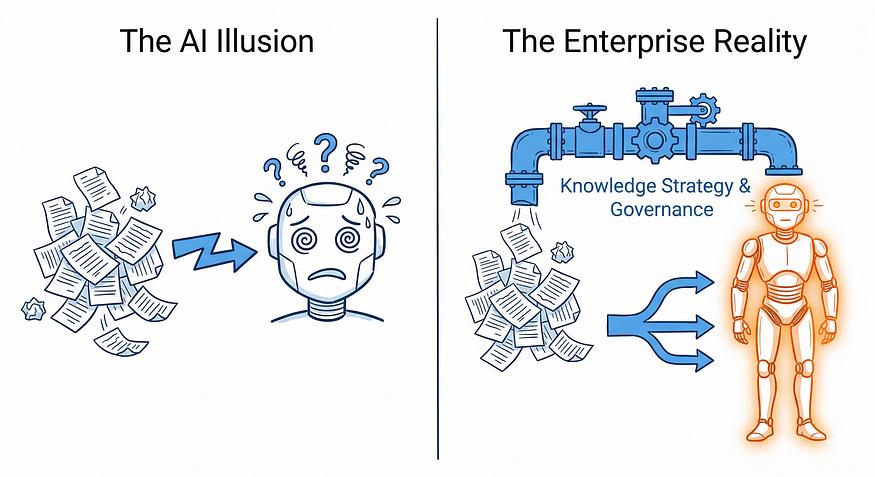
Knowledge Management Basic Framework: 4C and 4 Pillars
To industrialize AI, we must re - adopt the basic principles of knowledge management but with machine - like speed and precision. The knowledge lifecycle must be coordinated around the following four core elements (4C):
Tacit: Knowledge initially exists in tacit communication. AI should be used not only to answer questions but also to capture the essence of interactions (support tickets, meetings, Slack discussion threads), thus transforming informal information into structured assets.
Capture: Capture doesn't mean "save as a PDF file." It refers to extracting entities, relationships, and intentions at the moment of creation. If information isn't structured at the source, the cost of re - processing it later will be extremely high.
Content Review: This is a problem faced by 90% of organizations. Content review is the process of verification by subject matter experts (SMEs). Unverified content creates technical debt that can only be repaid by AI's guesswork in the end.
Circulation: AI has changed the distribution method from "pull" (keyword search) to contextual "push" (precise response to immediate needs).
However, technology only accounts for 20% of the total work. A powerful platform is built on four pillars: People (experts must be motivated to contribute knowledge), Process (data governance workflows), Technology (RAG and graph foundation), and Governance (legal and ethical responsibilities of information). The return on investment isn't out of reach: a mature knowledge base can significantly shorten the mean time to resolution (MTTR) of technical support, not because of faster search speed but because of providing clear and authoritative solutions.
Breaking the Monolithic Architecture: Federated Architecture and Data Mesh
The single "source of information" model is doomed to fail; it's an inevitable result of history. Trying to centralize all information will inevitably lead to obsolescence and the weakening of business unit power. The architecture we advocate is a federated architecture based on data mesh principles. Knowledge must always belong to its creators - the business units (legal, human resources, R & D).
Each domain manages its own "system of record" and follows its own data freshness rules. Our task is to overlay a global index and a semantic mediation layer on top of them. This enables the RAG process to switch seamlessly between data silos without large - scale migrations. We're transitioning from a static data warehouse to an interconnected knowledge ecosystem. This semantic network allows AI to understand that although the names are different, "Product X" mentioned in the sales manual and "Project X - 104" mentioned in the defect report refer to the same entity.
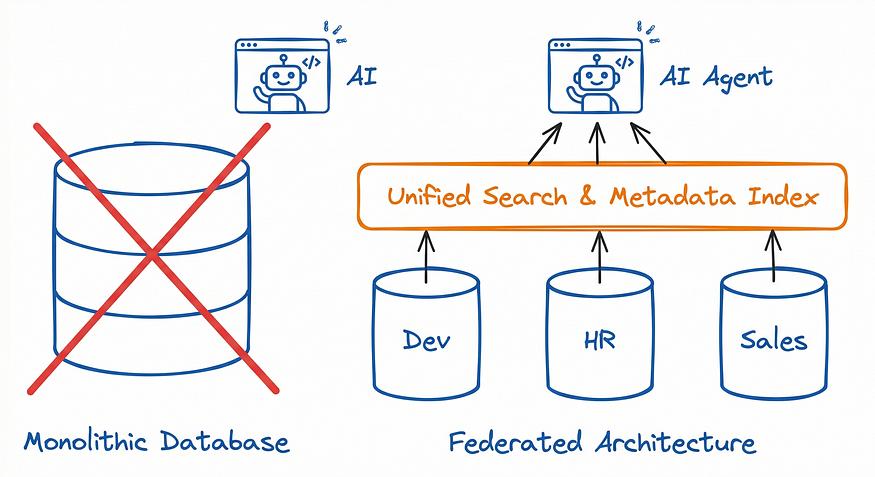
Content Standards and Metadata Foundation
For AI to run efficiently, it must have access to "AI - ready" content. This requires writing specifications with surgical precision. The golden rule is: "One article, one question." If your document is a 50 - page "wall of text" covering multiple topics, after chunking in the RAG process, it will produce context - less and incoherent fragments. Each part must be short (maximum 200 words) and well - structured for easy machine extraction.
But the real driving force is metadata. AI doesn't reduce the need for metadata; it intensifies it. Without clear signals, AI can't determine whether a document is outdated, whether it's only accessible to administrators, or whether it's only applicable to a specific jurisdiction. Here are the pillars of a metadata strategy built on the strictest standards:
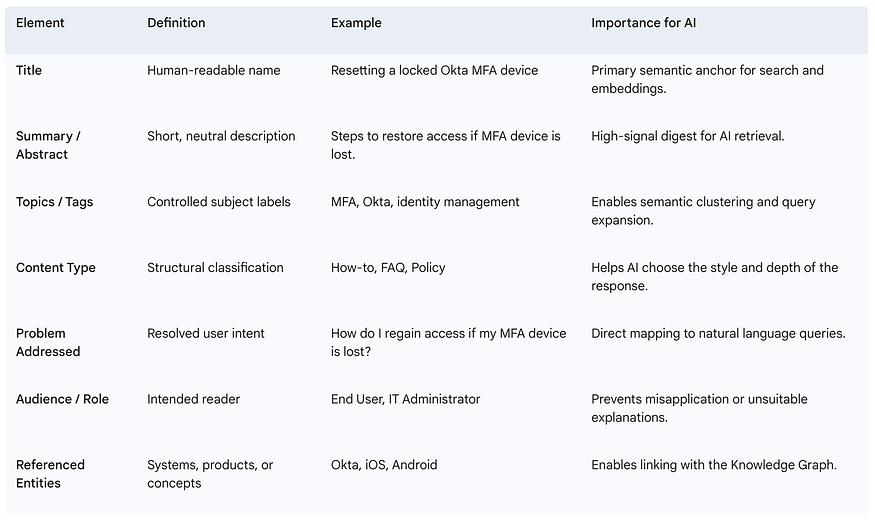
Table 1: Descriptive Metadata (Core of Search)
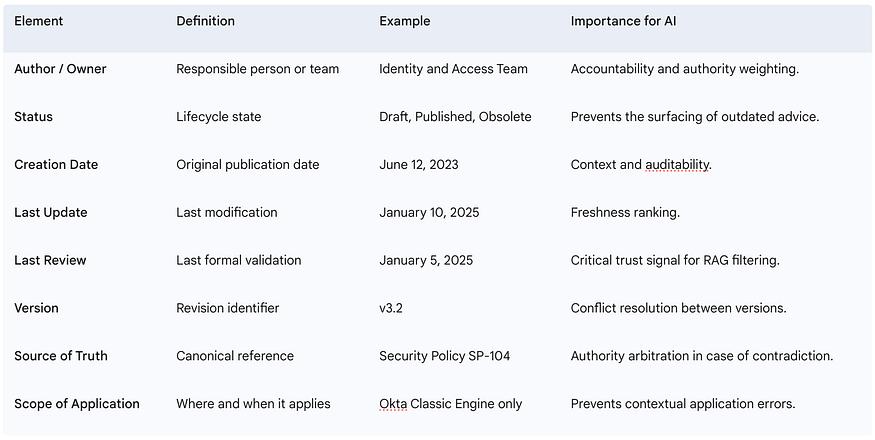
Table 2: Management Metadata (Freshness Guarantee)
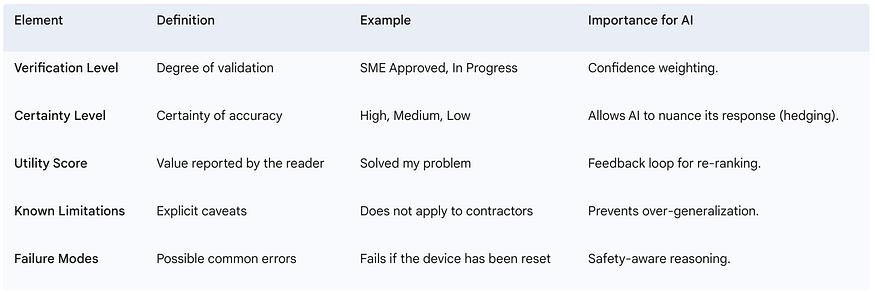
Table 3: Qualitative Metadata (Feedback Loop)
AI - Enabled Specific Metadata
This is where we distinguish architects from tinkers. These elements enable AI to interpret content, not just find it.
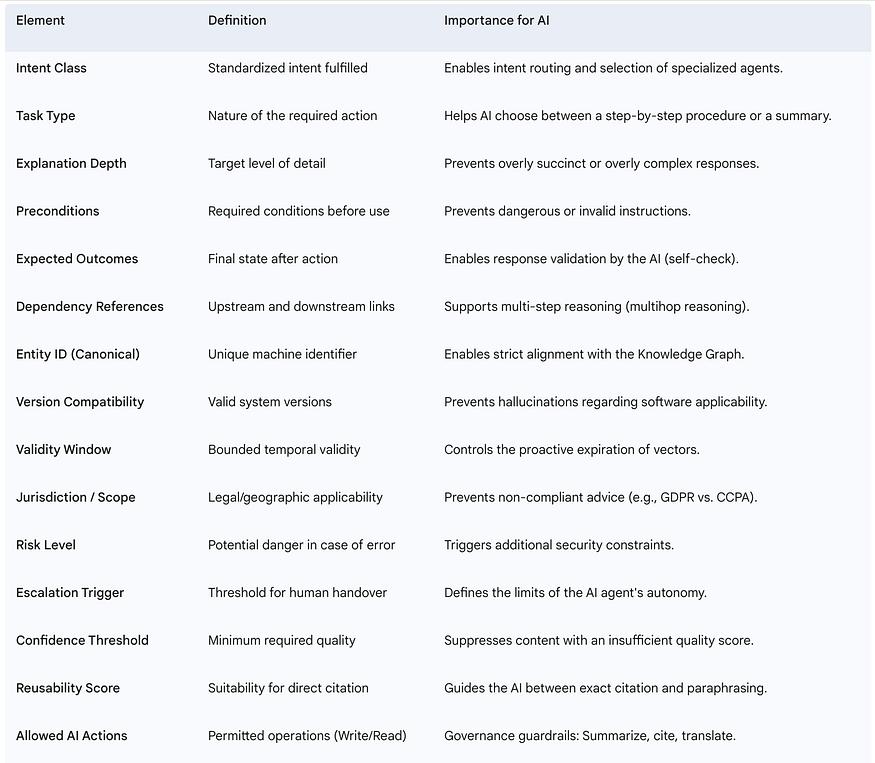
Table 4: AI - Enabled Specific Metadata
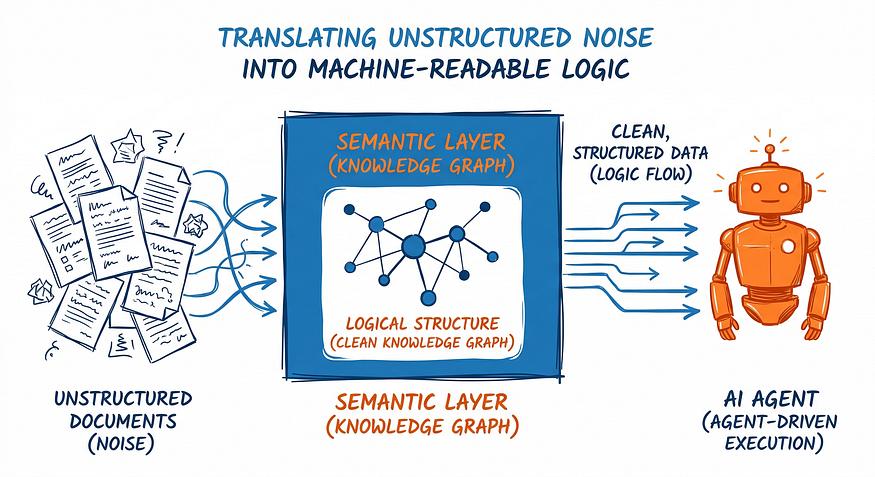
Semantic Layer and Knowledge Graph
AI often has difficulties with internal terms and contextual synonyms. For example, a user seeks a solution to a "fault," but the official document uses "service interruption." In a pure vector space, these two terms are close but not identical. The solution is to implement a semantic layer and materialize it through a knowledge graph (KG).
Unlike vector databases that store mathematical approximations, knowledge graphs use standards such as RDF (Resource Description Framework) and OWL (Web Ontology Language) to define entities (products, systems, events) and their explicit relationships. By building a minimum viable model (MVM), we encode business meanings. The OperationalIncident entity becomes the hub connecting the Outage, ServiceDisruption systems, and the ResponseProcedure event.
This structure supports multi - hop reasoning. If a user's question requires associating security policies with a specific software version in a specific region, the graph allows AI to reason along logical links ("semantic paths") rather than guessing statistical proximity. Merck's example is a benchmark: they use LLM - generated SPARQL queries to query their clinical data graph, forcing AI to work only within the scope of authorized structured data and eliminating the room for imagination. The knowledge graph is like a logical guardrail that limits the infinite imagination of LLMs.
RAG (Retrieval - Augmented Generation) Pipeline Engineering
The technical implementation of RAG must be treated like an industrial production line, not like a patched - together Python script.
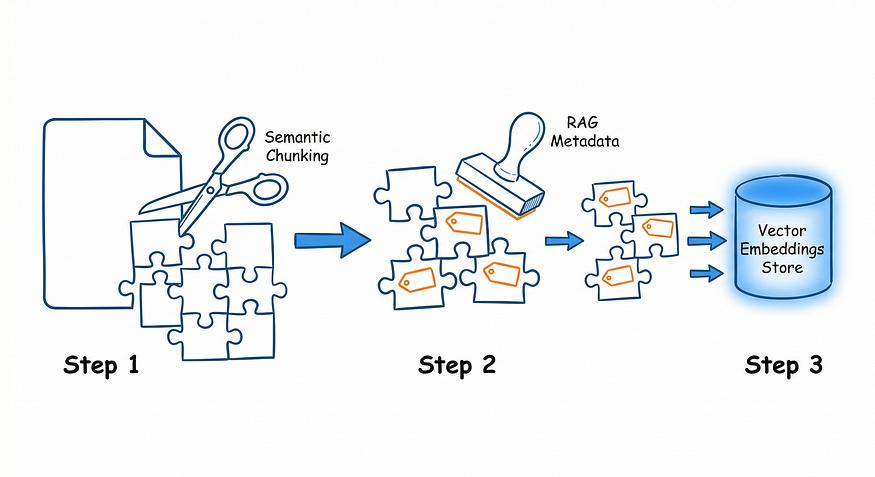
Text Chunking Process: Text chunking is a science. I advocate recursive text segmentation, which respects logical structures (paragraphs, lists) rather than randomly splitting by token count. The overlap must be finely tuned (10 - 15%) to maintain the semantic connection between two segments. A more advanced approach is parent document retrieval, which allows for searching smaller segments (more precise) while providing the complete parent document to the large language model (LLM) to ensure complete context information.
Vector Embedding and Mathematical Limitations: Although vector embedding is powerful, it's affected by the "curse of dimensionality." Cosine similarity may fail for some very specific technical terms or numerical error codes.
Hybrid Architecture (Vector Search + GraphRAG): Currently, the industry standard is GraphRAG. I combine the semantic flexibility of vector search with the logical rigor of knowledge graphs. Techniques such as context compression can filter retrieved segments and transmit only the "essence" of the information to the LLM, thus reducing noise and tokenization costs.
Bonfiglioli's experience shows that by combining technical documents with a powerful business ontology, their answer accuracy increased by 40%. They use a coordinating agent that decides whether to query the graph (for structured data) or the vector database (for text interpretation) based on the question.
Summary: Governance, Metrics, and Self - Learning
To manage this platform, you must abandon vanity metrics (such as the number of articles) and focus on AI - readiness key performance indicators (KPIs). The measures of success are:
Discoverability: First - search success rate.
Dwell Time and Bounce Rate: If a user spends only 2 seconds on a complex process, it means the content is either useless or poorly indexed.
RAG Precision: The accuracy of responses verified by subject matter experts (SMEs).
We must also integrate data maturity assessment through four AI - ready data models:
AI POC: Risk management depends on individual skills and sparse metadata.
Multi - Context: Data verification across multiple scenarios, the beginning of structuring.
Implementation: Transition to tools and platforms for automated preparation.
Production: System governance, deviation monitoring, and automatic correction.
The future belongs to self - learning knowledge bases. By analyzing search logs and response failures, AI can detect "knowledge gaps" on its own. It can proactively suggest creating articles or write initial versions based on resolved support tickets and submit all content for simplified human verification.
Knowledge management is no longer an auxiliary function but the nervous system of AI. Without a rigorous semantic structure, you'll only automate chaos. Invest in semantics, metadata, and governance; it's the only way to build AI that truly creates value rather than risks.
Don't build toys; build platforms.
This article is from the WeChat official account "Data - Driven Intelligence" (ID: Data_0101), author: Xiaoxiao. Republished by 36Kr with permission.