After large-scale "overdrafts", AI entrepreneurship has become more exhausting.
In the past two years, AI has sparked wave after wave of small and medium - sized entrepreneurial tides. However, different from the serious and dedicated approach of delving into technology, refining products, and building barriers in the past eras of the Internet, e - commerce, and content, current AI entrepreneurship is gradually deviating. There is little interest in technology and content, while on the contrary, "resource trading" has emerged prominently.
For example, "selling accounts" has once become the mainstream way to make money in the AI track. Even today, there has been a "resale wave" of AI creation accounts and computing power. It is reported that due to the continuous price increase of large - model computing power, an old membership account of Jimeng was speculated to nearly 20,000 yuan on Xianyu.
When opening e - commerce platforms, the resale of AI resources has formed a complete industrial chain: "2200 inspiration points of Keling AI, 27 yuan", "Unlimited points and unlimited generation of Jimeng AI, 1.08 yuan", "A new account of Hailuo AI, 19.8 yuan for 5000 points"...
Although the popularization of AI is getting faster and faster, there are still people reselling GPT accounts, building mirror websites, selling in - depth research reports on large models, and providing proxy operation services. From accounts to points, from computing power to proxy operation services and content... Almost all AI - related resources are clearly priced.
In this AI carnival where "everything can be sold", it is worth delving into how much meaning is left in AI entrepreneurship.
In the survival dilemma, is "selling accounts" the most realistic option?
An interesting question: How much can an account supported by AI be sold for?
Surveys show that there is a wide variety of accounts for AI account creation and AI content generation, including those of the mother - and - baby type, appearance type, pet type, and even health - preserving and emotional types favored by the middle - aged and elderly. The accounts for sale require "three non - s": no real - name authentication, no account violations, and no work violations. The transaction prices range from a few hundred to tens of thousands of yuan, usually 10% of the number of followers.
On a certain social platform, an AI health - preserving account with 25,000 followers is sold for 6,000 yuan; an AI pet account with 110,000 followers is sold for 16,000 yuan; an AI mother - and - baby account with 117,000 followers is sold for 13,500 yuan... According to the report of "Xinhua Viewpoint", some professional account - creation studios can usually "cultivate" an AI account with tens of thousands of followers in 3 to 5 days.
The whole set of operations is simple and crude. Taking the "health - preserving account" as an example: First, input keywords such as organs and foods into the AI software to generate eye - catching copywriting, produce materials in batches, and intelligently synthesize dynamic videos; then set health - preserving knowledge quizzes at the end of the video to guide interaction and stimulate sharing, and improve the account's interaction weight.
In this era filled with the myth of "getting rich overnight with AI", there is also a considerable market demand for the resale of such accounts.
According to incomplete statistics, when searching on QQ with the keyword "transaction on a certain short - video platform", at least 70 relevant QQ groups will appear, with the number of group members ranging from 500 to 2000. There has even been "account futures" trading online. Buyers pre - order accounts with 10,000 followers three months later, pay a 30% down payment, and complete the delivery after the account meets the standard.
Currently, major platforms are constantly rectifying account trading and regulating the AI content ecosystem. However, the low threshold, high output, and good market demand and income still stimulate a large number of small and medium - sized entrepreneurs. At the same time, "anti - identification services" have also become a business. Where there is the resale of AI resources on e - commerce platforms, there are merchants claiming to be able to remove 98% of the traces of AI generation without a trace, trying to evade platform control.
In short, a gray industrial chain has been formed, and a large number of accounts have flowed into the market.
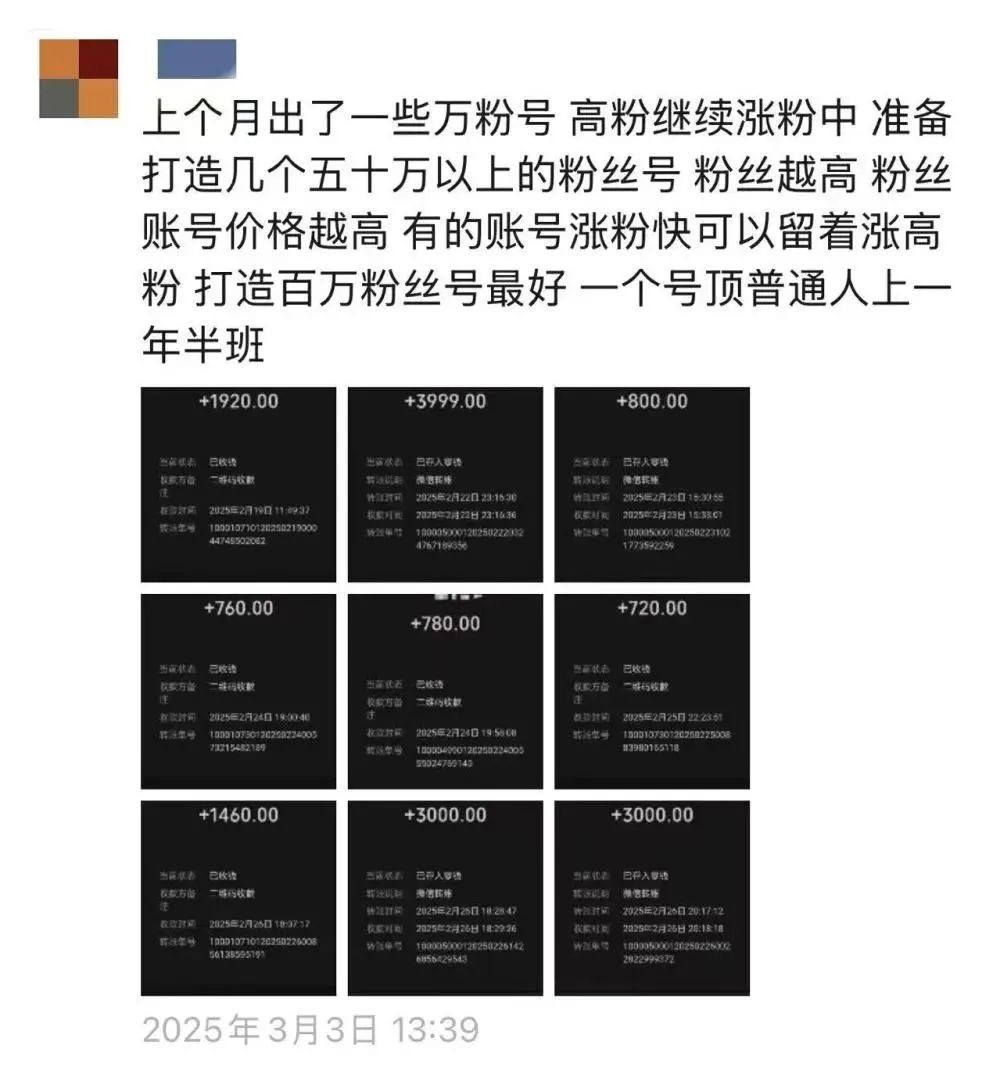
It is reported that some MCNs are accelerating the development of this business. In April 2026, there was a news report that in Shanghai, two people used 5 computers and 3 virtual servers, with the help of AI tools, to control more than 4,000 self - media accounts.
Why has "selling accounts" become a major mainstream of monetization in the AI entrepreneurship circle?
A fundamental reason is that with the popularization of AI tools, the technical threshold for content production has almost reached zero, and a large number of small and medium - sized entrepreneurs have flocked in.
Taking the short - drama and comic - drama tracks, which are most severely affected by the "get - rich - quick" atmosphere, as an example, in March 2026, the "Research Report on China's AI - Generated Content Industry" released by iResearch showed that the number of domestic AI - assisted short - drama creators had exceeded 1.2 million, a year - on - year increase of about 340% compared with 2025.
However, the income side is seriously disproportionate to the production side. According to the statistics of DataEye Research Institute at the beginning of 2026, there were about 1.2 million accounts that had released AI short - dramas on various platforms, and the number of monthly active publishers (those who released at least one complete short - drama per month) was about 310,000.
Among these 310,000 active creators, less than 8% had a monthly income of more than 10,000 yuan, about 22% had a monthly income between 3,000 and 10,000 yuan, and the remaining 70% had a monthly income of less than 3,000 yuan, among which a considerable number had a monthly income of less than 500 yuan.
Secondly, although the cost of AI content creation is not too high, various expenses are fragmented and the cumulative consumption is cumbersome. Over time, they gradually erode the already meager profits. In 2026, Tencent Cloud, Alibaba Cloud, Zhipu, and Baidu Smart Cloud successively followed up and raised the price of computing power. The price of some AI models on Tencent Cloud increased by as much as 463%.
Coupled with the cost of waste film rate, debugging cost, compliance cost... In the future, "zero - cost AI entrepreneurship" is almost unrealistic.
Due to the large number of entrants, many AI entrepreneurship tracks have started price wars. For example, in the field of AI short - dramas, the current market quotation has dropped as low as a few hundred yuan per minute. Similarly, AI copywriting priced at five yuan per order is in great demand, and AI avatars that cost ten yuan for package modification have become the norm. The industry pricing system has collapsed, leaving a large number of entrepreneurs exhausted.
Therefore, seizing the opportunity to generate income, quickly accepting orders, and making profits immediately... have become the common demands of a large number of AI entrepreneurs.
Compared with the long - term precipitation of the commercial value of content, the easily obtainable income from account resale is undoubtedly more attractive. The Jimeng accounts have become very popular on Xianyu. A short - drama creator calculated an account: Several Jimeng senior annual cards bought at the beginning of the year for 2,599 yuan can now be sold for 18,000 yuan, achieving a 700% return in 3 months.
"I've worked hard to take commercial orders for a year, but I can't earn as much as selling this account," he said angrily in the communication group. This is not an isolated case. After all, CCTV reported that although AI short - dramas were very popular in 2026, the monthly income of the vast majority of creators was less than 10 yuan, even less than the 500 yuan reported by DataEye Research Institute.
It's really better to sell accounts than to engage in creation. This is also the voice of countless AI entrepreneurs. Although this goes against the original intention of most people.
After mass "overdraft", is AI entrepreneurship more tiring?
So far, the shadow of AI can be seen everywhere on major content platforms. The "Research Report on the Development of Online Audio - Visual (2026)" shows that in 2025, the cumulative number of AI - generated audio - visual content in the whole industry exceeded 2 billion, more than 14 times that of 2024, and 54% of the respondents often watched AI short - videos.
At first, the monetization of AI content was quite considerable.
Li Mei (pseudonym), who has accumulated more than 90,000 followers by creating accounts with AI on Douyin, started posting AI videos in May 2025. By the third video, the view count exceeded 5 million. Subsequently, she opened a window, received advertisements and business opportunities, and with the traffic income, her income was acceptable.
However, in 2026, whether AI content is still "valuable" has become a tangled question for all small and medium - sized AI entrepreneurs.
On the one hand, the crazy trading of AI accounts has made the entire Internet full of AI influencers, and most of them have more than 10,000 followers, but their commercial capabilities have been greatly reduced. On the other hand, some industry insiders said that the reach rate of high - quality AI content is currently less than 0.3%, resulting in a serious mismatch between production capacity and attention. "Producing a lot but earning little" has become the norm.
Moreover, the problem of homogenization has been deeply rooted in the AI entrepreneurship track.
Not only in the aspect of AI content, but also in AI customer service, AI voice, AI digital humans... the whole line has entered the era of low - cost and mass production.
A set of data from iResearch shows that as early as 2023, more than 23,000 new AI enterprises were established in China, and 80% of them were concentrated in general scenarios such as intelligent customer service, AI drawing, and voice assistants. A comparative analysis in December 2025 showed that the similarity of the chatbot interfaces behind different products was as high as 92%.
The situation is the same overseas.
Public data shows that on the YouTube platform, more than 20% of the videos recommended to new users are "AI junk content", and nearly 10% of the fastest - growing channels are low - quality AI - generated videos. More importantly, 278 out of the top 15,000 channels globally specialize in publishing such content.
The overwhelming presence of AI has made the future of AI entrepreneurship more arduous. In 2026, more and more AI entrepreneurship teams have found that AI has changed from an early - stage productivity tool to a traffic machine for mass arbitrage. When the efficiency dividend is dissipated, AI has finally become a "new shackle" on the shoulders of countless entrepreneurs.
This is not groundless.
The "2026 B2B Content Marketing Trends Report" by CMI shows that the application rate of AI tools in B2B content teams has reached 95%, but only 58% of people think that the quality of their content has been improved by AI, and even 41% of people said that their content work is in a "stagnant or difficult" state.
Interestingly, when the monetization ability of AI entrepreneurship is weaker, some entrepreneurs will subconsciously rely more on AI. For example, they pile up a large number of AI tools, launch various intelligent systems, open memberships, and increase computing power. Especially against the background of the collective price increase of large models, the budget allocation chart in the CMI 2026 report shows that many teams have allocated 45% of their content budgets to AI tools.
In contrast, the investment in human resources only accounts for 9%. Emphasizing AI while neglecting human innovation. This has led to a "vicious cycle": the more prevalent the use of AI, the more boring and similar the content, and the more uncertain the subsequent monetization may be. Even some leading platforms have taken the initiative to "control" AI monetization.
In the first quarter of 2026, YouTube massively suspended or terminated the monetization qualifications of AI creators in the YouTube Partner Program. One of the most popular AI content channels on YouTube, "CuentosFacianantes", was dealt with. It is reported that this channel has about 5.95 million subscribers and an annual income of about $2.6575 million.
In China, platforms such as Xiaohongshu, WeChat, Douyin, Kuaishou, and Bilibili have also started similar actions.
All signs indicate that AI production has been over - exploited in large quantities, and some entrepreneurs who wanted to get rich overnight with AI are exhausted and on the verge of collapse.
What do AI entrepreneurs still lack: scenarios, barriers, and a sense of humanity?
Undoubtedly, most current small and medium - sized AI entrepreneurship belongs to "computing - power - driven" businesses.
A set of data from NetEase shows that in the first quarter of 2026, 89% of domestic AI start - up companies' core businesses relied on GPU computing power. The model of this type of business is obvious: relying on public large - model APIs + general open - source frameworks + shallow - scenario applications (such as automatic copywriting, poster generation, basic customer service, and simple web crawling).
However, with content homogenization, traffic reaching its peak, and monetization shrinking... the survival space of ordinary AI entrepreneurs will surely be continuously squeezed in the future. The article "The Endgame of AI Entrepreneurship in 2026" also predicts that 90% of the practitioners who followed the trend will face the first round of "closure tides" in the second half of 2026.
This is also one of the reasons for the prevalence of AI account resale and AI resource trading. After all, most people are sensitive to staying or leaving.
However, the world is deeply involved in a spectacular AI gold rush. AI - empowered business stories are staged one after another, and the entrepreneurial myths of getting rich overnight continue to ferment. It is difficult for this generation of entrepreneurs to take the initiative to withdraw. When the enthusiasm for account resale fades and the short - term speculative bubble bursts, how can the new round of AI entrepreneurship break the deadlock?
It is true that the answer to this question cannot be found on paper.
But it is certain that the dilemma of most AI entrepreneurship failures is not a shortage of computing power or backward technology. On the contrary, survivors need to jump out of the "computing - power - driven" quagmire. Content, scenarios, and barriers... the importance of these three in the era of AI entrepreneurship far exceeds the traditional concept of "computing power as the foundation".
First, let's look at content. This is the first survival rule for countless small and medium - sized AI entrepreneurs.
The CMI report shows that 65% of teams list "content quality" as the key factor for efficiency improvement in 2026. At the same time, the "10th New Media Ecosystem Conference of Kuaizhi in 2026" also proposed a super - creator formula: Super creator = human "slow heart" (values/aesthetics/empathy) × AI's "fast hand" (generation/distribution/iteration).
That is to say, the importance of a sense of humanity in the process of AI entrepreneurship has been increasing.
Secondly, it is the scenario. This is the key reason for a large number of AI entrepreneurs to leave helplessly. A McKinsey report on the AI entrepreneurship ecosystem shows that the average life cycle of global AI enterprises is only 2.7 years, and as high as 73% of the failure cases are due to zero profits caused by homogeneous competition. The core problem is the lack of scenario implementation ability.
Especially for some AI start - up companies whose main businesses are large - model fine - tuning, AI film and television creation, and intelligent Agent development, scenarios determine their survival. These companies generally have certain technical capabilities and are prone to fall into "technical self - indulgence", over - pursuing model accuracy and algorithm innovation, while ignoring scenario implementation, and finally getting out of touch with market demand.
Facts have also proved this.
In 2025, the latest list released by Henry Shi showed that in the AI small - team entrepreneurship ecosystem mainly composed of AI videos, AI games, and AI group - buying, successful teams tend to focus on business links where results can be directly measured