Will OpenAI "go head-to-head" with Apple by mass-producing AI phones in 2028?
OpenAI has taken the most "radical" step.
Recently, Guo Mingji, an analyst at Tianfeng International Securities, revealed that OpenAI is developing its own mobile phone. It will cooperate with MediaTek and Qualcomm to develop the mobile phone processor, and Luxshare Precision will be the exclusive system collaborative design and manufacturer. Mass production is expected in 2028.
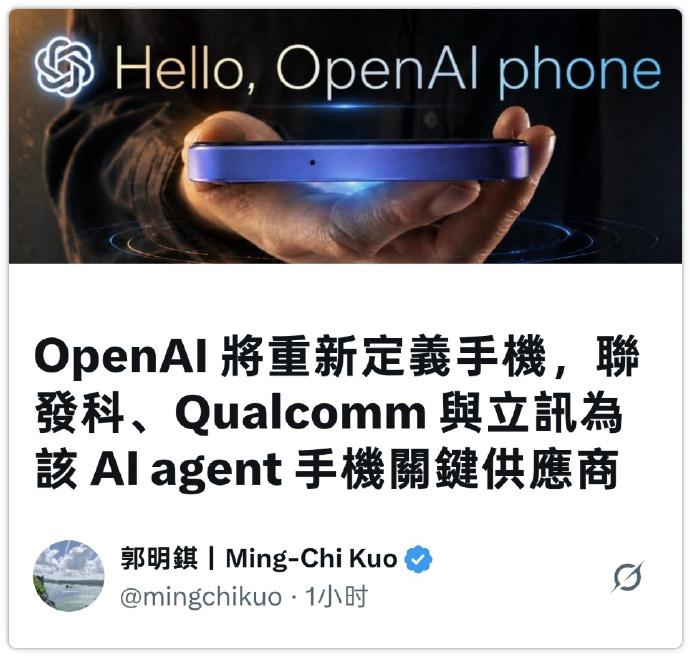
Source: Screenshot from social media
When the hardware fails to deliver a qualitative leap in user experience, "AI" is regarded by the mobile phone industry as the hope to drive the next wave of mobile phone replacement. However, not only mobile phone manufacturers want to get a share of the AI mobile phone business. Just as ByteDance cooperates with mobile phone manufacturers to develop Doubao mobile phones, OpenAI is also not content to be just a model provider.
So, what exactly will the AI mobile phone developed by OpenAI look like? Can OpenAI, by insisting on self - development, redefine human - machine interaction in the AI era, just as Apple redefined the mobile phone back then? Compared with ByteDance, which has a relatively easier start, OpenAI clearly faces more challenges ahead.
OpenAI Bets on Hardware
OpenAI's aspiration to develop hardware is not a recent one. In the past year, there have been successive reports that OpenAI is self - developing headphones, smart speakers, and glasses. Some industry insiders have said that OpenAI will not miss out on any terminal that has the potential to become the next - generation computing platform.
This time, OpenAI has set its sights on mobile phones, choosing the most difficult, high - threshold, and low - tolerance track among all hardware. According to Guo Mingji's analysis, OpenAI's decision to make mobile phones is mainly due to two reasons.
Firstly, although the sales of various smart hardware such as glasses, headphones, and "AI Pin" are growing rapidly, in the future, mobile phones will still be the terminal devices with the largest quantity and the most suitable carrier for Agent operation.
The future AI mobile phone will not be limited to a single screen. A former Baidu product manager said that the future AI mobile phone can not only help users perform tasks but also take the initiative to execute tasks after sensing the user's state, without the need for the user to give instructions.
For example, when a user needs to travel on business after a meeting, the mobile phone can actively book tickets and hotels after hearing the relevant conversation about the business trip. The user doesn't need to check the phone dozens of times a day, and the interaction with the phone will mainly change from touching the screen to voice dialogue.
Guo Mingji shared his concept map of the AI mobile phone. In the future form of mobile phones, all apps will disappear, and the front - end will be replaced by a series of Agents that can perform tasks.
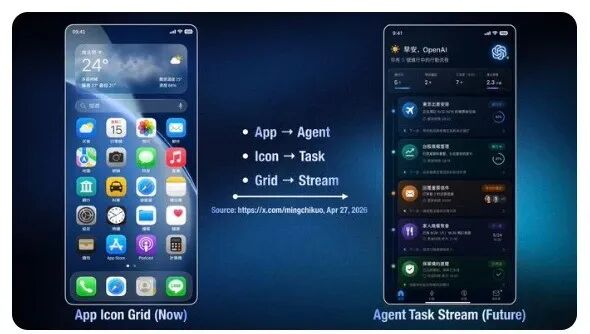
Source: Screenshot from social media
For an Agent to smoothly integrate into daily life, it requires a native operating system and software - hardware synergy. If OpenAI only focuses on models, it will always be just a "plug - in" parasitic in others' ecosystems in the future.
Currently, AI is firmly locked in the chat box by the existing mobile phone systems. It is prone to various "bottleneck" restrictions, similar to how mobile phone manufacturers replace some pre - installed apps. Only by getting involved in hardware development and having full control over all aspects such as chips, sensor scheduling, system permissions, and user data can OpenAI truly gain the right to speak in the next - generation interaction.
In addition, another important reason for OpenAI to compete for hardware terminals is that the data on the Internet is no longer sufficient.
Models rely on online text data for training and lack the perception and understanding of real - world scenarios. For example, when a user asked Doubao to "make their hand look more bony" in a photo, they received a photo similar to a CT image, which was quite absurd. This is because AI cannot understand the physical form of the real world and the semantic context of human daily life.
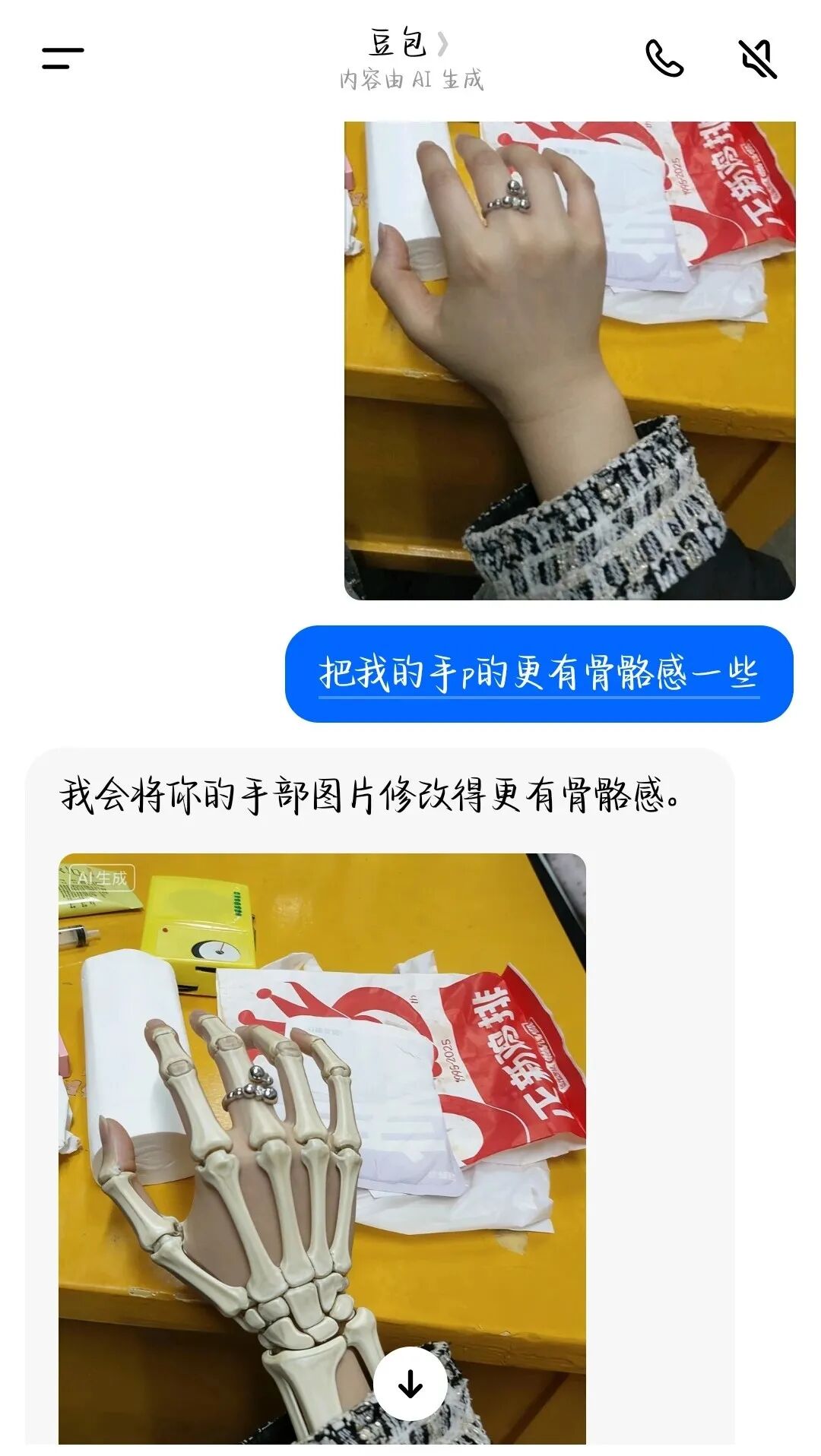
Source: Screenshot from Doubao
By controlling hardware terminals, model manufacturers can legally collect a large amount of multi - dimensional data from the physical world, and only then does AI have the possibility of understanding the real world. This is also the fundamental reason why software companies such as OpenAI and ByteDance are willing to cross - border at a high cost.
However, OpenAI did not cooperate with mobile phone manufacturers like ByteDance but chose the pure self - development route. Currently, ByteDance is collaborating with ZTE to build the second - generation Doubao mobile phone, while OpenAI's situation is more difficult. In the overseas market, the mobile phone industry is monopolized by Apple and Samsung. It is almost impossible for OpenAI to find a mobile phone manufacturer that has manufacturing capabilities and is willing to cede the system dominance. The only option for OpenAI is the single - plank bridge of pure self - development.
OpenAI's Technical Test
For model manufacturers like OpenAI, self - developing any hardware means starting from scratch, and there are more than one technical problems to be solved.
Firstly, at the software level, how to make Agents truly practical? This is also a problem that domestic mobile phone manufacturers are currently trying to solve.
The AI transformation of domestic mobile phones began in 2023. Now, the mobile phone assistants of Huawei, OPPO, vivo, Xiaomi, and Honor have all been deeply integrated with large models. However, the current AI level of mobile phones is far from achieving active perception. Even when it comes to passively performing tasks upon receiving instructions, they often deliver half - finished products. Users often complain that their mobile phone smart assistants cannot even change an alarm or do mathematical calculations within three digits.
Only the Doubao mobile phone before being banned could truly achieve cross - app, full - process autonomous execution, such as "ordering takeout with one sentence" or "creating a travel guide with one sentence".
The Doubao mobile phone does make usage more convenient and is currently the AI mobile phone with the highest level of intelligence that the public can access. However, since the GUI Agent route chosen by the Doubao mobile phone has higher security risks, most domestic mobile phone manufacturers have chosen the more conservative "API call" route - that is, to cooperate deeply with mainstream apps and allow the AI assistant to call specific functions through pre - set interfaces, rather than directly simulating human screen - clicking operations on apps like the GUI Agent.
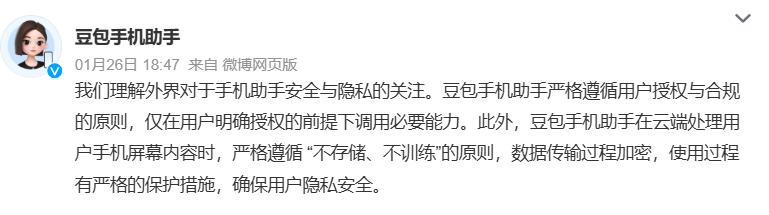
Source: Screenshot from Weibo
In order to further ensure privacy and data security and reduce latency, mobile phone manufacturers are exploring edge - side AI. That is, to install large models directly on the local mobile phone, upload as little user conversation and behavior data to the cloud as possible, and complete AI thinking, instruction judgment, and task processing locally on the mobile phone.
The strict supervision of data collection and privacy risks in the European and American markets also forces OpenAI to adopt a strong edge - side route, at least to run small models locally on the mobile phone to continuously understand and remember the user's daily life. Some high - intensity and complex tasks can then be handed over to the cloud for processing.
This places extremely high requirements on OpenAI's software - hardware synergy capabilities. OpenAI has long focused only on cloud - based large models and has a weak foundation in the hardware industry. It needs to develop a model that can run on the local mobile phone, design a chip that matches the computing characteristics of the model, and create a native AI operating system that allows the Agent to freely schedule various applications. OpenAI is starting from scratch in the research and development of chips, systems, and AI models, which may be the reason why OpenAI expects to achieve mass production of mobile phones in 2028.
In order to accelerate the R & D progress, OpenAI is using China's supply - chain capabilities to make up for its lack of hardware experience.
According to the information disclosed by Guo Mingji, OpenAI's supply - chain layout has taken initial shape: MediaTek and Qualcomm are responsible for the development of mobile phone processors; Luxshare Precision is the exclusive system collaborative design and manufacturer. Luxshare Precision is deeply involved in the assembly of AirPods, Apple Watch, and even iPhone, and has the full - chain capabilities from components to system - level packaging. As global chip leaders, MediaTek and Qualcomm are respectively good at the NPU of flagship platforms and power consumption control.
The birth of a mobile phone cannot be accomplished by just three core suppliers. For this reason, OpenAI has also poached many executives from Apple.
According to "Fun Interpretation of Business", OpenAI's hardware team now has more than 200 people, including Jony Ive, the former chief design officer of Apple, and Tang Tan, the former head of product design at Apple (who led the product launch of iPhone and Apple Watch). These are key figures from Apple.
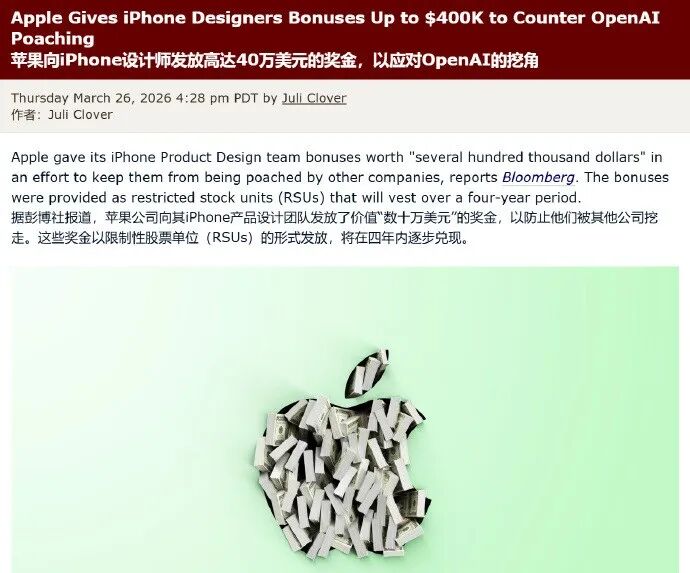
Source: Screenshot from social media
However, while talent can bring technical capabilities, it cannot bring the organizational capabilities and supplier relationship network that Apple has accumulated over decades. There are hundreds of suppliers behind a high - end smartphone, involving thousands of precise collaborative processes. Although OpenAI has drawn the "skeleton" of its supply - chain layout, filling in the "flesh" is the real test for it.
It is worth noting that the iteration of AI mobile phones by domestic manufacturers is also accelerating. By 2028, will Huawei, Xiaomi, Honor, etc. complete the implementation of full - scenario interaction of AI Agents ahead of time? It is worthy of further attention who will gain the right to speak in the future AI mobile phone market.
This article is from the WeChat public account "Fun Interpretation of Business", author: Zhang Yuge. Republished by 36Kr with permission.