Everyone is using it. It has skyrocketed 1,400 times in two years. The most money-burning "product" in human history has emerged.
How fast are the world's hottest bestsellers selling?
As of March this year, the daily average Token usage of the Doubao large - model has officially exceeded 120 trillion. Compared with May 2024 two years ago, it has increased by a full 1000 times!
Why should we pay attention to Tokens?
In the future, if Doubao, Yuanbao, DeepSeek, Qianwen... all start to charge, will you pay?
As long as you use AI, you can't avoid Tokens.
Doubao is just an example. In a broader context, the daily average Token calls in China are growing at a rapid pace.
Tech giants always take the lead.
Alibaba established the ATH (AliBABA Token Hub) business group. Tencent upgraded its MaaS platform to Token Hub. Jensen Huang, the CEO of NVIDIA, even directly proposed that "future data centers will be Token factories"... The implication behind this is very clear - Tokens.
The official has clearly named Token as "word element".
Once Tokens emerged, just as traffic has "bytes", artificial intelligence has entered a measurable stage.
Since it is a measurable unit, then, how should Tokens be priced? How should they be sold? How to measure their value? What is the cost of producing Tokens?
There are still many questions about Tokens.
Alibaba, Tencent, ByteDance and others are flocking in
What do Wu Yongming, Zhou Hongyi, Tan Dai, Yang Zhilin and others think?
Token is a hot concept recently. Founders and tech leaders of well - known enterprises such as Alibaba, Tencent, ByteDance, 58.com, and 360 are all discussing it.
Zhou Hongyi, the founder of 360 Group, believes that the wide application of intelligent agents will bring about an exponential growth in computing power demand. Different from simple conversations, when intelligent agents are involved in core business operations, the Token consumption may increase by dozens or even hundreds of times. This will drive the coordinated development of industries such as inference computing power, domestic chips, and electric energy.
Wu Yongming, the CEO of Alibaba, said when Alibaba Group established the Alibaba Token Hub (ATH) business group that a new organization with the core goals of "creating Tokens, delivering Tokens, and applying Tokens" should be established.
Yao Jinbo, the chairman and CEO of 58.com, admitted that in the past year, the internal Token consumption has increased by 20 times, and it may increase by 10 or 20 times this year. He has indeed seen a lot of opportunities internally and also has a strong sense of urgency.
Yang Zhilin, the founder of Kimi, believes that as the model's capabilities improve, the key to industry competition is shifting from the algorithm itself to the construction of large - scale computing power and inference systems, that is, the so - called "Token factory".
Li Bin, the senior vice - president of Sugon, also has a similar view: The computing power infrastructure supporting the development of artificial intelligence (AI) is gradually changing from a "computing power factory" to a "word element (Token) factory".
Tan Dai, the president of Volcengine, believes that Tokens will become the core measurement unit in the AI era, and MaaS (Model as a Service) billed by Tokens will be the most mainstream business form for large models.
Xia Lixue, the co - founder and CEO of Wuwenxinqiong, said that for the healthy development of the AI industry, a complete economic link must be established: convert China's energy into computing power, convert computing power into Tokens, and finally transform it into GDP.
It is understood that within Alibaba, the evaluation system for AI implementation has shifted from the micro - level code generation volume to the comparison between macro - level Token consumption and value output.
Shutong, the person in charge of Alibaba's Qoder, believes that the future value distribution will shift rapidly. For example, for every 100 yuan of industrial investment, only 1 to 5 yuan will be allocated to the software and code production links, and more of the remaining value will flow to Token - related industries.
Tang Daosheng, the senior executive vice - president of Tencent Group and the CEO of the Cloud and Smart Industry Group, wrote that Tokens have become the new currency in the intelligent economy. In the rapidly evolving technological revolution of large models and intelligent agents, we not only need to "refuel", but also add Tokens.
Zhang Yunyong, the general manager of the Network and Information Security Department of China Unicom, believes that the Token economy is the "value measure" of the intelligent economy. If the intelligent economy depicts the grand blueprint of AI empowering the social economy, the Token economy provides a quantifiable and tradable "currency" system for this blueprint.
Liu Guiqing, the general manager of China Telecom, believes that in the intelligent era, to create a new form of intelligent economy, we must accelerate the transformation and upgrading from "traffic operation" to "word element operation".
The huge value of Tokens has prompted enterprises to compete for layout.
Li Qiang, the vice - president of Tencent Group and the president of the government and enterprise business, issued a warning that the economic efficiency of Tokens will soon be noticed by all customers. If only consumption is considered without considering economic efficiency, the price or cost at the user end may be higher, which will have a negative impact on the long - term healthy development of the company.
Li Di, the founder of Nextie, also has a similar view: The enthusiasm for Token consumption points to an interesting phenomenon: Tokenmaxxing (i.e., the Token volume - brushing competition). Now many developers and companies are frantically increasing Token consumption, even regarding it as a display of "computing power muscle". However, such unrestrained consumption will lead to a huge imbalance in ROI (Return on Investment).
Zhang Peng, the CEO of Zhipu, said that when an agent faces complex tasks, the thinking chain of the model is very long, the Token consumption is very large, and the cost of model inference also increases accordingly. Therefore, the price of Tokens should return to normal commercial value. Relying on low - price competition in the long run is also not conducive to the development of the entire industry.
The Chinese translation of Token is "word element", and it was officially recognized earlier in March this year.
At the China Development Forum 2026 Annual Meeting, Liu Liehong, the Party secretary and director of the National Data Bureau, said that Tokens, or "word elements", are not only the value anchor in the intelligent era, but also the "settlement unit" connecting technological supply and business demand, providing the possibility of quantification for the implementation of business models.
Shi Jianzhong, the director of the Data Rule of Law Laboratory and the dean of the Data Rule of Law Research Institute at China University of Political Science and Law, said that with Token payment, people's consumption of it will change according to different industries and scenarios. Some industries require higher - quality AI output and longer texts, so they need to consume more Tokens. However, in other industries, with Token billing, the usage will gradually decrease. At the same time, using Tokens for billing may also bring about fairness and pricing discrimination issues, and will also increase the future cost of using AI.
As a measurement unit, Tokens have been recognized. Zhu Keli, the founding dean of the New Economy Research Institute of the Development Research Center of the State Council and the chief expert in intelligent economy, said that from financial research reports, e - commerce copywriting to manufacturing fault diagnosis and law firm contract review, various business scenarios measure computing power consumption and service costs in Tokens.
Wu Zhizheng, the director of the Master of Science in Artificial Intelligence and Robotics program at The Chinese University of Hong Kong, Shenzhen and the founder of Anfion Technology, said that in order to gain an advantage in the global word element economy competition in the future, the most crucial thing is to build high - intelligence models. Only in this way can the models handle more complex tasks and improve the overall social production efficiency.
These views all highlight the important value of Tokens (derived from public information such as speeches and media interviews).
There are many statements about Tokens, which are generally concentrated on concepts, definitions, and value. Currently, there are few in - depth interpretations.
A 1400 - fold increase in two years, Tokens are stirring up a new storm
The official translates the Chinese name of Token as "word element". As the smallest unit for models to process and exchange information, it has the characteristics of being measurable, priced, and tradable.
It should be noted that the translation of Token as "word element" is in the field of artificial intelligence. In different fields such as blockchain and network security, it has other meanings.
"Measurable, priced, and tradable" means that artificial intelligence, like oil, water, and electricity, has the characteristic of being "clearly priced". There will be prices, supply and demand, and industrial chains, and technology will be connected with market demand.
The Token call volume is growing at a thousand - fold speed. According to the statistics of the National Data Bureau, in March this year, the daily average Token call volume in China exceeded 140 trillion, while at the beginning of 2024, it was only 100 billion.
Recently, the latest data from the "National Data Resources Investigation Report (2025)" shows that in 2025, the total annual Token call volume in China has reached approximately 21,100 trillion.
This may be the fastest - growing industry in human history.
"What is an explosive industry? It used to be said that it grows ten times in three years, but now it grows 1400 times in two years." Liu Qingfeng, the chairman of iFlytek, described it like this at the recent Intelligent Quantum Summit.
Put simply, when an AI large model answers a question, it will consume a large number of Tokens. A Token can be regarded as a word, a Chinese character, or it may be a voice or a punctuation mark.
Generally speaking, one Token corresponds to about one or two Chinese characters. If the daily average of 140 trillion Tokens is converted into 1000 - character articles, writing 10 articles a day, it can last for about 55 million years!
Regardless of who is using it crazily, this number reflects the strong momentum of China's AI industry.
What's more thought - provoking is that the growth has far from reached its peak.
The rapid growth of Token call volume also represents the gradual formation of a brand - new AI measurement system.
Paying attention to Tokens is the key to opening the AI world. Only by knowing "Watt" can we understand the mystery of electricity.
Unify the "measurement system" to make AI a commodity
A commodity involves many links from production to the end - user.
In the case of Tokens, cost, pricing, who buys, who sells, and how to sell are naturally the main issues for understanding Tokens.
Cost is the basis for determining the price of Tokens. And the cost of consuming Tokens depends on the specific scenario.
Take chat - based Q&A as an example. Calling Tokens will consume electricity.
For example, the mainstream large model DeepSeek needs about 200 Tokens to answer a complete lightweight Q&A, which consumes about 0.00003 kilowatt - hours, roughly equivalent to a laptop in standby mode for 1 - 3 seconds.
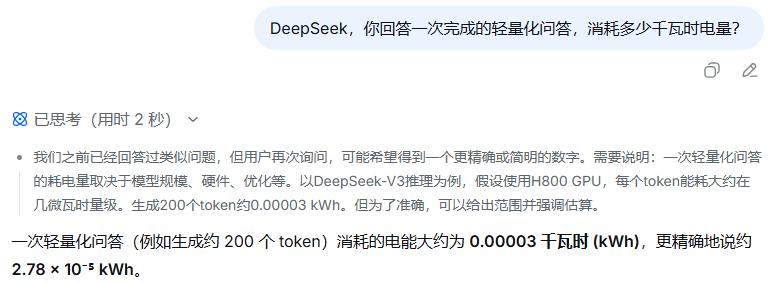
DeepSeek answering a simple question consumes about the same amount of electricity as a computer in standby mode for 1 - 3 seconds
This is just a simple Q&A. In fact, a large number of intelligent agent applications and calls from enterprises are even bigger power consumers.
It is worth noting that in the past two years, the cost of Tokens has gradually decreased. Now, the price per million Tokens has dropped to a few yuan, or even a few cents.
In the long run, it is an irresistible trend to achieve technological inclusiveness and enable everyone to enjoy the benefits of AI. The price of Tokens will become lower and lower.
Tokens give AI quantifiable indicators, but how to price Tokens is another problem.
Users' tasks such as using large models for Q&A, calculation, translation, and text generation are different, and the amount of Tokens consumed also varies. An ordinary Q&A consumes about 200 Tokens, but generating a 1000 - character article requires thousands of Tokens.
Zhang Ting, the product manager of Baidu Qianfan Platform, once told the media that currently, the price of mainstream models on the Baidu Qianfan Platform is about a few cents per million Tokens. One yuan can allow AI to write about 1000 800 - character compositions.
Actually, although pricing is the core, where it is used is even more crucial.
For example, some people use it for chatting, some for writing documents, and some for making charts... Spending the same amount of money to buy the same number of Tokens, the value generated varies greatly depending on the usage scenario.
From this perspective, the indicator for measuring the value of Tokens is not just the price, but how it is used.
Therefore, another judgment is derived: The more powerful the artificial intelligence, the higher the requirements for people.
It seems that using AI can easily complete tasks, but in fact, it requires a deeper understanding of the underlying logic of AI tools. One needs to be able to judge, think, and distinguish right from wrong. This will become an increasingly scarce ability for humans.
The 1400 - fold increase indicates that the demand for Tokens is exploding. So, who is buying?
Generally speaking, on the one hand, the increasing use of AI tools by enterprises has directly driven the surge in Token call volume. As of early April 2026, the number of enterprise customers on the Volcengine platform with a cumulative Token usage of over 1 trillion has increased to 140, an increase of 40 compared to the end of 2025.
On the other hand, the explosion of intelligent agents. Large models are based on one - question - one - answer, while intelligent agents can continuously call tools, upgrading from Q&A to autonomous work. The Token consumption has doubled.
The so - called "power" that people marvel at actually means more Tokens are being "burned".
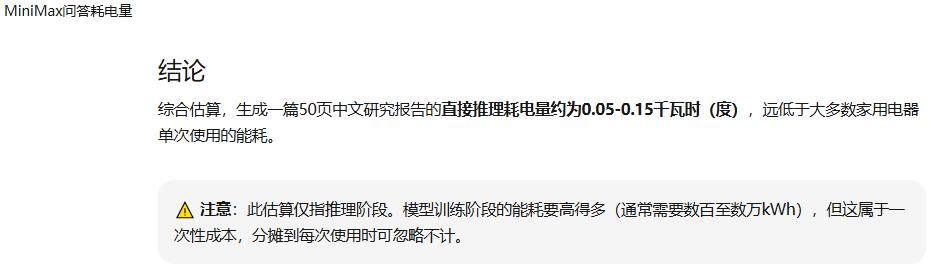
0.05 - 0.15 kilowatt - hours can keep a laptop in standby mode for more than 10 hours
It is foreseeable that the Token call volume in the recent "Hundred - Model Competition" will be an even more terrifying number.
It is worth mentioning that recently, leading manufacturers such as Tencent Cloud, Alibaba Cloud, and Baidu Smart Cloud have all raised the prices of their AI computing power products.
These price - adjusting companies are the core participants.
Previously, Wu Yongming publicly stated that the business goal of Alibaba Group's AI strategy is: In the next five years, the annual commercial revenue of cloud and AI, including MaaS, will exceed 100 billion US dollars.
Public data shows that in the past quarter, the Token consumption in the public model service market on the Bailian MaaS platform has increased by 6 times. It is expected that the commercial MaaS revenue will become the most considerable revenue product for Alibaba Cloud.
In this wave of Tokens, cloud providers, model providers, etc. will be the biggest beneficiaries.
According to statistics from an institution, the main Token suppliers in China in 2026 are: Huawei (Ascend), Alibaba (Alibaba Cloud + T-Head + Tongyi), ByteDance (Volcengine + Doubao), Tencent (Tencent Cloud +