Get the latest gossip quickly: The design ability of Kimi K2.6 surpasses that of Claude Design.
Claude Design had just given a huge shock to the design industry, but then it got hit hard itself.
The one who struck was Kimi K2.6 from China.
What?? You're telling me that the tool specifically launched by Claude for design couldn't beat Kimi's latest general - purpose flagship model??
Let's take a direct look. With the same prompt (a movie - level, scroll - driven independent game page), you can see with your own eyes which one is more appealing:
This is not just a single test.
More netizens said they had personally tested and found it to be true.

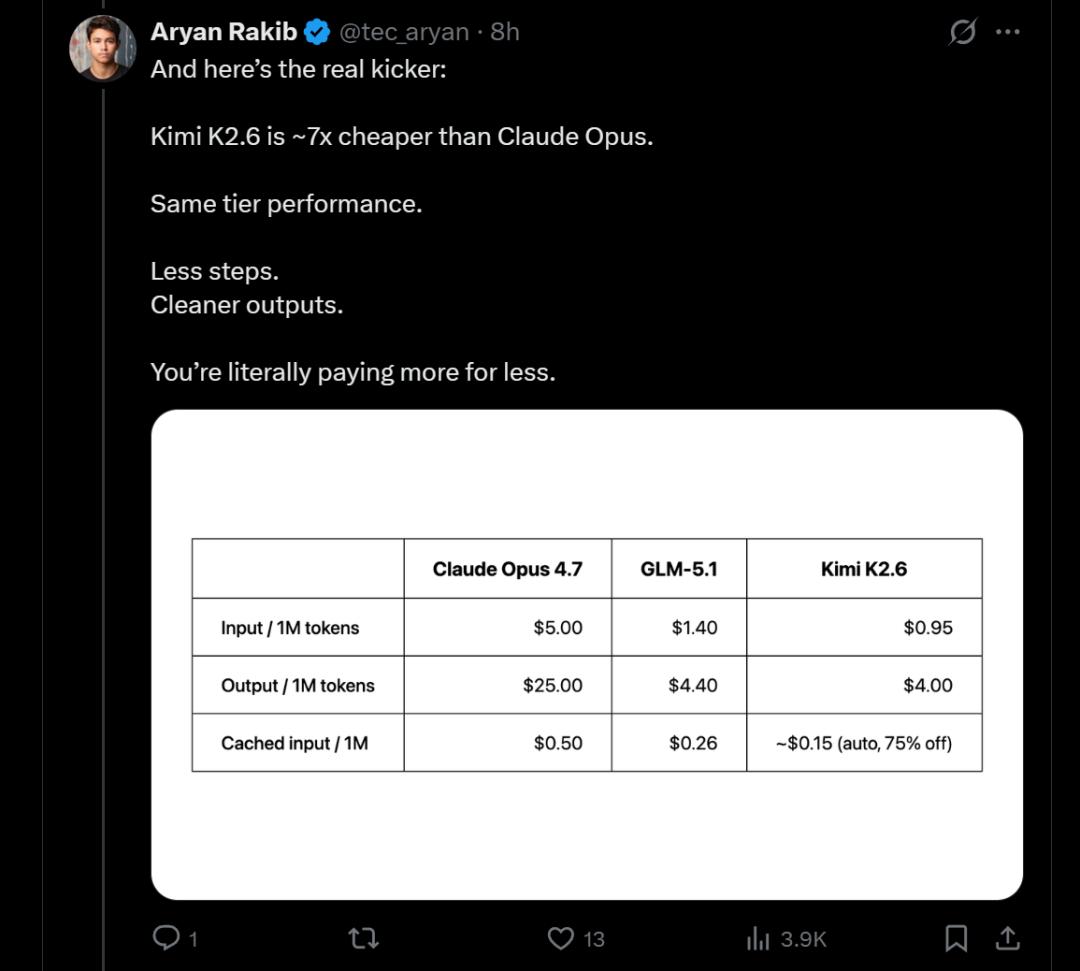
More importantly, Kimi K2.6 is seven times cheaper than Claude Design.
Claude Design: Fine, this is clearly aimed at me!
Claude Design is still alive, but it's already being commemorated (doge)
Leaving other things aside, I'm really curious about the design level of Kimi K2.6.
So I dug into the cases shared by netizens.
Just recently, 𝕏 blogger @Aryan Rakib conducted a series of actual tests, thoroughly exploring the front - end + vibe coding capabilities of Kimi K2.6.
In the first actual test, the guy asked Kimi K2.6 to help design a high - end "Velo City" cycling website.
As a result, there was a landing page, the UI was done, and even the structure and product logic were all delivered.
In the guy's own words:
This is not just demo code; it's code that can be directly delivered.
You know, half a year ago, this workload would have required a designer, a front - end developer, and a product manager working together to complete.
Now, with just one prompt, Kimi K2.6 throws the entire deliverable right in your face.
Not only for the front - end, but later the guy also tried to let Kimi K2.6 generate a website that integrates the front - end and back - end.
As expected, it was still a success...
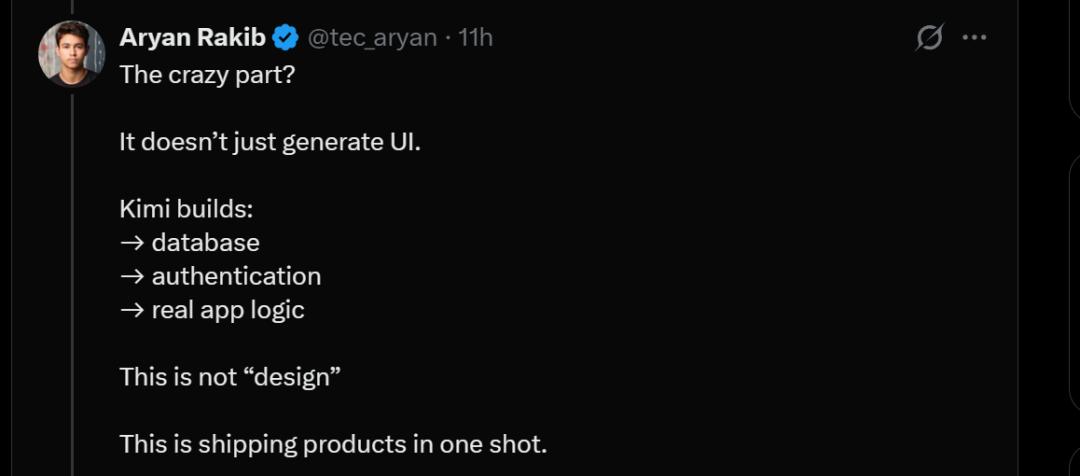
The guy commented on it:
This is not "design"; it's a one - shot success and ready for delivery.
At this point, the guy finally stopped pretending. He directly turned on Kimi K2.6's Agent Swarm mode (multi - agent cluster) and threw out a rather outrageous proposition:
Find 30 physical stores without official websites and generate a landing page for each of them.
Then we saw that the task was automatically disassembled by Kimi into multiple parallel sub - tasks, and 30 stores with 30 sets of customized designs started working simultaneously -
Multi - tasking, parallel execution, and structured output were all completed in one go.
Now the guy was completely out of energy and means. As he put it, "It's like having 100 agents working for you."
(Quietly revealing that according to the data officially released by Kimi, the agent cluster of K2.6 can be expanded to 300, so the guy was still being conservative.)

Coupled with the fact that it's cheaper than Claude Design, we finally understand how Kimi K2.6 is overtaking the predecessors.
However, by this point, some people may have noticed something strange:
In the so - called "design PK", why does Kimi K2.6 bring out a database, an agent cluster, and a full - stack solution?
Indeed, from the very beginning of this battle, the two sides were not on the same level -
Kimi K2.6 is not just a design tool; "design" is just a side job it does effortlessly.
About two weeks ago, Claude Design made a grand entrance into the design industry.
This tool, driven by Opus 4.7 and featuring "generating prototypes/PPTs/landing pages with a single sentence", shocked the entire design circle with its real - world results. On the day of its release, Figma's stock price dropped by about 7%, and Adobe's also dropped by 1.49%. All the design giants were trembling.
Even more dramatically, Mike Krieger, the CPO of Anthropic, resigned from the Figma board three days before the product launch. The plot was more exciting than a Hollywood movie.
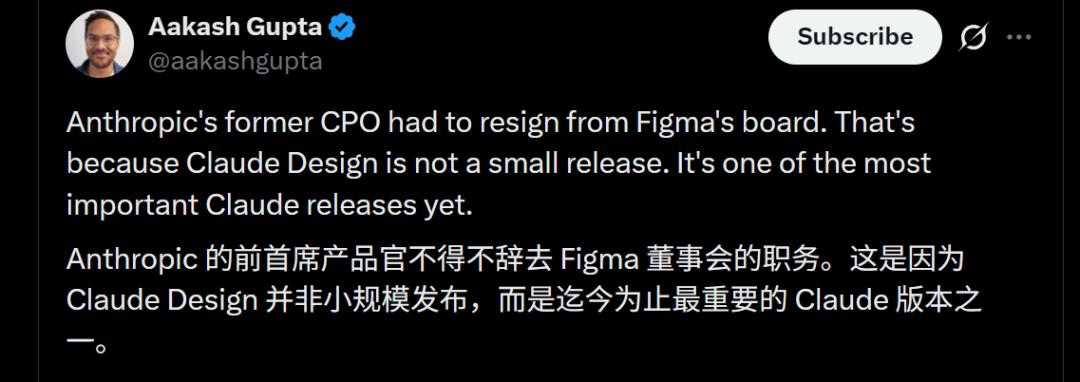
For a while, the design industry was in a panic, and the view that "Figma is going to die" was everywhere.
However, just three days later -
Kimi K2.6 was quietly open - sourced. After a simple press conference and a brief mention on X, it didn't even make much of a splash on the hot search.
Then, developers flocked to it. They quietly took out demos and started rigorous testing.
They were shocked by what they found.
This design function, which was just briefly mentioned along with the "code ability upgrade", was actually stronger than Claude Design.
It can only be said that this is due to Kimi K2.6's solid general - purpose foundation -
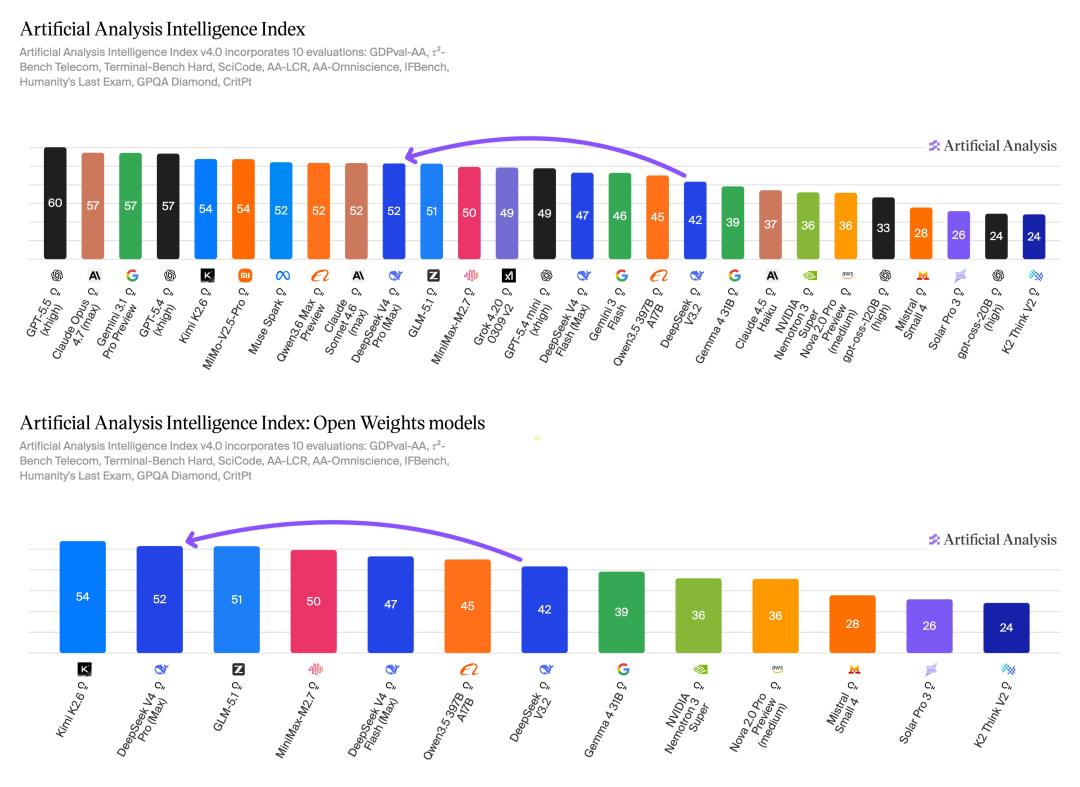
In the third - party Artificial Analysis evaluation, it ranks first among global open - source models and is only second to the three major closed - source models (Claude, GPT, Gemini).
Of course, nothing is absolute.
In this actual test, the guy's prompt skills were also quite impressive. After all, some netizens also shared completely opposite comparison results -
It can only be said that which one is stronger depends on how you use them.
And speaking of how to use it, some enthusiastic netizens have already summarized a tutorial for everyone.
Tutorial: Build a "$10,000 website" with Kimi K2.6
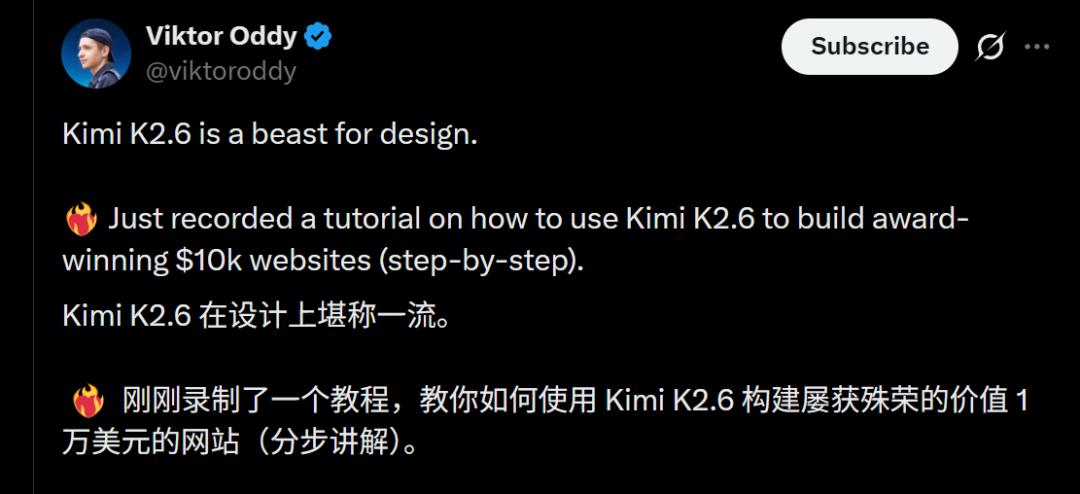
After seeing the powerful design ability of Kimi K2.6, blogger @Viktor Oddy quickly made a teaching video that lasts for more than ten minutes overnight.
The title is quite straightforward - How to build a $10,000 website with Kimi K2.6.
(It reminds people of the comparison between Nanfu's official websites at home and abroad some time ago.)
The key point is that you don't need to write a single line of code or open any design software throughout the process. You can "talk" a complete official website out just by having a conversation.
First, describe the vague requirements to give Kimi a general design direction:
Create a modern - style brand website called Shamoni. The visual theme is cats and flowers. The overall style is soft and artistic, including a navigation bar, a main visual area, and an introduction module.
After Kimi receives the requirements, it immediately generates a complete web page -
The brand title, background visuals, and layout hierarchy are all in place. It's not a collection of scattered components but a finished product that you can directly view.
Next, you can make changes while chatting: from fine - tuning the UI such as font, font size, and layout, to adjusting the information architecture such as adding card modules and hover effects, to engineering - level tasks such as sticky navbars and scroll animations. Finally, you can even polish the pixel - level spacing and animation curves.
Every time you say something, the page changes accordingly.
The entire process doesn't involve the traditional steps of design drafts, slicing images, and hand - writing code. The whole process is compressed into one sentence:
Describe the requirements → Generate the page → Iterate through language until you're satisfied.
Compared with the previous "design → review → development → debugging → modification" workflow, it at least saves the trouble of communication and disputes among three people.
As for whether it's worth "$10,000", you can judge for yourself (doge).
Claude: I'll struggle a bit more
BTW, Anthropic, which has been overtaken, doesn't seem to be sitting idle.
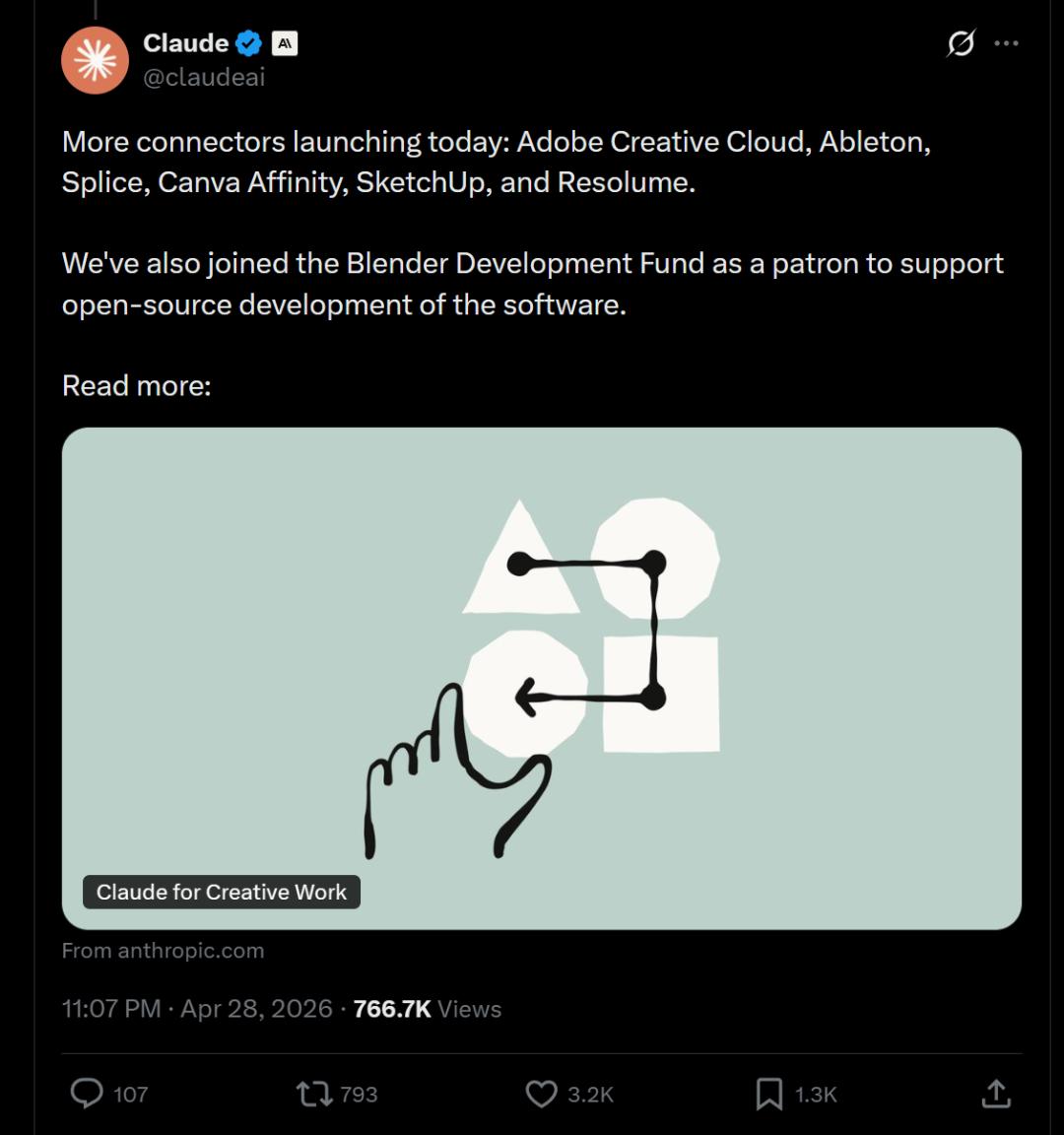
Its latest move is to form an alliance with a group of creative software giants such as Blender, Autodesk, Adobe, Ableton, and Splice, and launch a batch of connectors that cover multiple fields such as 3D modeling, graphic design, music production, and live visuals.
That is to say, Claude has now integrated into the software that creative people use every day.
Incidentally, it also joined the Blender Development Fund as a sponsor. Note that this is not just a simple act of charity -
Blender's Python API is the underlying interface of the connectors. When Anthropic invests in the foundation, it's like inserting Claude into Blender and expanding the "socket" at the same time.
Wow, its ambition is out in the open:
It wants to be both an AI - native design tool (Claude Design) and an AI interface for all existing design tools (the connector army), aiming to have it both ways.
But when it comes to Kimi K2.6, the story might be the opposite:
Designers don't need to change tools, developers don't need to learn Figma, and independent entrepreneurs don't need to hire a design team.
With an open - source model, a single prompt, and a cheaper API bill, you can complete everything from idea to launch.
As for who will win, let's wait and see.
After all, a lot can happen in two weeks in the AI circle.
Reference links:
[1]https://x.com/socialwithaayan/status/2049094873186435260
[2]https://x.com/HeyZoyaKhan/status/2049197606719623372?s=20
[3]https://x.com/viktoroddy/status/2049069846953103413?s=20
[4]https://x.com/tec_aryan/status/2049170121349062941?s=20
This article is from the WeChat official account “Quantum Bit”. Author: Yishui. Republished by 36Kr with authorization.