Is the prompt outdated? GPT-5.5 already has intuition. Simply specify the target, and the AI can take over automatically.
Recently, Greg Brockman, the President and Co-founder of OpenAI, first revealed several core details of GPT-5.5 in a special interview on the Big Technology Podcast.
Greg Brockman stated that the stage of piling up theoretical intelligence of models in the AI industry in the past two years has come to an end. AI is now officially ready to take over specific execution tasks. AI is transitioning from a mere brain system to a brand - new form of intelligent application.
Greg Brockman said that in practical applications, GPT - 5.5 demonstrates extremely strong intuition and context understanding ability, allowing humans to completely bid farewell to the cumbersome Prompt Engineering. This means that the interaction mode between humans and computers has undergone a fundamental change: users now only need to set the overall goal, and the model can automatically take over and solve problems end - to - end.
The following are the core highlights of this in - depth interview that we have sorted out:
1. The breakthrough of GPT - 5.5 lies in truly crossing the practicality threshold for business tasks
In the past, large models highly relied on complex prompt engineering for step - by - step guidance; now, with deeper context and intuitive understanding, users only need to issue the overall goal, and the model can independently take over the browser, process complex spreadsheets, or create presentations. In the new workflow, AI forms the torso and brain of execution, while humans are detached from specific clicks and writing, and are completely transformed into “supervisors”. Personal productivity will be infinitely magnified, and everyone is equivalent to managing a fully automated digital enterprise.
2. Open - source distillation cannot replicate end - to - end system capabilities
Facing the industry trend where open - source models use “distillation technology” to catch up quickly, OpenAI's real moat is not a single model parameter. Brockman said that simple model distillation cannot replicate the actual performance of GPT - 5.5. The real competitive barrier lies in “end - to - end system collaborative design ability” — it covers the seamless cooperation of computing power cluster scheduling, data pipelines, organizational structure, and security alignment. This systematic engineering ability to continuously test and iterate cutting - edge AI (i.e., “the machine that makes machines”) is a gap that the open - source community cannot easily bridge.
3. Large - scale deployment must be strongly bound to enterprise - level IT risk control
As AI systems gain more operation permissions, security and controllability have become core issues. Different from Anthropic's “unannounced deployment” strategy, OpenAI adheres to “iterative deployment” and advocates giving the model to network defenders for testing first to improve the risk - resistance ability of the real ecosystem. The more critical challenge lies in large - scale management: when the number of autonomous agents within an enterprise expands from a few to hundreds of thousands, the original management model will surely fail. Therefore, the large - scale autonomy of agents must be strongly bound to strict observability and enterprise - level IT governance architecture to ensure that the execution of digital employees is always within the human supervision sandbox.
4. Exchange the scale of underlying computing power for the speed of solving human problems
The world is entering a new stage driven by computing power: the more computing power is invested, the faster problems can be solved. The upper limit of human achievements in the fields of science and engineering will directly depend on the ceiling of available computing power. Take healthcare as an example. In the future, the exclusive computing power of a gigawatt - level data center can be mobilized to allow AI to continuously conduct inferences, consult expert data, and design experiments within a few months to tackle complex diseases such as Alzheimer's. Computing power will replace traditional resources and become the core infrastructure for solving daily business affairs and major scientific propositions. The global demand for computing power will face long - term structural growth.
The following is the transcript of Greg Brockman's interview:
1. OpenAI's Agent roadmap
Alex: In this episode, we have invited Greg Brockman, the President and Co - founder of OpenAI. We will delve into GPT5.5, the well - known Spud model, to see its functions and its significance to OpenAI. Greg, nice to see you. Welcome back to the show.
Greg Brockman: Thank you for the invitation. I hope this isn't too urgent a situation.
Alex: So let's start here. Can you confirm that GPT5.5 is Spud?
Greg Brockman: Yes. GPT5.5 is an amazing model. I think in many ways it is a step towards a new way of using computers to complete work. It is a brand - new category of intelligence. It is very useful in all aspects of programming and debugging, and shows great initiative when solving very difficult and tricky problems, and can truly solve problems end - to - end with very few instructions.
But what is most striking to me is not necessarily its improvement in programming ability, which I think is expected. What is most striking is that it has now truly crossed the practicality threshold and is suitable for various general - purpose applications. It performs better in creating slides and spreadsheets, and is also much better at computer operations, using browsers, and clicking through applications that were originally difficult for AI to run. So I think we are truly witnessing the rise of this new way of using computers, and it all starts with this core intelligence.
Alex: When we last talked, you mentioned that this is actually the culmination of a two - year research process. So was this planned two years ago? Does OpenAI have such a long - term planning cycle?
Greg Brockman: Yes, our planning does have a very long - term vision. It should be noted that we stack many research ideas and bets on various time scales and make continuous progress at every link of the technology stack. So what GPT5.5 represents is not the end, but in many ways a starting point. It is actually a step towards the kind of models we foresee will come in the next few months. You can expect us to achieve greater improvements in a wider range of fields, covering all aspects of the tasks that the model can complete. This will be very exciting. We have always been thinking about how to make the products we produce more useful for real - world uses, real users, and practical applications.
Alex: Can you specifically share what aspects we should focus on in the next few months? If this is just a beginning, what is it the beginning of?
Greg Brockman: Our grand vision is reflected in many things, not just the model. You can think of the model as the brain, and the systems, test frameworks, and applications such as super - apps as the body built around it to make it a useful AI. This is exactly the transformation that is currently taking place: from the language models produced by our kind of laboratories to truly practical AI, to an assistant that can really assist you according to your instructions, strive to achieve your goals, and actually operate.
You can see that Codex is no longer limited to programmers. It is actually suitable for anyone who uses a computer. It is not perfect at present. It should be able to do some tasks correctly but doesn't do them completely right. Sometimes its personality is not exactly what you want. It is extremely powerful and has done a lot of great things, but you still need to spend some time carefully reading its communication content to confirm how it solves problems. We are very clear about how to do these things better. From 5.4 to 5.5, we have made very significant progress. In the next process, we will also make more significant improvements in all aspects to make these models more practical. Internally, we have been deeply thinking about the final applications.
In the past twelve to eighteen months, one thing has changed. In the past, we only focused on continuously improving the benchmark tests to make these models more powerful at the brain level. But now our focus is to put them into real - world applications, thinking about how people in finance, sales, marketing, and every functional department use computers, and how we can assist their computer work. We think about how to make the model not only have theoretical assistance ability but also have practical experience and be able to recognize what is excellent work.
I think we are moving towards a situation where workers will become supervisors. You are almost like the CEO of this automated company, and it is running according to your goals. You still have the leading power and responsibility, and you need to think about whether this is what you want and whether the work meets the standards. But if the specific buttons clicked, the specific way of writing code, or the specific operation mechanism of the spreadsheet are not important to you, you can abstract yourself from them and only focus on evaluating whether the results meet your expectations. So this is like adding leverage to every worker.
2. End - to - end collaborative design is worth investing in
Alex: Okay. As you mentioned, this is the result of two years of work. For the sake of our audience, I'll explain that there are two different types of AI training. The first is pre - training, in which you just let the model predict the next word to make it a generalist and intelligent; the second is reinforcement learning, which allows it to actually execute and try to complete different tasks, and rewards it when it completes these tasks excellently and effectively, and in a sense, it learns how to complete these tasks. So basically what you mean is that during this period, OpenAI loaded a large amount of reinforcement learning content for specific tasks into this model, and that's the reason for the results you mentioned?
Greg Brockman: I'll express it in a slightly different way. There are many steps in the whole process, including pre - training, mid - training, reinforcement learning, and data collection. These different links work together to finally produce results and determine the way the model connects with the world. This is also the key to making it practical. We have been investing in each of these aspects. It's not just about the individual abilities of those working on each link, but a real cohesive team looking at the entire technology stack and discussing how we can make it more useful for real - world applications.
So it's not determined by a single thing we do. It actually depends on the overall effort. Just like building a car, it's not just about whether you have a better engine. You can build a great engine, but if the other parts of the car don't reach the quality level of the engine, it won't work. This is the real innovation: it is end - to - end collaborative design, where all links are combined in a repeatable way to make the model better and better to serve our users.
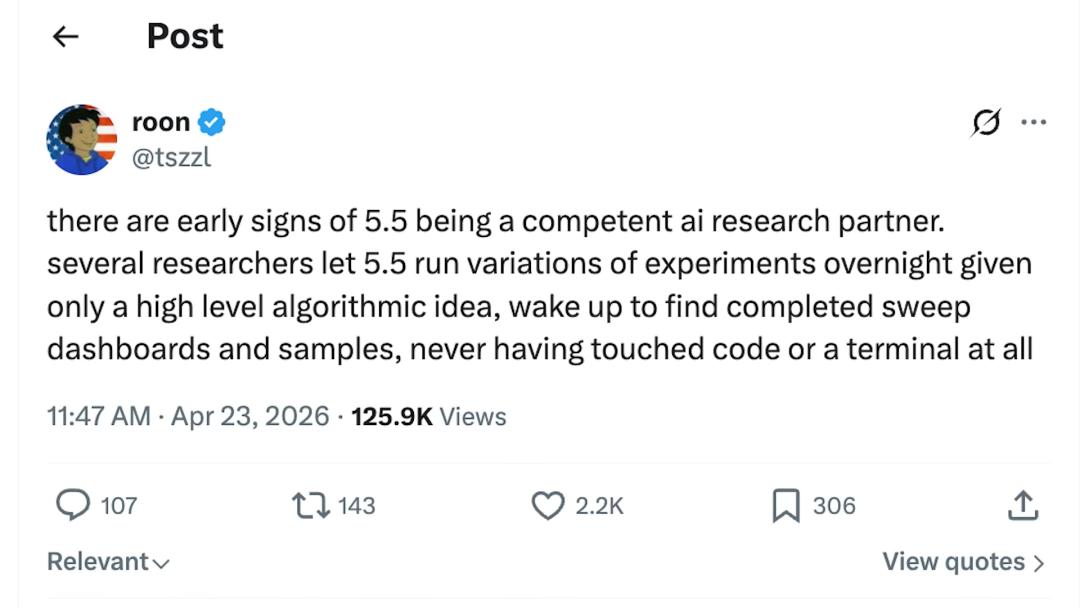
Alex: Earlier, you and I participated in a conference call with many media members. One interesting thing is that you said straight away that the model can understand your needs more intuitively and doesn't require such detailed and exact explanations as in the past. Here is a tweet from roon: There are early signs that 5.5 is a competent AI research partner. Several researchers let 5.5 run various variant experiments overnight, only providing high - level algorithm ideas, and when they woke up, they could see a complete experimental group, dashboard, and samples, without any contact with code or the terminal. Regarding this, this is a two - part question: How did you do it? Does it mean that prompt engineering is obsolete?
Greg Brockman: First of all, when we say there is a new category of intelligence, this is what we really mean. The models are becoming more intuitive to use because they have a deeper understanding ability and can really examine the context and figure out what they are asked to do.
As for the second part, is prompt engineering obsolete? I actually think that in some aspects, prompt engineering may be more vibrant than before. Now you spend a lot of time trying to explain to the computer what you really want, stuffing in all kinds of context to explain the current situation and requirements. You wonder why you have to explain these to the computer. The point is that the computer should assist me through its work. I don't want to break down the tasks and teach it step by step what to do. I just want to give it a direction, hope it handles the details and delivers the results, and provides some form of feedback in the process, becoming the driver of the underlying execution. So the future of prompt engineering is that you can get more from the model with less effort, and when you put in the same effort, you still have a multiplier effect and will get a greater improvement. We are now at the forefront of the current upper limit of the model's capabilities.
Alex: Okay. Let me briefly talk to you about the economic cost of building such a model. Although you haven't stated how much money or computing power was invested in training this huge giant model, we can safely assume that it is a huge investment. There has always been such a pattern: after these giant models are released, they will be distilled by open - source model makers, and then the open - source models will only lag behind the leading base models by a few months. I'm now curious. Since such a huge investment has been made, and as the model progresses, its capabilities have been significantly improved. So how to maintain the moat? In the long run, if this pattern just repeats over and over again, what's the point?
Greg Brockman: My view is a bit different. I think the real investment is in end - to - end collaborative design, building a system and a collaborative working method that combines developers and technology, and part of it involves how to use huge supercomputers to produce these models.
The current situation is not that by obtaining the model output and distilling it, you can simply get a model with exactly the same capabilities but smaller in size and faster in operation. If that were the case, we would have done it long ago, and it would be much easier to provide services. Although there are a lot of wonderful tricks behind distillation technology, the key point I want to make is that what we really invest in is the machine that makes machines.
At the deployment end, we have deeply thought about security guarantees and mitigation measures, and conducted a lot of tests in real - world scenarios for all aspects where the model may be misused. We have been working on this for many years and have deeply thought about these issues in fields such as network security and biology. This effort is reflected in our publicly available Preparedness Framework, which stipulates how we handle the use of the model and how we try to maximize benefits and reduce risks. So everything we do needs to be closely connected, which is about how to ensure continuous progress while making the model widely accessible. Because we firmly believe that this technology can empower people, benefit humanity, and improve everyone's living standards.
3. Model moat and distilled models
Alex: Back to the previous topic, as I know, the pricing of this model is twice that of the previous model, GPT 5.4. From an economic or business perspective, since you have invested so much infrastructure in training the model, if open - source models can provide slightly inferior but almost equivalent performance at a lower cost, how will you deal with this threat?
Greg Brockman: Looking back at our history, our development is not driven by competition but by our own desire for progress. At the same intelligent level, our prices have dropped significantly year - on - year, sometimes even by two orders of magnitude, up to 100 times. However, the typical Jevons Paradox has been playing out, that is, when you reduce the cost of something, it will trigger far more activities than before.
We constantly see that intelligence can bring returns. For the types of tasks that the model can currently complete, even a little improvement in intelligence can have a huge impact. This is the core meaning of version 5.5. People may think that this is just an incremental improvement in intelligence level, but I think it will bring a huge improvement in practical use. In fact, using “incremental update” to describe this model is very conservative. Although it is only a 0.1 version change, it greatly underestimates the magic that the model shows in actual work.
If the outside world sees the numbers and thinks that OpenAI is under IPO pressure, leading to the end of the free - lunch era, I oppose this view. Our business model is actually very simple, that is, to lease and build computing resources and then resell them with a certain profit margin. As long as there is an expandable demand for intelligence and there are still problems to be solved, this model holds. At each stage, we see that the demand far exceeds the supply, so we can continuously expand the scale of computing power.
My core instruction is to ask the team to think about how to add value on top of the original computing power and ensure a positive operating profit margin. This has nothing to do with