At this Beijing Auto Show, are the bosses more interesting to watch than the cars?
At the Beijing Auto Show, which is held every two years, the one who unveils the most significant new vehicle becomes the protagonist of that edition.
However, in the 2026 edition, the trend has changed, and the bosses have become the focus - creators.
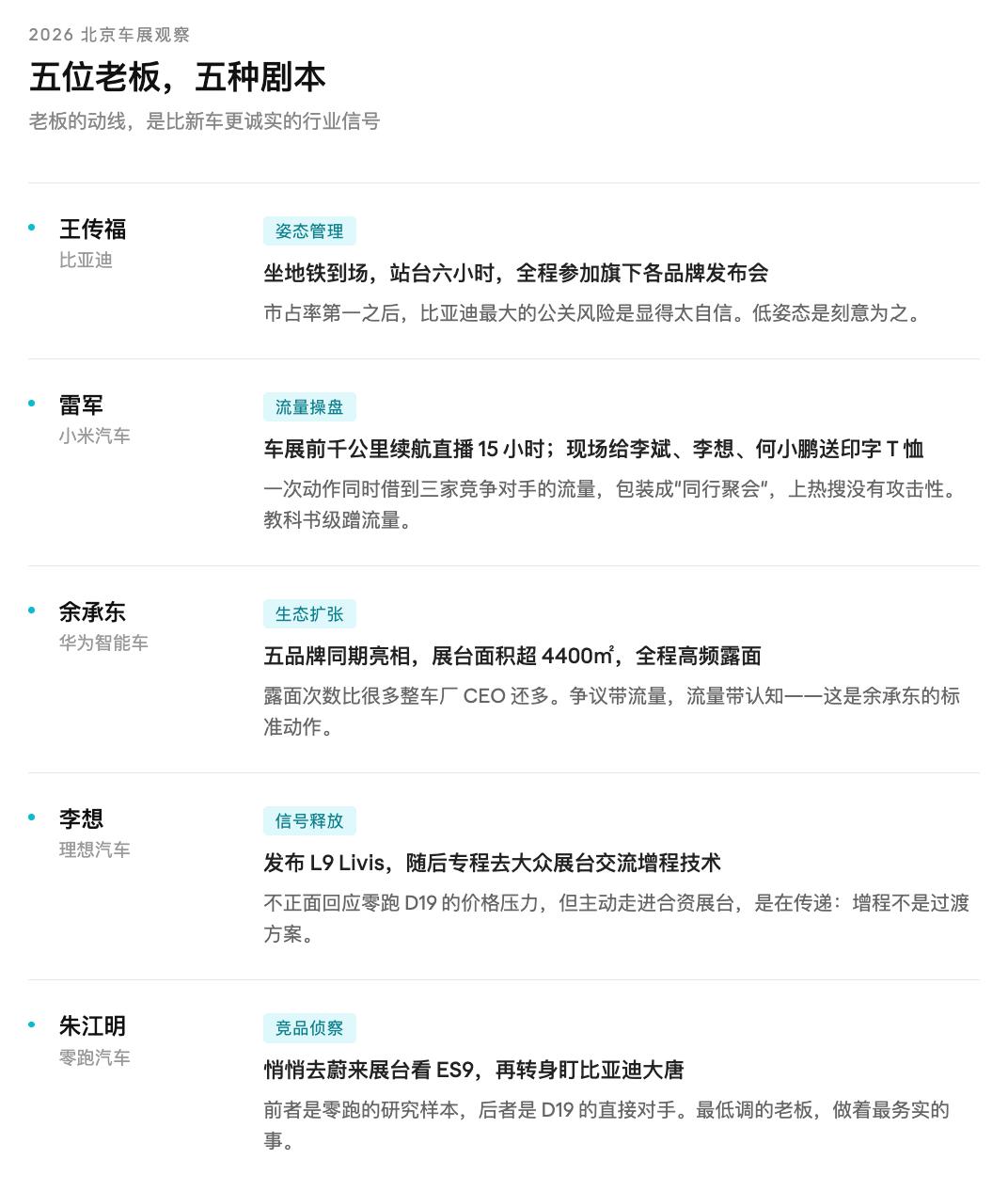
On the opening day, Wang Chuanfu took the subway to the exhibition hall and stood at the booth from 9 a.m. to 3 p.m. Lei Jun shuttled between the booths of competitors and gave printed T - shirts to Li Bin, Li Xiang, and He Xiaopeng respectively. Zhu Jiangming quietly slipped into NIO's booth to study the products and then turned to keep an eye on BYD Datang, the direct competitor of his newly launched D19.
Every move of the bosses at the auto show is carefully calculated. By following their movements, you may be able to catch a glimpse of the deeper battle situation behind the auto show.
1 · Wang Chuanfu Takes the Subway to the Auto Show: Save When You Should, Spend When You Need
On the morning of the auto show's opening day, Wang Chuanfu took the subway to the venue. From 9 a.m. to 3 p.m., he attended the press conferences of various BYD brands one after another at the booth.
Many people interpreted this detail as a "down - to - earth" gesture, but a more accurate understanding is that BYD doesn't dare to slack off. After maintaining the top market share for many consecutive years, BYD's biggest public - relations risk is actually appearing too confident. Wang Chuanfu taking the subway is an active gesture management.
In terms of products, BYD has made a series of intensive moves this time. The two flagship SUVs, Sea Lion 08 and Datang, made their debuts simultaneously. One targets the Ocean Network, and the other targets the Dynasty series. Coupled with the independent booths of Denza, Yangwang, and Fangchengbao, BYD is using almost the entire E3 hall to show that it has a presence in every price range and on every track.
In addition, Mega - watt fast charging and Tian Shen Zhi Yan, which used to be secondary selling points of product features, are now managed as independent brand assets, indicating that BYD is trying to extend its technical label from "cars sold by BYD" to "standards defined by BYD".
2 · Lei Jun's T - shirts and a Textbook - level Traffic Manipulation
Lei Jun's marketing moves this time can be divided into two main lines.
One is the pre - show warm - up. Before the auto show, he drove the full - range test from Beijing to Shanghai and live - streamed for 15 hours, creating a specific product topic and binding his personal IP at the same time. BMW China posted a video subtly mocking that "the car hasn't been built yet, but it has run millions of kilometers". Some netizens quickly pointed out that the target was Xiaomi, and this interaction itself helped Xiaomi achieve a free exposure.
The other is the on - site performance at the auto show. He visited the booths of NIO, XPeng, Li Auto, and BYD and gave printed T - shirts to Li Bin, Li Xiang, and He Xiaopeng respectively. The photos quickly hit the hot search. This move continues Lei Jun's consistent marketing thinking. It allows Xiaomi to borrow the traffic of all competitors at the same time and packages it in a gentle way of "a gathering of peers", which is neither aggressive nor fails to occupy a real position on the hot search.
Xiaomi's product strategy for cars is also in sync. Lei Jun confirmed at the auto show that the YU7 GT will be launched at the end of May, with dual - motor four - wheel drive and a 0 - 100 km/h acceleration within 3 seconds. This marketing rhythm is quite mature, releasing a new product signal every once in a while to keep the media and users continuously engaged. The "press - conference rhythm management" that Xiaomi has accumulated in the mobile - phone business seems to work well in the automotive category.
3 · Yu Chengdong's Home Court and an Expanding Business
Some people call this Beijing Auto Show "Huawei's home court", and you'll find it's not an exaggeration when you're on - site.
Huawei has gathered Yijing, Qijing, Avatr, and Mengshi in Hall W3. Huawei Qiankun and Huawei Digital Energy have independent booths. The total area of the HarmonyOS Smart Mobility series booth exceeds 4,400 square meters. Yu Chengdong made frequent appearances throughout the event and showed up at the press conferences of various brands more times than many CEOs of complete - vehicle manufacturers.
Yu Chengdong's on - site strategy has always been to start with a high - profile and create a contrast. From the initial "far ahead" to the current various technology releases, his public expression itself is a marketing asset for Huawei's automotive business. Controversy brings traffic, and traffic brings recognition.
However, this auto show also reveals a potential problem for Huawei: Five brands, Yijing, Qijing, AITO, Zhijie, and Zunjie, share the same Qiankun platform. How can consumers distinguish between the Dongfeng - version and GAC - version Huawei - affiliated cars? Where is the brand personality of the cooperating car companies? Yu Chengdong's current answer is mainly "strong technology", and a clear solution for brand - level differentiation has not yet been formed. The larger Huawei's automotive ecosystem becomes, the harder this problem is to avoid.
4 · Li Xiang's New Car and a Low - key Signal Release
Li Xiang was relatively low - key at this auto show but did a few things. First, he launched the most important new car of Li Auto this year, the L9 Livis, which is the core product for Li Auto to enter the pure - electric market. Second, he specifically visited the Volkswagen booth and exchanged ideas with the Volkswagen team about range - extender technology. The biggest doubts about Li Auto's range - extender route have never disappeared. Li Xiang's initiative to visit the booth of a joint - venture brand is also to send a signal: Range - extender is not a transitional solution but a route that can be continuously explored, and even Volkswagen is taking it seriously.
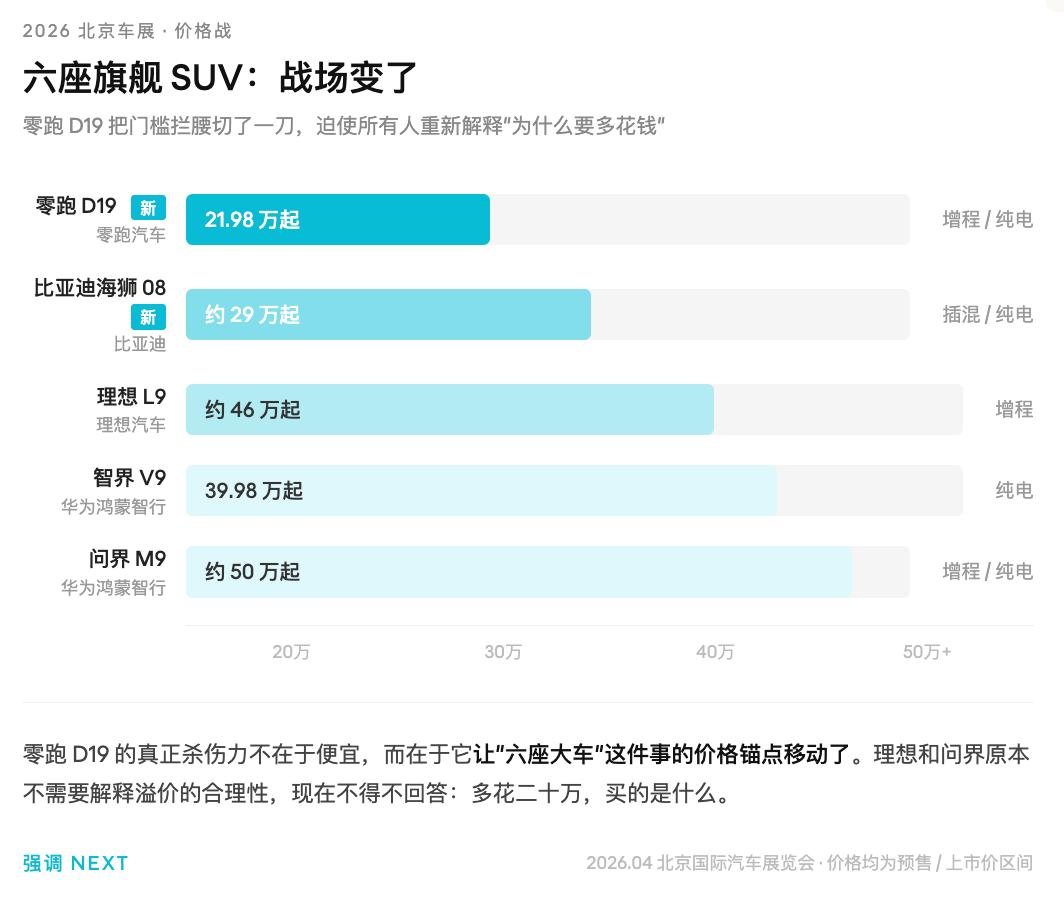
The pressure Li Auto faces in the six - seat SUV track is real. The Leapmotor D19 is priced from 219,800 yuan, directly cutting the price floor of large six - seat SUVs by nearly half. Why should users of the Li Auto L9 spend more than 100,000 yuan extra? Li Xiang didn't respond to this pressure directly at the auto show but accelerated the release of new cars.
5 · A Boss Didn't Appear, but Its Booth Tells the Story
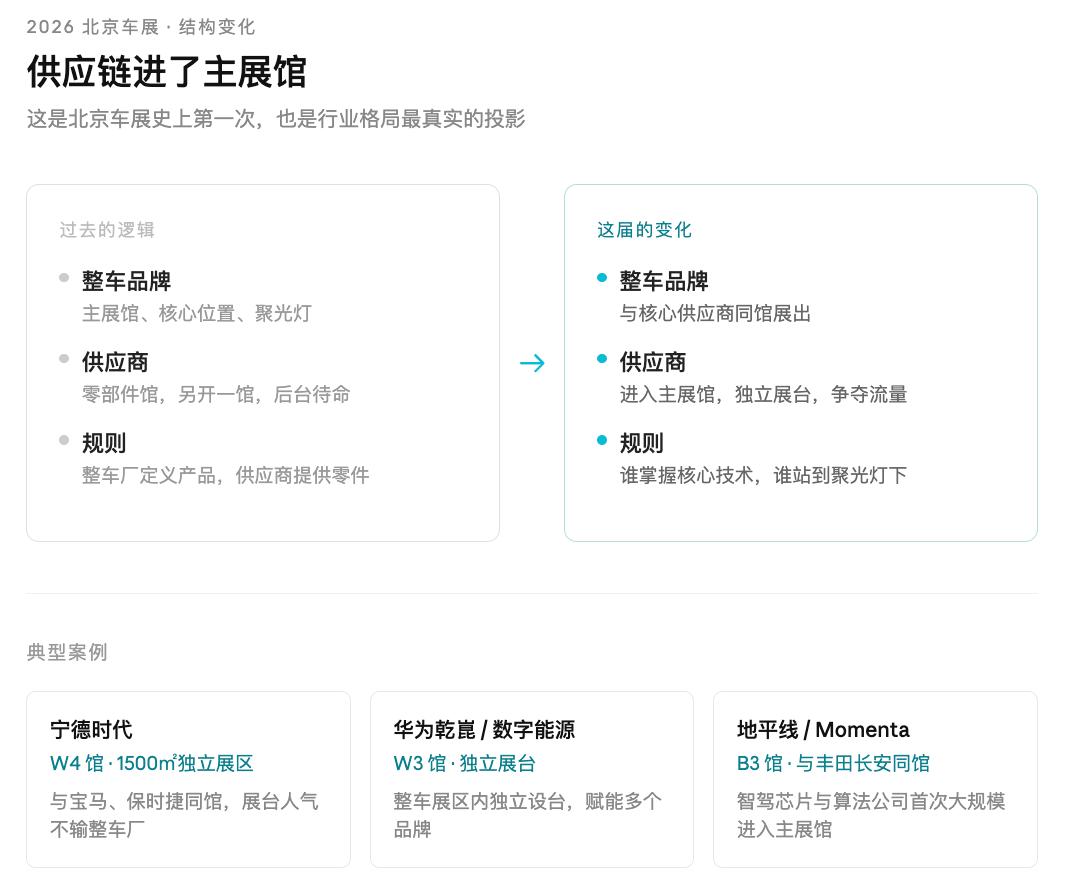
CATL set up a booth of over 1,500 square meters in Hall W4, sharing the same hall with BMW and Porsche. The booth was as popular as those of complete - vehicle manufacturers, and the exhibits covered almost all technological directions of power batteries, from the new - generation ultra - fast charging batteries to sodium - ion batteries and solid - state batteries.
Zeng Yuqun didn't appear in the high - frequency reports on the media day. CATL doesn't need its boss to stand on the stage in person. This in itself is a state. When your products become the common choice of almost all competitors, the best public relations is to put the technology itself in the spotlight.
This is the first time that "complete - vehicle and parts manufacturers share the same hall" at the auto show. It's also a historical moment for supply - chain enterprises to enter the main exhibition hall and share the stage with complete - vehicle brands.
6 · Nissan's 149,900 Yuan: Self - Degradation of Joint - Venture Brands
Compared with the above, the move of Dongfeng Nissan is more of an industry benchmark.
The NX8 is priced from 149,900 yuan. Its intelligent driving system is jointly developed with Momenta, equipped with a lidar, and supports urban NOA. The interior is equipped with the "AI Comfort Five - Piece Set", including the driver and passenger seats, a 25 - speaker audio system, and an AI - intelligent refrigerator, fully benchmarking the configuration logic of new - energy vehicle startups.
This approach means that Nissan has abandoned the strategy of building a moat through brand premium and instead accessed the technological ecosystem of Chinese local suppliers, trading configuration for sales volume. This is a pragmatic choice, but the price is: When a joint - venture car uses the intelligent - driving technology of a Chinese company and the seat solution of a Chinese company, what brand assets does it have left?
Downgrading can only delay the exit and cannot lead to a real counter - attack.
7 · The Best of Times
This is an era of high - level competition, and no company feels secure.
BYD is on the defensive, Huawei is expanding, Xiaomi is on the offensive, Li Auto is making adjustments, joint - venture brands are re - positioning, and supply - chain enterprises are competing for the right to speak. Every company is putting on a hard - working show at the auto show. The movements of the bosses together form the most real pressure distribution map of the Chinese automotive industry.
The auto show has always been a display of confidence, but this edition seems more like a display of anxiety, an anxiety that you must show the outside world that you're still fighting.
This is not a bad thing, especially for consumers.
This article is from the WeChat official account “Emphasize Next” (ID: leo89203898), author: Wen Xin. Republished by 36Kr with permission.